Species · Fishes
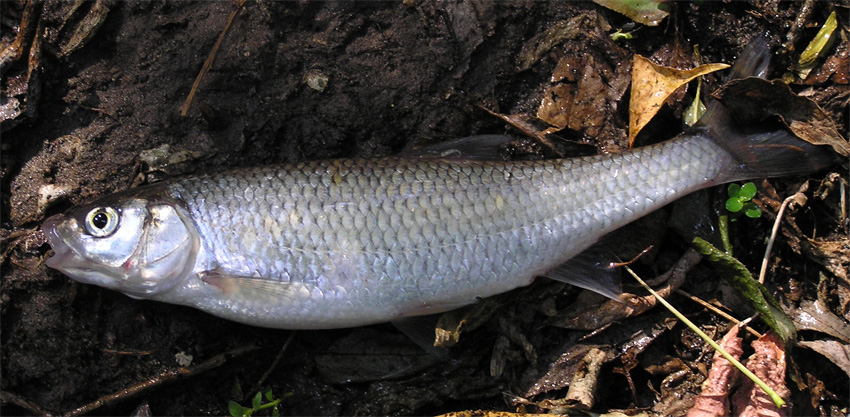
Amur Ide Leuciscus waleckii
The scientific name of the Amur Ide is Leuciscus waleckii. It is a species of fish in the family Cyprinidae (carps), order Cypriniformes. The name dates from 1869.
- Scientific name
- Leuciscus waleckii (Dybowski, 1869)
- Common name
- Amur Ide
- Genus
- Leuciscus
- Family
- Cyprinidae (Carps)
- Order
- Cypriniformes
- Class
- Teleostei
- Red List category
- LC Least Concern
- Environment
- freshwater
- Recorded in
- 5 countries
- Name status
- accepted in the Catalogue of Life

Overview
The species occurs in the Amur River basin across Russia, Mongolia, China and Korea, with populations also inhabiting Dali Nor Lake in Inner Mongolia, China. The species occurs in both freshwater and alkaline-water environments and can rapidly adjust to changes in salinity and alkalinity.
Written 27 November 2026 from the sources listed below. Each statement was checked against the passage it cites; statements that could not be supported were removed.
Appearance
The Amur Ide is a freshwater ray-finned fish.[1]
Habitat
The species occurs in both alkaline-water and freshwater environments. Some populations inhabit alkaline water with a pH of approximately 9.6, while freshwater populations occur in the Songhuajiang River and Heilongjiang River.[2][3][4]
The species occurs in the Amur River basin across Russia, Mongolia, China and Korea. A population also inhabits Dali Nor Lake in Inner Mongolia, China.[5][6]
Behaviour
The species can rapidly adjust to changes in salinity and alkalinity across different aquatic environments. It can transition from freshwater to alkaline water through directional domestication.[7][8]
Conservation
A population inhabiting Hulun Lake can tolerate very high levels of alkalinity.[9]
Classification of the Amur Ide
| Kingdom | Animalia |
|---|---|
| Phylum | Chordata |
| Subphylum | Vertebrata |
| Infraphylum | Gnathostomata |
| Parvphylum | Osteichthyes |
| Gigaclass | Actinopterygii |
| Superclass | Actinopteri |
| Class | Teleostei (Teleost) |
| Order | Cypriniformes |
| Family | Cyprinidae (Carps) |
| Subfamily | Leuciscinae |
| Genus | Leuciscus (European Daces) |
| Species | Leuciscus waleckii (Dybowski, 1869) |
Where the Amur Ide is found
Checklists and occurrence records place Leuciscus waleckii in 5 countries. GBIF holds 172 georeferenced records of it.
Countries
Regions and cities with the most records
- Shanxi, China 22
- Hebei, China 15
- Henan, China 10
- Khabarovsk, Russia 9
- Beijing, China 8
- Heilongjiang, China 6
- Jilin, China 6
- Spassk-Dal’niy, Russia 6
- Aoji-ri, North Korea 5
- Unggi, North Korea 5
- Baotou, China 4
- Hentiy, Mongolia 4
- Primorye, Russia 4
- Sakhalin Oblast, Russia 4
- Komsomolsk-on-Amur, Russia 3
- Xixiang, China 3
A number beside a place is its count of GBIF occurrence records. A place without a number comes from a checklist alone. Records show where a species has been observed or collected, which can include escapes and vagrants.
Common names
English
- Amur Ide
Names in 1 other language
- Chinese
- 华子鱼
Synonyms
15 other scientific names have been used for this species and are now treated as synonyms of Leuciscus waleckii.
- Idus waleckii Dybowski, 1869
- Idus waleckii sinensis Rendahl, 1925
- Leuciscus brevirostris Mori, 1927
- Leuciscus farnumi Fowler, 1899
- Leuciscus jeholi Howes, 1984
- Leuciscus mongolicus (Kessler, 1876)
- Leuciscus oshimae Fowler, 1958
- Leuciscus tumensis Mori, 1930
- Leuciscus waleckii Mori,1934
- Leuciscus waleckii joholensis Kimura, 1934
- Leuciscus waleckii sinensis Rendahl, 1925
- Leuciscus waleckii tumensis Mori, 1930
- Leuciscus waleckii waleckii (Dybowski, 1869)
- Rhodeus sericues sinensis Rendahl,1928
- Squalius mongolicus Kessler, 1876
Related species
-
 AspLeuciscus aspius
-
 IdeLeuciscus idus
-
 Common DaceLeuciscus leuciscus
-
 Issyk-Kul DaceLeuciscus bergi
-
 Schmidt's DaceLeuciscus schmidti
- Siberian DaceLeuciscus baicalensis
- Beaked DaceLeuciscus burdigalensis
- Don DaceLeuciscus danilewskii
Compare
Questions and answers
What is the scientific name of the Amur Ide?
The scientific name of the Amur Ide is Leuciscus waleckii. Written with its author, the full name is Leuciscus waleckii (Dybowski, 1869).
Which family does the Amur Ide belong to?
Leuciscus waleckii belongs to the family Cyprinidae, in the order Cypriniformes and the class Teleostei.
Where is the Amur Ide found?
Checklists and occurrence records place Leuciscus waleckii in 5 countries: China, Russia, Mongolia, Kazakhstan and North Korea.
What is the conservation status of the Amur Ide?
The IUCN Red List category recorded for Leuciscus waleckii is Least Concern (LC).
What other common name is used for the Amur Ide?
The species is also known as the Amur chebak.[10]
How does the Amur Ide adapt to alkaline water?
The species can rapidly adjust to changes in salinity and alkalinity. It can transition from freshwater to alkaline water through directional domestication, and its intestine plays an important role in regulating osmotic pressure during these transitions.[7][8][11]
How do the intestinal microbiota of alkaline-water and freshwater populations differ?
Their intestinal microbiota differ in composition, abundance and diversity. Enterobacter sp. is predominant in alkaline-water populations, while Aeromonas and Ralstonia are primarily present in freshwater populations.[12][13][14]
Which microorganisms are enriched in alkaline-water fish intestines?
Moraxella osloensis, Psychrobacter maritimus and Psychrobacter faecalis are significantly enriched in alkaline-water fish intestines compared with freshwater fish intestines.[15]
How much of the intestinal microbiota is shared with the living water environment?
Approximately one-third of the operational taxonomic units in the intestinal microbiota of each population are also present in its living water environment.[16]
Has the Amur Ide's transcriptome been sequenced?
The transcriptome of the species has been sequenced to investigate its tolerance of high alkalinity.[17]
Sources
Passages the profile rests on
- The Amur ide is a freshwater ray-finned fish. Source passage: “a species of freshwater ray-finned fish” — English Wikipedia
- Some populations inhabit alkaline water environments with a pH of approximately 9.6. Source passage: “can tolerate harsh water conditions with high alkalinity of ~53.57 mmol/L (pH 9.6)” — pmc.ncbi.nlm.nih.gov
- Freshwater populations occur in the Songhuajiang River and Heilongjiang River. Source passage: “such as the Songhuajiang River and Heilongjiang River” — pmc.ncbi.nlm.nih.gov
- The species occurs in both alkaline-water and freshwater environments. Source passage: “alkaline-water species (AW) and freshwater species (FW) of Amur ide” — pmc.ncbi.nlm.nih.gov
- The species occurs in the Amur River basin across Russia, Mongolia, China and Korea. Source passage: “This species is found in the Amur River basin in Russia, Mongolia, China and Korea.” — English Wikipedia
- A population of the species inhabits Dali Nor Lake in Inner Mongolia, China. Source passage: “Leuciscus waleckii living in Dali Nor-Lake, Inner Mongolia, China” — pmc.ncbi.nlm.nih.gov
- The species can rapidly adjust to changes in salinity and alkalinity across different aquatic environments. Source passage: “L. waleckii can rapidly adapt to salinity, and alkalinity changes in different water environments” — pmc.ncbi.nlm.nih.gov
- The species can transition from freshwater to alkaline water through directional domestication. Source passage: “It can interconvert from freshwater to alkaline water via a comparatively postponed directional domestication.” — pmc.ncbi.nlm.nih.gov
- A population inhabiting Hulun Lake can tolerate very high levels of alkalinity. Source passage: “The population found in Hulun Lake is capable of tolerating the very high levels of alkalinity in the lake.” — English Wikipedia
- The species is also known by the common name Amur chebak. Source passage: “also known as Amur chebak” — inaturalist.org
- The intestine plays an important role in regulating osmotic pressure in the species during transitions between freshwater and alkaline water. Source passage: “The intestine is an essential organ for conditioning fish osmotic pressure during this process.” — pmc.ncbi.nlm.nih.gov
- The intestinal microbiota of alkaline-water and freshwater populations differs in composition, abundance and diversity. Source passage: “The results indicated that the intestinal microbiota composition, abundance, and diversity of AW and FW were quite different.” — pmc.ncbi.nlm.nih.gov
- Enterobacter sp. was the predominant bacterial population identified in the intestines of alkaline-water populations. Source passage: “Enterobacter sp., the predominant population in the AW gut” — pmc.ncbi.nlm.nih.gov
- Aeromonas and Ralstonia were primarily present in the intestines of freshwater populations. Source passage: “Aeromonas and Ralstonia being primarily present in FW intestines.” — pmc.ncbi.nlm.nih.gov
- Moraxella osloensis, Psychrobacter maritimus and Psychrobacter faecalis were significantly enriched in alkaline-water fish intestines compared with freshwater fish intestines. Source passage: “Moraxella osloensis, Psychrobacter maritimus, and Psychrobacter faecalis were significantly enriched in the intestine of AW” — pmc.ncbi.nlm.nih.gov
- Approximately one-third of the operational taxonomic units in the intestinal microbiota of each population were also present in its living water environment. Source passage: “had approximately 1/3 of the operational taxonomic units in the respective living water environments” — pmc.ncbi.nlm.nih.gov
- The transcriptome of the species has been sequenced to investigate its tolerance of high alkalinity. Source passage: “The transcriptome of the species has been sequenced in order to better understand this tolerance.” — English Wikipedia
Data
- Catalogue of Life, 2026-10-16 XR cc by
- Global Biodiversity Information Facility CC BY 4.0
- Wikidata CC0
- GeoNames CC BY 4.0
- Wikimedia Commons per image; credit shown with each image
- Within the Catalogue of Life, this name comes from World Register of Marine Species cc by
References
- Dybowski, B. I. 1869. Vorläufige Mittheilungen über die Fischfauna des Ononflusses und des Ingoda in Transbaikalien. Verhandlungen der Kaiserlich-Königlichen Zoologisch-Botanischen Gesellschaft in Wien 19: 945-958, table. where the name was published
This species in other databases
Page built on 29 November 2026. See how the catalog is made and all sources and licences.
Cite this page
ScientificNames.org. (2026). Leuciscus waleckii (Amur Ide). Retrieved November 29, 2026, from https://scientificnames.org/species/leuciscus-waleckii
“Leuciscus waleckii (Amur Ide).” ScientificNames.org, 2026, scientificnames.org/species/leuciscus-waleckii. Accessed 29 Nov. 2026.
ScientificNames.org. “Leuciscus waleckii (Amur Ide).” Accessed November 29, 2026. https://scientificnames.org/species/leuciscus-waleckii.
@misc{scientificnames_leuciscus_waleckii_amur_ide,
  author = {{ScientificNames.org}},
  title = {Leuciscus waleckii (Amur Ide)},
  year = {2026},
  url = {https://scientificnames.org/species/leuciscus-waleckii},
  note = {Accessed 2026-11-29}
}