Species · Birds
Red-cockaded Woodpecker Leuconotopicus borealis
The scientific name of the Red-cockaded Woodpecker is Leuconotopicus borealis. It is a species of bird in the family Picidae (woodpecker), order Piciformes. The name dates from 1809.
- Scientific name
- Leuconotopicus borealis (Vieillot, 1809)
- Common name
- Red-cockaded Woodpecker
- Genus
- Leuconotopicus
- Family
- Picidae (Woodpecker)
- Order
- Piciformes
- Class
- Aves
- Red List category
- NT Near Threatened
- Recorded in
- 1 country
- Name status
- accepted in the Catalogue of Life

Overview
Leuconotopicus borealis is endemic to the southeastern United States. It has a black cap and nape surrounding large white cheek patches, with males having a small red streak on each side of the black cap.
Written 26 November 2026 from the sources listed below. Each statement was checked against the passage it cites; statements that could not be supported were removed.
Appearance
The species has a black cap and nape surrounding large white cheek patches. Males have a small red streak on each side of their black cap.[1][2]
Adults measure 18–23 cm in length, with a wingspan of 34–41 cm. They weigh 40–56 g.[3][4][5]
The wing chord measures 9.5–12.6 cm, and the tail measures 7–8.2 cm. The bill measures 1.9–2.3 cm and the tarsus measures 1.8–2.2 cm.[6][7][8][9]
Habitat
The species inhabits fire-dependent pine savannas and open woodlands. Longleaf pine is the most commonly preferred tree species in its habitat, which can also include other species of southern pine.[10][11][12][13]
The species excavates nesting cavities exclusively in living pine trees. A typical cavity-tree cluster covers approximately 10 acres, while a typical group's territory covers approximately 125–200 acres.[14][15][16]
Diet
The species primarily feeds on ants, beetles, cockroaches, caterpillars, wood-boring insects and spiders. Its diet occasionally includes fruit and berries.[17][18]
Most foraging takes place on pine trees. The species occasionally forages on hardwood trees and corn earworms in cornfields.[19][20]
Behaviour
The species is territorial, nonmigratory and cooperatively breeding. Individuals frequently retain the same mate for several years.[21][22]
Individuals excavate cavities in living pine trees for nesting and roosting. Completed nesting cavities can remain in use for decades.[23][24]
Individuals maintain resin wells around the entrances of actively used cavity trees. Resin around cavity entrances helps deter climbing predators such as rat snakes.[25][26]
The species also maintains incomplete cavity excavations known as cavity starts.[27]
Reproduction and life cycle
The nesting season extends from April through June. Breeding females lay three to four eggs in the breeding male's roost cavity.[28][29]
The eggs are white and are incubated for 10–13 days. Nestlings remain inside the cavity for approximately 26–29 days after hatching.[30][31]
Groups normally produce only one brood annually. Helpers, usually males from the previous breeding season, assist with incubation and raising young.[32][33]
Groups may contain as many as nine or more members after young birds remain with their parents. Juvenile females generally leave their natal group before the following breeding season.[34][35]
Conservation
The species is classified as threatened under the United States Endangered Species Act of 1973. The IUCN lists the species as Near Threatened.[36][37]
Habitat fragmentation caused by the removal of suitable pine trees threatens the species.[38]
Controlled burning is used to reduce deciduous vegetation around nesting colonies. Artificial nesting cavities have been created in longleaf pine trees in Texas, Louisiana, Alabama and Georgia.[39][40]
Uses
The species is considered a keystone species in southern pine forest ecosystems. At least 27 vertebrate species use its cavities secondarily.[41][42]
Classification of the Red-cockaded Woodpecker
| Kingdom | Animalia |
|---|---|
| Phylum | Chordata |
| Subphylum | Vertebrata |
| Infraphylum | Gnathostomata |
| Parvphylum | Osteichthyes |
| Megaclass | Tetrapoda |
| Class | Aves (Bird) |
| Order | Piciformes (Woodpeckers) |
| Family | Picidae (Woodpecker) |
| Subfamily | Picinae |
| Genus | Leuconotopicus |
| Species | Leuconotopicus borealis (Vieillot, 1809) |
Where the Red-cockaded Woodpecker is found
Checklists and occurrence records place Leuconotopicus borealis in 1 country across North America. GBIF holds 155,394 georeferenced records of it.
Countries
Regions and cities with the most records
- Florida, United States 16,244
- North Carolina, United States 7,586
- South Carolina, United States 7,074
- Texas, United States 5,420
- Louisiana, United States 3,744
- Georgia, United States 3,587
- Conroe, United States 2,965
- The Woodlands, United States 2,963
- Spring, United States 2,947
- Punta Gorda, United States 2,794
- Punta Gorda Isles, United States 2,768
- Port Charlotte, United States 2,730
- Pinehurst, United States 2,713
- Slidell, United States 1,873
- Havelock, United States 1,330
- Arkansas, United States 1,234
- Mississippi, United States 1,208
- Alabama, United States 1,056
- Virginia, United States 1,040
- Sebastian, United States 819
- Fort Bragg, United States 677
- Alafaya, United States 621
- Fayetteville, United States 611
- Golden Gate, United States 525
- East Naples, United States 521
- Naples, United States 492
- Socastee, United States 457
- North Myrtle Beach, United States 434
- Conway, United States 431
- Myrtle Beach, United States 430
- Tallahassee, United States 420
- Jupiter, United States 367
- Eustis, United States 346
- Starkville, United States 300
- Poinciana, United States 295
- Thomasville, United States 284
Range as the checklists state it
North America
A number beside a place is its count of GBIF occurrence records. A place without a number comes from a checklist alone. Records show where a species has been observed or collected, which can include escapes and vagrants.
Common names
English
- Red-cockaded Woodpecker
Names in 30 other languages
- Catalan
- picot garser de Florida
- Chinese
- 紅斑頂啄木, 红顶啄木鸟
- Croatian
- prugasti djetlić
- Czech
- strakapoud kokardový
- Danish
- Rødpenslet Flagspætte
- Dutch
- Kokardespecht
- Esperanto
- kokarda pego
- Estonian
- palu-kirjurähn
- Finnish
- pihkatikka
- French
- Pic à face blanche
- German
- Kokardenspecht
- Hebrew
- נקר אדום ציץ
- Hungarian
- kokárdás harkály
- Italian
- Picchio dalla coccarda, Picchio della coccarda
- Japanese
- ホオジロシマアカゲラ
- Latvian
- kokardes dzenis
- Lithuanian
- šiaurinis genys
- Norwegian
- kvaespett
- Persian
- دارکوب شمالی
- Polish
- dzięcioł skromny
- Portuguese
- pica-pau-de-faces-brancas
- Russian
- Кокардовый дятел
- Serbian
- Floridski borov detlić
- Slovak
- ďateľ borinový
- Spanish
- Pico de Florida
- Swedish
- tallspett
- Turkish
- Ak Yanaklı Ağaçkakan
- Ukrainian
- дятел флоридський
- Welsh
- cnocell fochwen
- pnb
- پکوایڈس بوریالس
Synonyms
9 other scientific names have been used for this species and are now treated as synonyms of Leuconotopicus borealis.
- Dendrocopos borealis (Vieillot, 1809)
- Dendrocopos borealis borealis (Vieillot, 1809)
- Dendrocopos borealis hylonomus (Wetmore, 1941)
- Dryobates borealis (Vieillot, 1809)
- Picoides borealis (Vieillot, 1809)
- Picoides borealis borealis (Vieillot, 1809)
- Picoides borealis hylonomus (Wetmore, 1941)
- Picus borealis Vieillot, LJP, 1809
- Picus querulus Wilson, A, 1810
Related species
-
 Hairy WoodpeckerLeuconotopicus villosus
-
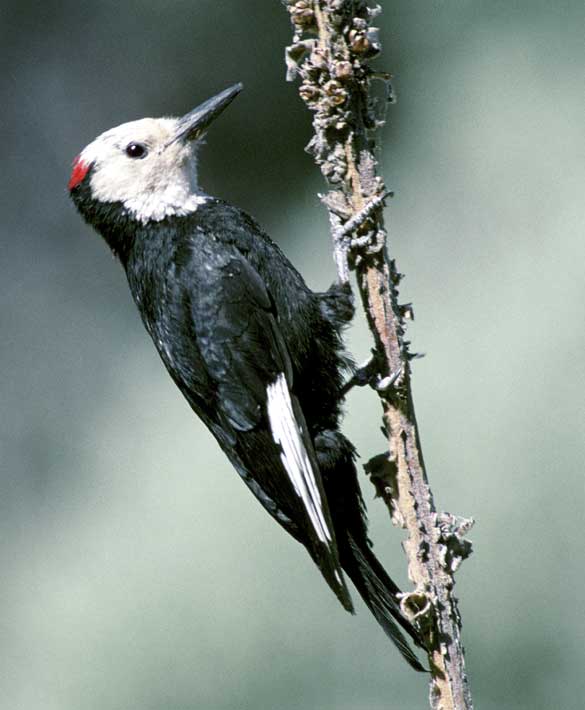 White-headed WoodpeckerLeuconotopicus albolarvatus
-
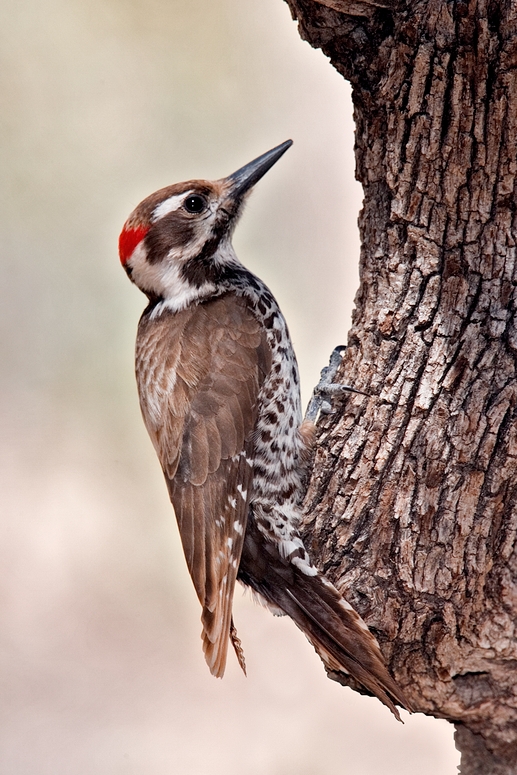 Arizona WoodpeckerLeuconotopicus arizonae
-
 Smoky-brown WoodpeckerLeuconotopicus fumigatus
-
 Strickland's WoodpeckerLeuconotopicus stricklandi
- Northern FlickerColaptes auratus
-
 Pileated WoodpeckerDryocopus pileatus
-
 Ivory-billed WoodpeckerCampephilus principalis
Compare
Questions and answers
What is the scientific name of the Red-cockaded Woodpecker?
The scientific name of the Red-cockaded Woodpecker is Leuconotopicus borealis. Written with its author, the full name is Leuconotopicus borealis (Vieillot, 1809).
Which family does the Red-cockaded Woodpecker belong to?
Leuconotopicus borealis belongs to the family Picidae, in the order Piciformes and the class Aves.
Where is the Red-cockaded Woodpecker found?
Checklists and occurrence records place Leuconotopicus borealis in 1 country: United States.
What is the conservation status of the Red-cockaded Woodpecker?
The IUCN Red List category recorded for Leuconotopicus borealis is Near Threatened (NT).
How rare is the red-cockaded woodpecker?
The species is classified as threatened under the United States Endangered Species Act of 1973 and Near Threatened by the IUCN. It has been locally extirpated in Kentucky, Maryland, Missouri, New Jersey and Tennessee.[43][36][37]
What is the habitat of the Red-cockaded Woodpecker?
The Red-cockaded Woodpecker inhabits fire-dependent pine savannas and open woodlands. Longleaf pine is the most commonly preferred tree species, although its habitat can also include other species of southern pine. It excavates nesting cavities exclusively in living pine trees.[10][11][14][12][13]
What does the Red-cockaded Woodpecker eat?
It primarily feeds on ants, beetles, cockroaches, caterpillars, wood-boring insects and spiders. Its diet occasionally includes fruit and berries, and it sometimes forages on corn earworms in cornfields.[17][18][20]
Sources
Passages the profile rests on
- The species has a black cap and nape surrounding large white cheek patches. Source passage: “Its back is barred with black and white horizontal stripes. The red-cockaded woodpecker's most distinguishing feature is a black cap and nape that encircle large white cheek patches.” — English Wikipedia
- Males have a small red streak on each side of their black cap. Source passage: “the male has a small red streak on each side of its black cap called a cockade” — English Wikipedia
- Adults measure 18–23 cm in length. Source passage: “This species measures 18–23 cm (7.1–9.1 in) in length” — English Wikipedia
- The wingspan measures 34–41 cm. Source passage: “spans 34–41 cm (13–16 in) across the wings” — English Wikipedia
- Adults weigh 40–56 g. Source passage: “weighs 40–56 g (1.4–2.0 oz)” — English Wikipedia
- The wing chord measures 9.5–12.6 cm. Source passage: “the wing chord is 9.5–12.6 cm (3.7–5.0 in)” — English Wikipedia
- The tail measures 7–8.2 cm. Source passage: “the tail is 7–8.2 cm (2.8–3.2 in)” — English Wikipedia
- The bill measures 1.9–2.3 cm. Source passage: “the bill is 1.9–2.3 cm (0.75–0.91 in)” — English Wikipedia
- The tarsus measures 1.8–2.2 cm. Source passage: “the tarsus is 1.8–2.2 cm (0.71–0.87 in)” — English Wikipedia
- The species inhabits fire-dependent pine savannas. Source passage: “The red-cockaded woodpecker makes its home in fire-dependent pine savannas.” — English Wikipedia
- Longleaf pine is the most commonly preferred tree species in its habitat. Source passage: “Longleaf pines (Pinus palustris) are most commonly preferred” — English Wikipedia
- Its habitat can also include other species of southern pine. Source passage: “but other species of southern pine are also acceptable.” — English Wikipedia
- Open woodlands are listed as habitat for the species. Source passage: “HabitatOpen Woodlands;” — allaboutbirds.org
- The species excavates nesting cavities exclusively in living pine trees. Source passage: “the red-cockaded woodpecker is the only one that excavates cavities exclusively in living pine trees.” — English Wikipedia
- A typical cavity-tree cluster covers approximately 10 acres. Source passage: “The average cluster is about 10 acres (40,000 m2).” — English Wikipedia
- A typical group's territory covers approximately 125–200 acres. Source passage: “The typical territory for a group ranges from about 125 to 200 acres” — English Wikipedia
- The species primarily feeds on ants, beetles, cockroaches, caterpillars, wood-boring insects and spiders. Source passage: “The red-cockaded woodpecker feeds primarily on ants, beetles, cockroaches, caterpillars, wood-boring insects, and spiders” — English Wikipedia
- Its diet occasionally includes fruit and berries. Source passage: “and occasionally fruit and berries.” — English Wikipedia
- Most of its foraging takes place on pine trees. Source passage: “The vast majority of foraging is on pines” — English Wikipedia
- The species occasionally forages on hardwood trees and corn earworms in cornfields. Source passage: “though they will occasionally forage on hardwoods and even on corn earworms in cornfields.” — English Wikipedia
- The species is territorial, nonmigratory and cooperatively breeding. Source passage: “Red-cockaded woodpeckers are a territorial, nonmigratory, cooperative breeding species” — English Wikipedia
- Individuals frequently retain the same mate for several years. Source passage: “frequently having the same mate for several years.” — English Wikipedia
- The species excavates cavities in living pine trees for nesting and roosting. Source passage: “They excavate cavities in live pine trees, favoring the longleaf pine.” — English Wikipedia
- Completed nesting cavities can remain in use for decades. Source passage: “Once completed, the cavity can remain in use for decades.” — English Wikipedia
- Individuals maintain resin wells around the entrances of actively used cavity trees. Source passage: “red-cockaded woodpeckers maintain small resin wells which exude sap around the cavity entrance.” — English Wikipedia
- Resin around cavity entrances helps deter climbing predators such as rat snakes. Source passage: “The resin flow acts as a defense mechanism against rat snakes and possibly other predators.” — English Wikipedia
- The species maintains incomplete cavity excavations known as cavity starts. Source passage: “These are incomplete cavity excavations which they continue to excavate over time.” — English Wikipedia
- The nesting season extends from April through June. Source passage: “The nesting season runs from April to June.” — English Wikipedia
- Breeding females lay three to four eggs in the breeding male's roost cavity. Source passage: “The breeding female lays three to four eggs in the breeding male's roost cavity.” — English Wikipedia
- The eggs are white and are incubated for 10–13 days. Source passage: “Group members incubate the small white eggs for 10–13 days.” — English Wikipedia
- Nestlings remain inside the cavity for approximately 26–29 days after hatching. Source passage: “Once hatched, the nestlings remain in the nest cavity for about 26–29 days.” — English Wikipedia
- Groups normally produce only one brood annually. Source passage: “and they normally only raise a single brood each year.” — English Wikipedia
- Helpers, usually males from the previous breeding season, assist with incubation and raising young. Source passage: “The other group members, called helpers, usually males from the previous breeding season, help incubate the eggs and raise the young.” — English Wikipedia
- Groups may contain as many as nine or more members after young birds remain with their parents. Source passage: “forming groups of up to nine or more members” — English Wikipedia
- Juvenile females generally leave their natal group before the following breeding season. Source passage: “Juvenile females generally leave the group before the next breeding season” — English Wikipedia
- The species is classified as threatened under the United States Endangered Species Act of 1973. Source passage: “It is a threatened species under the Endangered Species Act of 1973.” — English Wikipedia
- The IUCN lists the species as Near Threatened. Source passage: “The species is listed as Near Threatened by the IUCN” — English Wikipedia
- Habitat fragmentation caused by the removal of suitable pine trees threatens the species. Source passage: “The red-cockaded woodpecker suffers from habitat fragmentation when habitable pines are removed.” — English Wikipedia
- Controlled burning is used to reduce deciduous vegetation around nesting colonies. Source passage: “The use of controlled burning has been used to reduce deciduous growth around nesting colonies.” — English Wikipedia
- Artificial nesting cavities have been created in longleaf pine trees in Texas, Louisiana, Alabama and Georgia. Source passage: “states such as Texas, Louisiana, Alabama, and Georgia's wildlife management are creating artificial cavities in longleaf pine trees.” — English Wikipedia
- The species is considered a keystone species in southern pine forest ecosystems. Source passage: “The red-cockaded woodpecker is a keystone species in southern pine forest ecosystems.” — English Wikipedia
- At least 27 vertebrate species use its cavities secondarily. Source passage: “Their cavities are used secondarily by at least 27 species of vertebrates” — English Wikipedia
- The species has been locally extirpated in Kentucky, Maryland, Missouri, New Jersey and Tennessee. Source passage: “They have become locally extinct (extirpated) in Kentucky, Maryland, Missouri, New Jersey, and Tennessee.” — English Wikipedia
Data
- Catalogue of Life, 2026-10-16 XR cc by
- Global Biodiversity Information Facility CC BY 4.0
- Wikidata CC0
- GeoNames CC BY 4.0
- Wikimedia Commons per image; credit shown with each image
- Within the Catalogue of Life, this name comes from The Integrated Taxonomic Information System cc0
This species in other databases
Page built on 28 November 2026. See how the catalog is made and all sources and licences.
Cite this page
ScientificNames.org. (2026). Leuconotopicus borealis (Red-cockaded Woodpecker). Retrieved November 28, 2026, from https://scientificnames.org/species/leuconotopicus-borealis
“Leuconotopicus borealis (Red-cockaded Woodpecker).” ScientificNames.org, 2026, scientificnames.org/species/leuconotopicus-borealis. Accessed 28 Nov. 2026.
ScientificNames.org. “Leuconotopicus borealis (Red-cockaded Woodpecker).” Accessed November 28, 2026. https://scientificnames.org/species/leuconotopicus-borealis.
@misc{scientificnames_leuconotopicus_borealis_red_cockaded_woodpecker,
  author = {{ScientificNames.org}},
  title = {Leuconotopicus borealis (Red-cockaded Woodpecker)},
  year = {2026},
  url = {https://scientificnames.org/species/leuconotopicus-borealis},
  note = {Accessed 2026-11-28}
}