Species · Molluscs
Leucosyrinx rattiae
Leucosyrinx rattiae has no English name on record in the checklists used here. It is a species of mollusc in the family Antiplanidae, order Neogastropoda. The name dates from 2025.
- Scientific name
- Leucosyrinx rattiae Kantor, Fedosov & Puillandre, 2025
- Genus
- Leucosyrinx
- Family
- Antiplanidae
- Order
- Neogastropoda
- Class
- Gastropoda
- Environment
- marine
- Recorded in
- 1 country
- Name status
- accepted in the Catalogue of Life
Overview
The species occurs in marine waters off the Solomon Islands. It is distinguished by a small, fragile, fusiform to nearly biconic shell with strong axial folds, rounded spiral cords, and duplex radular marginal teeth.
Written 27 November 2026 from the sources listed below. Each statement was checked against the passage it cites; statements that could not be supported were removed.
Appearance
The shell is small, fragile, fusiform to nearly biconic, uniformly light tan, and has a moderately high spire. The holotype measures 24.9 mm in length and 9.7 mm in diameter.[1][2]
The shell has approximately eight teleoconch whorls. Its protoconch is smooth, eroded, paucispiral, and comprises fewer than 1.5 whorls.[3][4]
The teleoconch whorls have rounded shoulders and distinctly concave subsutural ramps. The suture is distinct, shallow, impressed, and has a slightly undulating margin.[5][6]
The last and penultimate whorls each bear 15 strong, broad, rounded, oblique axial folds. These folds remain well developed throughout the teleoconch, and their interspaces are slightly broader than the folds.[7][8]
Rounded, narrow, evenly developed spiral cords cover the entire shell surface. The subsutural ramp bears five to six particularly pronounced spiral cords on the last and penultimate whorls.[9][10]
Numerous fine growth lines occur on the shell and are especially conspicuous on the subsutural ramp. The shell base is slightly convex and gently curved, transitioning smoothly into a moderately long, straight siphonal canal.[11][12]
The aperture is narrow and elongate-oval, with weak differentiation from the siphonal canal. Its length measures 13.0 mm including the siphonal canal and 8.4 mm excluding it in the holotype.[13][14]
The inner lip is nearly straight. The columellar and parietal regions possess a narrow but distinct callus, and the anal sinus is moderately deep, subsutural, and broadly arcuate.[15][16][17]
The radular marginal teeth are duplex, relatively short, and rather broad. They measure approximately 230 μm in length.[18][19]
The major limb of each marginal tooth is broadly lanceolate in dorsal view and distinctly curved. The accessory limb is more than twice as narrow as the major limb, occupies approximately 75% of the total tooth length, and is inserted into a distinct, deep socket on the dorsal side of the major limb.[20][21][22]
Habitat
The species occurs in marine waters off the Solomon Islands at depths ranging from 1045 m to 1118 m.[23][24]
Classification of Leucosyrinx rattiae
| Kingdom | Animalia |
|---|---|
| Phylum | Mollusca |
| Class | Gastropoda (Gastropod) |
| Subclass | Caenogastropoda |
| Order | Neogastropoda |
| Superfamily | Conoidea |
| Family | Antiplanidae |
| Genus | Leucosyrinx |
| Species | Leucosyrinx rattiae Kantor, Fedosov & Puillandre, 2025 |
Origin of the name. Etymology The species is named after Claudia Ratti, member of the ERC " HYPERDIVERSE " team, for her contribution to the management of the neogastropod collection of the MNHN.
Where Leucosyrinx rattiae is found
Checklists and occurrence records place Leucosyrinx rattiae in 1 country. GBIF holds 3 georeferenced records of it.
Countries
A number beside a place is its count of GBIF occurrence records. A place without a number comes from a checklist alone. Records show where a species has been observed or collected, which can include escapes and vagrants.
Related species
- Leucosyrinx fijiensis
- Leucosyrinx claviforma
- Leucosyrinx elsa
- Leucosyrinx macrobertsoni
-
 Leucosyrinx pelagia
- Leucosyrinx bolbodes
-
 Leucosyrinx plebeia
-
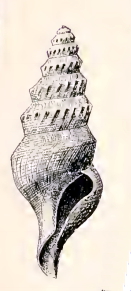 Leucosyrinx exulans
Compare
Questions and answers
Where does Leucosyrinx rattiae occur?
It occurs in marine waters off the Solomon Islands.[23]
At what depths does the species occur?
It occurs at depths ranging from 1045 m to 1118 m.[24]
What are the dimensions of the holotype shell?
The holotype shell measures 24.9 mm in length and 9.7 mm in diameter.[1]
How is the shell ornamented?
The shell has strong, broad, rounded, oblique axial folds and rounded, narrow spiral cords covering its entire surface. The subsutural ramp bears five to six particularly pronounced spiral cords on the last and penultimate whorls.[7][9][10]
What characterizes the radular marginal teeth?
The teeth are duplex, relatively short, and rather broad, measuring approximately 230 μm in length. Their accessory limb occupies approximately 75% of the total tooth length and is inserted into a distinct, deep socket on the dorsal side of the major limb.[18][19][21][22]
Sources
Passages the profile rests on
- The shell of the holotype measures 24.9 mm in length and 9.7 mm in diameter. Source passage: “The length of the shell of the holotype attains 24.9 mm; its diameter 9.7 mm” — English Wikipedia
- The shell is small, fragile, fusiform to nearly biconic, uniformly light tan, and has a moderately high spire. Source passage: “The small shell is fusiform to nearly biconic, fragile, and uniformly light tan in colour, with a moderately high spire.” — English Wikipedia
- The shell has approximately eight teleoconch whorls. Source passage: “It has approximately eight teleoconch whorls.” — English Wikipedia
- The protoconch is smooth, eroded, paucispiral, and comprises fewer than 1.5 whorls. Source passage: “The protoconch is paucispiral, smooth, and eroded, consisting of fewer than 1.5 whorls.” — English Wikipedia
- The teleoconch whorls have rounded shoulders and distinctly concave subsutural ramps. Source passage: “The teleoconch whorls are roundly angulate at the shoulder and possess a distinctly concave subsutural ramp.” — English Wikipedia
- The shell has a distinct, shallow, impressed suture with a slightly undulating margin. Source passage: “The suture is distinct, shallow, impressed, and has a slightly undulating margin.” — English Wikipedia
- The last and penultimate whorls each bear 15 strong, broad, rounded, oblique axial folds. Source passage: “The last and penultimate whorls each bear 15 strong, broad, rounded, oblique axial folds.” — English Wikipedia
- The axial folds remain well developed throughout the teleoconch, while their interspaces are slightly broader than the folds. Source passage: “They remain well developed throughout the teleoconch, and the interspaces are slightly broader than the folds.” — English Wikipedia
- The shell has rounded, narrow, evenly developed spiral cords covering its entire surface. Source passage: “consists of rounded, narrow, evenly developed spiral cords covering the entire shell, including both the axial folds and the interspaces.” — English Wikipedia
- The subsutural ramp bears five to six particularly pronounced spiral cords on the last and penultimate whorls. Source passage: “The cords are particularly pronounced on the subsutural ramp, where 5–6 cords are present on the last and penultimate whorls.” — English Wikipedia
- Numerous fine growth lines occur on the shell and are especially conspicuous on the subsutural ramp. Source passage: “Numerous fine growth lines are present and are especially conspicuous on the subsutural ramp.” — English Wikipedia
- The shell base is slightly convex and gently curved, transitioning smoothly into a moderately long, straight siphonal canal. Source passage: “The shell base is slightly convex and gently curved, passing smoothly into a moderately long, straight siphonal canal.” — English Wikipedia
- The holotype's aperture measures 13.0 mm including the siphonal canal and 8.4 mm excluding it. Source passage: “aperture length (including siphonal canal) 13.0 mm; aperture length (excluding canal) 8.4 mm.” — English Wikipedia
- The aperture is narrow and elongate-oval, with weak differentiation from the siphonal canal. Source passage: “The aperture is narrow, elongate-oval, and only weakly differentiated from the siphonal canal.” — English Wikipedia
- The inner lip is nearly straight. Source passage: “The inner lip is nearly straight.” — English Wikipedia
- The columellar and parietal regions possess a narrow but distinct callus. Source passage: “The columellar and parietal regions bear a narrow but distinct callus.” — English Wikipedia
- The anal sinus is moderately deep, subsutural, and broadly arcuate. Source passage: “The anal sinus is moderately deep, subsutural, and broadly arcuate” — English Wikipedia
- The radular marginal teeth are duplex, relatively short, and rather broad. Source passage: “The marginal teeth are duplex, approximately 230 μm long, relatively short (3.7% of the aperture length excluding the canal), and rather broad.” — English Wikipedia
- The radular marginal teeth measure approximately 230 μm in length. Source passage: “The marginal teeth are duplex, approximately 230 μm long” — English Wikipedia
- The major limb of each marginal tooth is broadly lanceolate in dorsal view and distinctly curved. Source passage: “The major limb is broadly lanceolate in dorsal view and distinctly curved.” — English Wikipedia
- The accessory limb is more than twice as narrow as the major limb and occupies approximately 75% of the total tooth length. Source passage: “The accessory limb is more than twice as narrow as the major limb, measures approximately 75% of the total tooth length” — English Wikipedia
- The accessory limb is inserted into a distinct, deep socket on the dorsal side of the major limb. Source passage: “is inserted into a distinct, deep socket on the dorsal side of the major limb.” — English Wikipedia
- The species occurs in marine waters off the Solomon Islands. Source passage: “This marine species occurs off the Solomon Islands” — English Wikipedia
- The species occurs at depths ranging from 1045 m to 1118 m. Source passage: “at depths between 1045 m and 1118 m.” — English Wikipedia
Data
- Catalogue of Life, 2026-10-16 XR cc by
- Global Biodiversity Information Facility CC BY 4.0
- Wikidata CC0
- GeoNames CC BY 4.0
- Within the Catalogue of Life, this name comes from World Register of Marine Species cc by
References
- Kantor, Y. I., Fedosov, A., & Puillandre, N. (2025). Revision of the Indo-Pacific species of the genus Leucosyrinx Dall, 1889 (Neogastropoda: Conoidea: Pseudomelatomidae). European Journal of Taxonomy, 999: 1–126. https://doi.org/10.5852/ejt.2025.999.2945 Link where the name was published
This species in other databases
Page built on 27 November 2026. See how the catalog is made and all sources and licences.
Cite this page
ScientificNames.org. (2026). Leucosyrinx rattiae. Retrieved November 27, 2026, from https://scientificnames.org/species/leucosyrinx-rattiae
“Leucosyrinx rattiae.” ScientificNames.org, 2026, scientificnames.org/species/leucosyrinx-rattiae. Accessed 27 Nov. 2026.
ScientificNames.org. “Leucosyrinx rattiae.” Accessed November 27, 2026. https://scientificnames.org/species/leucosyrinx-rattiae.
@misc{scientificnames_leucosyrinx_rattiae,
  author = {{ScientificNames.org}},
  title = {Leucosyrinx rattiae},
  year = {2026},
  url = {https://scientificnames.org/species/leucosyrinx-rattiae},
  note = {Accessed 2026-11-27}
}