Species · Other invertebrates
Tongue Worm Linguatula serrata
The scientific name of the Tongue Worm is Linguatula serrata. It is a species of animal in the family Linguatulidae. The name dates from 1789.
- Scientific name
- Linguatula serrata Frölich, 1789
- Common name
- Tongue Worm
- Genus
- Linguatula
- Family
- Linguatulidae
- Class
- Pentastomida
- Environment
- terrestrial
- Recorded in
- 8 countries
- Name status
- accepted in the Catalogue of Life
Overview
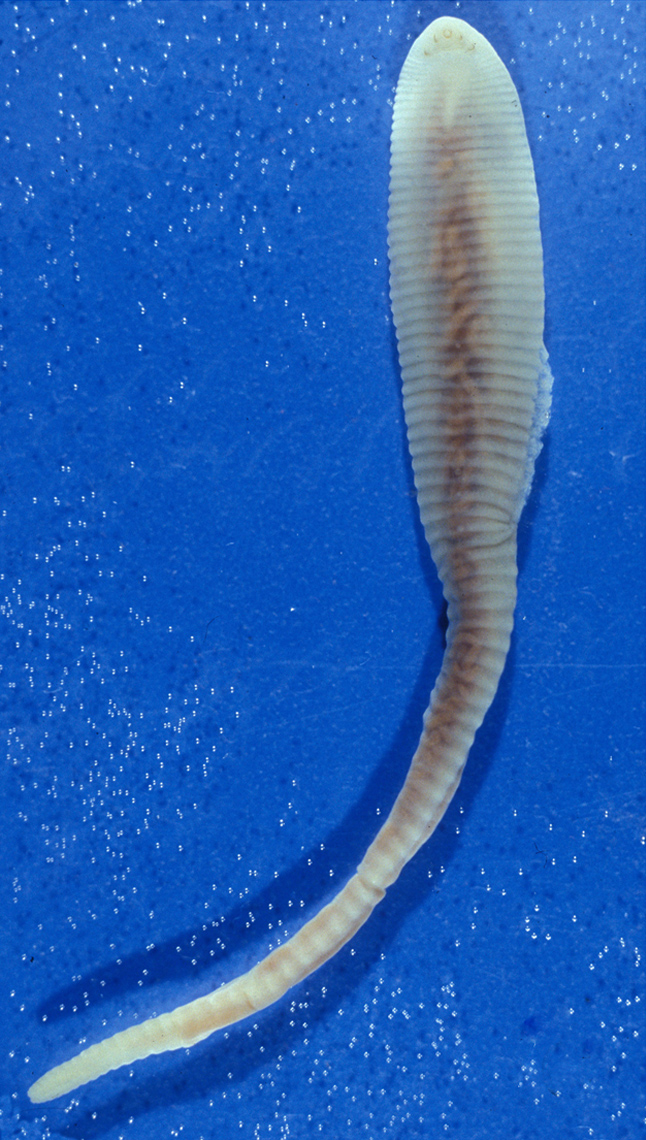
Adult parasites live in the nasopharyngeal region, nasal airways, and frontal sinuses of mammalian hosts, while immature larvae occur in the organs and tissues of intermediate hosts. Adults have a flattened, transparent body bearing approximately 70–100 annuli and four ventral hook pits.
Written 26 November 2026 from the sources listed below. Each statement was checked against the passage it cites; statements that could not be supported were removed.
Appearance
The adult parasite has a dorsoventrally flattened body that tapers towards the rear. Adult specimens are colorless and transparent, with approximately 70–100 annuli arranged along the body surface.[1][2][3]
The adult ventral surface bears four hook pits. The first larval instar has two pairs of leg-like appendages and superficially resembles a mite, although it is biologically a nauplius rather than a nymph.[4][5][6]
Adult males typically measure 18–20 mm in length, while adult females typically measure 80–120 mm. Some Australian female specimens have been recorded at lengths of up to 15 cm.[7][8][9]
The first larval stages normally measure 3–4 mm.[10]
Habitat
Adult parasites inhabit the nasopharyngeal region, nasal airways, and frontal sinuses of mammalian hosts. They attach to the mucous membranes of the nasal cavity, nasal turbinates, and frontal sinuses.[11][12][13]
Immature larvae can inhabit the mesenteric lymph nodes, lungs, and liver of intermediate hosts. Encysted larvae can also occur in their muscle tissue.[14][15]
Diet
Adult parasites feed on blood, lymph, and mucus from epithelial cells in the respiratory tract, obtaining fluids from the host's nasopharyngeal mucosa.[16][17]
Intermediate hosts acquire infection by ingesting eggs from aquatic or wet vegetation. Carnivorous definitive hosts acquire the parasite by eating infected intermediate hosts.[18][19]
Humans can become definitive hosts by consuming raw or undercooked viscera containing infective nymphs.[20]
Behaviour
Adult parasites use hooks to attach themselves to the respiratory tissues of their hosts. Papillae on their body annuli serve to sense their surroundings.[21][22]
Larvae use their leg-like appendages to move through intermediate hosts. Immature larvae tunnel through the intestinal wall using a stylet.[23][24]
Eggs leave definitive hosts through nasal secretions or feces after being swallowed. Infection of intermediate hosts commonly occurs through ingestion of contaminated environmental eggs.[25][26]
Reproduction and life cycle
The species has separate male and female individuals, and successful reproduction requires mating between them. Males tend to select females similar to them in body size, while females generally mate only once during their lifetime.[27][28][29][30]
Female parasites can produce up to one million eggs annually in the definitive host. After mating, females can lay as many as five million embryonated eggs per day.[31][32]
Eggs measure approximately 70–90 micrometers and contain a fully developed first-stage larva.[33]
Adult parasites develop in the respiratory tract of carnivorous hosts after several molts. Development from infective nymphs into adults in the nasal cavity and frontal sinuses takes six to seven months.[34][35]
Classification of the Tongue Worm
| Kingdom | Animalia |
|---|---|
| Phylum | Arthropoda |
| Subphylum | Crustacea |
| Class | Pentastomida |
| Family | Linguatulidae |
| Genus | Linguatula |
| Species | Linguatula serrata Frölich, 1789 |
This name was added to the Catalogue of Life from a contributing dataset by automated merging and has not yet been reviewed by its editors.
Where the Tongue Worm is found
Checklists and occurrence records place Linguatula serrata in 8 countries. GBIF holds 193 georeferenced records of it.
Countries
Regions and cities with the most records
- Isfahan, Iran 30
- New South Wales, Australia 18
- Dhaka Division, Bangladesh 6
- Mirzāpur, Bangladesh 6
- Mānikganj, Bangladesh 6
- Nāgarpur, Bangladesh 6
- New York, United States 3
1 more country has a few records outside this range
These countries hold a few records of Linguatula serrata but lie outside the range the checklists give for it. Such records are often zoo or garden specimens, museum material or vagrants, so the species is not counted as occurring there.
A number beside a place is its count of GBIF occurrence records. A place without a number comes from a checklist alone. Records show where a species has been observed or collected, which can include escapes and vagrants.
Common names
English
- Tongue Worm
- Canine Pentastome
- Canine Tongue Worm
- Common Tongue Worm
- Dog Tongue Worm
- Nasal Worm of Dogs
- Tongueworm
Names in 5 other languages
- Czech
- jazyčnatka tasemnicová
- Finnish
- kuonomato
- German
- Gemeiner Zungenwurm, Nasenwurm
- Russian
- Носовая пятиустка
- Swedish
- hundens tungmask, tungmask
Synonyms
12 other scientific names have been used for this species and are now treated as synonyms of Linguatula serrata.
- Linguatula denticulata Rudolphi, 1805
- Linguatula dingoensis Johnson, 1910
- Monostoma settenii Numan, 1840
- Pentastoma emarginatum Rudolphi, 1819
- Pentastoma fera Creplin, 1829
- Pentastomum cephalopodi_pygmaei Diesing, 1863
- Polystoma taenioides Rudolphi, 1809
- Taenia capraea Abildgaard, 1789
- Taenia caprina Gmelin, 1791
- Taenia lanceolata Rudolphi, 1805
- Taenia rhinaris Meyer, 1789
- Tetragulus caviae Bosc, 1811
Subspecies and varieties
- Linguatula serrata serengetiana subspecies
Questions and answers
What is the scientific name of the Tongue Worm?
The scientific name of the Tongue Worm is Linguatula serrata. Written with its author, the full name is Linguatula serrata Frölich, 1789.
Which family does the Tongue Worm belong to?
Linguatula serrata belongs to the family Linguatulidae and the class Pentastomida.
Where is the Tongue Worm found?
Checklists and occurrence records place Linguatula serrata in 8 countries, including Iran, Australia, United States, Romania, Bangladesh and The Netherlands.
What other names does the Tongue Worm have?
Linguatula serrata is also known in English as Canine Pentastome, Canine Tongue Worm, Common Tongue Worm, Dog Tongue Worm, Nasal Worm of Dogs and Tongueworm.
Can tongue worms infect humans?
Yes. Tongue worm is a zoonotic parasite capable of infecting humans. Humans can act as accidental intermediate hosts after ingesting contaminated water or vegetables, or become definitive hosts by consuming raw or undercooked viscera containing infective nymphs.[20][36][37]
Where do tongue worms live?
Adult tongue worms live in the nasopharyngeal region, nasal airways, and frontal sinuses of mammalian hosts. Immature larvae can inhabit the mesenteric lymph nodes, lungs, liver, and muscle tissue of intermediate hosts.[11][12][14][15]
Can humans get Linguatula serrata?
Yes. Humans can become accidental intermediate hosts after ingesting contaminated water or vegetables, or definitive hosts after consuming raw or undercooked viscera containing infective nymphs.[20][36][37]
What is Linguatula serrata?
Linguatula serrata Frölich, 1789, commonly called the Tongue worm, is an obligate zoonotic parasite in the family Linguatulidae and class Pentastomida. It has an indirect life cycle involving intermediate and definitive hosts, with adult parasites inhabiting the respiratory tract of mammalian hosts.[11][36][38][39]
Sources
Passages the profile rests on
- The adult parasite has a dorsoventrally flattened body that tapers towards the rear. Source passage: “The adult parasite is dorsoventrally flattened, tapering backwards, resembling a vertebrate tongue” — English Wikipedia
- Adult specimens are colorless and transparent. Source passage: “The worm is colorless and transparent.” — animaldiversity.org
- The adult body bears approximately 70–100 annuli arranged along its surface. Source passage: “The body is covered with about 70-100 annuli, or rings, with many pores and spines on each annulus arranged in rows.” — animaldiversity.org
- The adult ventral surface has four hook pits. Source passage: “The ventral has four hook pits.” — animaldiversity.org
- The first larval instar has two pairs of leg-like appendages and superficially resembles a mite. Source passage: “Because of its two pairs of leg-like appendages, the first larval instar superficially resembles a nymphal mite” — animaldiversity.org
- The first larval instar is biologically a nauplius rather than a nymph. Source passage: “though it is actually a nauplius.” — animaldiversity.org
- Adult males typically measure 18–20 mm in length. Source passage: “males: 18–20 millimetres (0.71–0.79 in) in length” — English Wikipedia
- Adult females typically measure 80–120 mm in length. Source passage: “while the females are 80–120 mm (3.1–4.7 in).” — English Wikipedia
- Some Australian female specimens have been recorded at lengths of up to 15 cm. Source passage: “some Australian female specimens showed great morphological variation in total body length and were up to 15 cm long” — pmc.ncbi.nlm.nih.gov
- The first larval stages normally measure 3–4 mm. Source passage: “Larval L. serrata normaly measure 3-4 mm.” — animaldiversity.org
- Adult parasites inhabit the nasopharyngeal region of mammalian hosts. Source passage: “They live in the nasopharyngeal region of mammals.” — English Wikipedia
- Adult specimens inhabit the nasal airways and frontal sinuses of carnivorous mammals. Source passage: “As an adult, Linguatula serrata lives in the nasal airways or frontal sinuses of dogs, wolves, foxes, felines or other carnivorous mammals.” — animaldiversity.org
- Adult parasites attach to the mucous membranes of the nasal cavity, nasal turbinates, and frontal sinuses. Source passage: “The adult parasites live attaching to the mucous membranes of the nasal cavity, turbinates, and frontal sinuses of the definitive hosts” — pmc.ncbi.nlm.nih.gov
- Immature larvae can inhabit the mesenteric lymph nodes, lungs, and liver of intermediate hosts. Source passage: “During these sexually immature stages, it resides in the herbivorous mammal's mesenteric lymph nodes, lungs and liver.” — animaldiversity.org
- Encysted larvae can also occur in the muscle tissue of intermediate hosts. Source passage: “Encysting can happen in a number of tissues, including the liver, lymph nodes and muscle.” — animaldiversity.org
- Adult parasites feed on blood and fluids obtained from their host's nasopharyngeal mucosa. Source passage: “Adult L. serrata embeds their forebody into the nasopharyngeal mucosa, feeding on blood and fluids.” — English Wikipedia
- Adult parasites consume blood, lymph, and mucus from epithelial cells in the respiratory tract. Source passage: “they feed on blood, lymph and mucus from epithelial cells” — animaldiversity.org
- Intermediate hosts acquire infection by ingesting eggs from aquatic or wet vegetation. Source passage: “The intermediate host ingests the eggs off aquatic or wet vegetation in the external environment.” — animaldiversity.org
- Carnivorous definitive hosts acquire the parasite by eating infected intermediate hosts. Source passage: “if the definitive, carnivorous host feeds upon the intermediate host when the larvae are in their third stage, the carnivore acquires the parasite.” — animaldiversity.org
- Humans can become definitive hosts by consuming raw or undercooked viscera containing infective nymphs. Source passage: “Humans can act as accidental intermediate hosts when they ingest water or vegetables contaminated by embryonated eggs of the parasite (Hajipour and Tavassoli, 2019), or as definitive hosts when they feed on raw or undercooked viscera containing infectious nymphs” — pmc.ncbi.nlm.nih.gov
- Adult parasites use hooks to attach themselves to the respiratory tissues of their hosts. Source passage: “Using hooks to attach, they feed on blood, lymph and mucus from epithelial cells” — animaldiversity.org
- Adult parasites use papillae on their body annuli to sense their surroundings. Source passage: “Adult Linguatula serrata uses papillae on its annuli to sense its environment.” — animaldiversity.org
- Larvae use their leg-like appendages to move through intermediate hosts. Source passage: “The larvae use leg-like appendages for movement through the intermediate host.” — animaldiversity.org
- Immature larvae tunnel through the intestinal wall using a stylet. Source passage: “The first larval stage of L. serrata tunnels through gut wall with a stylet” — animaldiversity.org
- Eggs leave definitive hosts through nasal secretions or feces after being swallowed. Source passage: “Eggs exit the host in nasal secretion or if swallowed, with feces.” — English Wikipedia
- Infection of intermediate hosts commonly occurs through ingestion of contaminated environmental eggs. Source passage: “The intermediate hosts become infested when they accidentally ingest larvated eggs from contaminated environments.” — pmc.ncbi.nlm.nih.gov
- The species has separate male and female individuals. Source passage: “gonochoric/gonochoristic/dioecious (sexes separate)” — animaldiversity.org
- Successful reproduction requires mating between male and female individuals. Source passage: “Both male and females are required to mate for successful reproduction.” — English Wikipedia
- Males tend to select females that are similar to them in body size. Source passage: “Males choose to mate with females that are close to their own size.” — English Wikipedia
- Female individuals generally mate only once during their lifetime. Source passage: “Linguatula serrata females mate once over the course of their lifetime” — animaldiversity.org
- Females can produce up to one million eggs annually in the definitive host. Source passage: “Females can lay up to one million eggs in the definitive host per year.” — animaldiversity.org
- Female parasites can lay as many as five million embryonated eggs per day after mating. Source passage: “After mating, females lay up to 5,000,000 embryonated eggs per day” — pmc.ncbi.nlm.nih.gov
- Eggs measure approximately 70–90 micrometers and contain a fully developed first-stage larva. Source passage: “The eggs are about 70-90 micrometers and contain the fully-developed first stage of the larva.” — animaldiversity.org
- Adult parasites develop in the respiratory tract of carnivorous hosts after several molts. Source passage: “Linguatula serrata reaches sexual maturity after several molts in a carnivorous host's repiratory tract.” — animaldiversity.org
- The parasite develops from infective nymphs into adults in the nasal cavity and frontal sinuses within six to seven months. Source passage: “When ingested by a definitive host, nymphs migrate to the nasal cavity and frontal sinus where they develop into adult parasites within 6–7 months” — pmc.ncbi.nlm.nih.gov
- The species is a zoonotic parasite capable of infecting humans. Source passage: “Linguatula serrata is a species of cosmopolitan zoonotic parasite” — English Wikipedia
- Humans can act as accidental intermediate hosts after ingesting contaminated water or vegetables. Source passage: “Humans can act as accidental intermediate hosts when they ingest water or vegetables contaminated by embryonated eggs of the parasite” — pmc.ncbi.nlm.nih.gov
- The species has an indirect life cycle involving intermediate and definitive hosts. Source passage: “This parasite has an indirect life cycle.” — pmc.ncbi.nlm.nih.gov
- The species is an obligate parasite. Source passage: “Linguatula serrata Frölich, 1789 is a cosmopolitan, zoonotic, and food-borne obligate parasite” — pmc.ncbi.nlm.nih.gov
Data
- Catalogue of Life, 2026-10-16 XR cc by
- Global Biodiversity Information Facility CC BY 4.0
- Wikidata CC0
- GeoNames CC BY 4.0
- Wikimedia Commons per image; credit shown with each image
- iNaturalist per image; credit shown with each image
- Within the Catalogue of Life, this name comes from World Register of Marine Species cc by
References
- Frölich, J.A. 1789. Beschreibungen einiger neuen Eingeweidewürmer. Der Naturforscher 24: 101-162. where the name was published
- Poore, G. C. B. (2012). The nomenclature of the Recent Pentastomida (Crustacea), with a list of species and available names.
- Christoffersen, M.L., and De Assis, J.E. 2013. A systematic monograph of the Recent Pentastomida, with a compilation of their hosts. Zoologische Mededelingen 87: 1-206.
This species in other databases
- Catalogue of Life QCFJM
- Wikidata Q3061587
- iNaturalist 346597
- WoRMS urn:lsid:marinespecies.org:taxname:730130
- ITIS 682443
- NCBI Taxonomy txid646052
Page built on 28 November 2026. See how the catalog is made and all sources and licences.
Cite this page
ScientificNames.org. (2026). Linguatula serrata (Tongue Worm). Retrieved November 28, 2026, from https://scientificnames.org/species/linguatula-serrata
“Linguatula serrata (Tongue Worm).” ScientificNames.org, 2026, scientificnames.org/species/linguatula-serrata. Accessed 28 Nov. 2026.
ScientificNames.org. “Linguatula serrata (Tongue Worm).” Accessed November 28, 2026. https://scientificnames.org/species/linguatula-serrata.
@misc{scientificnames_linguatula_serrata_tongue_worm,
  author = {{ScientificNames.org}},
  title = {Linguatula serrata (Tongue Worm)},
  year = {2026},
  url = {https://scientificnames.org/species/linguatula-serrata},
  note = {Accessed 2026-11-28}
}