Species · Birds
Dusky Piha Lipaugus fuscocinereus
The scientific name of the Dusky Piha is Lipaugus fuscocinereus. It is a species of bird in the family Cotingidae (contingas), order Passeriformes. The name dates from 1843.
- Scientific name
- Lipaugus fuscocinereus (Lafresnaye, 1843)
- Common name
- Dusky Piha
- Genus
- Lipaugus
- Family
- Cotingidae (Contingas)
- Order
- Passeriformes
- Class
- Aves
- Red List category
- LC Least Concern
- Recorded in
- 3 countries
- Name status
- accepted in the Catalogue of Life

Overview
Lipaugus fuscocinereus occurs in Colombia, Ecuador, and Peru, inhabiting the canopy and edges of montane forests and mature secondary forests in subtropical and temperate zones. It is the largest species in the genus Lipaugus and has the genus's longest tail.
Written 26 November 2026 from the sources listed below. Each statement was checked against the passage it cites; statements that could not be supported were removed.
Appearance
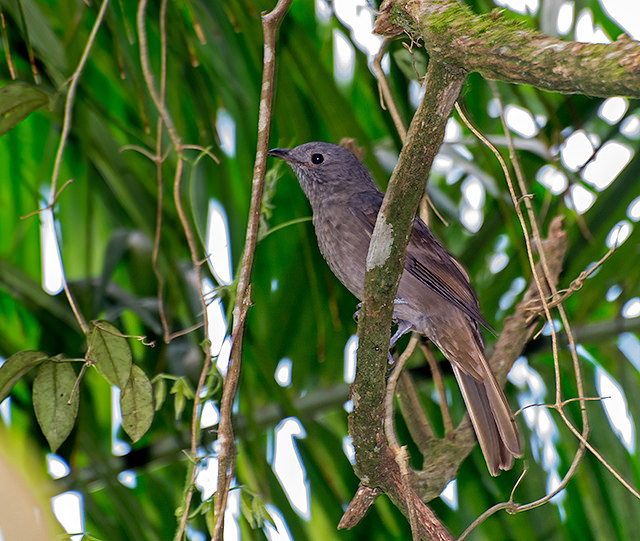
Adult Dusky Pihas have medium gray upperparts, darker gray wings and tails, and paler gray underparts with a brownish wash on the breast and belly. Their plumage is entirely plain gray without distinctive markings.[1][2]
Adults have dark brown irises, dark brown or blackish bills with paler mandible bases, and gray legs and feet. Immature birds have rufous tips on their wing coverts.[3][4]
Male and female Dusky Pihas have the same plumage. Adults measure 31–33 cm in length and weigh 120–138 g.[5][6][7]
Habitat
The Dusky Piha inhabits the canopy and edges of montane forests and mature secondary forests in subtropical and temperate zones. It occurs along all three ranges of the Colombian Andes, with its range extending south along the eastern Andes through Ecuador into far northern Peru, north of the Marañón River valley.[8][9][10]
In Colombia, the Dusky Piha occurs at elevations of 1,800–3,100 m. In Ecuador, it occurs at 1,700–2,600 m, and in Peru at 2,125–2,250 m.[11][12][13]
Diet
The Dusky Piha feeds on fruit and probably also eats insects.[14]
Behaviour
The Dusky Piha usually forages in small groups that regularly join mixed-species feeding flocks. It obtains fruit by making brief sallies from a perch.[15][16]
The Dusky Piha is believed to remain in its range throughout the year.[17]
The Dusky Piha produces a loud song resembling 'pee-a-weeee or pee-a-weeee-a-weeee', with the final syllable descending in pitch. Its wings produce a loud noise during courtship displays.[18][19]
Reproduction and life cycle
Male Dusky Pihas may court females in loose leks.[20]
A known Dusky Piha nest was discovered in Ecuador in late March. It was a shallow cup made of vine tendrils on a platform of sticks, situated in the fork of a horizontal branch approximately 8.5 m above the ground.[21][22][23]
The documented nest contained one pale beige egg marked with brown and lavender.[24]
Conservation
The Dusky Piha is classified as Least Concern by the IUCN. It has a large geographic range, but its population size is unknown and believed to be decreasing.[25][26]
The species is considered uncommon in Colombia, scarce and local in Ecuador, and rare and local in Peru. Extensive deforestation in the subtropical and temperate Andes has reduced its numbers.[27][28]
No immediate threats to the Dusky Piha have been identified. It was most recently assessed for the IUCN Red List in 2024.[29][30]
Similar species
The Scimitar-winged Piha (Lipaugus uropygialis) is a sister species of the Dusky Piha. The Chestnut-capped Piha (Lipaugus weberi) may belong to the same evolutionary clade as the Dusky Piha and Scimitar-winged Piha.[31][32]
Classification of the Dusky Piha
| Kingdom | Animalia |
|---|---|
| Phylum | Chordata |
| Subphylum | Vertebrata |
| Infraphylum | Gnathostomata |
| Parvphylum | Osteichthyes |
| Megaclass | Tetrapoda |
| Class | Aves (Bird) |
| Order | Passeriformes (Passerine) |
| Family | Cotingidae (Contingas) |
| Genus | Lipaugus (Pihas) |
| Species | Lipaugus fuscocinereus (Lafresnaye, 1843) |
Where the Dusky Piha is found
Checklists and occurrence records place Lipaugus fuscocinereus in 3 countries across South America. GBIF holds 4,248 georeferenced records of it.
Countries
Regions and cities with the most records
- Caldas Department, Colombia 1,360
- Villamaría, Colombia 1,325
- Manizales, Colombia 1,298
- Napo, Ecuador 965
- Neira, Colombia 800
- Chinchiná, Colombia 362
- Quindío Department, Colombia 296
- Risaralda Department, Colombia 288
- Antioquia, Colombia 285
- Tolima Department, Colombia 281
- Circasia, Colombia 208
- Santa Rosa de Cabal, Colombia 195
- Anaime, Colombia 178
- Urrao, Colombia 141
- Andes, Colombia 119
- Putumayo Department, Colombia 101
- Zamora Chinchipe, Ecuador 100
- Riosucio, Colombia 99
- Huila Department, Colombia 91
- Supía, Colombia 88
- Valle del Cauca Department, Colombia 86
- Dosquebradas, Colombia 84
- Mocoa, Colombia 82
- Santander Department, Colombia 70
- Pereira, Colombia 63
- Piedecuesta, Colombia 48
- Chocó, Colombia 47
- Calarcá, Colombia 45
- Tungurahua Province, Ecuador 41
- Pelileo, Ecuador 38
- Cauca Department, Colombia 35
- Floridablanca, Colombia 28
- Morona-Santiago Province, Ecuador 28
- Bucaramanga, Colombia 24
- Isnos, Colombia 23
- Girón, Colombia 22
Range as the checklists state it
South America
A number beside a place is its count of GBIF occurrence records. A place without a number comes from a checklist alone. Records show where a species has been observed or collected, which can include escapes and vagrants.
Common names
English
- Dusky Piha
Names in 23 other languages
- Arabic
- بيها داكنة
- Catalan
- cotinga fosc
- Chinese
- 暗色伞鸟, 烏暗皮哈鳥
- Croatian
- sinja kotinga
- Czech
- kotinga temná
- Danish
- Askepiha
- Dutch
- Grauwe Piha
- Esperanto
- malhela kotingo
- Finnish
- savukotinga
- French
- Piauhau sombre, Tijuca sombre
- German
- Andengraupiha, Graukotinga, Langschwanz-Piha, Langschwanzpiha
- Italian
- Piha fosca
- Japanese
- オオムジカザリドリ
- Lithuanian
- tamsioji piha
- Polish
- bławatowiec duży
- Portuguese
- guarda-bosques-escuro, tropeiro-escuro
- Russian
- Длиннохвостая сорокопутовая пиха, Тёмная пиха
- Serbian
- Tamna piha
- Slovak
- kotinga tmavá
- Spanish
- Guardabosque cenizo, Guardabosques oscuro
- Swedish
- gråpiha
- Turkish
- Esmer Kotinga
- Ukrainian
- пига довгохвоста
Synonyms
One other scientific name has been used for this species and is now treated as a synonym of Lipaugus fuscocinereus.
- Querula fuscocinerea Lafresnaye, 1843
Related species
-
 Screaming PihaLipaugus vociferans
-
 Rufous PihaLipaugus unirufus
-
 Chestnut-capped PihaLipaugus weberi
-
 Black-and-gold CotingaLipaugus ater
-
 Rose-collared PihaLipaugus streptophorus
-
 Cinnamon-vented PihaLipaugus lanioides
-
 Scimitar-winged PihaLipaugus uropygialis
- Grey-winged CotingaLipaugus conditus
Compare
Questions and answers
What is the scientific name of the Dusky Piha?
The scientific name of the Dusky Piha is Lipaugus fuscocinereus. Written with its author, the full name is Lipaugus fuscocinereus (Lafresnaye, 1843).
Which family does the Dusky Piha belong to?
Lipaugus fuscocinereus belongs to the family Cotingidae, in the order Passeriformes and the class Aves.
Where is the Dusky Piha found?
Checklists and occurrence records place Lipaugus fuscocinereus in 3 countries: Colombia, Ecuador and Peru.
What is the conservation status of the Dusky Piha?
The IUCN Red List category recorded for Lipaugus fuscocinereus is Least Concern (LC).
Sources
Passages the profile rests on
- Adult Dusky Pihas have medium gray upperparts, darker gray wings and tails, and paler gray underparts with a brownish wash on the breast and belly. Source passage: “Adults have medium gray upperparts and duskier gray wings and tail. Their underparts are paler gray with a brownish wash on the breast and belly.” — English Wikipedia
- The Dusky Piha has entirely plain gray plumage without distinctive markings. Source passage: “This large, relatively long-tailed cotinga is completely lacking in distinctive plumage: it is entirely plain gray.” — ebird.org
- Adult Dusky Pihas have dark brown irises, dark brown or blackish bills with paler mandible bases, and gray legs and feet. Source passage: “They have a dark brown iris, a dark brown or blackish bill with a paler base to the mandible, and gray legs and feet.” — English Wikipedia
- Immature Dusky Pihas have rufous tips on their wing coverts. Source passage: “Immatures have rufous tips on the wing coverts.” — English Wikipedia
- Male and female Dusky Pihas have the same plumage. Source passage: “The sexes have the same plumage.” — English Wikipedia
- Adult Dusky Pihas measure 31–33 cm in length. Source passage: “They are 31 to 33 cm (12 to 13 in) long” — English Wikipedia
- Adult Dusky Pihas weigh 120–138 g. Source passage: “weigh 120 to 138 g (4.2 to 4.9 oz).” — English Wikipedia
- The Dusky Piha inhabits the canopy and edges of montane forests and mature secondary forests in subtropical and temperate zones. Source passage: “It inhabits the canopy and edges of montane forest and mature secondary forest in the subtropical and temperate zones.” — English Wikipedia
- In Colombia, the Dusky Piha occurs along all three ranges of the Colombian Andes. Source passage: “It is found along all three ranges of the Colombian Andes” — English Wikipedia
- The Dusky Piha's range extends south along the eastern Andes through Ecuador into far northern Peru, north of the Marañón River valley. Source passage: “south along the eastern slope through Ecuador slightly into far northern Peru north of the Marañón River valley.” — English Wikipedia
- In Colombia, the Dusky Piha occurs at elevations of 1,800–3,100 m. Source passage: “between 1,800 and 3,100 m (5,900 and 10,200 ft) in Colombia” — English Wikipedia
- In Ecuador, the Dusky Piha occurs at elevations of 1,700–2,600 m. Source passage: “between 1,700 and 2,600 m (5,600 and 8,500 ft) in Ecuador” — English Wikipedia
- In Peru, the Dusky Piha occurs at elevations of 2,125–2,250 m. Source passage: “between 2,125 and 2,250 m (7,000 and 7,400 ft) in Peru.” — English Wikipedia
- The Dusky Piha feeds on fruit and probably also eats insects. Source passage: “The dusky piha is known to feed on fruit and probably eats insects as well.” — English Wikipedia
- The Dusky Piha usually forages in small groups that regularly join mixed-species feeding flocks. Source passage: “It usually forages in small groups that regularly join mixed-species feeding flocks.” — English Wikipedia
- The Dusky Piha obtains fruit by making brief sallies from a perch. Source passage: “It plucks fruit with a brief sally from a perch.” — English Wikipedia
- The Dusky Piha is believed to remain in its range throughout the year. Source passage: “The dusky piha is believed to be a year-round resident.” — English Wikipedia
- The Dusky Piha produces a loud song resembling 'pee-a-weeee or pee-a-weeee-a-weeee', with the final syllable descending in pitch. Source passage: “The dusky piha's song is a loud "pee-a-weeee or pee-a-weeee-a-weeee" whose last syllable slurs down the scale.” — English Wikipedia
- The Dusky Piha's wings produce a loud noise during courtship displays. Source passage: “Its wings make a loud noise during courtship display.” — English Wikipedia
- Male Dusky Pihas may court females in loose leks. Source passage: “Males perhaps court females in loose leks.” — English Wikipedia
- A known Dusky Piha nest was discovered in Ecuador in late March. Source passage: “The one known dusky piha nest was found in Ecuador in late March.” — English Wikipedia
- The documented Dusky Piha nest was a shallow cup made of vine tendrils on a platform of sticks. Source passage: “It was a flattish cup made from vine tendrils on a platform of sticks” — English Wikipedia
- The documented Dusky Piha nest was situated in the fork of a horizontal branch approximately 8.5 m above the ground. Source passage: “it was perched on the fork of a horizontal branch about 8.5 m (30 ft) above the ground.” — English Wikipedia
- The documented Dusky Piha nest contained one pale beige egg marked with brown and lavender. Source passage: “It held one egg that was pale beige with brown and lavender markings.” — English Wikipedia
- The Dusky Piha is classified as Least Concern by the IUCN. Source passage: “The IUCN has assessed the dusky piha as being of Least Concern.” — English Wikipedia
- The Dusky Piha has a large geographic range, but its population size is unknown and believed to be decreasing. Source passage: “It has a large range; its population size is not known and is believed to be decreasing.” — English Wikipedia
- The Dusky Piha is considered uncommon in Colombia, scarce and local in Ecuador, and rare and local in Peru. Source passage: “It is considered uncommon in Colombia, scarce and local in Ecuador, and rare and local in Peru.” — English Wikipedia
- Extensive deforestation in the subtropical and temperate Andes has reduced Dusky Piha numbers. Source passage: “Numbers have certainly been reduced by extensive deforestation of Andes at subtropical and temperate levels.” — English Wikipedia
- No immediate threats to the Dusky Piha have been identified. Source passage: “No immediate threats have been identified.” — English Wikipedia
- The Dusky Piha was most recently assessed for the IUCN Red List in 2024. Source passage: “Dusky Piha Lipaugus fuscocinereus has most recently been assessed for The IUCN Red List of Threatened Species in 2024.” — iucnredlist.org
- The Scimitar-winged Piha (Lipaugus uropygialis) is a sister species of the Dusky Piha. Source passage: “It and the scimitar-winged piha (L. uropygialis) are sister species;” — English Wikipedia
- The Chestnut-capped Piha (Lipaugus weberi) may belong to the same evolutionary clade as the Dusky Piha and Scimitar-winged Piha. Source passage: “the chestnut-capped piha (L. weberi) may also belong to that clade.” — English Wikipedia
Data
- Catalogue of Life, 2026-10-16 XR cc by
- Global Biodiversity Information Facility CC BY 4.0
- Wikidata CC0
- GeoNames CC BY 4.0
- Wikimedia Commons per image; credit shown with each image
- Within the Catalogue of Life, this name comes from The Integrated Taxonomic Information System cc0
References
- Gill, Frank, & and Minturn Wright. (2006). Birds of the World: Recommended English Names.
This species in other databases
Page built on 27 November 2026. See how the catalog is made and all sources and licences.
Cite this page
ScientificNames.org. (2026). Lipaugus fuscocinereus (Dusky Piha). Retrieved November 27, 2026, from https://scientificnames.org/species/lipaugus-fuscocinereus
“Lipaugus fuscocinereus (Dusky Piha).” ScientificNames.org, 2026, scientificnames.org/species/lipaugus-fuscocinereus. Accessed 27 Nov. 2026.
ScientificNames.org. “Lipaugus fuscocinereus (Dusky Piha).” Accessed November 27, 2026. https://scientificnames.org/species/lipaugus-fuscocinereus.
@misc{scientificnames_lipaugus_fuscocinereus_dusky_piha,
  author = {{ScientificNames.org}},
  title = {Lipaugus fuscocinereus (Dusky Piha)},
  year = {2026},
  url = {https://scientificnames.org/species/lipaugus-fuscocinereus},
  note = {Accessed 2026-11-27}
}