Species · Fishes
Ghost Jawfish Lonchopisthus lemur
The scientific name of the Ghost Jawfish is Lonchopisthus lemur. It is a species of fish in the family Opistognathidae (smilers), order Perciformes. The name dates from 1935.
- Scientific name
- Lonchopisthus lemur (Myers, 1935)
- Common name
- Ghost Jawfish
- Genus
- Lonchopisthus
- Family
- Opistognathidae (Smilers)
- Order
- Perciformes
- Class
- Teleostei
- Red List category
- LC Least Concern
- Environment
- marine
- Recorded in
- 4 countries
- Name status
- accepted in the Catalogue of Life
Overview
The Ghost Jawfish (Lonchopisthus lemur) is a fish in the family Opistognathidae. It occurs in the western Atlantic, including Nicaragua, Cuba, Costa Rica, Venezuela, and Brazil. It has an elongated body, a large bulbous head, and a sharply pointed tail fin.
Written 28 November 2026 from the sources listed below. Each statement was checked against the passage it cites; statements that could not be supported were removed.
Appearance
The Ghost Jawfish has an elongated, compressed body that tapers toward the rear. Its head is large and bulbous, with a large eye positioned high on its side.[1][2]
Its mouth opens at the front and extends backward to the rear of the eye. The rear end of the upper jaw is concave, with a blunt notch underneath.[3][4]
Its dorsal and anal fins have long bases. The dorsal fin has 10–11 spines and 11–12 soft rays, while the anal fin has three spines and 10–12 soft rays.[5][6][7]
Its pelvic fins are short, measuring 16–30% of standard length, and their bases are positioned ahead of the pectoral fins. Each pelvic fin has one spine and five soft rays, comprising two stout unbranched outer rays and three weaker branched inner rays.[8][9][10]
Its tail fin is much longer than its head and sharply pointed. It has 8–13 branched rays and lacks elongated free central rays.[11][12]
Its body has 26–33 longitudinal scale rows. The cheeks are scaled, while the remainder of the head is scaleless.[13][14]
Its lateral line extends only along the front half of the body and is positioned high. The species has 12–17 gill rakers on the upper portion and 26–28 on the lower portion.[15][16]
Preserved specimens are yellow-brown, with dark coloration extending from the snout to the nape. The fins are dark but not black, while the pelvic fins are blackish.[17][18]
The membrane connecting the upper and lower jaws at the rear of the mouth is pale.[19]
The recorded total length is 10.3.[20]
Habitat
The Ghost Jawfish occurs at depths of 64–375 m. FishBase classifies it as bathydemersal.[21][22]
It is associated with soft bottoms consisting of mud, sand, gravel, beaches, estuaries, mangroves, or seagrass.[23]
Diet
The Ghost Jawfish feeds on mobile benthic crustaceans, including shrimps and crabs.[24]
Classification of the Ghost Jawfish
| Kingdom | Animalia |
|---|---|
| Phylum | Chordata |
| Subphylum | Vertebrata |
| Infraphylum | Gnathostomata |
| Parvphylum | Osteichthyes |
| Gigaclass | Actinopterygii |
| Superclass | Actinopteri |
| Class | Teleostei (Teleost) |
| Order | Perciformes |
| Suborder | Percoidei |
| Family | Opistognathidae (Smilers) |
| Genus | Lonchopisthus |
| Species | Lonchopisthus lemur (Myers, 1935) |
Where the Ghost Jawfish is found
Checklists and occurrence records place Lonchopisthus lemur in 4 countries. GBIF holds 47 georeferenced records of it.
Countries
Regions and cities with the most records
A number beside a place is its count of GBIF occurrence records. A place without a number comes from a checklist alone. Records show where a species has been observed or collected, which can include escapes and vagrants.
Common names
English
- Ghost Jawfish
- Palemouth Jawfish
Names in 4 other languages
- Czech
- studnař portorický
- Portuguese
- Bocão-fantasma
- Russian
- Лонхистиум-лемур
- Spanish
- bocón fantasma
Synonyms
2 other scientific names have been used for this species and are now treated as synonyms of Lonchopisthus lemur.
- Lonchistium lemur Myers, 1935
- Lonchopisthus meadi Menezes & Lima de Figueiredo, 1971
Related species
-
 Swordtail JawfishLonchopisthus micrognathus
- Spotcheek JawfishLonchopisthus higmani
- Longtailed JawfishLonchopisthus sinuscalifornicus
- Hook JawfishLonchopisthus ancistrus
-
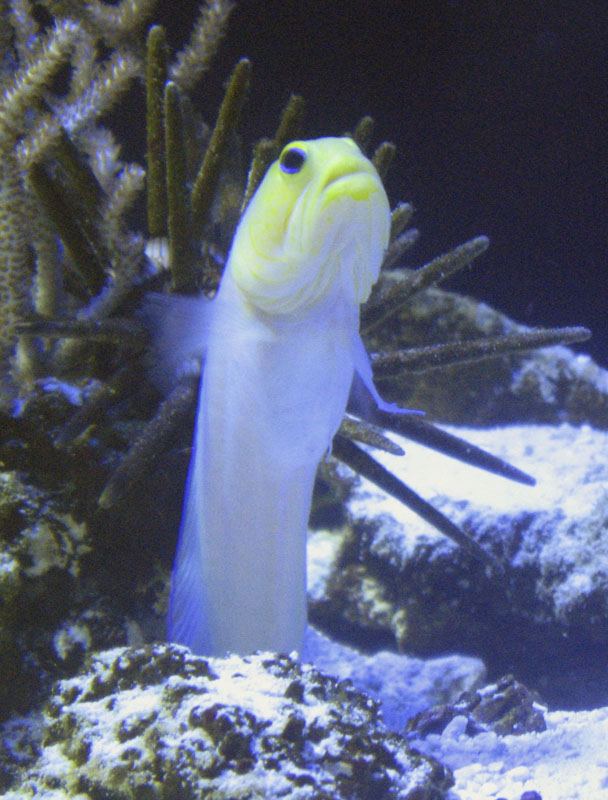 Yellowhead JawfishOpistognathus aurifrons
-
 Blue-spotted JawfishOpistognathus rosenblatti
-
 Bartail JawfishOpistognathus cuvierii
-
 Dusky JawfishOpistognathus whitehursti
Compare
Questions and answers
What is the scientific name of the Ghost Jawfish?
The scientific name of the Ghost Jawfish is Lonchopisthus lemur. Written with its author, the full name is Lonchopisthus lemur (Myers, 1935).
Which family does the Ghost Jawfish belong to?
Lonchopisthus lemur belongs to the family Opistognathidae, in the order Perciformes and the class Teleostei.
Where is the Ghost Jawfish found?
Checklists and occurrence records place Lonchopisthus lemur in 4 countries: Brazil, Colombia, Honduras and Venezuela.
What is the conservation status of the Ghost Jawfish?
The IUCN Red List category recorded for Lonchopisthus lemur is Least Concern (LC).
What other names does the Ghost Jawfish have?
Lonchopisthus lemur is also known in English as Palemouth Jawfish.
Is a ghost fish a real fish?
The Ghost Jawfish is a recorded fish species in the family Opistognathidae.[25]
Sources
Passages the profile rests on
- The species has an elongated, compressed body that tapers toward the rear. Source passage: “Elongate, compressed, tapering body” — biogeodb.stri.si.edu
- The species has a large, bulbous head and a large eye positioned high on the side of the head. Source passage: “large bulbous head, eye large, high on side of head” — biogeodb.stri.si.edu
- Its mouth opens at the front and extends backward to the rear of the eye. Source passage: “mouth opens at front, large, extends to rear of eye” — biogeodb.stri.si.edu
- The rear end of its upper jaw is concave and has a blunt notch underneath. Source passage: “top jaw with rear end concave, a blunt notch on underside at rear” — biogeodb.stri.si.edu
- Its dorsal and anal fins have long bases. Source passage: “dorsal and anal fins with long bases” — biogeodb.stri.si.edu
- Its dorsal fin has 10–11 spines and 11–12 soft rays. Source passage: “dorsal fin X-XI, 12 (11-12)” — biogeodb.stri.si.edu
- Its anal fin has three spines and 10–12 soft rays. Source passage: “anal fin III, 12 (10-12)” — biogeodb.stri.si.edu
- Its pelvic fins are short, measuring 16–30% of standard length. Source passage: “pelvics short (16-30% of SL)” — biogeodb.stri.si.edu
- Each pelvic fin has one spine and five soft rays, with two stout unbranched outer rays and three weaker branched inner rays. Source passage: “I, 5, outer 2 rays stout and unbranched, inner 3 rays weaker and branched” — biogeodb.stri.si.edu
- The pelvic fin bases are positioned ahead of the pectoral fins. Source passage: “fin base before the pectoral” — biogeodb.stri.si.edu
- Its tail fin is much longer than its head and sharply pointed. Source passage: “tail fin much longer than head, sharply pointed” — biogeodb.stri.si.edu
- Its tail fin has 8–13 branched rays and lacks elongated free central rays. Source passage: “12 (8-13) branched rays, no elongated free central fin rays” — biogeodb.stri.si.edu
- Its body has 26–33 longitudinal scale rows. Source passage: “26-33 longitudinal scale rows along body” — biogeodb.stri.si.edu
- Its cheeks are scaled, while the remainder of its head is scaleless. Source passage: “cheeks scaly, rest of head scaleless” — biogeodb.stri.si.edu
- The species has 12–17 gill rakers on the upper portion and 26–28 on the lower portion. Source passage: “gill rakers 12-17 + 26-28” — biogeodb.stri.si.edu
- Its lateral line extends only along the front half of the body and is positioned high. Source passage: “lateral line on front half of body only, high.” — biogeodb.stri.si.edu
- Preserved specimens are yellow-brown, with dark coloration extending from the snout to the nape. Source passage: “Preserved fish: yellow-brown, snout to nape dark” — biogeodb.stri.si.edu
- Its fins are dark but not black, while its pelvic fins are blackish. Source passage: “fins dark but not black; pelvics blackish” — biogeodb.stri.si.edu
- The membrane connecting the upper and lower jaws at the rear of the mouth is pale. Source passage: “inner membrane connecting top and bottom jaws at rear of mouth pale.” — biogeodb.stri.si.edu
- The species is recorded with a total length of 10.3. Source passage: “Lonchopisthus lemur, Opistognathidae, bathydemersal, 10.3 TL” — fishbase.se
- The species occurs at depths of 64–375 m. Source passage: “Depth range: 64-375 m” — biogeodb.stri.si.edu
- FishBase classifies the species as bathydemersal. Source passage: “Lonchopisthus lemur, Opistognathidae, bathydemersal” — fishbase.se
- The species is associated with soft bottoms consisting of mud, sand, gravel, beaches, estuaries, mangroves, or seagrass. Source passage: “Soft bottom (mud/sand/gravel/beach/estuary/mangrove/seagrass)” — biogeodb.stri.si.edu
- The species is recorded as feeding on mobile benthic crustaceans, including shrimps and crabs. Source passage: “Mobile benthic crustacea (shrimps/crabs)” — biogeodb.stri.si.edu
- FishBase lists the species under the family Opistognathidae. Source passage: “Lonchopisthus lemur, Opistognathidae” — fishbase.se
Data
- Catalogue of Life, 2026-10-16 XR cc by
- Global Biodiversity Information Facility CC BY 4.0
- Wikidata CC0
- GeoNames CC BY 4.0
- Within the Catalogue of Life, this name comes from World Register of Marine Species cc by
References
- Myers, George S. (1935). A new genus of opisthognathid fishes. Smithsonian Miscellaneous Collections, Vol. 91, No. 23. where the name was published
This species in other databases
- Catalogue of Life 3VY8V
- Wikidata Q3270901
- iNaturalist 618804
- WoRMS urn:lsid:marinespecies.org:taxname:281384
- ITIS 645461
Page built on 29 November 2026. See how the catalog is made and all sources and licences.
Cite this page
ScientificNames.org. (2026). Lonchopisthus lemur (Ghost Jawfish). Retrieved November 29, 2026, from https://scientificnames.org/species/lonchopisthus-lemur
“Lonchopisthus lemur (Ghost Jawfish).” ScientificNames.org, 2026, scientificnames.org/species/lonchopisthus-lemur. Accessed 29 Nov. 2026.
ScientificNames.org. “Lonchopisthus lemur (Ghost Jawfish).” Accessed November 29, 2026. https://scientificnames.org/species/lonchopisthus-lemur.
@misc{scientificnames_lonchopisthus_lemur_ghost_jawfish,
  author = {{ScientificNames.org}},
  title = {Lonchopisthus lemur (Ghost Jawfish)},
  year = {2026},
  url = {https://scientificnames.org/species/lonchopisthus-lemur},
  note = {Accessed 2026-11-29}
}