Species · Birds
Dusky Munia Lonchura fuscans
The scientific name of the Dusky Munia is Lonchura fuscans. It is a species of bird in the family Estrildidae (munias), order Passeriformes. The name dates from 1852.
- Scientific name
- Lonchura fuscans (Cassin, 1852)
- Common name
- Dusky Munia
- Genus
- Lonchura
- Family
- Estrildidae (Munias)
- Order
- Passeriformes
- Class
- Aves
- Red List category
- LC Least Concern
- Recorded in
- 3 countries
- Name status
- accepted in the Catalogue of Life

Overview
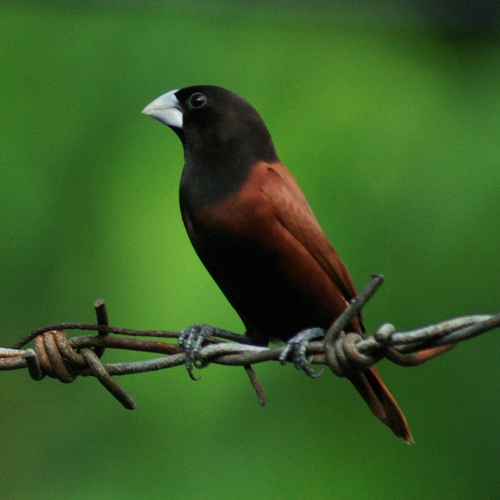
The species is endemic to Borneo and occurs in Brunei, Indonesia, Malaysia, and the Philippines. It has predominantly rich dark-brown plumage, pale-brown streaks on its crown, and a gray ring around its eye.
Written 26 November 2026 from the sources listed below. Each statement was checked against the passage it cites; statements that could not be supported were removed.
Appearance
The Dusky Munia has predominantly rich dark-brown plumage, with crown feathers streaked with pale brown. It has a gray ring around its eye, a black upper mandible, and a blue-gray lower mandible.[1][2][3][4]
Male and female Dusky Munias do not differ in feather pattern. Adult birds measure 10–11 cm in body length and weigh approximately 9.5 grams.[5][6][7]
Habitat
The Dusky Munia is widespread across the lowlands of Borneo and its lower-elevation foothills. It inhabits subtropical and tropical lowland shrubland, forest, and grassland.[8][9][10]
The species occurs in foothills, grasslands, agricultural fields, rice paddy fields, riverbanks, reed-beds, secondary scrub, and cultivated areas. It is found from sea level to elevations of approximately 500 meters.[11][12][13][14]
The species is frequently encountered in grassland, scrubby forest, and weedy forest. Introduced populations occur in the Natuna, Banggi, Cagayan, and Sulu Islands.[15][16]
Diet
The Dusky Munia eats grass seeds, weed seeds, rice grains, and insects.[17][18][19][20]
Behaviour
The species searches for food mainly in vegetation and on the ground. It extracts seeds from overturned clumps of earth and buffalo dung.[21][22]
The Dusky Munia is non-migratory. Individuals fly in flocks while communicating through gentle whistles.[23][24]
During flight, the species gives a low-toned 'teck teck' call. On the ground or in trees, it produces shrill 'pee pee' calls, high-pitched peeps, or thin chirrups.[25][26]
Reproduction and life cycle
Female Dusky Munias construct nests using collected pieces of grass. They sometimes take over abandoned nests built by chestnut munias.[27][28]
The species prefers dark, elevated nesting locations or small crevices. It nests in caves, riverbank holes, bushes, dense trees, hollow trees, and roots of fallen trees.[29][30]
Completed nests are used for roosting, breeding, and incubation. Females typically lay clutches containing four to six eggs, although clutches can contain as many as eight eggs.[31][32][33]
Egg incubation takes approximately 13–14 days, depending on clutch size. Young Dusky Munias fledge after spending approximately three weeks in the nest.[34][35]
Conservation
The Dusky Munia is classified as Least Concern, and its population trend is stable. The species has an extremely large range, while the number of mature individuals is unknown.[36][37][38][39]
Classification of the Dusky Munia
| Kingdom | Animalia |
|---|---|
| Phylum | Chordata |
| Subphylum | Vertebrata |
| Infraphylum | Gnathostomata |
| Parvphylum | Osteichthyes |
| Megaclass | Tetrapoda |
| Class | Aves (Bird) |
| Order | Passeriformes (Passerine) |
| Family | Estrildidae (Munias) |
| Genus | Lonchura (Mannikins) |
| Species | Lonchura fuscans (Cassin, 1852) |
Where the Dusky Munia is found
Checklists and occurrence records place Lonchura fuscans in 3 countries. GBIF holds 10,427 georeferenced records of it.
Countries
Regions and cities with the most records
- Sabah, Malaysia 7,805
- Sarawak, Malaysia 1,525
- Sandakan, Malaysia 1,486
- Kota Kinabalu, Malaysia 818
- Donggongon, Malaysia 809
- Putatan, Malaysia 803
- Petagas, Malaysia 800
- Kinarut, Malaysia 733
- Ranau, Malaysia 667
- Tambunan, Malaysia 317
- Kuching, Malaysia 275
- Tebedu, Malaysia 167
- Siburan, Malaysia 108
- Sengkurong, Brunei 90
- Sibu, Malaysia 87
- Bandar Seri Begawan, Brunei 85
- Lahad Datu, Malaysia 78
- Bau, Malaysia 74
- Beaufort, Malaysia 74
- Palangkaraya, Indonesia 70
- Temburong, Brunei 66
- Sibu Jaya, Malaysia 63
- Limbang, Malaysia 55
- Mentiri, Brunei 55
- Keningau, Malaysia 52
- Belait, Brunei 51
- Serasa, Brunei 44
- Tawau, Malaysia 44
- Tutong, Brunei 43
- Balikpapan, Indonesia 42
- Papar, Malaysia 42
- Kuala Belait, Brunei 29
- Kudat, Malaysia 29
- Lundu, Malaysia 28
- Miri, Malaysia 24
- Kapit, Malaysia 21
A number beside a place is its count of GBIF occurrence records. A place without a number comes from a checklist alone. Records show where a species has been observed or collected, which can include escapes and vagrants.
Common names
English
- Dusky Munia
Names in 31 other languages
- Arabic
- مونيا أغبس
- Catalan
- maniquí fosc
- Chinese
- 暗栗文鳥, 暗栗文鸟, 暗栗色文鳥
- Croatian
- borneanska amadina
- Czech
- panenka bornejská
- Danish
- Borneo Bronzefinke
- Dutch
- Borneobronzemannetje
- Esperanto
- bornea estrildo
- Estonian
- kalimantani amadiin
- Finnish
- borneonmanikki
- French
- Capucin sombre
- German
- Borneo-Bronzemännchen, Borneobronzemännchen
- Hungarian
- borneói bronzpinty
- Indonesian
- Bondol kalimantan
- Italian
- Munia fosca, Passero del Borneo
- Japanese
- コゲチャキンパラ
- Lithuanian
- bornėjinė munija
- Malay
- Burung Bondol Kalimantan
- Malayalam
- ഡസ്കി മുനിയ
- Norwegian
- kullnonne
- Persian
- نوکنقرهای تیره
- Polish
- mniszka ciemna
- Portuguese
- capuchinho-escuro
- Russian
- Коричневая амадина, Коричневая муния
- Serbian
- Tamni galebić
- Slovak
- mníška tmavá
- Spanish
- Capuchino Sombrio, Capuchino sombrío
- Swedish
- borneomunia
- Turkish
- Karaca Munya
- Ukrainian
- мунія борнейська
- Welsh
- Manicin Tywyll
Synonyms
2 other scientific names have been used for this species and are now treated as synonyms of Lonchura fuscans.
- Spermestes fuscans Cassin, J, 1852
- Uroloncha fuscans
Related species
-
 Scaly-breasted MuniaLonchura punctulata
-
 White-rumped MuniaLonchura striata
-
 Chestnut MuniaLonchura atricapilla
- Chestnut-breasted MannikinLonchura castaneothorax
-
 Tricoloured MuniaLonchura malacca
-
 White-headed MuniaLonchura maja
-
 Javan MuniaLonchura leucogastroides
-
 Black-throated MuniaLonchura kelaarti
Compare
Questions and answers
What is the scientific name of the Dusky Munia?
The scientific name of the Dusky Munia is Lonchura fuscans. Written with its author, the full name is Lonchura fuscans (Cassin, 1852).
Which family does the Dusky Munia belong to?
Lonchura fuscans belongs to the family Estrildidae, in the order Passeriformes and the class Aves.
Where is the Dusky Munia found?
Checklists and occurrence records place Lonchura fuscans in 3 countries: Malaysia, Indonesia and Brunei.
What is the conservation status of the Dusky Munia?
The IUCN Red List category recorded for Lonchura fuscans is Least Concern (LC).
Sources
Passages the profile rests on
- The Dusky Munia has predominantly rich dark-brown plumage. Source passage: “Their plumage is a rich dark brown” — English Wikipedia
- The crown feathers are streaked with pale brown. Source passage: “with feathers of its crown streaked pale brown” — English Wikipedia
- The species has a gray ring around its eye. Source passage: “It has a gray ring around its eye” — English Wikipedia
- Its upper mandible is black and its lower mandible is blue-gray. Source passage: “with a bill that has a black upper mandible, and a blue-gray lower mandible.” — English Wikipedia
- Male and female Dusky Munias do not differ in feather pattern. Source passage: “There is no distinction in feather pattern between male or female.” — English Wikipedia
- Adult Dusky Munias measure 10–11 cm in body length. Source passage: “adults growing to reach a body length of 10 to 11 centimeters long” — English Wikipedia
- The species weighs approximately 9.5 grams. Source passage: “and weighing in at 9.5 grams.” — English Wikipedia
- The species is widespread across the lowlands of Borneo and its lower-elevation foothills. Source passage: “widespread across Borneo's lowlands and lower-elevation foothills.” — ebird.org
- The Dusky Munia inhabits subtropical and tropical lowland shrubland. Source passage: “It is found in subtropical/ tropical lowland shrubland, forest and grassland habitat.” — English Wikipedia
- The species occurs in subtropical and tropical lowland forest and grassland. Source passage: “It is found in subtropical/ tropical lowland shrubland, forest and grassland habitat.” — English Wikipedia
- The species has been recorded in Borneo's foothills, grasslands, and agricultural fields. Source passage: “with sightings being recorded in the foothills of the island Borneo, grasslands, and agricultural fields” — English Wikipedia
- Rice paddy fields are among the agricultural habitats used by the species. Source passage: “agricultural fields such as rice paddy fields.” — English Wikipedia
- The Dusky Munia inhabits riverbanks, reed-beds, secondary scrub, and cultivated areas. Source passage: “They also tend to reside along riverbanks, reed-beds, secondary scrub and cultivated areas” — English Wikipedia
- The species occurs from sea level to elevations of approximately 500 meters. Source passage: “from sea-level all the way up to 500 meters above ground.” — English Wikipedia
- The species is frequently encountered in grassland, scrubby forest, and weedy forest. Source passage: “Frequently encountered in grassland, scrubby or weedy forest” — ebird.org
- Introduced populations occur in the Natuna, Banggi, Cagayan, and Sulu Islands. Source passage: “It is also an introduced species in Natuna, Banggi, Cagayan and Sulu Islands.” — English Wikipedia
- The Dusky Munia eats grass seeds. Source passage: “Its diet consists of grass seeds, seeds of weeds, rice grains, and insects.” — English Wikipedia
- The species consumes weed seeds. Source passage: “Its diet consists of grass seeds, seeds of weeds, rice grains, and insects.” — English Wikipedia
- Rice grains are part of the species' diet. Source passage: “Its diet consists of grass seeds, seeds of weeds, rice grains, and insects.” — English Wikipedia
- The Dusky Munia consumes insects. Source passage: “Its diet consists of grass seeds, seeds of weeds, rice grains, and insects.” — English Wikipedia
- The species searches for food mainly in vegetation and on the ground. Source passage: “When searching for food, they mainly look through vegetation and on the ground.” — English Wikipedia
- Dusky Munias extract seeds from overturned clumps of earth and buffalo dung. Source passage: “They also carefully pick out seeds from overturned clumps of earth and buffalo dung” — English Wikipedia
- The species is non-migratory. Source passage: “They are not migrants” — English Wikipedia
- Dusky Munias fly in flocks while communicating through gentle whistles. Source passage: “They fly in flocks while communicating with gentle whistles.” — English Wikipedia
- During flight, the species gives a low-toned 'teck teck' call. Source passage: “During flight, it calls out with a low-toned "teck teck".” — English Wikipedia
- When on the ground or in trees, the species produces shrill 'pee pee' calls, high-pitched peeps, or thin chirrups. Source passage: “While on the ground or in a tree, it can call out a shrill "pee pee", a high-pitched "peep" or a thin "chirrup".” — English Wikipedia
- Female Dusky Munias construct nests using collected pieces of grass. Source passage: “The females in the species build their nests out of bits of collected grass” — English Wikipedia
- Females sometimes take over abandoned nests built by chestnut munias. Source passage: “or take over abandoned nests built by smaller birds (chestnut munia).” — English Wikipedia
- The species prefers dark, elevated nesting locations or small crevices. Source passage: “preferred conditions are dark, elevated spaces or small crevices.” — English Wikipedia
- Dusky Munias nest in caves, riverbank holes, bushes, dense trees, hollow trees, and roots of fallen trees. Source passage: “Many nest in caves, holes in river banks, bushes, dense trees, hollow trees, and roots of fallen trees.” — English Wikipedia
- The species uses completed nests for roosting, breeding, and incubation. Source passage: “Once the nest has been fully constructed, it is used for roosting, breeding and incubating.” — English Wikipedia
- Female Dusky Munias typically lay clutches containing four to six eggs. Source passage: “After breeding, the female lays clutches of an average of 4-6 eggs.” — English Wikipedia
- Clutches can contain as many as eight eggs. Source passage: “Larger clutches can get up to 8 eggs.” — English Wikipedia
- Egg incubation takes approximately 13–14 days, depending on clutch size. Source passage: “The average incubation period for a clutch of eggs is 13-14 days, depending on size.” — English Wikipedia
- Young Dusky Munias fledge after spending approximately three weeks in the nest. Source passage: “Once hatched, the young fledge after three weeks in the nest.” — English Wikipedia
- The Dusky Munia is classified as Least Concern. Source passage: “The status of the species is evaluated as Least Concern.” — English Wikipedia
- The population trend of the species is stable. Source passage: “the population growth is stable” — English Wikipedia
- The number of mature individuals in the species is unknown. Source passage: “Number of mature individuals Unknown” — datazone.birdlife.org
- The species has an extremely large range. Source passage: “This species has an extremely large range” — datazone.birdlife.org
Data
- Catalogue of Life, 2026-10-16 XR cc by
- Global Biodiversity Information Facility CC BY 4.0
- Wikidata CC0
- GeoNames CC BY 4.0
- Wikimedia Commons per image; credit shown with each image
- Within the Catalogue of Life, this name comes from The Integrated Taxonomic Information System cc0
References
- Gill, Frank, & and Minturn Wright. (2006). Birds of the World: Recommended English Names.
This species in other databases
Page built on 27 November 2026. See how the catalog is made and all sources and licences.
Cite this page
ScientificNames.org. (2026). Lonchura fuscans (Dusky Munia). Retrieved November 27, 2026, from https://scientificnames.org/species/lonchura-fuscans
“Lonchura fuscans (Dusky Munia).” ScientificNames.org, 2026, scientificnames.org/species/lonchura-fuscans. Accessed 27 Nov. 2026.
ScientificNames.org. “Lonchura fuscans (Dusky Munia).” Accessed November 27, 2026. https://scientificnames.org/species/lonchura-fuscans.
@misc{scientificnames_lonchura_fuscans_dusky_munia,
  author = {{ScientificNames.org}},
  title = {Lonchura fuscans (Dusky Munia)},
  year = {2026},
  url = {https://scientificnames.org/species/lonchura-fuscans},
  note = {Accessed 2026-11-27}
}