Species · Insects
Longitarsus obliteratus
Longitarsus obliteratus has no English name on record in the checklists used here. It is a species of insect in the family Chrysomelidae (leaf beetle), order Coleoptera. The name dates from 1847.
- Scientific name
- Longitarsus obliteratus (Rosenhauer, 1847)
- Genus
- Longitarsus
- Family
- Chrysomelidae (Leaf Beetle)
- Order
- Coleoptera
- Class
- Insecta
- Recorded in
- 15 countries
- Name status
- accepted in the Catalogue of Life

Overview
The species occurs in Europe, including Southern England and North Poland, and in Asia Minor, the Caucasus, the Middle East, Afghanistan and Iran. It has green coloration, orange legs and antennae, and males are smaller than females.
Written 27 November 2026 from the sources listed below. Each statement was checked against the passage it cites; statements that could not be supported were removed.
Appearance
The species has green coloration, with orange legs and antennae.[1][2]
Male individuals are smaller than female individuals.[3]
Classification of Longitarsus obliteratus
| Kingdom | Animalia |
|---|---|
| Phylum | Arthropoda |
| Subphylum | Hexapoda |
| Class | Insecta (Insect) |
| Order | Coleoptera (Beetle) |
| Suborder | Polyphaga |
| Series | Cucujiformia |
| Superfamily | Chrysomeloidea |
| Family | Chrysomelidae (Leaf Beetle) |
| Subfamily | Galerucinae |
| Tribe | Alticini |
| Genus | Longitarsus |
| Species | Longitarsus obliteratus (Rosenhauer, 1847) |
This name was added to the Catalogue of Life from a contributing dataset by automated merging and has not yet been reviewed by its editors.
Where Longitarsus obliteratus is found
Checklists and occurrence records place Longitarsus obliteratus in 15 countries. GBIF holds 576 georeferenced records of it.
Countries
- Albania 8
- Austria 41
- Croatia 6
- France 37
- Germany 134
- Greece 5
- Hungary 15
- Italy 22
- Luxembourg 5
- Poland 108
- Russia 16
- Slovenia 32
- Switzerland 11
- Ukraine 28
- United Kingdom 108
Regions and cities with the most records
- England, United Kingdom 99
- Thuringia, Germany 29
- Baden-Wurttemberg, Germany 26
- Rheinland-Pfalz, Germany 25
- Bavaria, Germany 24
- Horley, United Kingdom 17
- Redhill, United Kingdom 17
- Reigate, United Kingdom 17
- Lower Austria, Austria 16
- Saxony-Anhalt, Germany 16
- Ternopil, Ukraine 16
- Chatham, United Kingdom 15
- Gillingham, United Kingdom 15
- Halberstadt, Germany 15
- Maidstone, United Kingdom 15
- Baden, Austria 13
- Chuvash Republic, Russia 12
- Crawley, United Kingdom 12
- Blankenburg, Germany 11
- Mayen, Germany 11
- Apolda, Germany 10
- Chernivtsi, Ukraine 10
- Folkestone, United Kingdom 10
- Horsham, United Kingdom 10
- Provence-Alpes-Côte d'Azur, France 10
- Ljubljana, Slovenia 9
- Upper Austria, Austria 9
- Centre-Val de Loire, France 8
- Cuneo, Italy 8
- Emmendingen, Germany 8
- Freiburg, Germany 8
- Saalfeld, Germany 8
- Trentino-Alto Adige, Italy 8
- Wernigerode, Germany 8
- Mössingen, Germany 7
- Nagykanizsa, Hungary 7
A number beside a place is its count of GBIF occurrence records. A place without a number comes from a checklist alone. Records show where a species has been observed or collected, which can include escapes and vagrants.
Common names
Names in 2 other languages
- Lithuanian
- Čiobrelinė pėdūnė
- Russian
- Прыгун губоцветный чёрный
Synonyms
One other scientific name has been used for this species and is now treated as a synonym of Longitarsus obliteratus.
- Teinodactyla obliterata Rosenhauer, 1847
Related species
-
 Tansy Ragwort Flea BeetleLongitarsus jacobaeae
-
 Longitarsus exsoletus
-
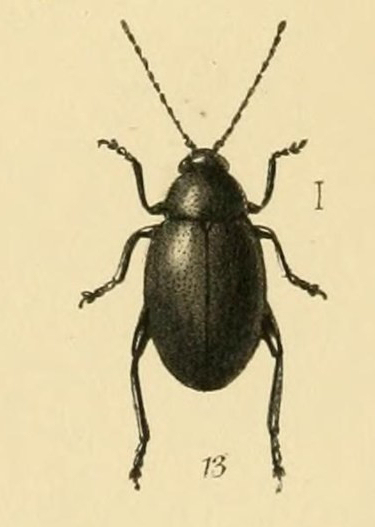 Bladderwort Flea BeetleLongitarsus nigerrimus
-
 Longitarsus pratensis
-
 Longitarsus gracilis
-
 Longitarsus luridus
- Longitarsus pellucidus
- Longitarsus linnaei
Compare
Questions and answers
Where does Longitarsus obliteratus occur?
It occurs in Europe, including Southern England and North Poland, as well as Asia Minor, the Caucasus, the Middle East, Afghanistan and Iran.[4][5]
What colour is Longitarsus obliteratus?
It has green coloration, orange legs and orange antennae.[1][2]
Are males and females the same size?
No. Male individuals are smaller than female individuals.[3]
Sources
Passages the profile rests on
- The species has a green coloration. Source passage: “The species is green coloured, and has orange legs and antennae.” — English Wikipedia
- The species has orange legs and antennae. Source passage: “The species is green coloured, and has orange legs and antennae.” — English Wikipedia
- Male individuals are smaller than female individuals. Source passage: “The males are smaller than the females.” — English Wikipedia
- The species occurs in Europe, including Southern England and North Poland. Source passage: “The species can be found in Europe, including Southern England and North Poland.” — English Wikipedia
- The species occurs in Asia Minor, the Caucasus, the Middle East, Afghanistan and Iran. Source passage: “It can also be found in Asia, including Asia Minor, the Caucasus, the Middle East, Afghanistan and Iran.” — English Wikipedia
Data
- Catalogue of Life, 2026-10-16 XR cc by
- Global Biodiversity Information Facility CC BY 4.0
- Wikidata CC0
- GeoNames CC BY 4.0
- Wikimedia Commons per image; credit shown with each image
- Within the Catalogue of Life, this name comes from TAXREF cc by
This species in other databases
Page built on 27 November 2026. See how the catalog is made and all sources and licences.
Cite this page
ScientificNames.org. (2026). Longitarsus obliteratus. Retrieved November 27, 2026, from https://scientificnames.org/species/longitarsus-obliteratus
“Longitarsus obliteratus.” ScientificNames.org, 2026, scientificnames.org/species/longitarsus-obliteratus. Accessed 27 Nov. 2026.
ScientificNames.org. “Longitarsus obliteratus.” Accessed November 27, 2026. https://scientificnames.org/species/longitarsus-obliteratus.
@misc{scientificnames_longitarsus_obliteratus,
  author = {{ScientificNames.org}},
  title = {Longitarsus obliteratus},
  year = {2026},
  url = {https://scientificnames.org/species/longitarsus-obliteratus},
  note = {Accessed 2026-11-27}
}