Species · Reptiles
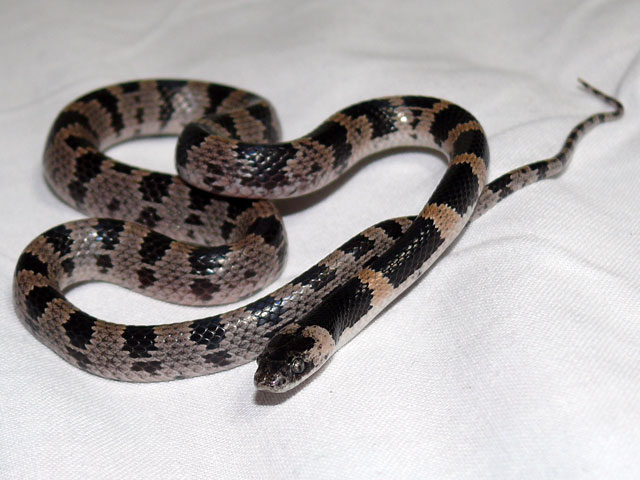
Oriental Odd-tooth Snake Lycodon orientalis
The scientific name of the Oriental Odd-tooth Snake is Lycodon orientalis. It is a species of reptile in the family Colubridae (colubrid), order Squamata. The name dates from 1880.
- Scientific name
- Lycodon orientalis (Hilgendorf, 1880)
- Common name
- Oriental Odd-tooth Snake
- Genus
- Lycodon
- Family
- Colubridae (Colubrid)
- Order
- Squamata
- Class
- Reptilia
- Red List category
- LC Least Concern
- Recorded in
- 1 country
- Name status
- accepted in the Catalogue of Life
Overview
The Oriental odd-tooth snake (Lycodon orientalis), sometimes called the Japanese odd-tooth snake, is a species endemic to Japan, belonging to the family Colubridae. It is found in Hokkaido, Honshu, Shikoku, Kyushu, the Goto Islands, Iki Island, Izu Ōshima, the Oki Islands, Sado Island, Tanegashima, and Yakushima. It has also been reported in Shiashkotan, one of the Chishima Islands.
Classification of the Oriental Odd-tooth Snake
| Kingdom | Animalia |
|---|---|
| Phylum | Chordata |
| Subphylum | Vertebrata |
| Infraphylum | Gnathostomata |
| Parvphylum | Osteichthyes |
| Megaclass | Tetrapoda |
| Class | Reptilia (Reptile) |
| Order | Squamata (Snakes) |
| Suborder | Serpentes (Snakes) |
| Infraorder | Alethinophidia |
| Family | Colubridae (Colubrid) |
| Subfamily | Colubrinae |
| Genus | Lycodon (Oriental Wolf Snakes) |
| Species | Lycodon orientalis (Hilgendorf, 1880) |
Where the Oriental Odd-tooth Snake is found
Checklists and occurrence records place Lycodon orientalis in 1 country across Asia. GBIF holds 389 georeferenced records of it.
Countries
Regions and cities with the most records
- Gifu, Japan 16
- Kanagawa, Japan 15
- Shizuoka, Japan 14
- Hachiōji, Japan 12
- Akiruno, Japan 11
- Hino, Japan 11
- Aihara, Japan 10
- Fussa, Japan 10
- Hamura, Japan 10
- Tokyo, Japan 10
- Akishima, Japan 9
- Fujisawa, Japan 9
- Gifu, Japan 9
- Minamirinkan, Japan 9
- Hiroshima, Japan 8
- Inuyama, Japan 8
- Kamakura, Japan 8
- Kunitachi, Japan 8
- Musashimurayama, Japan 8
- Sagamihara, Japan 8
- Tachikawa, Japan 8
- Yamato, Japan 8
- Yokota, Japan 8
- Zama, Japan 8
- Zushi, Japan 8
- Ōme, Japan 8
- Atsugi, Japan 7
- Hannō, Japan 7
- Kakamigahara, Japan 7
- Kani, Japan 7
- Kōnan, Japan 7
- Machida, Japan 7
- Sekimachi, Japan 7
- Tama, Japan 7
- Yokohama, Japan 7
- Ayase, Japan 6
Range as the checklists state it
Japan (Kyushu, Honshu). One find on the Shiashkotan Island in Russia (fide KHALIKOV, pers. comm.)
A number beside a place is its count of GBIF occurrence records. A place without a number comes from a checklist alone. Records show where a species has been observed or collected, which can include escapes and vagrants.
Common names
English
- Oriental Odd-tooth Snake
Names in 5 other languages
- Chinese
- 東部狼齒蛇
- Danish
- Østasiatisk Ulvesnog
- Japanese
- シロマダラ
- Korean
- 일본동부구렁이
- Russian
- Восточный динодон, Японский динодон
Synonyms
3 other scientific names have been used for this species and are now treated as synonyms of Lycodon orientalis.
- Dinodon orientale (Hilgendorf, 1880)
- Ophites japonicus Günther, 1880
- Ophites orientalis Hilgendorf, 1880
Related species
-
 Common Wolf SnakeLycodon capucinus
-
 Indian Wolf SnakeLycodon aulicus
-
 White-banded Wolf SnakeLycodon septentrionalis
-
 Yellow-spotted Wolf SnakeLycodon flavomaculatus
- Red-banded SnakeLycodon rufozonatus
-
 Travancore Wolf SnakeLycodon travancoricus
-
 Banded Wolf SnakeLycodon fasciatus
-
 Barred Wolf SnakeLycodon striatus
Compare
Questions and answers
What is the scientific name of the Oriental Odd-tooth Snake?
The scientific name of the Oriental Odd-tooth Snake is Lycodon orientalis. Written with its author, the full name is Lycodon orientalis (Hilgendorf, 1880).
Which family does the Oriental Odd-tooth Snake belong to?
Lycodon orientalis belongs to the family Colubridae, in the order Squamata and the class Reptilia.
Where is the Oriental Odd-tooth Snake found?
Checklists and occurrence records place Lycodon orientalis in 1 country: Japan.
What is the conservation status of the Oriental Odd-tooth Snake?
The IUCN Red List category recorded for Lycodon orientalis is Least Concern (LC).
Sources
Data
- Catalogue of Life, 2026-10-16 XR cc by
- Global Biodiversity Information Facility CC BY 4.0
- Wikidata CC0
- English Wikipedia CC BY-SA 4.0
- GeoNames CC BY 4.0
- Wikimedia Commons per image; credit shown with each image
- Within the Catalogue of Life, this name comes from The Reptile Database cc by
References
- Hilgendorf, F. (1880). Bemerkungen über die von ihm in Japan gesammelten Schlangen nebst Beschreibungen zweier neuer Schlangenarten. Sitzungsber. Ges. Naturf. Freunde Berlin 1880 (8): 111-121.
- Günther, C. A. L. G. (1880). Description of Ophites japonicus, a new snake from Japan. Ann. Mag. Nat. Hist. (5) 6: 462.
- Boulenger, G. A. (1893). Catalogue of the snakes in the British Museum (Nat. Hist.) I. London (Taylor & Francis), 448 Pp.
- Stejneger, LEONHARD H. (1907). Herpetology of Japan and adjacent territory. Bull. US Natl. Mus. 58: Xx, 1-577.
- Barbour, & Thomas. (1909). Notes on Amphibia and Reptilia from Eastern Asia. Proc. New England Zool. Club 4: 53-78, 2 Plates.
- Maki, M. (1931). Monograph of the Snakes of Japan. Dai-Ichi Shobo, Tokyo. (1), 7, 240 Pages (Expanded Edition 1933).
- Mori, M. (1982). Japans Schlangen, Vols. 1-3 (80, 102, 123 pp.). Tokyo (Igaku-Shoin Ltd.) [Bilingual Edition in German and Japanese].
- Toriba, & Michihisa. (1991). Karyotypes of two colubrine snakes, Entechinus semicarinatus and Dinodon orientalis. The Snake 23: 1-5.
- Szczerbak, N. N. (2003). Guide to the Reptiles of the Eastern Palearctic. Krieger, Malabar, FL, 260 Pp.
- Goris, R. C., & Maeda, N. (2004). Guide to the Amphibians and Reptiles of Japan. Krieger, Malabar, 285 Pp.
- Tokuda, & Tatsuhiro. (2010). Records of Dinodon orientale confirmed by in Hokkaido as of 2009. Bulletin of the Herpetological Society of Japan 2010 (1): 32-35.
- Siler, C. D., Oliveros, C. H., Santanen, A., & Brown, R. M. (2013). Multilocus phylogeny reveals unexpected diversification patterns in Asian wolf snakes (genus Lycodon). Zoologica Scripta 42: 262–277.
- Wallach, Van; Kenneth L. Williams, Jeff Boundy. (2014). Snakes of the World: A Catalogue of Living and Extinct Species. [type catalogue]. Taylor and Francis, CRC Press, 1237 Pp.
- Yamasaki, Yohei and Yoshihisa Mori. (2015). Natural history of the Oriental Odd-tooth Snake (Dinodon orientale) in Yamanashi, Japan: Seasonal activity and body condition associated with sex. Current Herpetology 34 (1): 60-66.
- Janssen HY, Pham CT, Ngo HT, Le MD, Nguyen TQ, & Ziegler T. (2019). A new species of Lycodon Boie, 1826 (Serpentes, Colubridae) from northern Vietnam. ZooKeys 875: 1-29.
- Hasegawa, & Masami and Akira Mori. (2023). Giant Snakes and Tiny Seabirds on a Small Japanese Island. In: Lillywhite & Martins, eds., Islands and snakes, vol. II. Oxford University Press, P. 100 Ff.
- Kubo, G., & Fukuyama, I. (2024). First record of amphibian prey of the Oriental Odd-Tooth Snake, Lycodon orientalis (Hilgendorf, 1880), in Japan. Herpetology Notes 17: 603-605.
- Sawada, K., Watanabe, Y., Kobayashi, K., Magome, Y., Abe, H. and Kamijo, T. (2025). , Multidimensional niche partitioning allows coexistence of multiple snake species. J Zool, 325: 323-333.
This species in other databases
Page built on 24 November 2026. See how the catalog is made and all sources and licences.
Cite this page
ScientificNames.org. (2026). Lycodon orientalis (Oriental Odd-tooth Snake). Retrieved November 24, 2026, from https://scientificnames.org/species/lycodon-orientalis
“Lycodon orientalis (Oriental Odd-tooth Snake).” ScientificNames.org, 2026, scientificnames.org/species/lycodon-orientalis. Accessed 24 Nov. 2026.
ScientificNames.org. “Lycodon orientalis (Oriental Odd-tooth Snake).” Accessed November 24, 2026. https://scientificnames.org/species/lycodon-orientalis.
@misc{scientificnames_lycodon_orientalis_oriental_odd_tooth_snake,
  author = {{ScientificNames.org}},
  title = {Lycodon orientalis (Oriental Odd-tooth Snake)},
  year = {2026},
  url = {https://scientificnames.org/species/lycodon-orientalis},
  note = {Accessed 2026-11-24}
}