Species · Insects
Spanish Fly Lytta vesicatoria
The scientific name of the Spanish Fly is Lytta vesicatoria. It is a species of insect in the family Meloidae (blister beetle), order Coleoptera. The name dates from 1758.
- Scientific name
- Lytta vesicatoria (Linnaeus, 1758)
- Common name
- Spanish Fly
- Genus
- Lytta
- Family
- Meloidae (Blister Beetle)
- Order
- Coleoptera
- Class
- Insecta
- Recorded in
- 31 countries
- Name status
- accepted in the Catalogue of Life
Overview
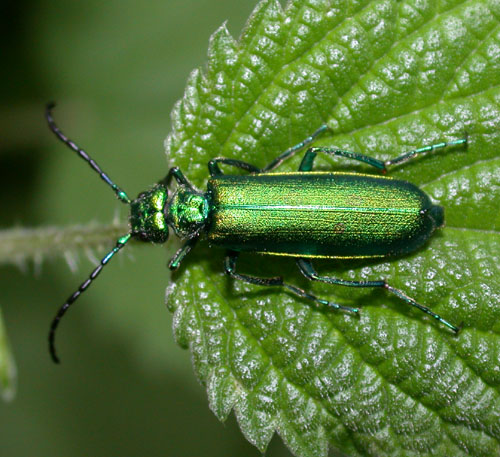
The species occurs across Eurasia, with its distribution concentrated mainly in southern Europe and additional records from southern Great Britain and Poland. Adult beetles have a slender, soft-bodied appearance and metallic, iridescent golden-green coloration.
Written 26 November 2026 from the sources listed below. Each statement was checked against the passage it cites; statements that could not be supported were removed.
Appearance
Adult beetles have a slender, soft-bodied appearance with metallic, iridescent golden-green coloration. The species has emerald-green coloration.[1][2]
Adult beetles measure approximately 20 mm in length and 5 mm in width.[3]
Habitat
Adult beetles inhabit woody plants on which they feed. Females deposit their eggs on the ground near the nests of solitary bees that nest underground.[4][5]
Diet
Adult beetles primarily consume the leaves of ash, lilac, Amur privet, honeysuckle, and white willow. Plum, rose, and elm are occasional food plants.[6][7]
The larval stages consume bee larvae and food stored in solitary bee nests.[8]
Behaviour
Newly hatched larvae actively climb flowering plants while waiting for solitary bees. First-instar larvae attach themselves to solitary bees using three claws on their legs, and the bees transport them into their nests.[9][10][11]
Adult beetles aggregate conspicuously in exposed locations, a pattern associated with aposematic coloration.[12]
Reproduction and life cycle
Females lay fertilized eggs on the ground close to ground-nesting solitary bee nests. Larval development involves hypermetamorphosis, with active early larvae transforming into a different larval form during subsequent instars.[13][14]
Males synthesize cantharidin, while females acquire the compound from males during mating through the spermatophore. This transfer may function as a nuptial gift that increases the reproductive fitness of males.[15][16]
Uses
The species has historically been processed into traditional apothecary preparations known as cantharides. Cantharidin obtained from the beetle was historically used as an exfoliating agent, an anti-rheumatic drug, and an aphrodisiac.[17][18]
The beetle has traditionally been administered as a sexual stimulant to male livestock to facilitate breeding.[19]
Beetle-derived cantharidin has been incorporated into certain North African ras el hanout spice blends. In Morocco and other parts of North Africa, green metallic beetles believed to be this species were occasionally included as minor ingredients in ras el hanout.[20][21]
The sale of beetles believed to be this species in Moroccan spice markets was prohibited during the 1990s.[22]
Cantharidin is currently used primarily as a topical treatment for warts and molluscum contagiosum.[23]
Classification of the Spanish Fly
| Kingdom | Animalia |
|---|---|
| Phylum | Arthropoda |
| Subphylum | Hexapoda |
| Class | Insecta (Insect) |
| Order | Coleoptera (Beetle) |
| Suborder | Polyphaga |
| Series | Cucujiformia |
| Superfamily | Tenebrionoidea |
| Family | Meloidae (Blister Beetle) |
| Subfamily | Meloinae |
| Tribe | Lyttini |
| Genus | Lytta |
| Species | Lytta vesicatoria (Linnaeus, 1758) |
This name was added to the Catalogue of Life from a contributing dataset by automated merging and has not yet been reviewed by its editors.
Where the Spanish Fly is found
Checklists and occurrence records place Lytta vesicatoria in 31 countries across Asia. GBIF holds 4,280 georeferenced records of it.
Countries
- Austria 147
- Azerbaijan 5
- Belarus 10
- Bulgaria 16
- Croatia 16
- Czechia 32
- Denmark 23
- France 595
- Germany 423
- Hungary 42
- Italy 259
- Kazakhstan 29
- Kosovo 5
- Kyrgyzstan 4
- Latvia 4
- Lithuania 16
- Moldova 5
- Montenegro 3
- Poland 44
- Portugal 163
- Romania 20
- Russia 382
- Serbia 59
- Slovakia 6
- Spain 469
- Sweden 176
- Switzerland 1,069
- The Netherlands 39
- Turkey 4
- Ukraine 155
- United Kingdom 60
Regions and cities with the most records
- Valais, Switzerland 654
- Sierre, Switzerland 271
- Sitten, Switzerland 241
- Martigny-Ville, Switzerland 205
- Provence-Alpes-Côte d'Azur, France 189
- Madrid, Spain 145
- Monthey, Switzerland 144
- Ticino, Switzerland 121
- Brandenburg, Germany 92
- Occitanie, France 87
- Skåne, Sweden 84
- Saxony, Germany 81
- Collado-Villalba, Spain 80
- Centre-Val de Loire, France 75
- Galapagar, Spain 75
- Lower Austria, Austria 63
- Lugano, Switzerland 62
- Basque Country, Spain 60
- Varese, Italy 60
- Kalmar, Sweden 59
- Galicia, Spain 57
- El Escorial, Spain 56
- Malnate, Italy 56
- San Lorenzo de El Escorial, Spain 56
- England, United Kingdom 55
- Locarno, Switzerland 55
- Gasteiz / Vitoria, Spain 54
- Rheinland-Pfalz, Germany 54
- Bellinzona, Switzerland 53
- Saxony-Anhalt, Germany 51
- Kalmar, Sweden 50
- Tradate, Italy 50
- Como, Italy 47
- Markkleeberg, Germany 47
- Lazio, Italy 45
- Sremska Mitrovica, Serbia 45
Range as the checklists state it
Europe & Northern Asia (excluding China)
Southern Asia
A number beside a place is its count of GBIF occurrence records. A place without a number comes from a checklist alone. Records show where a species has been observed or collected, which can include escapes and vagrants.
Common names
English
- Spanish Fly
- Lytta Spanishfly
Names in 19 other languages
- Asturian
- cantárida
- Basque
- Errauli
- Chinese
- 斑蝥
- Czech
- puchýřník lékařský
- Danish
- Spansk flue, Spansk fluebille
- Dutch
- Spaanse vlieg
- French
- Cantharide officinale, Mouche cantharide, Mouche d'Espagne, Mouche de Milan, Mouche espagnole
- German
- Spanische Fliege
- Italian
- Cantaride officinale
- Japanese
- スパニッシュフライ
- Korean
- 물집청가리
- Polish
- Pryszczel lekarski
- Portuguese
- Besouro‑verde‑das‑verrugas
- Russian
- Шпанская мушка
- Slovak
- pľuzgiernik lekársky
- Slovenian
- Španska muha
- Spanish
- Cantárida Medicinal
- Swedish
- spansk fluga
- Ukrainian
- Шпанська мушка звичайна
Synonyms
One other scientific name has been used for this species and is now treated as a synonym of Lytta vesicatoria.
- Meloe vesicatorius Linnaeus, 1758
Subspecies and varieties
- Lytta vesicatoria vesicatoria subspecies
Related species
-
 Master Blister BeetleLytta magister
-
 Nuttall's Blister BeetleLytta nuttalli
-
 Say Blister BeetleLytta sayi
-
 Brassy Blister BeetleLytta aenea
-
 Green Blister BeetleLytta stygica
-
 Red-eared Blister BeetleLytta auriculata
- Lytta melaena
-
 Diamond-head LyttaLytta cribrata
Compare
Questions and answers
What is the scientific name of the Spanish Fly?
The scientific name of the Spanish Fly is Lytta vesicatoria. Written with its author, the full name is Lytta vesicatoria (Linnaeus, 1758).
Which family does the Spanish Fly belong to?
Lytta vesicatoria belongs to the family Meloidae, in the order Coleoptera and the class Insecta.
Where is the Spanish Fly found?
Checklists and occurrence records place Lytta vesicatoria in 31 countries, including Switzerland, France, Spain, Germany, Russia and Italy.
What other names does the Spanish Fly have?
Lytta vesicatoria is also known in English as Lytta Spanishfly.
Why do people take Spanish fly?
The beetle has historically been used as an aphrodisiac, and cantharidin obtained from it was historically used as an aphrodisiac. The beetle was also traditionally administered as a sexual stimulant to male livestock to facilitate breeding.[18][19]
How is Spanish fly used?
The species was historically processed into apothecary preparations known as cantharides. Its cantharidin was historically used as an exfoliating agent, an anti-rheumatic drug, and an aphrodisiac. Cantharidin is currently used primarily as a topical treatment for warts and molluscum contagiosum.[17][18][23]
Sources
Passages the profile rests on
- The adult beetle has a slender, soft-bodied appearance with metallic, iridescent golden-green coloration. Source passage: “The adult Spanish fly is a slender, soft-bodied metallic and iridescent golden-green insect, one of the blister beetles.” — English Wikipedia
- The species has emerald-green coloration. Source passage: “Spanish fly is an emerald-green beetle, Lytta vesicatoria, in the blister beetle family (Meloidae).” — inaturalist.org
- Adult beetles measure approximately 20 mm in length and 5 mm in width. Source passage: “It is approximately 5 mm (0.2 in) wide by 20 mm (0.8 in) long.” — English Wikipedia
- Females deposit their eggs on the ground near the nests of solitary bees that nest underground. Source passage: “The female lays her fertilised eggs on the ground, near the nest of a ground-nesting solitary bee.” — English Wikipedia
- Adult beetles inhabit woody plants on which they feed. Source passage: “The adults emerge from the bees' nest and fly to the woody plants on which they feed.” — English Wikipedia
- Adult beetles primarily consume the leaves of ash, lilac, Amur privet, honeysuckle, and white willow. Source passage: “Adult beetles primarily feed on leaves of ash, lilac, amur privet, honeysuckle and white willow.” — English Wikipedia
- Plum, rose, and elm are occasional food plants for adult beetles. Source passage: “It is occasionally found on plum, rose, and elm.” — English Wikipedia
- The larval stages consume bee larvae and food stored in solitary bee nests. Source passage: “The bee carries the larvae back to its nest, where they feed on bee larvae and the bees' food supplies.” — English Wikipedia
- Newly hatched larvae actively climb flowering plants while waiting for solitary bees. Source passage: “The larvae are very active as soon as they hatch. They climb a flowering plant and await the arrival of a solitary bee.” — English Wikipedia
- First-instar larvae attach themselves to solitary bees using three claws on their legs. Source passage: “They hook themselves on to the bee using the three claws on their legs that give the first instar larvae their name, triungulins” — English Wikipedia
- Solitary bees transport the attached larvae into their nests. Source passage: “The bee carries the larvae back to its nest” — English Wikipedia
- Adult beetles aggregate conspicuously in exposed locations, a pattern associated with aposematic coloration. Source passage: “the conspicuous coloration, the presence of a powerful toxin, and the adults' aggregating behaviour in full view of any predators strongly suggest aposematism among the blistering meloid beetles.” — English Wikipedia
- Females lay fertilized eggs on the ground close to ground-nesting solitary bee nests. Source passage: “The female lays her fertilised eggs on the ground, near the nest of a ground-nesting solitary bee.” — English Wikipedia
- Larval development involves hypermetamorphosis, with active early larvae transforming into a different larval form during subsequent instars. Source passage: “The active larvae moult into very different, more typically scarabaeoid larvae for the remaining two or more instars, in a development type called hypermetamorphosis.” — English Wikipedia
- Males synthesize cantharidin, while females acquire the compound from males during mating through the spermatophore. Source passage: “The defensive chemical cantharidin, for which the beetle is known, is synthesised only by males; females obtain it from males during mating, as the spermatophore contains some.” — English Wikipedia
- The transfer of cantharidin during mating may function as a nuptial gift that increases the reproductive fitness of males. Source passage: “This may be a nuptial gift, increasing the value of mating to the female, and thus increasing the male's reproductive fitness.” — English Wikipedia
- The species has historically been processed into traditional apothecary preparations known as cantharides. Source passage: “The species and others in its family were used in traditional apothecary preparations as "Cantharides".” — English Wikipedia
- Cantharidin obtained from the beetle was historically used as an exfoliating agent, an anti-rheumatic drug, and an aphrodisiac. Source passage: “The insect is the source of the terpenoid cantharidin, a toxic blistering agent once used as an exfoliating agent, anti-rheumatic drug and an aphrodisiac.” — English Wikipedia
- The beetle has traditionally been administered as a sexual stimulant to male livestock to facilitate breeding. Source passage: “It has been a traditional sexual stimulant fed to male livestock to facilitate breeding.” — britannica.com
- Beetle-derived cantharidin has been incorporated into certain North African ras el hanout spice blends. Source passage: “The substance has also found culinary use in some blends of the North African spice mix ras el hanout.” — English Wikipedia
- In Morocco and other parts of North Africa, green metallic beetles believed to be this species were occasionally included as minor ingredients in ras el hanout. Source passage: “In Morocco and other parts of North Africa, spice blends known as ras el hanout sometimes included as a minor ingredient "green metallic beetles", inferred to be L. vesicatoria” — English Wikipedia
- The sale of beetles believed to be this species in Moroccan spice markets was prohibited during the 1990s. Source passage: “although its sale in Moroccan spice markets was banned in the 1990s.” — English Wikipedia
- Cantharidin is currently used primarily as a topical treatment for warts and molluscum contagiosum. Source passage: “Contemporary, cantharidin is used primarily as a topical treatment for warts and molluscum contagiosum.” — English Wikipedia
Data
- Catalogue of Life, 2026-10-16 XR cc by
- Global Biodiversity Information Facility CC BY 4.0
- Wikidata CC0
- GeoNames CC BY 4.0
- Wikimedia Commons per image; credit shown with each image
- Within the Catalogue of Life, this name comes from The Integrated Taxonomic Information System cc0
References
- García-París, M., J. L. Ruiz, and M. París. (2003). Los representantes ibericos de la tribu Lyttini (Coleoptera, Meloidae). Graellsia, Vol. 59, No. 2-3.
This species in other databases
Page built on 26 November 2026. See how the catalog is made and all sources and licences.
Cite this page
ScientificNames.org. (2026). Lytta vesicatoria (Spanish Fly). Retrieved November 26, 2026, from https://scientificnames.org/species/lytta-vesicatoria
“Lytta vesicatoria (Spanish Fly).” ScientificNames.org, 2026, scientificnames.org/species/lytta-vesicatoria. Accessed 26 Nov. 2026.
ScientificNames.org. “Lytta vesicatoria (Spanish Fly).” Accessed November 26, 2026. https://scientificnames.org/species/lytta-vesicatoria.
@misc{scientificnames_lytta_vesicatoria_spanish_fly,
  author = {{ScientificNames.org}},
  title = {Lytta vesicatoria (Spanish Fly)},
  year = {2026},
  url = {https://scientificnames.org/species/lytta-vesicatoria},
  note = {Accessed 2026-11-26}
}