Species · Insects
Pink Mealybug Maconellicoccus hirsutus
The scientific name of the Pink Mealybug is Maconellicoccus hirsutus. It is a species of insect in the family Pseudococcidae (mealybug), order Hemiptera. The name dates from 1908.
- Scientific name
- Maconellicoccus hirsutus (Green, 1908)
- Common name
- Pink Mealybug
- Genus
- Maconellicoccus
- Family
- Pseudococcidae (Mealybug)
- Order
- Hemiptera
- Class
- Insecta
- Recorded in
- 106 countries
- Name status
- accepted in the Catalogue of Life
Overview
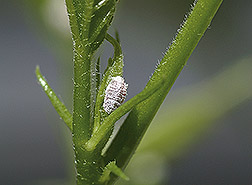
Maconellicoccus hirsutus, (also known as the pink, grape or hibiscus mealybug) is a pest of many plants, trees, and shrubs. It infests hibiscus, citrus, coffee, sugar cane, annonas, plums, guava, mango (although, mango mealybug is more problematic), okra, sorrel, teak, mora, pigeon pea, peanut, grapevine, maize, asparagus, chrysanthemum, beans, cotton, soybean, cocoa, and many other plants.
Classification of the Pink Mealybug
| Kingdom | Animalia |
|---|---|
| Phylum | Arthropoda |
| Subphylum | Hexapoda |
| Class | Insecta (Insect) |
| Order | Hemiptera |
| Suborder | Sternorrhyncha |
| Infraorder | Coccomorpha |
| Family | Pseudococcidae (Mealybug) |
| Genus | Maconellicoccus |
| Species | Maconellicoccus hirsutus (Green, 1908) |
Where the Pink Mealybug is found
Checklists and occurrence records place Maconellicoccus hirsutus in 106 countries across Africa, Asia, Europe, North America, Oceania and South America. GBIF holds 900 georeferenced records of it.
Countries
- Algeria
- Anguilla
- Antigua and Barbuda
- Aruba
- Australia 53
- Bahamas 6
- Bangladesh 7
- Barbados
- Belize
- Benin 2
- Brazil 8
- British Virgin Islands
- Brunei 1
- Burkina Faso 3
- Cabo Verde
- Cambodia
- Cameroon
- Cayman Islands
- Central African Republic
- Chad 13
- China 149
- Colombia 7
- Costa Rica
- Cuba
- Curacao
- Cyprus 2
- Democratic Republic of the Congo 4
- Dominica
- Ecuador
- Egypt 25
- Fiji
- French Guiana 4
- Gabon
- Gambia 1
- Georgia
- Greece
- Grenada 15
- Guadeloupe 3
- Guam
- Guyana 3
- Haiti
- Hong Kong 9
- India 189
- Indonesia 17
- Iran
- Israel
- Ivory Coast 1
- Jamaica
- Japan 5
- Jordan
- Kenya 10
- Laos
- Lebanon
- Liberia 1
- Malaysia 20
- Maldives 11
- Martinique 3
- Mexico
- Micronesia
- Montserrat 2
- Myanmar
- Nepal 1
- New Caledonia 4
- Nicaragua
- Niger 2
- Nigeria 11
- Northern Mariana Islands
- Oman 3
- Pakistan 8
- Palau
- Papua New Guinea 45
- Philippines 11
- Puerto Rico 1
- Republic of the Congo
- Reunion 3
- Saint Barthelemy 3
- Saint Kitts and Nevis 5
- Saint Lucia 2
- Saint Martin 3
- Saint Vincent and the Grenadines 5
- Samoa 1
- Saudi Arabia 9
- Senegal 4
- Seychelles 6
- Singapore 1
- Solomon Islands 1
- Somalia 3
- Sri Lanka 6
- Sudan 38
- Suriname 1
- Taiwan 1
- Tanzania 6
- Thailand 36
- Tonga 1
- Trinidad and Tobago 5
- Tunisia 4
- Turkey
- Tuvalu 45
- U.S. Virgin Islands 5
- United Arab Emirates 1
- United States 28
- Vanuatu 5
- Venezuela
- Vietnam 10
- Yemen 2
- Zambia
Regions and cities with the most records
- Guangdong, China 33
- Hainan, China 24
- Northern Territory, Australia 20
- Yunnan, China 14
- California, United States 10
- Western Australia, Australia 10
- Guangxi, China 8
- Haikou, China 8
- Maba, China 8
- Maoming, China 8
- Qiongshan, China 8
- Queensland, Australia 8
- Sanger, United States 8
- Shaoguan, China 8
- Xiuying, China 8
- Gujarat, India 7
- Baise, China 6
- Raval, India 6
- Yunfu, China 6
- Dasha, China 5
- Okinawa, Japan 5
- Hekou, China 4
- Ishigaki, Japan 4
- Karnataka, India 4
- Karratha, Australia 4
- Lào Cai, Vietnam 4
- Qionghai, China 4
- Sanya, China 4
- Wanning, China 4
- Gustavia, Saint Barthelemy 3
- Marigot, Saint Martin 3
- Philipsburg, Sint Maarten 3
- Yelahanka, India 3
- Madhya Pradesh, India 2
- Kerala, India 1
- Alabama, United States
Range as the checklists state it
Zanzibar South and Central
British Virgin Islands
Baja California Sur
Northern Territory
A number beside a place is its count of GBIF occurrence records. A place without a number comes from a checklist alone. Records show where a species has been observed or collected, which can include escapes and vagrants.
Common names
English
- Pink Mealybug
- Hickory Chionaspis
- Grape Mealybug
- Hibiscus Mealybug
- Hirsutus Mealybug
- Pink Hibiscus Mealybug
Names in 8 other languages
- Arabic
- بق الهبسكس الدقيقى
- Chinese
- 桑粉介殼蟲
- Dutch
- hibiscus wolluis
- French
- Cochenille de l'hibiscus, Cochenille de l’hibiscus, La cochenille de l'Hibiscus
- German
- Hibiscus-schmierlaus
- Japanese
- ワタコナカイガラムシ
- Portuguese
- cochonilha-rosada
- Spanish
- cochinilla rosada del hibisco
Synonyms
12 other scientific names have been used for this species and are now treated as synonyms of Maconellicoccus hirsutus.
- Maconelicoccus hirsutus (Green, 1908)
- Maconellicoccus pasaniae (Borchsenius, 1962)
- Maconellicoccus perforatus (De Lotto, 1954)
- Paracoccus pasaniae Borchsenius, 1962
- Phenacoccus glomeratus Green, 1922
- Phenacoccus quarternus Ramakrishna Ayyar, 1921
- Phenacoccus quarternus Varshney, 1992
- Phenacoccus quarternus Shafee, Khalid & Ahmad, 1989
- Pseudococcus crotolariae Yunus & Ho, 1980
- Pseudococcus hibisci Hall, 1921
- Spilococcus perforatus De Lotto, 1954
- Phenacoccus hirsutus Green, 1908 ambiguous synonym
Questions and answers
What is the scientific name of the Pink Mealybug?
The scientific name of the Pink Mealybug is Maconellicoccus hirsutus. Written with its author, the full name is Maconellicoccus hirsutus (Green, 1908).
Which family does the Pink Mealybug belong to?
Maconellicoccus hirsutus belongs to the family Pseudococcidae, in the order Hemiptera and the class Insecta.
Where is the Pink Mealybug found?
Checklists and occurrence records place Maconellicoccus hirsutus in 106 countries, including India, China, Australia, Papua New Guinea, Tuvalu and Sudan.
What other names does the Pink Mealybug have?
Maconellicoccus hirsutus is also known in English as Hickory Chionaspis, Grape Mealybug, Hibiscus Mealybug, Hirsutus Mealybug and Pink Hibiscus Mealybug.
Sources
Data
- Catalogue of Life, 2026-10-16 XR cc by
- Global Biodiversity Information Facility CC BY 4.0
- Wikidata CC0
- English Wikipedia CC BY-SA 4.0
- GeoNames CC BY 4.0
- Wikimedia Commons per image; credit shown with each image
- Within the Catalogue of Life, this name comes from Systematic Database of the Scale Insects of the World cc by
References
- Green, E.E. (1908) Remarks on Indian scale insects (Coccidae), Part III. With a catalogue of all species hitherto recorded from the Indian continent. Memoirs of the Department of Agriculture in India, Entomology Series, 2. where the name was published
- Hernández-García, J.M., Castellanos-Potenciano, B.P., Ramírez-Guillermo, M.A. & Ramos-Hernández, E. (2024) Bibliometric analysis of the scientific production on Maconellicoccus hirsutus (1971-2021). Revista Mexicana Ciencias Agrícolas, 15 (8). https://doi.org/10.29312/remexca.v15i8.3071
- Goel, S.C. (1996) In Integrated Pest Management and Sustainable Agriculture: An Entomological Approach, Insect and Environment, VI; Symposium, September 22-24, 1995. the Uttar Pradesh Zoological Society, Muzaffarnagar, India. xi + 224 pp. [in English]
- Prasanna, P.M. & Balikai, R.A. (2015) Seasonal incidence of grapevine mealy bug, Maconellicoccus hirsutus (Green) and its natural enemies. Karnataka Journal of Agricultural Sciences, 28(3).
- Shrike, M.S. & Salunkhe, G.N. (1996) Biology and effect of food on adult longevity and fecundity of Cryptolaemus montrouzieri Mulsant a predator on mealybugs. Journal of Maharashtra Agricultural Universities, 21(2).
- Roltsch, W.J., Meyerdirk, D.E., Warkentin, R.W., Andress, E.R. & Carrera, K. (2006) Classical biological control of the pink hibiscus mealybug, Maconellicoccus hirsutus (Green), in southern California. Biological Control, 37(2).
- Chong, J.H., Roda, A.L. & Mannion, C.M. (2008) Life history of the mealybug, Maconellicoccus hirsutus (Hemiptera: Pseudococcidae), at constant temperatures. Environmental Entomology, 37(2). https://doi.org/10.1603/0046-225X(2008)37[323:LHOTMM]2.0.CO;2
- Kitherian, S., Kumar, V., Banu, N., Avery, P.B., Radhika, A., McKenzie, C.L. & Osborne, L.S. (2018) Predation potential of Rhynocoris marginatus (Hemiptera: Reduviidae) against three mealybug species of agricultural importance. Applied Entomology and Zoology, 53.
- Kaydan, M.B., Çalışkan, A.F. & Rifat Ulusoy, M. (2013) New record of invasive mealybug Phenacoccus solenopsis Tinsley (Hemiptera: Pseudococcidae) in Turkey. EPPO Bulletin, 43(1).
- Williams, D.J. & Miller, D.R. (2010) Scale insects (Hemiptera: Sternorrhyncha: Coccoidea) of the Krakatau Islands including species from adjacent Java. Zootaxa, 2451. Link
- Serrano, M.S., Lapointe, S.L. & Meyerdirk, D.E. (2001) Attraction of males by virgin females of the mealybug Maconellicoccus hirsutus (Hemiptera: Pseudococcidae). Environmental Entomology, 30(2).
- Alemán, J., Martínez, M.A., Milián, O., Massó, E. & Rijo, E. (2005) Monitoreo de calidad en la cría de Cryptolaemus montrouzieri. [Monitoring the quality of growth of Cryptolaemus montrouzieri.]. Fitosanidad, 9(1).
- Ramos, A.S.J.C., Peronti, A.L.B.G., Kondo, T. & Lemos, R.N.S. (2017) First record of Crypticerya zeteki (Cockerell, 1914) (Monophlebidae) in Brazil and Maconellicoccus hirsutus (Green, 1908) (Pseudococcidae) in the state of Maranhão. Brazilian Journal of Biology, http.
- Tourneur, J.C. (1970) L'utilisation des coccinelles prédatrices en lutte biologique. [The utilization of predatory coccinelles on biological control.]. Fruits, 25(2).
- Mdellel, L., Adouani, R., Zouari, S., Ben Halima, M.K. & Germain, J.-F. (2019) Inventory of ornamental plant mealybug (Hemiptera Pseudococcidae) in Tunisia: species, host plants and distribution. Redia, http.
- Wang, Y.S., Zhou, P., Tian, H., Wan, F.H. & Zhang, G.F. (2018) First Record of the Invasive Pest Pseudococcus jackbeardsleyi (Hemiptera: Pseudococcidae) on the Chinese Mainland and Its Rapid Identification Based on Species-Specific Polymerase Chain Reaction. Journal of Economic Entomology, 111(5).
- Parsa, S., Kondo, T. & Winotai, A. (2012) The Cassava Mealybug (Phenacoccus manihoti) in Asia: First Records, Potential Distribution, and an Identification Key. PLoS One, 7(10).
- Ramakrishna Ayyar, T.V. (1941) Notes on some south Indian mealy bugs. Indian Journal of Entomology, 3(1).
- Sagarra, L.A., Vincent, C. & Stewart, R.K. (2002) Impact of mating on Anagyrus kamali Moursi (Hym., Encyrtidae) lifetime fecundity, reproductive longevity, progeny emergence and sex ratio. Journal of Applied Entomology, 126(7-8).
- Holtz, A.M., Piffer, A.B.M., Holtz, F.G., Carvalho, J.R., Aguiar, R.L. & Pratissoli, D. (2021) Is the Mixture between Castor and Jatropha Oils Efficient in the Management of Pink Hibiscus Mealybug. Revista Ifes Ciência, 6(4).
- Nagrare, V.S., Kranthi, S., Biradar, V.K., Zade, N.N., Sangode, V., Kakde, G., Shukla, R.M., Shivare, D., Khadi, B.M. & Kranthi, K.R. (2009) Widespread infestation of the exotic mealybug species, Phenacoccus solenopsis (Tinsley) (Hemiptera: Pseudococcidae), on cotton in India. Bulletin of Entomological Research, 99(5).
- Caicedo Ramirez, G. & Suárez, J.H. (2000) La cochinilla rosada Maconellicoccus hirsutus: una plaga cuarentenaria que amenaza a Colombia. [The rosy scale Maconellicoccus hirsutus (Hemiptera: Sternorrhyncha: Pseudococcidae): a quarantine pest which threatens Colombia]. Entomologo, 28.
- De Lotto, G. (1964) Observations on African mealy bugs (Hemiptera: Coccoidea). Bulletin of the British Museum (Natural History) Entomology, 14.
- Lalitha, N., Santhakumar, M.V. & Nirmal Kumar, S. (2018) Species diversity of predators on sucking pest complex in mulberry gardens of West Bengal. Journal of Entomology and Zoology Studies, 6(1).
- Beccari, F. (1971) [Contribution to the knowledge of the entomofauna of Saudi Arabia. First list of insects, mites and nematodes.]. Rivista di Agricoltura Subtropicale e Tropicale. Firenze, 65.
This species in other databases
Page built on 26 November 2026. See how the catalog is made and all sources and licences.
Cite this page
ScientificNames.org. (2026). Maconellicoccus hirsutus (Pink Mealybug). Retrieved November 26, 2026, from https://scientificnames.org/species/maconellicoccus-hirsutus
“Maconellicoccus hirsutus (Pink Mealybug).” ScientificNames.org, 2026, scientificnames.org/species/maconellicoccus-hirsutus. Accessed 26 Nov. 2026.
ScientificNames.org. “Maconellicoccus hirsutus (Pink Mealybug).” Accessed November 26, 2026. https://scientificnames.org/species/maconellicoccus-hirsutus.
@misc{scientificnames_maconellicoccus_hirsutus_pink_mealybug,
  author = {{ScientificNames.org}},
  title = {Maconellicoccus hirsutus (Pink Mealybug)},
  year = {2026},
  url = {https://scientificnames.org/species/maconellicoccus-hirsutus},
  note = {Accessed 2026-11-26}
}