Species · Insects
Macrosaccus gliricidius
Macrosaccus gliricidius has no English name on record in the checklists used here. It is a species of insect in the family Gracillariidae (gracillariid), order Lepidoptera. The name dates from 2011.
- Scientific name
- Macrosaccus gliricidius Davis, 2011
- Genus
- Macrosaccus
- Family
- Gracillariidae (Gracillariid)
- Order
- Lepidoptera
- Class
- Insecta
- Recorded in
- 2 countries
- Name status
- accepted in the Catalogue of Life

Overview
Macrosaccus gliricidius occurs in Central America, including Honduras, and the West Indies, including Guadeloupe.
Written 27 November 2026 from the sources listed below. Each statement was checked against the passage it cites; statements that could not be supported were removed.
Appearance
The forewings measure 2.2–2.6 mm in length.[1]
Habitat
The species occurs in Central America, including Honduras, and the West Indies, including Guadeloupe.[2]
Diet
The larvae feed on Gliricidia sepium.[3]
Behaviour
The larvae create mines in the leaves of their host plant. Each mine begins as an elongated serpentine track that abruptly expands into an elongated oval, whitish blotch.[4][5]
The whitish blotch mine can occur on either the upper or lower surface of a leaflet. Mines on the underside usually develop along the midrib, while those on the upper surface occur directly above the midrib.[6][7][8]
Classification of Macrosaccus gliricidius
| Kingdom | Animalia |
|---|---|
| Phylum | Arthropoda |
| Subphylum | Hexapoda |
| Class | Insecta (Insect) |
| Order | Lepidoptera |
| Superfamily | Gracillarioidea |
| Family | Gracillariidae (Gracillariid) |
| Subfamily | Lithocolletinae |
| Genus | Macrosaccus |
| Species | Macrosaccus gliricidius Davis, 2011 |
Origin of the name. Etymology. The species name is derived from the generic name of its host, Gliricidia. The specific epithet is a noun in the nominative singular. Figures 54 - 58. Leafmines of Macrosaccus gliricidius on Gliricidia sepium. 54 General damage to host 55 Adaxial blotch mine 56 Late instar tissue feeding larva 57 Open blotch mine with single cocoon 58 Pupa with cocoon removed. Photographs by R. Cave. Figures 59 - 65. Sap feeding larval instar of Macrosaccus robiniella. 59 Head, dorsal view (50 µm) 60 Detail of mouthparts, antenna, dorsal view (10 µm) 61 Head, ventral view (50 µm) 62 Antenna dorsal view (10 µm) 63 Detail of mouthparts, ventral view (10 µm) 64 Head, lateral view (20 µm) 65 Detail of stemmatal area, lateral view (20 µm). (Scale lengths in parentheses). Figures 66 - 71. Late tissue feeding instar larva of Macrosaccus robiniella. 66 Ventral view (1 mm) 67 Head, dorsal view (100 µm) 68 Mouthparts, dorsal view (50 µm) 69 Maxilla, anterior view (5 µm) 70 Antenna, lateral view (10 µm) 71 Mandible, dorsal view (10 µm). (Scale lengths in parentheses). Figures 72 - 77. Late tissue feeding instar larva of Macrosaccus robiniella. 72 Head, ventral view (100 µm) 73 Detail of mouthparts, ventral view (20 µm) 74 Lateral view of mouthparts (50 µm) 75 Lateral view of head (100 µm) 76 Thoracic leg (20 µm) 77 Abdominal segments 9, 10, dorsal view (100 µm). (Scale lengths in parentheses). Figures 78 - 83. Late tissue feeding instar larva and pupa of Macrosaccus robiniella. 78 - 80 Larva 78 Abdominal segments 9, 10, ventral view 79 Anal proleg 80 Abdominal segments 9, 10, lateral view. 81 - 83 Pupa 81 Head, ventral view 82 Lateral view 83 Anterior row of dorsal abdominal spines. (Scale lengths in parentheses). Figures 84 - 89. Pupa of Macrosaccus robiniella. 83 Abdominal segments 7, 8, 9 + 10, ventral view (100 µm) 85 Detail of accessory cremaster, abdominal sternum 7 (100 µm) 86 Abdominal segments 8, 9 + 10, dorsal view (100 µm) 87 Abdominal segments 8, 9 + 10, ventral view (50 µm) 88 Caudal view of abdomen (100 µm) 89 Abdominal segments 8, 9 + 10, lateral view (100 µm). (Scale lengths in parentheses). Figures 90 - 98. Late tissue feeding instar larva and pupa of Macrosaccus robiniella. 90 - 96 Larval chaetotaxy. 90 Lateral schematic of prothorax, mesothorax, and abdominal segments 1, 2, 5 - 10 91 dorsal view of head 92 Ventral view 93 Lateral view 94 Dorsal view of abdominal segments 8 - 10 95 Labrum, dorsal view 96 Mandible. 97 - 98 Pupa. 97 Ventral view 98 lateral view. (Bar scale for figures as indicated).
Where Macrosaccus gliricidius is found
Checklists and occurrence records place Macrosaccus gliricidius in 2 countries. GBIF holds 12 georeferenced records of it.
Countries
Regions and cities with the most records
- Baie-Mahault, Guadeloupe 8
- Le Gosier, Guadeloupe 8
- Les Abymes, Guadeloupe 8
- Petit-Bourg, Guadeloupe 8
- Pointe-à-Pitre, Guadeloupe 8
- Sainte-Rose, Guadeloupe 5
- Francisco Morazán Department, Honduras 4
A number beside a place is its count of GBIF occurrence records. A place without a number comes from a checklist alone. Records show where a species has been observed or collected, which can include escapes and vagrants.
Related species
-
 Macrosaccus morrisella
-
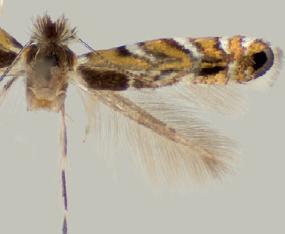 Macrosaccus uhlerella
-
 Macrosaccus neomexicanus
-
 Black Locust LeafminerMacrosaccus robiniella
- Macrosaccus coursetiae
-
 Horse-chestnut Leaf MinerCameraria ohridella
-
 Citrus LeafminerPhyllocnistis citrella
-
 Lime LeafminerPhyllonorycter issikii
Compare
Questions and answers
What does the species epithet gliricidius mean?
The epithet gliricidius derives from the generic name of its host plant, Gliricidia.[9]
How long are the forewings?
The forewings measure 2.2–2.6 mm in length.[1]
Where do the larvae feed?
The larvae feed on Gliricidia sepium.[3]
Sources
Passages the profile rests on
- The forewings of Macrosaccus gliricidius measure 2.2–2.6 mm in length. Source passage: “The length of the forewings is 2.2–2.6 mm.” — English Wikipedia
- Macrosaccus gliricidius occurs in Central America, including Honduras, and the West Indies, including Guadeloupe. Source passage: “It is known from Central America (such as Honduras) and the West Indies (such as Guadeloupe).” — English Wikipedia
- The larvae of Macrosaccus gliricidius feed on Gliricidia sepium. Source passage: “The larvae feed on Gliricidia sepium.” — English Wikipedia
- The larvae create mines in the leaves of their host plant. Source passage: “They mine the leaves of their host plant.” — English Wikipedia
- The larval leaf mine begins as an elongated serpentine track that abruptly expands into an elongated oval, whitish blotch. Source passage: “The mine begins as an elongate serpentine track which abruptly enlarges to an elongate-oval, whitish blotch” — English Wikipedia
- The whitish blotch mine can occur on either the upper or lower surface of a leaflet. Source passage: “located on either the upper or lower side of the leaflet.” — English Wikipedia
- Blotch mines on the underside of leaflets usually develop along the midrib. Source passage: “When present on the under side, the blotch mines usually develop along the midrib.” — English Wikipedia
- Blotch mines on the upper surface of leaflets occur directly above the midrib. Source passage: “Only the upperside blotch mines occurred directly on top of the midrib.” — English Wikipedia
- The species epithet gliricidius derives from the generic name of its host plant, Gliricidia. Source passage: “The species name is derived from the generic name of its host, Gliricidia.” — English Wikipedia
Data
- Catalogue of Life, 2026-10-16 XR cc by
- Global Biodiversity Information Facility CC BY 4.0
- Wikidata CC0
- GeoNames CC BY 4.0
- Wikimedia Commons per image; credit shown with each image
- Within the Catalogue of Life, this name comes from Global Taxonomic Database of Gracillariidae cc by
References
- Davis, D. R., & De Prins, J. (2011). Systematics and biology of the new genus Macrosaccus with descriptions of two new species (Lepidoptera, Gracillariidae). https://zookeys.pensoft.net/article/2344/ Link where the name was published
This species in other databases
Page built on 27 November 2026. See how the catalog is made and all sources and licences.
Cite this page
ScientificNames.org. (2026). Macrosaccus gliricidius. Retrieved November 27, 2026, from https://scientificnames.org/species/macrosaccus-gliricidius
“Macrosaccus gliricidius.” ScientificNames.org, 2026, scientificnames.org/species/macrosaccus-gliricidius. Accessed 27 Nov. 2026.
ScientificNames.org. “Macrosaccus gliricidius.” Accessed November 27, 2026. https://scientificnames.org/species/macrosaccus-gliricidius.
@misc{scientificnames_macrosaccus_gliricidius,
  author = {{ScientificNames.org}},
  title = {Macrosaccus gliricidius},
  year = {2026},
  url = {https://scientificnames.org/species/macrosaccus-gliricidius},
  note = {Accessed 2026-11-27}
}