Species · Insects
Macrosoma albimacula
Macrosoma albimacula has no English name on record in the checklists used here. It is a species of insect in the family Hedylidae (moth-butterflies), order Lepidoptera. The name dates from 1900.
- Scientific name
- Macrosoma albimacula Warren, 1900
- Genus
- Macrosoma
- Family
- Hedylidae (Moth-butterflies)
- Order
- Lepidoptera
- Class
- Insecta
- Recorded in
- 1 country
- Name status
- accepted in the Catalogue of Life
Overview
The species occurs in western and northern Ecuador, including Paramba in Imbabura Province.
Written 27 November 2026 from the sources listed below. Each statement was checked against the passage it cites; statements that could not be supported were removed.
Appearance
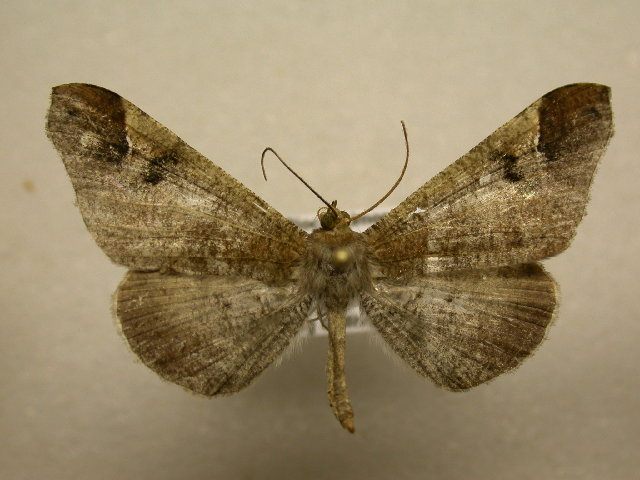
Male specimens have greyish-brown wings. The male forewing has a dark, minimally excavated apex, a pale-coloured leading edge, a prominent white patch at the distal end of the cell and a tiny white marking toward the costa.[1][2][3][4]
The male forewing measures 19–20 mm in length. The male antennae are not bipectinate.[5][6]
The male gnathos is broad and toothed, with a very short, weakly sclerotized, tongue-shaped median lobe that does not curve downward. The male valva is approximately triangular in shape.[7][8]
Habitat
The species has been recorded at elevations reaching 1,630 m.[9]
Similar species
The wing coloration of this species most closely resembles that of Macrosoma subornata. Unlike Macrosoma subornata, this species lacks a distinct costal marking.[10][11]
Its genitalia closely resemble those of Macrosoma leucophasiata and Macrosoma amaculata, although the valva shape differs. Its wing markings distinguish it clearly from both species.[12][13]
Classification of Macrosoma albimacula
| Kingdom | Animalia |
|---|---|
| Phylum | Arthropoda |
| Subphylum | Hexapoda |
| Class | Insecta (Insect) |
| Order | Lepidoptera |
| Superfamily | Papilionoidea |
| Family | Hedylidae (Moth-butterflies) |
| Genus | Macrosoma |
| Species | Macrosoma albimacula Warren, 1900 |
Where Macrosoma albimacula is found
Checklists and occurrence records place Macrosoma albimacula in 1 country. GBIF holds 11 georeferenced records of it.
Countries
Regions and cities with the most records
A number beside a place is its count of GBIF occurrence records. A place without a number comes from a checklist alone. Records show where a species has been observed or collected, which can include escapes and vagrants.
Related species
-
 Macrosoma albida
-
 Macrosoma bahiata
- Macrosoma tipulata
- Macrosoma leucophasiata
- Macrosoma hyacinthina
- Macrosoma albifascia
- Macrosoma lucivittata
- Macrosoma conifera
Compare
Questions and answers
Who described Macrosoma albimacula and when?
The species was described by William Warren in 1900.[14]
In which genus was the species originally classified?
The species was originally classified in the genus Hyphedyle.[15]
Where does Macrosoma albimacula occur?
It occurs in western and northern Ecuador, including Paramba in Imbabura Province.[16]
What is the length of the male forewing?
The male forewing measures 19–20 mm in length.[5]
Sources
Passages the profile rests on
- Male specimens have greyish-brown wings. Source passage: “Male M. albimacula specimens have wings of a greyish brown colour.” — English Wikipedia
- The male forewing has a dark, minimally excavated apex. Source passage: “The forewing has a dark and hardly excavated apex.” — English Wikipedia
- The male forewing has a pale-coloured leading edge. Source passage: “The costa, the leading edge of the wing is pale in color.” — English Wikipedia
- The male forewing bears a prominent white patch at the distal end of the cell and a tiny white marking toward the costa. Source passage: “There is a prominent white patch at the distal end of the cell with a minute white blip towards the costa.” — English Wikipedia
- The male forewing measures 19–20 mm in length. Source passage: “The length of the forewing is 19–20 mm.” — English Wikipedia
- The male antennae are not bipectinate. Source passage: “The antenna is not bipectinate.” — English Wikipedia
- The male gnathos is broad and toothed, with a very short, weakly sclerotized, tongue-shaped median lobe that does not curve downward. Source passage: “Gnathos is broad and denticulate, with medial tongue-shaped lobe which is very short, weakly sclerotized and not down curved.” — English Wikipedia
- The male valva is approximately triangular in shape. Source passage: “Valva is subtriangular.” — English Wikipedia
- The species has been recorded at elevations reaching 1,630 m. Source passage: “at altitudes up to 1,630 m.” — English Wikipedia
- The wing coloration of this species most closely resembles that of Macrosoma subornata. Source passage: “The wing colour is most similar to that of M. subornata” — English Wikipedia
- Unlike Macrosoma subornata, this species lacks a distinct costal marking. Source passage: “but the discrete costal marking of that species is absent from M. albimacula.” — English Wikipedia
- Its genitalia closely resemble those of Macrosoma leucophasiata and Macrosoma amaculata, although the valva shape differs. Source passage: “The genitalia are very similar to those of M. leucophasiata and M. amaculata although the shape of the valva differs” — English Wikipedia
- The wing markings distinguish this species clearly from Macrosoma leucophasiata and Macrosoma amaculata. Source passage: “but the differences in wing markings of the species are pronounced.” — English Wikipedia
- The species was described by William Warren in 1900. Source passage: “Macrosoma albimacula is moth-like butterfly described by William Warren in 1900.” — English Wikipedia
- The species was originally classified in the genus Hyphedyle. Source passage: “Originally it belonged to the genus Hyphedyle.” — English Wikipedia
- The species occurs in western and northern Ecuador, including Paramba in Imbabura Province. Source passage: “The species is found in the west and north of Ecuador (Paramba of Imbabura Province)” — English Wikipedia
Data
- Catalogue of Life, 2026-10-16 XR cc by
- Global Biodiversity Information Facility CC BY 4.0
- Wikidata CC0
- GeoNames CC BY 4.0
- Within the Catalogue of Life, this name comes from Global Lepidoptera Index cc by
This species in other databases
Page built on 28 November 2026. See how the catalog is made and all sources and licences.
Cite this page
ScientificNames.org. (2026). Macrosoma albimacula. Retrieved November 28, 2026, from https://scientificnames.org/species/macrosoma-albimacula
“Macrosoma albimacula.” ScientificNames.org, 2026, scientificnames.org/species/macrosoma-albimacula. Accessed 28 Nov. 2026.
ScientificNames.org. “Macrosoma albimacula.” Accessed November 28, 2026. https://scientificnames.org/species/macrosoma-albimacula.
@misc{scientificnames_macrosoma_albimacula,
  author = {{ScientificNames.org}},
  title = {Macrosoma albimacula},
  year = {2026},
  url = {https://scientificnames.org/species/macrosoma-albimacula},
  note = {Accessed 2026-11-28}
}