Species · Insects
Macrosoma heliconiaria
Macrosoma heliconiaria has no English name on record in the checklists used here. It is a species of insect in the family Hedylidae (moth-butterflies), order Lepidoptera. The name dates from 1857.
- Scientific name
- Macrosoma heliconiaria Guenée, 1857
- Genus
- Macrosoma
- Family
- Hedylidae (Moth-butterflies)
- Order
- Lepidoptera
- Class
- Insecta
- Recorded in
- 9 countries
- Name status
- accepted in the Catalogue of Life
Overview
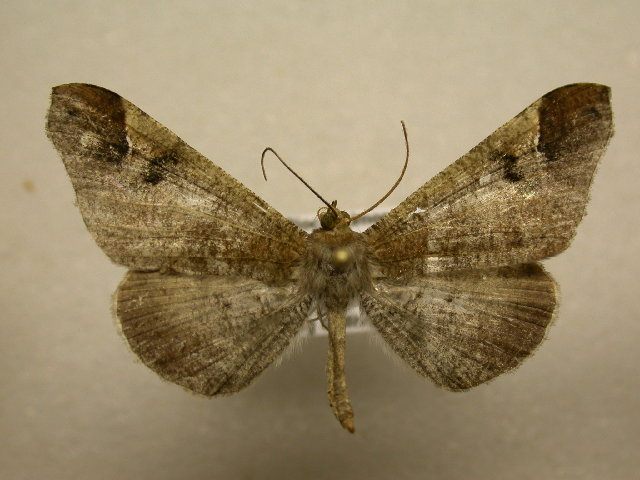
Macrosoma heliconiaria Guenée, 1857 is an insect in the family Hedylidae, order Lepidoptera, and class Insecta. The species is recorded in Colombia, Venezuela, French Guiana, Brazil as far as Belém, and south to mid-western Peru. It has greyish brown wings, a white triangular forewing marking, and a narrow translucent central area on the hindwing.
Written 27 November 2026 from the sources listed below. Each statement was checked against the passage it cites; statements that could not be supported were removed.
Appearance
The wings are greyish brown. The forewing has a white triangular marking along its costa, while the hindwing has a narrow translucent central area.[1][2][3]
The antennae are bipectinate in both sexes. The forewing measures 17–19 mm in length.[4][5]
The male uncus is not notched in lateral view, and the gnathos has short, truncated lateral members. The apex of the male valva is narrow and has a prominent inner lobe.[6][7][8]
The female anal papillae are pointed, and the corpus bursae is globose. The signum is a sclerotized, denticulate collar that partially encircles the neck of the corpus bursae.[9][10][11]
Similar species
Macrosoma heliconiaria resembles Macrosoma semiermis but has a less extensive translucent hindwing area and a greyer ground color. It does not have the distinctly darker forewing apex found in Macrosoma semiermis.[12][13][14]
The shape of the gnathos and the presence of an inner lobe on the valva distinguish the male of this species from Macrosoma semiermis. In females, the globose corpus bursae and collar-like signum provide distinguishing characteristics.[15][16]
Habitat
The species is recorded in Colombia, Venezuela, French Guiana, Brazil as far as Belém, and south to mid-western Peru.[17]
Behaviour
The species has ultrasonic hearing associated with adaptations for avoiding bat predation. It also has night vision through superposition optics.[18][19]
Classification of Macrosoma heliconiaria
| Kingdom | Animalia |
|---|---|
| Phylum | Arthropoda |
| Subphylum | Hexapoda |
| Class | Insecta (Insect) |
| Order | Lepidoptera |
| Superfamily | Papilionoidea |
| Family | Hedylidae (Moth-butterflies) |
| Genus | Macrosoma |
| Species | Macrosoma heliconiaria Guenée, 1857 |
Where Macrosoma heliconiaria is found
Checklists and occurrence records place Macrosoma heliconiaria in 9 countries. GBIF holds 532 georeferenced records of it.
Countries
- Brazil 7
- Colombia 18
- Costa Rica 421
- Ecuador 6
- French Guiana 20
- Nicaragua 6
- Panama 23
- Peru 28
- Venezuela 3
Regions and cities with the most records
- Puntarenas Province, Costa Rica 191
- Limón Province, Costa Rica 82
- Heredia Province, Costa Rica 69
- Guanacaste Province, Costa Rica 30
- Alajuela Province, Costa Rica 25
- Madre de Dios, Peru 12
- Panamá Oeste Province, Panama 12
- San José, Costa Rica 12
- Siquirres, Costa Rica 12
- Guápiles, Costa Rica 7
- Huánuco Department, Peru 7
- Cuzco Department, Peru 5
- Darién, Panama 5
- San José, Costa Rica 5
- Tejar, Costa Rica 5
- Antioquia, Colombia 4
- Napo, Ecuador 4
- Nicoya, Costa Rica 4
- Acre, Brazil 3
- Amazonas Department, Colombia 3
- Cayenne, French Guiana 3
- Limón, Costa Rica 3
- Rémire-Montjoly, French Guiana 3
A number beside a place is its count of GBIF occurrence records. A place without a number comes from a checklist alone. Records show where a species has been observed or collected, which can include escapes and vagrants.
Synonyms
3 other scientific names have been used for this species and are now treated as synonyms of Macrosoma heliconiaria.
- Hedyle heliconaria Walker, 1862
- Hedyle heliconiaria Guenée, 1858
- Macrosoma heliconaria Guenée, 1857
Related species
-
 Macrosoma albida
-
 Macrosoma bahiata
- Macrosoma tipulata
- Macrosoma leucophasiata
- Macrosoma hyacinthina
- Macrosoma albifascia
- Macrosoma lucivittata
- Macrosoma conifera
Compare
Sources
Passages the profile rests on
- The wings of this species are greyish brown. Source passage: “The wings are greyish brown in color.” — English Wikipedia
- The forewing has a white triangular marking along its costa. Source passage: “Forewing has white triangle on the costa.” — English Wikipedia
- The hindwing has a narrow translucent central area. Source passage: “Hindwing is narrow translucent in the central area.” — English Wikipedia
- The antennae are bipectinate in both sexes. Source passage: “The antenna is bipectinate in both sexes.” — English Wikipedia
- The forewing measures 17–19 mm in length. Source passage: “The length of forewing can be 17–19 mm.” — English Wikipedia
- The male has an uncus that is not notched in lateral view. Source passage: “Uncus is not notched in lateral view.” — English Wikipedia
- The male gnathos has short, truncated lateral members. Source passage: “Gnathos has short, truncated lateral members.” — English Wikipedia
- The apex of the male valva is narrow and has a prominent inner lobe. Source passage: “The apex of the Valva is narrow with prominent inner lobe.” — English Wikipedia
- The female anal papillae are pointed. Source passage: “The anal papillae is pointed.” — English Wikipedia
- The female corpus bursae is globose. Source passage: “Corpus bursae is globose;” — English Wikipedia
- The female signum is a sclerotized, denticulate collar that partially encircles the neck of the corpus bursae. Source passage: “Signum is a form of sclerotized, denticulate collar half encircling the neck of the corpus.” — English Wikipedia
- Macrosoma heliconiaria resembles Macrosoma semiermis, but has a less extensive translucent hindwing area. Source passage: “M. heliconiaria is similar to M. semiermis, but the translucent area on the hindwing is less extensive” — English Wikipedia
- Macrosoma heliconiaria has a greyer ground color than Macrosoma semiermis. Source passage: “the ground color of the moth is more grey” — English Wikipedia
- Unlike Macrosoma semiermis, this species does not have a distinctly darker forewing apex. Source passage: “the apex of the forewing is not distinctly darker than the rest of the wing in terms of intensity.” — English Wikipedia
- The shape of the gnathos and the presence of an inner lobe on the valva distinguish this species from Macrosoma semiermis. Source passage: “The shape of the gnathos and the presence of the lobe on the valva also distinguishes M. heliconiaria from M. semiermis” — English Wikipedia
- The globose corpus bursae and collar-like signum distinguish this species from Macrosoma semiermis. Source passage: “as does the globose corpus bursae with its collar like signum.” — English Wikipedia
- The species is recorded in Colombia, Venezuela, French Guiana, Brazil as far as Belém, and south to mid-western Peru. Source passage: “Colombia, Venezuela, French Guiana, across Brazil to Belém at the mouth of the Amazon; south to the mid-west of Peru.” — English Wikipedia
- The species has ultrasonic hearing associated with adaptations for avoiding bat predation. Source passage: “Adaptions to avoid bat predation have given the species ultrasonic hearing” — English Wikipedia
- The species has night vision through superposition optics. Source passage: “night vision through superposition optics.” — English Wikipedia
Data
- Catalogue of Life, 2026-10-16 XR cc by
- Global Biodiversity Information Facility CC BY 4.0
- Wikidata CC0
- GeoNames CC BY 4.0
- Within the Catalogue of Life, this name comes from Global Lepidoptera Index cc by
References
- Guenée. (1857). Histoire naturelle des insectes. 10. http://www.biodiversitylibrary.org/item/37718#page/112/mode/2up Link where the name was published
This species in other databases
Page built on 28 November 2026. See how the catalog is made and all sources and licences.
Cite this page
ScientificNames.org. (2026). Macrosoma heliconiaria. Retrieved November 28, 2026, from https://scientificnames.org/species/macrosoma-heliconiaria
“Macrosoma heliconiaria.” ScientificNames.org, 2026, scientificnames.org/species/macrosoma-heliconiaria. Accessed 28 Nov. 2026.
ScientificNames.org. “Macrosoma heliconiaria.” Accessed November 28, 2026. https://scientificnames.org/species/macrosoma-heliconiaria.
@misc{scientificnames_macrosoma_heliconiaria,
  author = {{ScientificNames.org}},
  title = {Macrosoma heliconiaria},
  year = {2026},
  url = {https://scientificnames.org/species/macrosoma-heliconiaria},
  note = {Accessed 2026-11-28}
}