Species · Flowering plants
Arrowroot Maranta arundinacea
The scientific name of the Arrowroot is Maranta arundinacea. It is a species of flowering plant in the family Marantaceae (arrowroots), order Zingiberales.
- Scientific name
- Maranta arundinacea L.
- Common name
- Arrowroot
- Genus
- Maranta
- Family
- Marantaceae (Arrowroots)
- Order
- Zingiberales
- Class
- Liliopsida
- Recorded in
- 55 countries
- Name status
- accepted in the Catalogue of Life

Overview
Arrowroot (Maranta arundinacea L.) is an erect, herbaceous perennial flowering plant in the family Marantaceae, order Zingiberales, and class Liliopsida. Its edible rhizomes are a source of starch used in food preparations and other products.
Written 26 November 2026 from the sources listed below. Each statement was checked against the passage it cites; statements that could not be supported were removed.
Appearance
The plant grows to a height of approximately 0.3–1.5 metres. Its rhizomes measure approximately 20–45 centimetres in length.[1][2]
Habitat
Arrowroot occurs naturally on the floors of moist evergreen and deciduous forests, particularly in relatively well-lit clearings. It also grows in partial shade near or along the margins of water.[3][4]
The plant grows in clay loam and sandy soils with good drainage and moist conditions. It grows best in regions receiving approximately 150–200 centimetres of annual precipitation and at temperatures between 23 and 29 degrees Celsius.[5][6][7]
Reproduction and life cycle
Arrowroot rarely produces seeds and is generally propagated by planting a rhizome section containing a bud. It can also be propagated through division or seed.[8][9]
The plant produces twin clusters of small white flowers approximately 90 days after planting. Its flowering period includes spring and summer.[10][11]
Uses
The edible rhizome is used as a source of starch. The starch is used in food preparations, confectionery, cosmetics, and glue.[12][13]
Arrowroot starch is used to thicken sauces and soups and to prepare pastries. It can also serve as a gluten-free substitute for wheat flour in food preparations.[14][15]
Arrowroot starch has potential applications in baked goods, ice cream stabilizers, jellies, cakes, and infant foods. Its high viscosity makes it suitable for use as a thickener.[16][17]
Arrowroot starch is described as easily digestible and suitable for infants, elderly people, and patients with digestive problems. In Sri Lankan folk and Ayurvedic medicine, it is used as a soothing agent and treatment for digestive problems.[18][19]
The rhizome starch can be applied internally against ingested poison or externally to extract poison from wounds. Historically, the plant's starch was used as a poultice for extracting poison from arrow wounds.[20][21]
The rhizomes can be consumed boiled with grated coconut or prepared in porridge and curry. The fibrous residue remaining after starch extraction can be used as livestock feed.[22][23]
The plant serves as a food source for the larvae of several butterfly and moth species.[24]
Classification of the Arrowroot
| Kingdom | Plantae |
|---|---|
| Subkingdom | Pteridobiotina |
| Phylum | Tracheophyta |
| Class | Liliopsida |
| Order | Zingiberales |
| Family | Marantaceae (Arrowroots) |
| Genus | Maranta (Prayer Plant) |
| Species | Maranta arundinacea L. |
Where the Arrowroot is found
Checklists and occurrence records place Maranta arundinacea in 55 countries across Africa, Asia, North America, Oceania and South America. GBIF holds 3,664 georeferenced records of it.
Countries where it is native or its origin is not stated
- Argentina 30
- Barbados 3
- Belize 32
- Bolivia 6
- Bonaire, Saint Eustatius and Saba 4
- Brazil 292
- Colombia 68
- Costa Rica 251
- Cuba 15
- Dominica 15
- Dominican Republic 11
- Ecuador 48
- El Salvador 110
- French Guiana 38
- Grenada 3
- Guadeloupe 9
- Guatemala 28
- Guyana 45
- Haiti 5
- Honduras 36
- Martinique 14
- Mexico 1,921
- Nicaragua 217
- Panama 73
- Paraguay 9
- Peru 11
- Puerto Rico 23
- Saint Barthelemy 4
- Saint Martin 3
- Saint Vincent and the Grenadines 14
- Suriname 30
- U.S. Virgin Islands 3
- Venezuela 54
Countries where it has been introduced
- Bahamas
- Bangladesh 3
- Bermuda 5
- Cambodia
- China 28
- Cook Islands
- Equatorial Guinea 2
- Gabon 3
- India 23
- Jamaica 17
- Japan 3
- Mauritius 1
- Myanmar 3
- Philippines 38
- Reunion 26
- Samoa 4
- Sri Lanka 2
- Taiwan 22
- Tonga 13
- Trinidad and Tobago 11
- United States 34
- Vanuatu 1
Regions and cities with the most records
- Veracruz, Mexico 260
- Oaxaca, Mexico 236
- Guanacaste Province, Costa Rica 177
- Chiapas, Mexico 172
- Campeche, Mexico 164
- Yucatán, Mexico 128
- Jalisco, Mexico 109
- Crucecita, Mexico 105
- Nayarit, Mexico 73
- Guerrero, Mexico 66
- Catemaco, Mexico 50
- Campeche, Mexico 43
- Tuxtla, Mexico 41
- Granada, Nicaragua 38
- San Andrés Tuxtla, Mexico 38
- José Cardel, Mexico 37
- Puebla, Mexico 34
- Valladolid, Mexico 34
- Nandaime, Nicaragua 33
- Morelos, Mexico 32
- Granada Department, Nicaragua 31
- Chiapa de Corzo, Mexico 27
- Masatepe, Nicaragua 26
- Masaya, Nicaragua 26
- Valente Diaz, Mexico 26
- Ahuachapan, El Salvador 25
- Berriozábal, Mexico 25
- Managua Department, Nicaragua 25
- Michoacán, Mexico 24
- Tabasco, Mexico 24
- Ahuachapán, El Salvador 23
- Quintana Roo, Mexico 22
- Veracruz, Mexico 22
- Xalisco, Mexico 22
- Puntarenas Province, Costa Rica 21
- Sinaloa, Mexico 20
14 more countries have a few records outside this range
These countries hold a few records of Maranta arundinacea but lie outside the range the checklists give for it. Such records are often zoo or garden specimens, museum material or vagrants, so the species is not counted as occurring there.
A number beside a place is its count of GBIF occurrence records. A place without a number comes from a checklist alone. Records show where a species has been observed or collected, which can include escapes and vagrants.
Common names
English
- Arrowroot
- West Indian Arrowroot
- Maranta
Names in 15 other languages
- Chinese
- 竹芋, 葛鬱金
- Czech
- maranta třtinovitá
- Finnish
- nuolijuuri
- French
- herbe aux flèches
- German
- Pfeilwurz
- Hawaiian
- Pia
- Indonesian
- Garut
- Japanese
- クズウコン
- Polish
- maranta trzcinowa
- Portuguese
- agutiguepe, araruta, araruta-comum, araruta-palmeira
- Slovak
- maranta trsťovitá
- Spanish
- Arrurruz, Azafrán, arruruz, chuchute tamalera
- Swedish
- arrowrot
- bno
- araro
- yua
- chaak
Synonyms
10 other scientific names have been used for this species and are now treated as synonyms of Maranta arundinacea.
- Donax arundinacea Lour.
- Maranta arundinacea f. sylvestris Matuda
- Maranta arundinacea var. arundinacea
- Maranta arundinacea var. indica (Tussac) Petersen
- Maranta arundinacea var. variegata Ridl.
- Maranta indica Tussac
- Maranta minor Chantrier ex André
- Maranta ramosissima Wall.
- Maranta sylvatica Roscoe ex Sm.
- Phrynium variegatum N.E.Br. ambiguous synonym
Related species
-
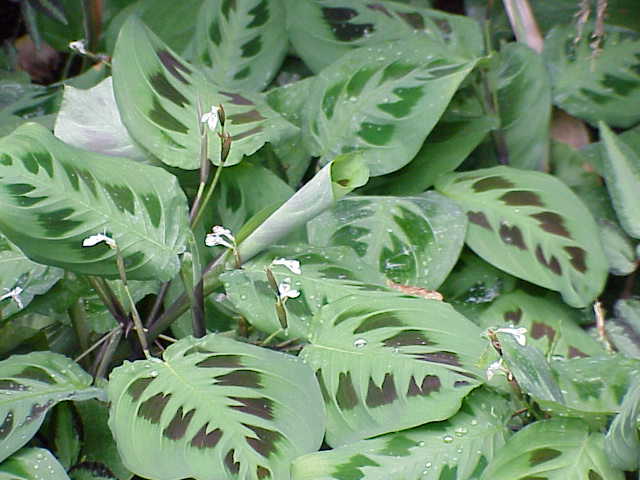 Prayer PlantMaranta leuconeura
- Maranta gibba
-
 Maranta cristata
-
 Maranta humilis
- Maranta furcata
-
 Maranta ruiziana
- Maranta pohliana
- Maranta sobolifera
Compare
Questions and answers
What is the scientific name of the Arrowroot?
The scientific name of the Arrowroot is Maranta arundinacea. Written with its author, the full name is Maranta arundinacea L..
Which family does the Arrowroot belong to?
Maranta arundinacea belongs to the family Marantaceae, in the order Zingiberales and the class Liliopsida.
Where is the Arrowroot found?
Checklists and occurrence records place Maranta arundinacea in 55 countries, including Mexico, Brazil, Costa Rica, Nicaragua, El Salvador and Panama.
What other names does the Arrowroot have?
Maranta arundinacea is also known in English as West Indian Arrowroot and Maranta.
Sources
Passages the profile rests on
- The plant grows to a height of approximately 0.3–1.5 metres. Source passage: “Arrowroot is a perennial plant growing to a height of between 0.3 m (1 ft) and 1.5 m (5 ft).” — English Wikipedia
- The rhizomes measure approximately 20–45 centimetres in length. Source passage: “The rhizomes are fleshy, cylindrical, and grow from 20 cm (8 in) to 45 cm (18 in) long.” — English Wikipedia
- The species occurs naturally on the floors of moist evergreen and deciduous forests, particularly in relatively well-lit clearings. Source passage: “native to the floor of moist evergreen or deciduous forests, often in clearings where light levels are relatively high” — plants.ces.ncsu.edu
- The plant grows in partial shade near or along the margins of water. Source passage: “grows in partial shade near or in the margins of water.” — plants.ces.ncsu.edu
- The species grows best in regions receiving approximately 150–200 centimetres of annual precipitation. Source passage: “annual precipitation between 150 cm (59 in) and 200 cm (79 in).” — English Wikipedia
- The plant grows best at temperatures between 23 and 29 degrees Celsius. Source passage: “It grows best between temperatures of 23 °C (73 °F) and 29 °C (84 °F)” — English Wikipedia
- The species can grow in clay loam and sandy soils with good drainage and moist conditions. Source passage: “Soil Texture: Clay Loam (Silt) Sand Soil pH: Acid (<6.0) Soil Drainage: Good Drainage Moist Occasional Flooding” — plants.ces.ncsu.edu
- The species rarely produces seeds and is generally propagated by planting a rhizome section containing a bud. Source passage: “The plant rarely produces seeds and reproduction is typically by planting part of a rhizome with a bud.” — English Wikipedia
- The species can be propagated through division or seed. Source passage: “Recommended Propagation Strategy: Division Seed” — plants.ces.ncsu.edu
- The plant produces twin clusters of small white flowers approximately 90 days after planting. Source passage: “Twin clusters of small white flowers bloom about 90 days after planting.” — English Wikipedia
- The flowering period includes spring and summer. Source passage: “Flower Bloom Time: Spring Summer” — plants.ces.ncsu.edu
- The edible rhizome is used as a source of starch. Source passage: “The edible part of the plant is the rhizome.” — English Wikipedia
- Arrowroot starch is used in food preparations, confectionery, cosmetics, and glue. Source passage: “Currently, arrowroot starch is used in food preparations and confectionery, and for industrial applications such as cosmetics and glue.” — English Wikipedia
- The starch is used to thicken sauces and soups and to prepare pastries. Source passage: “Rhizome is a source of a high quality starch used in pastries or for thickening sauces and soup.” — plants.ces.ncsu.edu
- Arrowroot starch can serve as a gluten-free substitute for wheat flour in food preparations. Source passage: “but it is a gluten-free alternative to wheat flour that can be used in food preparations” — pmc.ncbi.nlm.nih.gov
- Arrowroot starch has potential applications in baked goods, ice cream stabilizers, jellies, cakes, and infant foods. Source passage: “arrowroot starch could be used in baked goods, ice cream stabilizers, jellies, cakes, and infant food” — pmc.ncbi.nlm.nih.gov
- Arrowroot starch can be used as a thickener because of its high viscosity. Source passage: “Arrowroot starch had high viscosity defining its potential as a thickener.” — pmc.ncbi.nlm.nih.gov
- Arrowroot starch is used in Sri Lankan folk and Ayurvedic medicine as a soothing agent and treatment for digestive problems. Source passage: “As a soothing agent and treatment for digestive issues, arrowroot is commonly used in folk and Ayurvedic medicine in Sri Lanka” — pmc.ncbi.nlm.nih.gov
- The starch is described as easily digestible and suitable for infants, elderly people, and patients with digestive problems. Source passage: “Due to its excellent digestibility, arrowroot is useful for infants, the elderly, patients with digestive issues” — pmc.ncbi.nlm.nih.gov
- The rhizome starch can be applied internally against ingested poison or externally to extract poison from wounds. Source passage: “This starch can be used internally against ingested poison or externally to extract poison from a wound.” — plants.ces.ncsu.edu
- The plant's starch was historically used as a poultice for extracting poison from arrow wounds. Source passage: “The common name, Arrowroot, comes from its use as a poultice to remove poison from arrow wounds.” — plants.ces.ncsu.edu
- The fibrous residue remaining after starch extraction can be used as livestock feed. Source passage: “The residue of starch extraction has a high fibre content and can be fed to livestock.” — English Wikipedia
- The rhizomes can be consumed boiled with grated coconut or prepared in porridge and curry. Source passage: “primarily restricted to dishes such as porridge, boiled rhizomes with grated coconut, and curry” — pmc.ncbi.nlm.nih.gov
- The plant serves as a food source for the larvae of several butterfly and moth species. Source passage: “This plant serves as food for the larval stage of Leguminivora glycinivorella, the Soybean Moth; Rhinthon cubana, the Cuban Skipper;” — plants.ces.ncsu.edu
Data
- Catalogue of Life, 2026-10-16 XR cc by
- Global Biodiversity Information Facility CC BY 4.0
- Wikidata CC0
- GeoNames CC BY 4.0
- Wikimedia Commons per image; credit shown with each image
- Within the Catalogue of Life, this name comes from The World Checklist of Vascular Plants (WCVP) cc by
References
- Sp. Pl. [Linnaeus] 1: 2. 1753 [1 May 1753] Link where the name was published
This species in other databases
- Catalogue of Life 6QTTJ
- Wikidata Q767103
- iNaturalist 126244
- World Flora Online wfo-0000466473
- GRIN 23393
Page built on 28 November 2026. See how the catalog is made and all sources and licences.
Cite this page
ScientificNames.org. (2026). Maranta arundinacea (Arrowroot). Retrieved November 28, 2026, from https://scientificnames.org/species/maranta-arundinacea
“Maranta arundinacea (Arrowroot).” ScientificNames.org, 2026, scientificnames.org/species/maranta-arundinacea. Accessed 28 Nov. 2026.
ScientificNames.org. “Maranta arundinacea (Arrowroot).” Accessed November 28, 2026. https://scientificnames.org/species/maranta-arundinacea.
@misc{scientificnames_maranta_arundinacea_arrowroot,
  author = {{ScientificNames.org}},
  title = {Maranta arundinacea (Arrowroot)},
  year = {2026},
  url = {https://scientificnames.org/species/maranta-arundinacea},
  note = {Accessed 2026-11-28}
}