Species · Fishes
Comb Flounder Marleyella bicolorata
The scientific name of the Comb Flounder is Marleyella bicolorata. It is a species of fish in the family Pleuronectidae (dabs), order Pleuronectiformes. The name dates from 1922.
- Scientific name
- Marleyella bicolorata (von Bonde, 1922)
- Common name
- Comb Flounder
- Genus
- Marleyella
- Family
- Pleuronectidae (Dabs)
- Order
- Pleuronectiformes
- Class
- Teleostei
- Red List category
- DD Data Deficient
- Environment
- marine
- Recorded in
- 3 countries
- Name status
- accepted in the Catalogue of Life

Overview
Marleyella bicolorata inhabits tropical waters of the western Indian Ocean, from KwaZulu-Natal and Mozambique to coastal Tanzania and Kenya, as well as Somalia, Karnataka and Maharashtra. It has both eyes on its right side, a dark brown eyed side with vaguely cruciform dark spots and blotches, and a dark brown underside.
Written 27 November 2026 from the sources listed below. Each statement was checked against the passage it cites; statements that could not be supported were removed.
Appearance
Comb Flounder is a flatfish with both eyes positioned on its right side. Its eyed side is dark brown with vaguely cruciform dark spots and blotches, and its head has round black spots.[1][2][3]
The underside is dark brown. A dark bar is present at the base of the caudal fin.[4][5]
The species can reach a maximum length of 19 centimetres.[6]
Habitat
Comb Flounder is demersal and inhabits saltwater bottoms. It occurs at depths ranging from 20 to 406 metres.[7][8]
Classification of the Comb Flounder
| Kingdom | Animalia |
|---|---|
| Phylum | Chordata |
| Subphylum | Vertebrata |
| Infraphylum | Gnathostomata |
| Parvphylum | Osteichthyes |
| Gigaclass | Actinopterygii |
| Superclass | Actinopteri |
| Class | Teleostei (Teleost) |
| Order | Pleuronectiformes |
| Suborder | Pleuronectoidei |
| Family | Pleuronectidae (Dabs) |
| Subfamily | Poecilopsettinae |
| Genus | Marleyella |
| Species | Marleyella bicolorata (von Bonde, 1922) |
Where the Comb Flounder is found
Checklists and occurrence records place Marleyella bicolorata in 3 countries. GBIF holds 24 georeferenced records of it.
Countries
A number beside a place is its count of GBIF occurrence records. A place without a number comes from a checklist alone. Records show where a species has been observed or collected, which can include escapes and vagrants.
Common names
English
- Comb Flounder
- Bicolor Righteye Flounder
Names in 1 other language
- Russian
- Южноафриканская марлейелла
Synonyms
One other scientific name has been used for this species and is now treated as a synonym of Marleyella bicolorata.
- Poecilopsetta bicolorata von Bonde, 1922
Related species
-
 Maldiviаn Righteye FlounderMarleyella maldivensis
-
 European PlaicePleuronectes platessa
-
 Atlantic HalibutHippoglossus hippoglossus
-
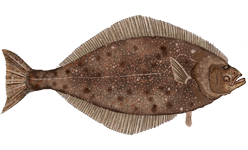 Pacific HalibutHippoglossus stenolepis
-
 Greenland HalibutReinhardtius hippoglossoides
-
 Lemon SoleMicrostomus kitt
-
 European FlounderPlatichthys flesus
-
 Common DabLimanda limanda
Compare
Questions and answers
What is the scientific name of the Comb Flounder?
The scientific name of the Comb Flounder is Marleyella bicolorata. Written with its author, the full name is Marleyella bicolorata (von Bonde, 1922).
Which family does the Comb Flounder belong to?
Marleyella bicolorata belongs to the family Pleuronectidae, in the order Pleuronectiformes and the class Teleostei.
Where is the Comb Flounder found?
Checklists and occurrence records place Marleyella bicolorata in 3 countries: South Africa, Mozambique and New Caledonia.
What is the conservation status of the Comb Flounder?
The IUCN Red List category recorded for Marleyella bicolorata is Data Deficient (DD).
What other names does the Comb Flounder have?
Marleyella bicolorata is also known in English as Bicolor Righteye Flounder.
Sources
Passages the profile rests on
- The species is a flatfish with both eyes positioned on its right side. Source passage: “The comb flounder is a right-eyed flatfish.” — English Wikipedia
- The eyed side of the fish is dark brown with vaguely cruciform dark spots and blotches. Source passage: “Its upper (eyed) side is dark brown, marked with vaguely cruciform dark spots and blotches” — English Wikipedia
- The fish has round black spots on its head. Source passage: “with round black spots on the head” — English Wikipedia
- The fish has a dark bar at the base of its caudal fin. Source passage: “and a dark bar at the base of the caudal fin.” — English Wikipedia
- The underside of the fish is dark brown. Source passage: “The underside is also dark brown.” — English Wikipedia
- The species can reach a maximum length of 19 centimetres. Source passage: “It can grow up to 19 centimetres (7.5 in) in length.” — English Wikipedia
- The species is demersal and inhabits saltwater bottoms. Source passage: “It is a demersal fish that lives on saltwater bottoms” — English Wikipedia
- The species occurs at depths ranging from 20 to 406 metres. Source passage: “at depths of between 20 and 406 metres (66 and 1,332 ft).” — English Wikipedia
Data
- Catalogue of Life, 2026-10-16 XR cc by
- Global Biodiversity Information Facility CC BY 4.0
- Wikidata CC0
- GeoNames CC BY 4.0
- Wikimedia Commons per image; credit shown with each image
- Within the Catalogue of Life, this name comes from World Register of Marine Species cc by
This species in other databases
- Catalogue of Life 3Y7R4
- Wikidata Q1823139
- iNaturalist 619377
- WoRMS urn:lsid:marinespecies.org:taxname:219814
- ITIS 172968
Page built on 29 November 2026. See how the catalog is made and all sources and licences.
Cite this page
ScientificNames.org. (2026). Marleyella bicolorata (Comb Flounder). Retrieved November 29, 2026, from https://scientificnames.org/species/marleyella-bicolorata
“Marleyella bicolorata (Comb Flounder).” ScientificNames.org, 2026, scientificnames.org/species/marleyella-bicolorata. Accessed 29 Nov. 2026.
ScientificNames.org. “Marleyella bicolorata (Comb Flounder).” Accessed November 29, 2026. https://scientificnames.org/species/marleyella-bicolorata.
@misc{scientificnames_marleyella_bicolorata_comb_flounder,
  author = {{ScientificNames.org}},
  title = {Marleyella bicolorata (Comb Flounder)},
  year = {2026},
  url = {https://scientificnames.org/species/marleyella-bicolorata},
  note = {Accessed 2026-11-29}
}