Species · Molluscs
Ochlockonee Moccasinshell Medionidus simpsonianus
The scientific name of the Ochlockonee Moccasinshell is Medionidus simpsonianus. It is a species of mollusc, order Unionida. The name dates from 1905.
- Scientific name
- Medionidus simpsonianus B. Walker, 1905
- Common name
- Ochlockonee Moccasinshell
- Genus
- Medionidus
- Order
- Unionida
- Class
- Bivalvia
- Red List category
- CR Critically Endangered
- Environment
- freshwater
- Recorded in
- 1 country
- Name status
- accepted in the Catalogue of Life

Overview
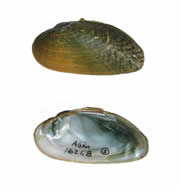
The natural habitat consists of rivers. Its dark yellow shell has dark green pencilled rays forming angular network-like lines and pronounced folds on the posterior slope.
Written 27 November 2026 from the sources listed below. Each statement was checked against the passage it cites; statements that could not be supported were removed.
Appearance
The shell is small, relatively thin, somewhat inflated, elliptical and asymmetrical. Its outer surface is dark yellow, smooth and polished, with dark green pencilled rays forming angular network-like lines.[1][2]
The anterior end is compressed, rounded and slightly elevated above the hinge line. The posterior end is bluntly rounded, with its tip positioned nearly on the shell's median line, and the posterior ridge is somewhat angular.[3][4][5]
The posterior slope has pronounced folds. The dorsal slope has strong, somewhat irregular concentric ridges extending from the posterior ridge to the shell margin.[6][7]
The basal margin is regularly curved, while the hinge margin is nearly straight. The cardinal teeth are upright, relatively compressed and crenulated, and the lateral teeth are slender, straight and nearly smooth.[8][9][10]
The anterior muscle scars are deeply impressed, while the posterior scars are distinct. The beak cavity is relatively shallow, and the main cavity is deep and uniform.[11][12]
The nacre is bluish-white and relatively thicker toward the anterior end.[13]
The original species description records a shell length of 36 mm, height of 19 mm and width of 13 mm. The species is generally smaller than 55 mm in length.[14][15]
Habitat
The species' natural habitat consists of rivers.[16]
The species is endemic to the United States.[17]
Similar species
The Ochlockonee Moccasinshell belongs to the conradicus group of Medionidus. Medionidus penicillatus is identified as its closest relative in the original description.[18][19]
The species differs from its described relatives in its compressed anterior end, elevated upper anterior margin and regularly rounded posterior margin.[20]
Its posterior-slope ridges are as strong as those of Medionidus kinyii but are less numerous.[21]
Classification of the Ochlockonee Moccasinshell
| Kingdom | Animalia |
|---|---|
| Phylum | Mollusca |
| Class | Bivalvia |
| Subclass | Autobranchia |
| Infraclass | Heteroconchia |
| Subterclass | Palaeoheterodonta |
| Order | Unionida |
| Subfamily | Ambleminae |
| Tribe | Lampsilini |
| Genus | Medionidus (Moccasinshells) |
| Species | Medionidus simpsonianus B. Walker, 1905 |
Where the Ochlockonee Moccasinshell is found
Checklists and occurrence records place Medionidus simpsonianus in 1 country. GBIF holds 55 georeferenced records of it.
Countries
Regions and cities with the most records
A number beside a place is its count of GBIF occurrence records. A place without a number comes from a checklist alone. Records show where a species has been observed or collected, which can include escapes and vagrants.
Common names
English
- Ochlockonee Moccasinshell
Related species
-
 Suwannee MoccasinshellMedionidus walkeri
-
 Alabama MoccasinshellMedionidus acutissimus
-
 Coosa MoccasinshellMedionidus parvulus
-
 Gulf MoccasinshellMedionidus penicillatus
-
 Cumberland MoccasinshellMedionidus conradicus
- Medionidus lapilloides
Compare
Questions and answers
What is the scientific name of the Ochlockonee Moccasinshell?
The scientific name of the Ochlockonee Moccasinshell is Medionidus simpsonianus. Written with its author, the full name is Medionidus simpsonianus B. Walker, 1905.
Where is the Ochlockonee Moccasinshell found?
Checklists and occurrence records place Medionidus simpsonianus in 1 country: United States.
What is the conservation status of the Ochlockonee Moccasinshell?
The IUCN Red List category recorded for Medionidus simpsonianus is Critically Endangered (CR).
What habitat do mussels live in?
The Ochlockonee Moccasinshell's natural habitat consists of rivers.[16]
Sources
Passages the profile rests on
- The shell is small, relatively thin, somewhat inflated, elliptical and asymmetrical. Source passage: “Shell small, rather thin, somewhat inflated, elliptical, inequilateral” — English Wikipedia
- The shell's outer surface is dark yellow, smooth and polished, with dark green pencilled rays forming angular network-like lines. Source passage: “Epidermis dark yellow, smooth, polished, covered with dark green pencilled rays which tend to break into a net-work of angular lines covering the entire surface.” — English Wikipedia
- The anterior end of the shell is compressed, rounded and slightly elevated above the hinge line. Source passage: “Anterior end compressed, rounded, and slightly elevated above the line of the hinge superiorly;” — English Wikipedia
- The posterior end is bluntly rounded, with its tip positioned nearly on the shell's median line. Source passage: “posterior extremity obtusely rounded, the tip being nearly on the median line of the shell;” — English Wikipedia
- The posterior ridge is somewhat angular. Source passage: “posterior ridge somewhat angled;” — English Wikipedia
- The posterior slope of the shell has pronounced folds. Source passage: “strongly plicate on the posterior slope.” — English Wikipedia
- The dorsal slope has strong, somewhat irregular concentric ridges extending from the posterior ridge to the shell margin. Source passage: “dorsal slope covered with strong sub-concentric, somewhat irregular ridges extending from the posterior ridge to the margin;” — English Wikipedia
- The shell's basal margin is regularly curved and its hinge margin is nearly straight. Source passage: “basal margin regularly curved; hinge margin nearly straight,” — English Wikipedia
- The cardinal teeth are upright, relatively compressed and crenulated. Source passage: “Cardinal teeth crenulate, erect, rather compressed,” — English Wikipedia
- The lateral teeth are slender, straight and nearly smooth. Source passage: “lateral teeth slender, straight and nearly smooth.” — English Wikipedia
- The shell's anterior muscle scars are deeply impressed, while its posterior scars are distinct. Source passage: “Anterior cicatrices well impressed, posterior cicatrices distinct,” — English Wikipedia
- The shell's beak cavity is relatively shallow, while its main cavity is deep and uniform. Source passage: “Beak cavity rather shallow, cavity of the shell deep and uniform.” — English Wikipedia
- The nacre is bluish-white and relatively thicker toward the anterior end. Source passage: “Nacre bluish-white, rather thicker anteriorly.” — English Wikipedia
- The original species description records a shell length of 36 mm, height of 19 mm and width of 13 mm. Source passage: “Length 36; height 19, width 13 mm.” — English Wikipedia
- The species is generally smaller than 55 mm in length. Source passage: “The Ochlockonee moccasinshell is a small species, generally under 55 mm (2.2” — govinfo.gov
- The species' natural habitat consists of rivers. Source passage: “Its natural habitat is rivers.” — English Wikipedia
- The species is endemic to the United States. Source passage: “This species is endemic to the United States.” — English Wikipedia
- The species belongs to the conradicus group of Medionidus. Source passage: “This species belongs to the "conradicus" group of Medionidus as defined by Simpson,” — English Wikipedia
- Medionidus penicillatus is identified as the species' closest relative in the original description. Source passage: “and is most nearly related to M. penicillatus.” — English Wikipedia
- The species differs from its described relatives in its compressed anterior end, elevated upper anterior margin and regularly rounded posterior margin. Source passage: “the compression of the anterior end, the elevation of the superior-anterior margin and the regularly rounded posterior margin,” — English Wikipedia
- Its posterior-slope ridges are as strong as those of Medionidus kinyii but are less numerous. Source passage: “The ridges on the posterior slope are quite as strong, but not so numerous as in M. kinyii.” — English Wikipedia
Data
- Catalogue of Life, 2026-10-16 XR cc by
- Global Biodiversity Information Facility CC BY 4.0
- Wikidata CC0
- GeoNames CC BY 4.0
- Wikimedia Commons per image; credit shown with each image
- Within the Catalogue of Life, this name comes from World Register of Marine Species cc by
References
- Walker, B. (1905). A new species of Medionidus. The Nautilus, 18. where the name was published
This species in other databases
Page built on 29 November 2026. See how the catalog is made and all sources and licences.
Cite this page
ScientificNames.org. (2026). Medionidus simpsonianus (Ochlockonee Moccasinshell). Retrieved November 29, 2026, from https://scientificnames.org/species/medionidus-simpsonianus
“Medionidus simpsonianus (Ochlockonee Moccasinshell).” ScientificNames.org, 2026, scientificnames.org/species/medionidus-simpsonianus. Accessed 29 Nov. 2026.
ScientificNames.org. “Medionidus simpsonianus (Ochlockonee Moccasinshell).” Accessed November 29, 2026. https://scientificnames.org/species/medionidus-simpsonianus.
@misc{scientificnames_medionidus_simpsonianus_ochlockonee_moccasinshell,
  author = {{ScientificNames.org}},
  title = {Medionidus simpsonianus (Ochlockonee Moccasinshell)},
  year = {2026},
  url = {https://scientificnames.org/species/medionidus-simpsonianus},
  note = {Accessed 2026-11-29}
}