Species · Fishes
Indo-Pacific Tarpon Megalops cyprinoides
The scientific name of the Indo-Pacific Tarpon is Megalops cyprinoides. It is a species of fish in the family Megalopidae (oxeye), order Elopiformes. The name dates from 1782.
- Scientific name
- Megalops cyprinoides (Broussonet, 1782)
- Common name
- Indo-Pacific Tarpon
- Genus
- Megalops
- Family
- Megalopidae (Oxeye)
- Order
- Elopiformes
- Class
- Teleostei
- Red List category
- DD Data Deficient
- Environment
- brackish, freshwater, marine
- Recorded in
- 33 countries
- Name status
- accepted in the Catalogue of Life
Overview
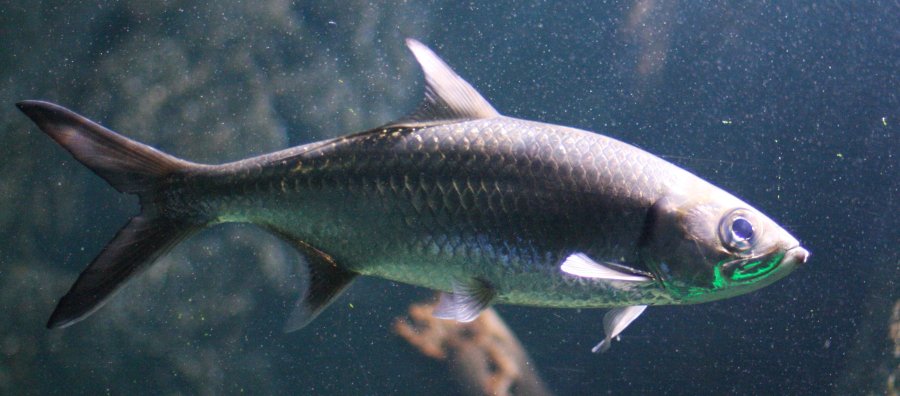
The Indo-Pacific Tarpon is a ray-finned fish belonging to the family Megalopidae. It occurs in tropical coastal and brackish waters of the Indo-Pacific region, in both freshwater and saltwater environments. It has an olive-green upper body, silver sides, a large upward-facing mouth, and an elongated bony plate in its lower jaw.
Written 26 November 2026 from the sources listed below. Each statement was checked against the passage it cites; statements that could not be supported were removed.
Appearance
The Indo-Pacific Tarpon has an olive-green upper body and silver sides. Its large mouth faces upward, and its lower jaw contains an elongated bony plate.[1][2][3]
The last ray of its dorsal fin is considerably longer than the other rays and extends nearly to the tail.[4]
Habitat
The Indo-Pacific Tarpon inhabits coral reefs, mangroves, swamps, rivers, lakes, reservoirs, floodplains, and canals. It occurs in coastal waters and estuaries, as well as freshwater rivers and lakes far upstream from estuaries.[5][6][7][8]
The species is commonly found near the surface in shallow inshore waters and occurs at depths reaching 50 m.[9][10]
Diet
The Indo-Pacific Tarpon feeds opportunistically on smaller fish and crustaceans and occasionally consumes plants. In saltwater, its principal foods include prawns and herring.[11][12]
In freshwater, the species mainly consumes freshwater prawns and bony bream.[13]
Behaviour
The Indo-Pacific Tarpon migrates between the open sea and inland rivers, moving between rivers and the sea in both directions. It can fill its swim bladder with air and absorb oxygen from it.[14][15][16]
Juveniles remain inshore and move toward coastal areas as they mature for spawning.[17]
Reproduction and life cycle
The Indo-Pacific Tarpon spawns mainly offshore and typically spawns twice annually. It can reproduce in both freshwater and saltwater and reaches sexual maturity within two years.[18][19][20][21]
Its larvae are flattened, transparent, and eel-like. The species completes metamorphosis from its larval stage in 10 days.[22][23]
Conservation
The Indo-Pacific Tarpon is described as extremely common throughout its geographical range. Population data are deficient because commercial landings and human disturbances are unknown.[24][25]
Similar species
The Indo-Pacific Tarpon is smaller than the other tarpon species.[26]
Classification of the Indo-Pacific Tarpon
| Kingdom | Animalia |
|---|---|
| Phylum | Chordata |
| Subphylum | Vertebrata |
| Infraphylum | Gnathostomata |
| Parvphylum | Osteichthyes |
| Gigaclass | Actinopterygii |
| Superclass | Actinopteri |
| Class | Teleostei (Teleost) |
| Order | Elopiformes |
| Family | Megalopidae (Oxeye) |
| Genus | Megalops (Tarpons) |
| Species | Megalops cyprinoides (Broussonet, 1782) |
Where the Indo-Pacific Tarpon is found
Checklists and occurrence records place Megalops cyprinoides in 33 countries. GBIF holds 1,977 georeferenced records of it.
Countries
- Australia 599
- Bangladesh 18
- Brunei 5
- China 25
- Fiji 10
- French Polynesia 10
- Hong Kong 26
- India 123
- Indonesia 176
- Japan 207
- Madagascar 38
- Malaysia 38
- Mauritius 3
- Mayotte 15
- Micronesia 3
- Mozambique 28
- Myanmar 4
- New Caledonia 9
- Northern Mariana Islands 8
- Papua New Guinea 25
- Philippines 146
- Reunion 4
- Samoa 11
- Saudi Arabia 4
- Singapore 23
- South Africa 99
- South Korea 5
- Sri Lanka 11
- Taiwan 235
- Tanzania 17
- Thailand 35
- Vietnam 14
- Zimbabwe 3
Regions and cities with the most records
- Queensland, Australia 231
- Northern Territory, Australia 197
- Taiwan, Taiwan 87
- KwaZulu-Natal, South Africa 53
- Palmerston, Australia 43
- Tainan, Taiwan 36
- Kerala, India 34
- Kokōtamangalam South, India 33
- Srīkandamangalam, India 33
- Thanneermukkom, India 33
- Yongkang, Taiwan 32
- Aroor, India 30
- Arukutti, India 30
- Ezhupunna, India 30
- Kodamthuruth, India 30
- Kumbalam, India 30
- Manakunnam, India 30
- Yilan, Taiwan 30
- Cherthala, India 29
- Kutiatodu, India 29
- Shertallai, India 29
- Thaikkattussery, India 29
- Vaikam, India 29
- Vayalār, India 29
- Kochi, India 28
- Pallipuram, India 28
- Darwin, Australia 27
- Maradu, India 27
- Mulamthuruthy, India 27
- Tripunittura, India 26
- Neihu, Taiwan 25
- New Taipei City, Taiwan 25
- Western Australia, Australia 24
- Banqiao, Taiwan 22
- Chaozhou, Taiwan 22
- Donggang, Taiwan 22
A number beside a place is its count of GBIF occurrence records. A place without a number comes from a checklist alone. Records show where a species has been observed or collected, which can include escapes and vagrants.
Common names
English
- Indo-Pacific Tarpon
- Indopacific Tarpon
- Ox-eye Tarpon
- Oxeye Herring
- Oxeye
Names in 16 other languages
- Arabic
- خنجولة الهادي الهندي, طربون الهادي الهندي
- Chinese
- 大海鰱, 大海鰱 (大眼海鰱), 大眼海鰱, 海菴, 海鰱, 溪鰳, 粗鱗鰱, 草鰱
- Czech
- tarpon indický
- Dutch
- Indopacifische tarpoen
- French
- Tarpon, tarpon indo-pacifique
- German
- Indopazifischer Tarpun
- Indonesian
- Bulan-bulan
- Italian
- Tarpone indo-pacifico
- Japanese
- イセゴイ
- Korean
- 인도-태평양 타폰, 풀잉어
- Portuguese
- Tarpão-do-Indo-Pacífico
- Russian
- Индо-тихоокеанский тарпон
- Spanish
- tarpón indo-pacífico
- Tamil
- மோரான் கெண்டை
- Thai
- ปลาตาเหลือก, ปลาตาเหลือกสั้น
- Vietnamese
- Cá Cháo Lớn
Synonyms
19 other scientific names have been used for this species and are now treated as synonyms of Megalops cyprinoides.
- Brisbania staigeri Castelnau, 1878
- Clupea cyprinoides Broussonet, 1782
- Clupea gigantea Shaw, 1804
- Clupea thrissoides Bloch & Schneider, 1801
- Cyprinodon cundinga Hamilton, 1822
- Elops cundinga (Hamilton, 1822)
- Elops cyprinoides (Broussonet, 1782)
- Magalops cyprinoides (Broussonet, 1782)
- Megalops cundinga (Hamilton, 1822)
- Megalops curtifilis Richardson, 1846
- Megalops cyoprinoides (Broussonet, 1782)
- Megalops filamentosus Lacepède, 1803
- Megalops giganteus (Shaw, 1804)
- Megalops indicus Valenciennes, 1847
- Megalops kundinga Bleeker, 1866
- Megalops macrophthalmus Bleeker, 1851
- Megalops macropterus Bleeker, 1866
- Megalops oligolepis Bleeker, 1866
- Megalops setipinnis Richardson, 1843
Related species

Compare
Questions and answers
What is the scientific name of the Indo-Pacific Tarpon?
The scientific name of the Indo-Pacific Tarpon is Megalops cyprinoides. Written with its author, the full name is Megalops cyprinoides (Broussonet, 1782).
Which family does the Indo-Pacific Tarpon belong to?
Megalops cyprinoides belongs to the family Megalopidae, in the order Elopiformes and the class Teleostei.
Where is the Indo-Pacific Tarpon found?
Checklists and occurrence records place Megalops cyprinoides in 33 countries, including Australia, Taiwan, Japan, Indonesia, Philippines and India.
What is the conservation status of the Indo-Pacific Tarpon?
The IUCN Red List category recorded for Megalops cyprinoides is Data Deficient (DD).
What other names does the Indo-Pacific Tarpon have?
Megalops cyprinoides is also known in English as Indopacific Tarpon, Ox-eye Tarpon, Oxeye Herring and Oxeye.
How big can Indo-Pacific tarpon get?
Freshwater individuals grow to just over 50 cm in length, while saltwater individuals grow to more than 1 m.[27][28]
Sources
Passages the profile rests on
- The Indo-Pacific tarpon has an olive-green upper body and silver sides. Source passage: “olive-green on top, and silver on the sides.” — English Wikipedia
- The species has a large, upward-facing mouth. Source passage: “The large mouth is turned upwards;” — English Wikipedia
- Its lower jaw contains an elongated bony plate. Source passage: “the lower jaw contains an elongated, bony plate.” — English Wikipedia
- The last ray of its dorsal fin is considerably longer than the other rays and extends nearly to the tail. Source passage: “The last ray of the dorsal fin is much longer than the others, reaching nearly to the tail.” — English Wikipedia
- The species inhabits coral reefs. Source passage: “They inhabit coral reefs, mangroves, swamps, rivers, lakes, reservoirs, floodplains, and canals.” — English Wikipedia
- The species inhabits mangroves. Source passage: “They inhabit coral reefs, mangroves, swamps, rivers, lakes, reservoirs, floodplains, and canals.” — English Wikipedia
- The species occurs in swamps, rivers, lakes, reservoirs, floodplains, and canals. Source passage: “swamps, rivers, lakes, reservoirs, floodplains, and canals.” — English Wikipedia
- The species occurs in coastal waters, estuaries, and freshwater rivers and lakes far upstream from estuaries. Source passage: “Their usual habitat is in coastal waters, estuaries and many miles upstream (from the estuaries) in freshwater rivers and lakes.” — English Wikipedia
- The species occurs at depths reaching 50 m. Source passage: “They are found at depths to 50 m (160 ft),” — English Wikipedia
- The species is commonly found near the surface in shallow inshore waters. Source passage: “but are commonly found by the surface in shallow, inshore waters.” — English Wikipedia
- The species feeds opportunistically on smaller fish and crustaceans, and occasionally consumes plants. Source passage: “They are opportunistic, feeding on smaller fish, crustaceans, and even plants rarely.” — English Wikipedia
- In saltwater, its principal foods include prawns and herring. Source passage: “In salt water, they mainly feed on prawns and herring,” — English Wikipedia
- In freshwater, the species mainly consumes freshwater prawns and bony bream. Source passage: “they eat freshwater prawns and bony bream, mainly.” — English Wikipedia
- The species can fill its swim bladder with air and absorb oxygen from it. Source passage: “It is capable of filling its swim bladder with air and absorbing oxygen from it.” — English Wikipedia
- The species migrates between the open sea and inland rivers. Source passage: “The Indo-Pacific tarpon migrates between the open sea and inland rivers.” — English Wikipedia
- The species migrates between rivers and the sea in both directions. Source passage: “They are amphidromus, i.e. they migrate from the river to the sea, and from the sea to the river.” — English Wikipedia
- Juveniles remain inshore and move toward coastal areas as they mature for spawning. Source passage: “Juveniles of the species stay inshore and migrate to coastal areas while maturing to spawn.” — English Wikipedia
- The species spawns mainly offshore. Source passage: “As with all Elopiformes, it spawns mainly offshore.” — English Wikipedia
- The species typically spawns twice annually. Source passage: “Typically, they spawn twice a year.” — English Wikipedia
- The Indo-Pacific tarpon can reproduce in both freshwater and saltwater. Source passage: “they are able to breed in fresh and salt water.” — English Wikipedia
- The species reaches sexual maturity within two years. Source passage: “They live upwards of 44 years and mature within two.” — English Wikipedia
- Its larvae are flattened, transparent, and eel-like. Source passage: “the larvae migrate inland and are leptocephalic (flattened, transparent and eel-like).” — English Wikipedia
- The species completes metamorphosis from its larval stage in 10 days. Source passage: “They complete their metamorphosis from their larval stage in 10 days.” — English Wikipedia
- The species is described as extremely common throughout its geographical range. Source passage: “but they are known to be extremely common throughout their range.” — English Wikipedia
- Population data are deficient because commercial landings and human disturbances are unknown. Source passage: “Data are deficient on their population, as their commercial landings and human disturbances are unknown,” — English Wikipedia
- The Indo-Pacific tarpon is smaller than the other tarpon species. Source passage: “is the smaller of the two species of tarpon” — English Wikipedia
- Freshwater individuals grow to just over 50 cm in length. Source passage: “Those living in fresh water tend to be smaller than the ones living in saltwater, growing just over 50 cm (20 in),” — English Wikipedia
- Saltwater individuals grow to more than 1 m in length. Source passage: “saltwater examples grow over 1 m (3.3 ft).” — English Wikipedia
Data
- Catalogue of Life, 2026-10-16 XR cc by
- Global Biodiversity Information Facility CC BY 4.0
- Wikidata CC0
- GeoNames CC BY 4.0
- Wikimedia Commons per image; credit shown with each image
- Within the Catalogue of Life, this name comes from World Register of Marine Species cc by
This species in other databases
- Catalogue of Life 3YVJV
- Wikidata Q221572
- iNaturalist 62618
- WoRMS urn:lsid:marinespecies.org:taxname:212253
- ITIS 553289
Page built on 29 November 2026. See how the catalog is made and all sources and licences.
Cite this page
ScientificNames.org. (2026). Megalops cyprinoides (Indo-Pacific Tarpon). Retrieved November 29, 2026, from https://scientificnames.org/species/megalops-cyprinoides
“Megalops cyprinoides (Indo-Pacific Tarpon).” ScientificNames.org, 2026, scientificnames.org/species/megalops-cyprinoides. Accessed 29 Nov. 2026.
ScientificNames.org. “Megalops cyprinoides (Indo-Pacific Tarpon).” Accessed November 29, 2026. https://scientificnames.org/species/megalops-cyprinoides.
@misc{scientificnames_megalops_cyprinoides_indo_pacific_tarpon,
  author = {{ScientificNames.org}},
  title = {Megalops cyprinoides (Indo-Pacific Tarpon)},
  year = {2026},
  url = {https://scientificnames.org/species/megalops-cyprinoides},
  note = {Accessed 2026-11-29}
}