Species · Birds
White-fronted Woodpecker Melanerpes cactorum
The scientific name of the White-fronted Woodpecker is Melanerpes cactorum. It is a species of bird in the family Picidae (woodpecker), order Piciformes. The name dates from 1840.
- Scientific name
- Melanerpes cactorum (d'Orbigny, 1840)
- Common name
- White-fronted Woodpecker
- Genus
- Melanerpes
- Family
- Picidae (Woodpecker)
- Order
- Piciformes
- Class
- Aves
- Red List category
- LC Least Concern
- Recorded in
- 5 countries
- Name status
- accepted in the Catalogue of Life

Overview
The White-fronted Woodpecker (Melanerpes cactorum) is a medium-sized woodpecker measuring approximately 17 cm in length. It is native to central South America, where it inhabits dry forests, shrubland, Chaco, savannah and semi-desert areas. It has a white forehead and cheeks, glossy black upperparts, bluish-black wings with white barring and grey underparts.
Written 26 November 2026 from the sources listed below. Each statement was checked against the passage it cites; statements that could not be supported were removed.
Appearance
Adult males and females have similar plumage, although males may have a small red crown patch. The crown, nape and upperparts are glossy black, with a narrow white line extending from the white nape patch down the back.[1][2]
A black facial mask surrounds the eye and extends to the mantle. The forehead and cheeks are white, while the chin and throat can be white, yellow or buff.[3][4][5]
The upper wing surfaces are bluish-black with prominent white barring. The breast and belly are grey, with indistinct barring on the flanks and lower belly.[6][7]
The iris is reddish-brown, the bill is greyish-black and the legs are grey. The species has a white forehead, a yellow or white throat, greyish underparts and a barred mantle and tail.[8][9]
Juveniles generally have duller black plumage and more heavily barred underparts than adults. Juveniles of both sexes have traces of red or orange on the middle of the crown.[10][11]
Adult individuals measure approximately 17 cm in length.[12]
Habitat
Its natural habitats include subtropical or tropical dry forests, dry shrubland and high-altitude shrubland. It occurs in Chaco, savannah and semi-desert areas containing scattered trees, shrubs and cacti.[13][14][15][16]
It also occupies palm groves, gallery forests and agricultural land with scattered trees. It occurs at elevations reaching approximately 2,500 m.[17][18]
The species is native to central South America. Its documented range includes southeastern Peru, Bolivia, Uruguay, northern Argentina, Paraguay and southeastern Brazil, with records mainly from Bolivia, Paraguay and Argentina.[19][20][21][22][23][24][25][26]
Behaviour
The species is sedentary and does not migrate. During the study period, individuals drilled holes in the trunks and branches of Prosopis flexuosa.[27][28]
Its call is described as a nasal, repeated weep-weep sound.[29]
Conservation
The species has a very extensive geographical range and its population is considered stable. It is described as common, and no particular threats have been recognised.[30][31][32][33]
The White-fronted Woodpecker is classified as Least Concern by the International Union for Conservation of Nature. Its most recent assessment for the IUCN Red List was in 2018.[34][35]
Classification of the White-fronted Woodpecker
| Kingdom | Animalia |
|---|---|
| Phylum | Chordata |
| Subphylum | Vertebrata |
| Infraphylum | Gnathostomata |
| Parvphylum | Osteichthyes |
| Megaclass | Tetrapoda |
| Class | Aves (Bird) |
| Order | Piciformes (Woodpeckers) |
| Family | Picidae (Woodpecker) |
| Subfamily | Picinae |
| Genus | Melanerpes (Melanerpine Woodpeckers) |
| Species | Melanerpes cactorum (d'Orbigny, 1840) |
Where the White-fronted Woodpecker is found
Checklists and occurrence records place Melanerpes cactorum in 5 countries across South America. GBIF holds 27,368 georeferenced records of it.
Countries
Regions and cities with the most records
- Cordoba, Argentina 8,212
- Entre Rios, Argentina 4,591
- La Calera, Argentina 4,104
- Córdoba, Argentina 3,780
- Unquillo, Argentina 3,007
- Santa Fe, Argentina 2,819
- Chaco, Argentina 1,545
- Cosquín, Argentina 1,335
- San Luis, Argentina 1,252
- Salta, Argentina 1,242
- Santiago del Estero, Argentina 1,178
- Fontana, Argentina 871
- Paraná, Argentina 859
- Resistencia, Argentina 832
- Barranqueras, Argentina 830
- Corrientes, Argentina 802
- Catamarca, Argentina 777
- Diamante, Argentina 733
- Santa Cruz Department, Bolivia 571
- Formosa, Argentina 567
- Mendoza, Argentina 506
- Boquerón Department, Paraguay 505
- Esperanza, Argentina 494
- Santa Fe, Argentina 492
- Santiago del Estero, Argentina 478
- Cafayate, Argentina 460
- La Falda, Argentina 443
- Presidente Hayes, Paraguay 439
- Santo Tomé, Argentina 433
- Alta Gracia, Argentina 430
- Tucuman, Argentina 421
- San Isidro, Argentina 416
- Catamarca, Argentina 415
- Villa Carlos Paz, Argentina 410
- Cochabamba, Bolivia 359
- Mato Grosso, Brazil 354
Range as the checklists state it
South America
A number beside a place is its count of GBIF occurrence records. A place without a number comes from a checklist alone. Records show where a species has been observed or collected, which can include escapes and vagrants.
Common names
English
- White-fronted Woodpecker
Names in 26 other languages
- Catalan
- picot dels cactus
- Chinese
- 白額啄木, 白额啄木鸟
- Croatian
- bjeločeli djetlić
- Czech
- datel kaktusový
- Danish
- Kaktusspætte
- Dutch
- Cactusspecht
- Esperanto
- blankfrunta pego
- Estonian
- valgekukal-maskrähn
- Finnish
- valko-otsatikka
- French
- Pic des cactus
- German
- Kaktusspecht
- Hungarian
- fehérhomlokú küllő
- Italian
- Picchio frontebianca
- Japanese
- サボテンゲラ
- Lithuanian
- baltakaktis tamsianugaris genys
- Norwegian
- hvitpannespett
- Polish
- dzięciur białoczelny
- Portuguese
- pica-pau-de-testa-branca, pica-pau-dos-cactos
- Russian
- Белолобый дятел, Кактусовый дятел
- Serbian
- Beločeli detlić
- Slovak
- tesárik bieločelý
- Spanish
- Carpintero de los cardones, Carpintero del cardón
- Swedish
- vitpannad hackspett
- Turkish
- Ak Alınlı Ağaçkakan
- Ukrainian
- гіла кактусова
- Welsh
- cnocell fronwen
Synonyms
4 other scientific names have been used for this species and are now treated as synonyms of Melanerpes cactorum.
- Centurus cactorum d'Orbigny, ACVMD, 1839
- Picus cactorum d'Orbigny, ACVMD, 1839
- Trichopicus cactorum d'Orbigny, ACVMD, 1839
- Trichopicus cactorum parvus Brodkorb, P, 1941
Related species
-
 Red-bellied WoodpeckerMelanerpes carolinus
-
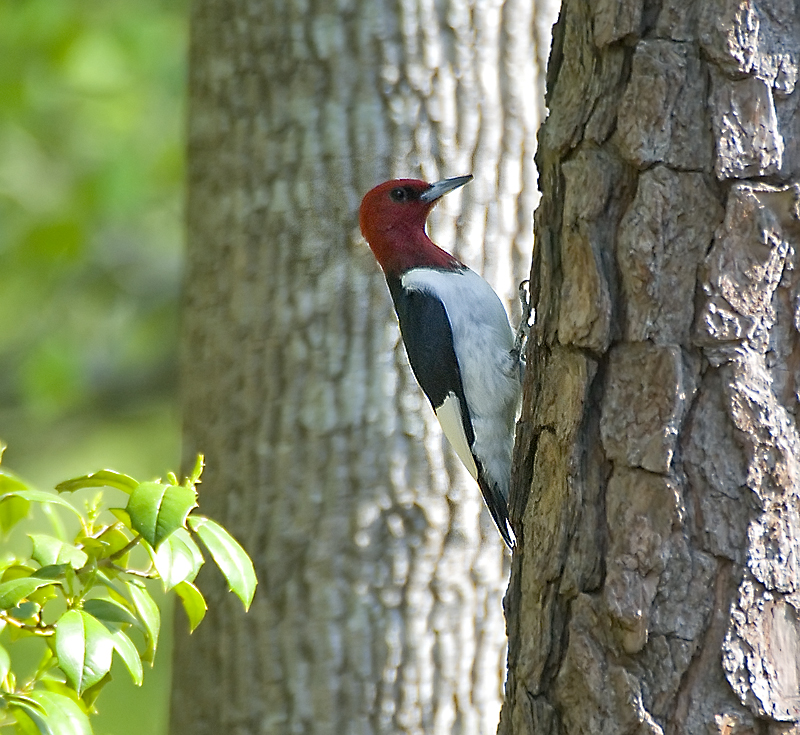 Red-headed WoodpeckerMelanerpes erythrocephalus
-
 Acorn WoodpeckerMelanerpes formicivorus
-
 Gila WoodpeckerMelanerpes uropygialis
-
 Lewis's WoodpeckerMelanerpes lewis
- Golden-fronted WoodpeckerMelanerpes aurifrons
-
 Hispaniolan WoodpeckerMelanerpes striatus
-
 Red-crowned WoodpeckerMelanerpes rubricapillus
Compare
Questions and answers
What is the scientific name of the White-fronted Woodpecker?
The scientific name of the White-fronted Woodpecker is Melanerpes cactorum. Written with its author, the full name is Melanerpes cactorum (d'Orbigny, 1840).
Which family does the White-fronted Woodpecker belong to?
Melanerpes cactorum belongs to the family Picidae, in the order Piciformes and the class Aves.
Where is the White-fronted Woodpecker found?
Checklists and occurrence records place Melanerpes cactorum in 5 countries: Argentina, Paraguay, Bolivia, Brazil and Uruguay.
What is the conservation status of the White-fronted Woodpecker?
The IUCN Red List category recorded for Melanerpes cactorum is Least Concern (LC).
What type of habitat do woodpeckers live in?
The White-fronted Woodpecker inhabits subtropical or tropical dry forests, dry shrubland and high-altitude shrubland. It also occurs in Chaco, savannah, semi-desert areas, palm groves, gallery forests and agricultural land with scattered trees.[13][14][15][16][17]
Sources
Passages the profile rests on
- Adult males and females have similar plumage, although males may have a small red crown patch. Source passage: “The sexes are similar in appearance except for a small patch of red, not always visible, on the crown in males.” — English Wikipedia
- The crown, nape and upperparts are glossy black, with a narrow white line extending from the white nape patch down the back. Source passage: “The crown, nape and upper parts are glossy black, apart from a thin white line running from a white nape patch down the centre of the back.” — English Wikipedia
- A black facial mask surrounds the eye and extends to the mantle. Source passage: “A black mask surrounds the eye and extends to the mantle.” — English Wikipedia
- The forehead and cheeks are white. Source passage: “The fore-crown and cheeks are white” — English Wikipedia
- The chin and throat can be white, yellow or buff. Source passage: “the chin and throat are white, yellow or buff.” — English Wikipedia
- The upper wing surfaces are bluish-black with prominent white barring. Source passage: “The upper side of the wings is bluish-black, boldly barred with white” — English Wikipedia
- The breast and belly are grey, with indistinct barring on the flanks and lower belly. Source passage: “The breast and belly are some shade of grey, with indistinct barring on the flanks and lower belly.” — English Wikipedia
- The iris is reddish-brown, the bill is greyish-black and the legs are grey. Source passage: “The iris is reddish-brown, the beak greyish-black and the legs grey.” — English Wikipedia
- The species has a white forehead, a yellow or white throat, greyish underparts and a barred mantle and tail. Source passage: “Has a white forehead and a yellow or white throat and is grayish below with a barred mantle and tail.” — ebird.org
- Juveniles generally have duller black plumage and more heavily barred underparts than adults. Source passage: “Juveniles are similar to the adults but are generally a duller black, the underparts being more heavily barred” — English Wikipedia
- Juveniles of both sexes have traces of red or orange on the middle of the crown. Source passage: “both sexes having traces of red or orange on the mid-crown.” — English Wikipedia
- Adult individuals measure approximately 17 cm in length. Source passage: “The adult white-fronted woodpecker is about 17 cm (7 in) in length.” — English Wikipedia
- Its natural habitats include subtropical or tropical dry forests. Source passage: “Its natural habitats are subtropical or tropical dry forests” — English Wikipedia
- It inhabits subtropical or tropical dry shrubland. Source passage: “subtropical or tropical dry shrubland” — English Wikipedia
- It also occurs in subtropical or tropical high-altitude shrubland. Source passage: “subtropical or tropical high-altitude shrubland.” — English Wikipedia
- Typical habitats include Chaco, savannah and semi-desert areas containing scattered trees, shrubs and cacti. Source passage: “Its typical habitat is chaco, savannah and semi-desert with scattered trees, shrubs and cacti.” — English Wikipedia
- The species also occupies palm groves, gallery forests and agricultural land with scattered trees. Source passage: “It also occurs in palm groves, gallery forest and agricultural land with scattered trees.” — English Wikipedia
- It occurs at elevations reaching approximately 2,500 m. Source passage: “It lives at altitudes of up to 2,500 m (8,000 ft).” — English Wikipedia
- The species is native to central South America. Source passage: “The white-fronted woodpecker is native to central South America.” — English Wikipedia
- Its documented range includes southeastern Peru. Source passage: “Its range includes southeastern Peru” — English Wikipedia
- Its documented range includes Bolivia. Source passage: “Bolivia, Uruguay, northern Argentina, Paraguay and southeastern Brazil.” — English Wikipedia
- Its documented range includes Uruguay. Source passage: “Bolivia, Uruguay, northern Argentina, Paraguay and southeastern Brazil.” — English Wikipedia
- Its documented range includes northern Argentina. Source passage: “Bolivia, Uruguay, northern Argentina, Paraguay and southeastern Brazil.” — English Wikipedia
- Its documented range includes Paraguay. Source passage: “Bolivia, Uruguay, northern Argentina, Paraguay and southeastern Brazil.” — English Wikipedia
- Its documented range includes southeastern Brazil. Source passage: “Bolivia, Uruguay, northern Argentina, Paraguay and southeastern Brazil.” — English Wikipedia
- The species is reported mainly from Bolivia, Paraguay and Argentina. Source passage: “It is found mainly in Bolivia, Paraguay and Argentina.” — inaturalist.org
- During the study period, individuals drilled holes in the trunks and branches of Prosopis flexuosa. Source passage: “During this period the White-fronted Woodpecker. (Melanerpes cactorum) drills holes in the trunks and branches of Prosopisjexuosa” — digitalcommons.usf.edu
- The species is sedentary and does not migrate. Source passage: “It is a non-migratory, sedentary species.” — English Wikipedia
- Its call is described as a nasal, repeated weep-weep sound. Source passage: “Call is a nasal “weep-weep.” — ebird.org
- The species has a very extensive geographical range. Source passage: “This woodpecker has a very extensive range” — English Wikipedia
- Its population is considered stable. Source passage: “the population seems stable” — English Wikipedia
- No particular threats have been recognised for the species. Source passage: “no particular threats have been recognised.” — English Wikipedia
- The species is described as common. Source passage: “It is described as a common species” — English Wikipedia
- The species is classified as Least Concern by the International Union for Conservation of Nature. Source passage: “the International Union for Conservation of Nature has assessed its conservation status as being of "least concern".” — English Wikipedia
- The species was most recently assessed for the IUCN Red List in 2018. Source passage: “White-fronted Woodpecker Melanerpes cactorum has most recently been assessed for The IUCN Red List of Threatened Species in 2018.” — iucnredlist.org
Data
- Catalogue of Life, 2026-10-16 XR cc by
- Global Biodiversity Information Facility CC BY 4.0
- Wikidata CC0
- GeoNames CC BY 4.0
- Wikimedia Commons per image; credit shown with each image
- Within the Catalogue of Life, this name comes from The Integrated Taxonomic Information System cc0
References
- Gill, Frank, & and Minturn Wright. (2006). Birds of the World: Recommended English Names.
This species in other databases
Page built on 28 November 2026. See how the catalog is made and all sources and licences.
Cite this page
ScientificNames.org. (2026). Melanerpes cactorum (White-fronted Woodpecker). Retrieved November 28, 2026, from https://scientificnames.org/species/melanerpes-cactorum
“Melanerpes cactorum (White-fronted Woodpecker).” ScientificNames.org, 2026, scientificnames.org/species/melanerpes-cactorum. Accessed 28 Nov. 2026.
ScientificNames.org. “Melanerpes cactorum (White-fronted Woodpecker).” Accessed November 28, 2026. https://scientificnames.org/species/melanerpes-cactorum.
@misc{scientificnames_melanerpes_cactorum_white_fronted_woodpecker,
  author = {{ScientificNames.org}},
  title = {Melanerpes cactorum (White-fronted Woodpecker)},
  year = {2026},
  url = {https://scientificnames.org/species/melanerpes-cactorum},
  note = {Accessed 2026-11-28}
}