Species · Birds
Grey-breasted Woodpecker Melanerpes hypopolius
The scientific name of the Grey-breasted Woodpecker is Melanerpes hypopolius. It is a species of bird in the family Picidae (woodpecker), order Piciformes. The name dates from 1829.
- Scientific name
- Melanerpes hypopolius (Wagler, 1829)
- Common name
- Grey-breasted Woodpecker
- Genus
- Melanerpes
- Family
- Picidae (Woodpecker)
- Order
- Piciformes
- Class
- Aves
- Red List category
- LC Least Concern
- Environment
- terrestrial
- Recorded in
- 2 countries
- Name status
- accepted in the Catalogue of Life

Overview
Melanerpes hypopolius is endemic to the interior of southwestern Mexico, with a documented range in Guerrero, Morelos, and Puebla. Adult males have a rounded red crown patch.
Written 26 November 2026 from the sources listed below. Each statement was checked against the passage it cites; statements that could not be supported were removed.
Similar species
The Grey-breasted Woodpecker resembles the Gila woodpecker and zebra-backed members of the genus Melanerpes. Its underparts and head are darker and grayer than those of the Gila woodpecker.[1][2][3]
Appearance
The species has a pale red cheek and a short black line above the eye. Adult males have a rounded red crown patch.[4][5]
Fledglings have darker necks and breasts than adults, along with a noticeably darker red crown patch.[6][7]
Habitat
The Grey-breasted Woodpecker inhabits subtropical or tropical moist lowland forests and subtropical or tropical high-altitude shrubland.[8][9]
Diet
The species feeds on cactus fruit and insects, including cicadas and termites. It sometimes catches flies.[10][11][12]
Behaviour
Groups of three to ten individuals forage together and cooperate by scanning for food. They do not display outward aggression toward one another when competing for food.[13][14][15]
The species exhibits communal roosting on cacti. Fledglings spend most of their time concealed inside cacti, and visible fledglings do not beg their parents for attention or food.[16][17][18]
The species produces a loud vocalization described as an aggressive-sounding rattle and another described as a yak sound with heavy inflection. Females produce a chuck sound when an observer approaches their nests.[19][20][21]
Reproduction and life cycle
Feeding rates were documented at three nests of this species in Oaxaca, Mexico.[22]
Conservation
The estimated population in its native Mexico is slightly below 50,000 individuals. The species is classified as Least Concern for extinction.[23][24]
Its resident and breeding extent of occurrence is 81,800 square kilometres. The species is non-migratory.[25][26]
Classification of the Grey-breasted Woodpecker
| Kingdom | Animalia |
|---|---|
| Phylum | Chordata |
| Subphylum | Vertebrata |
| Infraphylum | Gnathostomata |
| Parvphylum | Osteichthyes |
| Megaclass | Tetrapoda |
| Class | Aves (Bird) |
| Order | Piciformes (Woodpeckers) |
| Family | Picidae (Woodpecker) |
| Subfamily | Picinae |
| Genus | Melanerpes (Melanerpine Woodpeckers) |
| Species | Melanerpes hypopolius (Wagler, 1829) |
Where the Grey-breasted Woodpecker is found
Checklists and occurrence records place Melanerpes hypopolius in 2 countries across North America. GBIF holds 7,402 georeferenced records of it.
Countries
Regions and cities with the most records
- Oaxaca, Mexico 4,531
- San Antonio de la Cal, Mexico 2,624
- Oaxaca, Mexico 2,013
- Santa Cruz Xoxocotlán, Mexico 1,981
- Santa María Atzompa, Mexico 1,934
- Puebla, Mexico 1,284
- Morelos, Mexico 1,035
- Emiliano Zapata, Mexico 612
- Xochitepec, Mexico 612
- Yautepec, Mexico 609
- Temixco, Mexico 600
- Jiutepec, Mexico 592
- Tres de Mayo, Mexico 585
- Tehuacán, Mexico 540
- Altepexi, Mexico 466
- Cuernavaca, Mexico 461
- Santa Rosa Treinta, Mexico 278
- Cuautla, Mexico 233
- Zacatepec de Hidalgo, Mexico 200
- Xoxocotla, Mexico 196
- Jojutla, Mexico 195
- Tlaquiltenango, Mexico 193
- Ajalpan, Mexico 169
- Zinacatepec, Mexico 168
- Guerrero, Mexico 162
- Axochiapan, Mexico 154
- Baja California Sur, Mexico 134
- Ocotlán de Morelos, Mexico 133
- Puebla, Mexico 82
- San Bernardino Tlaxcalancingo, Mexico 80
- Yecapixtla, Mexico 79
- Izúcar de Matamoros, Mexico 78
- Casa Blanca, Mexico 73
- Tlapa de Comonfort, Mexico 67
- Los Reyes de Juárez, Mexico 65
- Amozoc de Mota, Mexico 63
Range as the checklists state it
Middle America
A number beside a place is its count of GBIF occurrence records. A place without a number comes from a checklist alone. Records show where a species has been observed or collected, which can include escapes and vagrants.
Common names
English
- Grey-breasted Woodpecker
- Gray-breasted Woodpecker
Names in 25 other languages
- Catalan
- picot de pit gris
- Chinese
- 灰胸啄木, 灰胸啄木鸟
- Croatian
- smeđoprsi djetlić
- Czech
- datel mexický
- Danish
- Gråbrystet Spætte
- Dutch
- Grijskeelspecht
- Esperanto
- grizbrusta pego
- Estonian
- oaxaca leeträhn
- Finnish
- meksikonraitatikka
- French
- Pic alezan
- German
- Fahlbrustspecht, Graukehlspecht
- Italian
- Picchio pettogrigio
- Japanese
- ハイイロシマセゲラ
- Lithuanian
- pilkakrūtis tamsianugaris genys
- Norwegian
- gråbrystspett
- Polish
- dzięciur łzawy
- Portuguese
- pica-pau-do-balsas
- Russian
- Серогорлый меланерпес, Серогрудый дятел
- Serbian
- Sivogrudi detlić
- Slovak
- tesárik sivoprsý
- Spanish
- Carpintero del Balsas, Carpintero pechigrís, Carpintero pecho gris
- Swedish
- gråbröstad hackspett
- Turkish
- Dumanlı Ağaçkakan
- Ukrainian
- гіла сірогорла
- Welsh
- cnocell fronllwyd
Synonyms
3 other scientific names have been used for this species and are now treated as synonyms of Melanerpes hypopolius.
- Centurus hypopolius Wagler, JG, 1829
- Melanerpes hypopolius hypopolius Wagler, JG, 1829
- Picus hypopolius Wagler, JG, 1829
Related species
-
 Red-bellied WoodpeckerMelanerpes carolinus
-
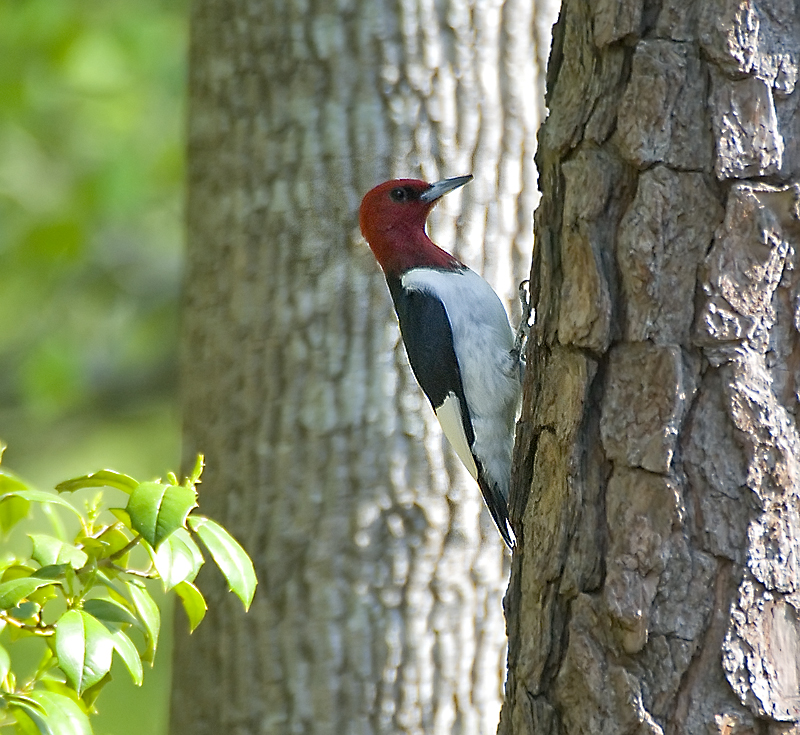 Red-headed WoodpeckerMelanerpes erythrocephalus
-
 Acorn WoodpeckerMelanerpes formicivorus
-
 Gila WoodpeckerMelanerpes uropygialis
-
 Lewis's WoodpeckerMelanerpes lewis
- Golden-fronted WoodpeckerMelanerpes aurifrons
-
 Hispaniolan WoodpeckerMelanerpes striatus
-
 Red-crowned WoodpeckerMelanerpes rubricapillus
Compare
Questions and answers
What is the scientific name of the Grey-breasted Woodpecker?
The scientific name of the Grey-breasted Woodpecker is Melanerpes hypopolius. Written with its author, the full name is Melanerpes hypopolius (Wagler, 1829).
Which family does the Grey-breasted Woodpecker belong to?
Melanerpes hypopolius belongs to the family Picidae, in the order Piciformes and the class Aves.
Where is the Grey-breasted Woodpecker found?
Checklists and occurrence records place Melanerpes hypopolius in 2 countries: Mexico and United States.
What is the conservation status of the Grey-breasted Woodpecker?
The IUCN Red List category recorded for Melanerpes hypopolius is Least Concern (LC).
What other names does the Grey-breasted Woodpecker have?
Melanerpes hypopolius is also known in English as Gray-breasted Woodpecker.
Is there a gray woodpecker?
The Grey-breasted Woodpecker is a woodpecker with underparts and a head that are darker and grayer than those of the Gila woodpecker.[3]
Sources
Passages the profile rests on
- The species resembles the Gila woodpecker. Source passage: “Like Gila woodpecker” — English Wikipedia
- The species also resembles zebra-backed members of the genus Melanerpes. Source passage: “It is also similar to the zebra-backed birds of the same genus.” — English Wikipedia
- Its underparts and head are darker and grayer than those of the Gila woodpecker. Source passage: “much darker and grayer below and on head.” — English Wikipedia
- The species has a pale red cheek and a short black line above the eye. Source passage: “pale red on cheek; short black line over eye;” — English Wikipedia
- Adult males have a rounded red crown patch. Source passage: “male has round red crown patch” — English Wikipedia
- Fledglings have darker necks and breasts than adults. Source passage: “featuring darker necks and breasts,” — English Wikipedia
- Fledglings have a noticeably darker red crown patch than adults. Source passage: “the red crown patch is significantly darker than adults, enough that it is noticeable.” — English Wikipedia
- The species inhabits subtropical or tropical moist lowland forests. Source passage: “Its natural habitats are subtropical or tropical moist lowland forests” — English Wikipedia
- The species also inhabits subtropical or tropical high-altitude shrubland. Source passage: “subtropical or tropical high-altitude shrubland.” — English Wikipedia
- Cactus fruit is one of the species' food sources. Source passage: “Its food source is the fruit of the cactus,” — English Wikipedia
- The species feeds on insects including cicadas and termites. Source passage: “groups of 3–10 forage for various insects of the region, like cicadas and termites,” — English Wikipedia
- The species sometimes catches flies. Source passage: “and sometimes, they even catch flies.” — English Wikipedia
- Groups of three to ten individuals forage together. Source passage: “groups of 3–10 forage for various insects of the region” — English Wikipedia
- Individuals cooperate by scanning for food together. Source passage: “The birds work together to scan for food,” — English Wikipedia
- Individuals do not display outward aggression toward one another when competing for food. Source passage: “they do so in an amiable fashion, never showing outward aggression for food.” — English Wikipedia
- The species exhibits communal roosting on cacti. Source passage: “The study confirmed the communal roosting habits of the birds, specifically on cacti.” — English Wikipedia
- Fledglings spend most of their time concealed inside cacti. Source passage: “Fledglings spend most of their time hidden inside cacti,” — English Wikipedia
- Visible fledglings do not beg their parents for attention or food. Source passage: “They don't beg for their parent's attention or for food, but this observable behavior only references when they are not hidden.” — English Wikipedia
- The species produces a loud vocalization described as an aggressive-sounding rattle. Source passage: “a loud and aggressive sounding rattle,” — English Wikipedia
- Females produce a chuck sound when an observer approaches their nests. Source passage: “a "chuck" sound by females when the observer approached nests,” — English Wikipedia
- The species also produces a vocalization described as a yak sound with heavy inflection. Source passage: “a "yak" sound with a heavy inflection.” — English Wikipedia
- Feeding rates were documented at three nests of this species in Oaxaca, Mexico. Source passage: “Feeding rates at three Grey-breasted Woodpecker (Melanerpes hypopolius) nests in Oaxaca, Mex- ico.” — digitalcommons.usf.edu
- The estimated population in its native Mexico is slightly below 50,000 individuals. Source passage: “The population is slightly less than 50,000 in its native Mexico,” — English Wikipedia
- The species is classified as Least Concern for extinction. Source passage: “classifying it as a species of least concern for extinction.” — English Wikipedia
- The species has a resident and breeding extent of occurrence of 81,800 square kilometres. Source passage: “Extent of Occurrence (resident/breeding) 81,800 km²” — datazone.birdlife.org
- The species is non-migratory. Source passage: “Migratory status Not a Migrant” — datazone.birdlife.org
Data
- Catalogue of Life, 2026-10-16 XR cc by
- Global Biodiversity Information Facility CC BY 4.0
- Wikidata CC0
- GeoNames CC BY 4.0
- Wikimedia Commons per image; credit shown with each image
- Within the Catalogue of Life, this name comes from The Integrated Taxonomic Information System cc0
References
- Isis von Oken, col. 514. 1829 where the name was published
- Gill, Frank, & and Minturn Wright. (2006). Birds of the World: Recommended English Names.
This species in other databases
Page built on 28 November 2026. See how the catalog is made and all sources and licences.
Cite this page
ScientificNames.org. (2026). Melanerpes hypopolius (Grey-breasted Woodpecker). Retrieved November 28, 2026, from https://scientificnames.org/species/melanerpes-hypopolius
“Melanerpes hypopolius (Grey-breasted Woodpecker).” ScientificNames.org, 2026, scientificnames.org/species/melanerpes-hypopolius. Accessed 28 Nov. 2026.
ScientificNames.org. “Melanerpes hypopolius (Grey-breasted Woodpecker).” Accessed November 28, 2026. https://scientificnames.org/species/melanerpes-hypopolius.
@misc{scientificnames_melanerpes_hypopolius_grey_breasted_woodpecker,
  author = {{ScientificNames.org}},
  title = {Melanerpes hypopolius (Grey-breasted Woodpecker)},
  year = {2026},
  url = {https://scientificnames.org/species/melanerpes-hypopolius},
  note = {Accessed 2026-11-28}
}