Species · Insects
Melanotus communis
Melanotus communis has no English name on record in the checklists used here. It is a species of insect in the family Elateridae (click beetle), order Coleoptera. The name dates from 1817.
- Scientific name
- Melanotus communis (Gyllenhal, 1817)
- Genus
- Melanotus
- Family
- Elateridae (Click Beetle)
- Order
- Coleoptera
- Class
- Insecta
- Recorded in
- 2 countries
- Name status
- accepted in the Catalogue of Life

Overview
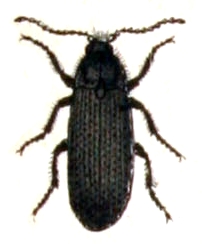
Melanotus communis is a species of click beetle. The adult beetle is reddish-brown in color, and is about 13 millimetres (0.51 in) long. The egg is white in color, and is about 0.3 mm (0.012 in) long. The larva is a short-legged wireworm. It is a pale yellow to reddish-brown in color, and is 21–25 mm (0.83–0.98 in) long when mature. The pupa is white in color, and is about the same size as an adult.
Classification of Melanotus communis
| Kingdom | Animalia |
|---|---|
| Phylum | Arthropoda |
| Subphylum | Hexapoda |
| Class | Insecta (Insect) |
| Order | Coleoptera (Beetle) |
| Suborder | Polyphaga |
| Series | Elateriformia |
| Superfamily | Elateroidea |
| Family | Elateridae (Click Beetle) |
| Subfamily | Elaterinae |
| Tribe | Melanotini |
| Genus | Melanotus |
| Species | Melanotus communis (Gyllenhal, 1817) |
This name was added to the Catalogue of Life from a contributing dataset by automated merging and has not yet been reviewed by its editors.
Where Melanotus communis is found
Checklists and occurrence records place Melanotus communis in 2 countries across North America. GBIF holds 825 georeferenced records of it.
Countries
Regions and cities with the most records
- Pennsylvania, United States 425
- Erie, United States 143
- Kentucky, United States 128
- Georgetown, United States 90
- Lexington, United States 90
- Lexington-Fayette, United States 90
- Nicholasville, United States 90
- State College, United States 52
- Newark, United States 34
- New York, United States 28
- Illinois, United States 20
- Ashmont, United States 16
- Boston, United States 16
- Braintree, United States 16
- Chelsea, United States 16
- Dorchester, United States 16
- East Boston, United States 16
- Greenburgh, United States 16
- Harrison, United States 16
- Lake Forest, United States 16
- Mamaroneck, United States 16
- Mattapan, United States 16
- Milton, United States 16
- Orient Heights, United States 16
- Quincy, United States 16
- Roxbury Crossing, United States 16
- Scarsdale, United States 16
- Weymouth, United States 16
- Winthrop, United States 16
- Grayslake, United States 15
- Gurnee, United States 15
- Libertyville, United States 15
- Mundelein, United States 15
- North Chicago, United States 15
- Revere, United States 15
- Waukegan, United States 15
Range as the checklists state it
Ontario
Québec
A number beside a place is its count of GBIF occurrence records. A place without a number comes from a checklist alone. Records show where a species has been observed or collected, which can include escapes and vagrants.
Related species
- Chestnut-footed Click BeetleMelanotus castanipes
-
 Melanotus punctolineatus
-
 Melanotus longulus
- Melanotus villosus
- Melanotus punctosus
- Melanotus brunniopacus
- Melanotus crassicollis
-
 Melanotus brunnipes
Compare
Sources
Data
- Catalogue of Life, 2026-10-16 XR cc by
- Global Biodiversity Information Facility CC BY 4.0
- Wikidata CC0
- English Wikipedia CC BY-SA 4.0
- GeoNames CC BY 4.0
- Wikimedia Commons per image; credit shown with each image
- Within the Catalogue of Life, this name comes from Checklist of Beetles (Coleoptera) of Canada and Alaska. Second Edition. cc by
This species in other databases
Page built on 27 November 2026. See how the catalog is made and all sources and licences.
Cite this page
ScientificNames.org. (2026). Melanotus communis. Retrieved November 27, 2026, from https://scientificnames.org/species/melanotus-communis
“Melanotus communis.” ScientificNames.org, 2026, scientificnames.org/species/melanotus-communis. Accessed 27 Nov. 2026.
ScientificNames.org. “Melanotus communis.” Accessed November 27, 2026. https://scientificnames.org/species/melanotus-communis.
@misc{scientificnames_melanotus_communis,
  author = {{ScientificNames.org}},
  title = {Melanotus communis},
  year = {2026},
  url = {https://scientificnames.org/species/melanotus-communis},
  note = {Accessed 2026-11-27}
}