Species · Flowering plants
Yellow Evodia Melicope xanthoxyloides
The scientific name of the Yellow Evodia is Melicope xanthoxyloides. It is a species of flowering plant in the family Rutaceae (rue family), order Sapindales.
- Scientific name
- Melicope xanthoxyloides (F.Muell.) T.G.Hartley
- Common name
- Yellow Evodia
- Genus
- Melicope
- Family
- Rutaceae (Rue Family)
- Order
- Sapindales
- Class
- Magnoliopsida
- Red List category
- LC Least Concern
- Recorded in
- 2 countries
- Name status
- accepted in the Catalogue of Life
Overview
Melicope xanthoxyloides grows in rainforest habitats in New Guinea, the Bismarck Archipelago and Queensland.
Written 27 November 2026 from the sources listed below. Each statement was checked against the passage it cites; statements that could not be supported were removed.
Appearance
Its leaves grow in opposite pairs and consist of three leaflets. The leaf petioles measure between 35 and 140 millimetres long, and the elliptical to egg-shaped leaflets measure 110–270 millimetres long and 50–125 millimetres wide, with the narrower end towards the base.[1][2][3][4]
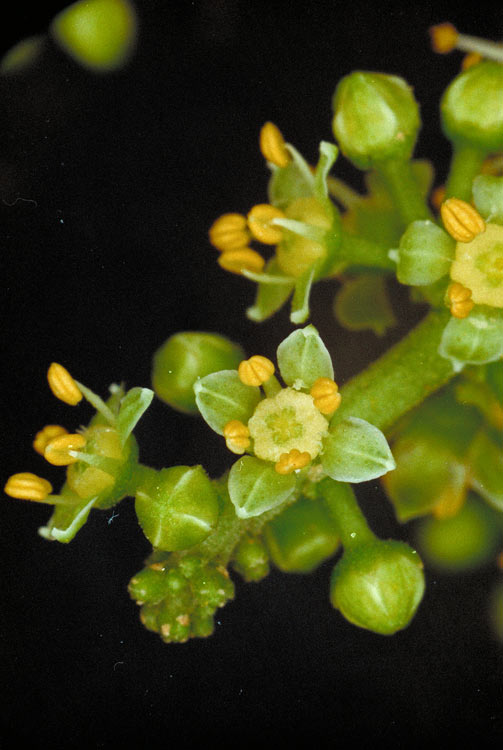
The flowers are arranged in panicles in the leaf axils, measuring between 50 and 140 millimetres long. The sepals are egg-shaped to triangular, fused at the base and approximately 0.5 millimetres long; the green, yellow or cream-coloured petals measure between 1.3 and 2 millimetres long.[5][6][7][8][9][10]
Its flowers have four stamens. The fruit consists of up to four follicles fused at the base, each measuring between 3 and 4 millimetres long.[11][12][13]
Habitat
Yellow Evodia grows in rainforest habitats from near sea level to elevations of 1,100 metres. It is native to New Guinea and Queensland, and its distribution includes the Bismarck Archipelago.[14][15][16][17]
In Queensland, the species occurs from the McIlwraith Range on Cape York Peninsula to the Herbert River.[18]
Reproduction and life cycle
Male and female flowers occur on separate plants. The species flowers between November and April.[19][20]
Conservation
Yellow Evodia is classified as of least concern under Queensland's Nature Conservation Act 1992.[21]
Classification of the Yellow Evodia
| Kingdom | Plantae |
|---|---|
| Subkingdom | Pteridobiotina |
| Phylum | Tracheophyta |
| Class | Magnoliopsida |
| Order | Sapindales |
| Family | Rutaceae (Rue Family) |
| Subfamily | Zanthoxyloideae |
| Tribe | Zanthoxyleae |
| Subtribe | Boroniinae |
| Genus | Melicope |
| Species | Melicope xanthoxyloides (F.Muell.) T.G.Hartley |
Where the Yellow Evodia is found
Checklists and occurrence records place Melicope xanthoxyloides in 2 countries across Oceania. GBIF holds 789 georeferenced records of it.
Countries
Regions and cities with the most records
- Queensland, Australia 360
- Morobe Province, Papua New Guinea 59
- Central Province, Papua New Guinea 43
- Cairns, Australia 31
- East Sepik Province, Papua New Guinea 24
- Oro Province, Papua New Guinea 24
- West New Britain Province, Papua New Guinea 17
- Southern Highlands Province, Papua New Guinea 16
- Lae, Papua New Guinea 15
- Bulolo, Papua New Guinea 12
- East New Britain Province, Papua New Guinea 12
- Sandaun Province, Papua New Guinea 12
- Madang Province, Papua New Guinea 11
- Gulf Province, Papua New Guinea 10
- Western Province, Papua New Guinea 10
- Milne Bay Province, Papua New Guinea 9
- Popondetta, Papua New Guinea 9
- Hela Province, Papua New Guinea 7
- Manus Province, Papua New Guinea 6
1 more country has a few records outside this range
These countries hold a few records of Melicope xanthoxyloides but lie outside the range the checklists give for it. Such records are often zoo or garden specimens, museum material or vagrants, so the species is not counted as occurring there.
Range as the checklists state it
New Guinea (Irian Jaya, Papua New Guinea); Bismarck Arch. (New Britain, Admiralty Isl.); Australia (NE-Queensland)
A number beside a place is its count of GBIF occurrence records. A place without a number comes from a checklist alone. Records show where a species has been observed or collected, which can include escapes and vagrants.
Common names
English
- Yellow Evodia
Synonyms
11 other scientific names have been used for this species and are now treated as synonyms of Melicope xanthoxyloides.
- Ampacus alata (F.Muell.) Kuntze
- Ampacus xanthoxylodes (F.Muell.) Kuntze
- Ampacus xanthoxyloides (F.Muell.) Kuntze
- Euodia alata F.Muell.
- Euodia bakeriana Domin
- Euodia bismarckii-montium Lauterb.
- Euodia chlorantha Lauterb.
- Euodia maidenii K.Schum.
- Euodia micrantha Lauterb.
- Euodia mollis Warb.
- Euodia xanthoxyloides F.Muell.
Related species
-
 Pink Flowered DoughwoodMelicope elleryana
-
 Little EvodiaMelicope rubra
-
 Obovate MelicopeMelicope obovata
-
 WharangiMelicope ternata
- Kaholuamanu MelicopeMelicope macropus
-
 Melicope denhamii
-
 Hairy-leaved DoughwoodMelicope micrococca
-
 Melicope lunu-ankenda
Compare
Questions and answers
What is the scientific name of the Yellow Evodia?
The scientific name of the Yellow Evodia is Melicope xanthoxyloides. Written with its author, the full name is Melicope xanthoxyloides (F.Muell.) T.G.Hartley.
Which family does the Yellow Evodia belong to?
Melicope xanthoxyloides belongs to the family Rutaceae, in the order Sapindales and the class Magnoliopsida.
Where is the Yellow Evodia found?
Checklists and occurrence records place Melicope xanthoxyloides in 2 countries: Australia and Papua New Guinea.
What is the conservation status of the Yellow Evodia?
The IUCN Red List category recorded for Melicope xanthoxyloides is Least Concern (LC).
Sources
Passages the profile rests on
- Its leaves grow in opposite pairs and consist of three leaflets. Source passage: “The leaves are arranged in opposite pairs and trifoliate” — English Wikipedia
- Its leaf petioles measure between 35 and 140 millimetres long. Source passage: “on a petiole 35–140 mm (1.4–5.5 in) long.” — English Wikipedia
- Its leaflets are elliptical to egg-shaped, with the narrower end towards the base. Source passage: “are elliptical to egg-shaped with the narrower end towards the base” — English Wikipedia
- Its leaflets measure 110–270 millimetres long and 50–125 millimetres wide. Source passage: “110–270 mm (4.3–10.6 in) long and 50–125 mm (2.0–4.9 in) wide.” — English Wikipedia
- Its flowers are arranged in panicles in the leaf axils. Source passage: “The flowers are arranged in panicles 50–140 mm (2.0–5.5 in) long in leaf axils” — English Wikipedia
- Its flower panicles measure between 50 and 140 millimetres long. Source passage: “panicles 50–140 mm (2.0–5.5 in) long” — English Wikipedia
- Its sepals are egg-shaped to triangular and fused at the base. Source passage: “The sepals are egg-shaped to triangular, about 0.5 mm (0.020 in) long and fused at the base” — English Wikipedia
- Its sepals are approximately 0.5 millimetres long. Source passage: “about 0.5 mm (0.020 in) long” — English Wikipedia
- Its petals are green, yellow or cream-coloured. Source passage: “the petals green to yellow or cream-coloured” — English Wikipedia
- Its petals measure between 1.3 and 2 millimetres long. Source passage: “1.3–2 mm (0.051–0.079 in) long” — English Wikipedia
- Its flowers have four stamens. Source passage: “and there are four stamens.” — English Wikipedia
- Its fruit consists of up to four follicles fused at the base. Source passage: “the fruit consists of up to four follicles 3–4 mm (0.12–0.16 in) long and fused at the base.” — English Wikipedia
- Its fruit follicles measure between 3 and 4 millimetres long. Source passage: “3–4 mm (0.12–0.16 in) long” — English Wikipedia
- Yellow Evodia grows in rainforest habitats. Source passage: “Yellow evodia grows in rainforest” — English Wikipedia
- The species occurs in rainforest from near sea level to elevations of 1,100 metres. Source passage: “grows in rainforest from near sea level to an altitude of 1,100 m (3,600 ft).” — English Wikipedia
- The species is native to New Guinea and Queensland. Source passage: “is native to New Guinea and Queensland.” — English Wikipedia
- Its distribution includes the Bismarck Archipelago. Source passage: “It occurs in New Guinea including in the Bismarck Archipelago” — English Wikipedia
- In Queensland, the species occurs from the McIlwraith Range on Cape York Peninsula to the Herbert River. Source passage: “from the McIlwraith Range on Cape York Peninsula to the Herbert River in northern Queensland.” — English Wikipedia
- Male and female flowers occur on separate plants. Source passage: “are male-only and female-only on separate plants.” — English Wikipedia
- The species flowers between November and April. Source passage: “Flowering occurs from November to April” — English Wikipedia
- The species is classified as of least concern under Queensland's Nature Conservation Act 1992. Source passage: “This species is classified as of "least concern" under the Queensland Government Nature Conservation Act 1992.” — English Wikipedia
Data
- Catalogue of Life, 2026-10-16 XR cc by
- Global Biodiversity Information Facility CC BY 4.0
- Wikidata CC0
- GeoNames CC BY 4.0
- Wikimedia Commons per image; credit shown with each image
- Within the Catalogue of Life, this name comes from Synonymic Checklists of the Vascular Plants of the World cc by
References
- Hartley, T. G. (2001). Allertonia 8(1): 119 (2001). where the name was published
This species in other databases
Page built on 29 November 2026. See how the catalog is made and all sources and licences.
Cite this page
ScientificNames.org. (2026). Melicope xanthoxyloides (Yellow Evodia). Retrieved November 29, 2026, from https://scientificnames.org/species/melicope-xanthoxyloides
“Melicope xanthoxyloides (Yellow Evodia).” ScientificNames.org, 2026, scientificnames.org/species/melicope-xanthoxyloides. Accessed 29 Nov. 2026.
ScientificNames.org. “Melicope xanthoxyloides (Yellow Evodia).” Accessed November 29, 2026. https://scientificnames.org/species/melicope-xanthoxyloides.
@misc{scientificnames_melicope_xanthoxyloides_yellow_evodia,
  author = {{ScientificNames.org}},
  title = {Melicope xanthoxyloides (Yellow Evodia)},
  year = {2026},
  url = {https://scientificnames.org/species/melicope-xanthoxyloides},
  note = {Accessed 2026-11-29}
}