Species · Crustaceans
Anchialine Snapping Shrimp Metabetaeus lohena
The scientific name of the Anchialine Snapping Shrimp is Metabetaeus lohena. It is a species of crustacean in the family Alpheidae (snapping shrimps), order Decapoda. The name dates from 1960.
- Scientific name
- Metabetaeus lohena A. H. Banner & D. M. Banner, 1960
- Common name
- Anchialine Snapping Shrimp
- Genus
- Metabetaeus
- Family
- Alpheidae (Snapping Shrimps)
- Order
- Decapoda
- Class
- Malacostraca
- Environment
- marine
- Recorded in
- 1 country
- Name status
- accepted in the Catalogue of Life

Overview
The anchialine snapping shrimp is native to Hawaii and Easter Island. It inhabits anchialine pools connected underground to the ocean. It ranges in colour from pale pink to vibrant red and has large claws and a clearly visible mandibular spot.
Written 26 November 2026 from the sources listed below. Each statement was checked against the passage it cites; statements that could not be supported were removed.
Appearance
The anchialine snapping shrimp ranges in colour from pale pink to vibrant red. It has large claws and a clearly visible mandibular spot.[1][2]
Habitat
The anchialine snapping shrimp inhabits anchialine pools, which are landlocked water bodies connected underground to the ocean. These pools can contain fresh or brackish surface water and saline water at greater depths.[3][4]
The species has been recorded in water with salinities ranging from 2 to 36 ppt and occurs at temperatures of approximately 20 °C or higher.[5][6]
The species is native to Hawaii and Easter Island and has a widespread distribution across multiple Hawaiian islands.[7][8]
Diet
The anchialine snapping shrimp scavenges for food and hunts small anchialine invertebrates.[9]
Behaviour
Hawaiian populations coexist with the ʻōpaeʻula shrimp, Halocaridina rubra, whose known distribution completely overlaps theirs.[10]
Invasive fish have a negative relationship with the density of the anchialine snapping shrimp. Its density has a positive relationship with the presence of Halocaridina rubra.[11][12]
Reproduction and life cycle
Gravid females produce egg masses containing 20 to 29 eggs. The larvae lack a yolk sac, suggesting that they undergo a planktotrophic feeding phase.[13][14]
Classification of the Anchialine Snapping Shrimp
| Kingdom | Animalia |
|---|---|
| Phylum | Arthropoda |
| Subphylum | Crustacea |
| Class | Malacostraca |
| Order | Decapoda |
| Suborder | Pleocyemata |
| Infraorder | Caridea |
| Superfamily | Alpheoidea |
| Family | Alpheidae (Snapping Shrimps) |
| Genus | Metabetaeus |
| Species | Metabetaeus lohena A. H. Banner & D. M. Banner, 1960 |
Where the Anchialine Snapping Shrimp is found
Checklists and occurrence records place Metabetaeus lohena in 1 country. GBIF holds 84 georeferenced records of it.
Countries
Regions and cities with the most records
- Hawaii, United States 6
- Kapolei, United States 3
- Kapolei Villages, United States 3
- Makakilo, United States 3
- Makakilo / Kapolei / Honokai Hale, United States 3
- Makakilo City, United States 3
- Makakilo-Makaīwa Hills-Kunia, United States 3
- ʻEwa Gentry-West Loch, United States 3
- ‘Ewa Gentry, United States 3
Range as the checklists state it
Indo-West Pacific
A number beside a place is its count of GBIF occurrence records. A place without a number comes from a checklist alone. Records show where a species has been observed or collected, which can include escapes and vagrants.
Common names
English
- Anchialine Snapping Shrimp
- ʻōpaeʻulaʻnui
Names in 1 other language
- Japanese
- ドウクツテッポウエビ
Related species
- Metabetaeus mcphersonae
- Metabetaeus minutus
- Metabetaeus lapillicola
-
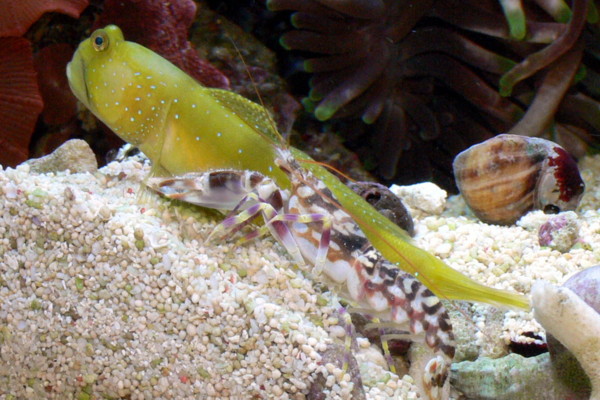 Tiger Pistol ShrimpAlpheus bellulus
- Eusocial ShrimpSynalpheus regalis
-
 Bigclaw Snapping ShrimpAlpheus heterochaelis
-
 Pink Floyd Pistol ShrimpSynalpheus pinkfloydi
-
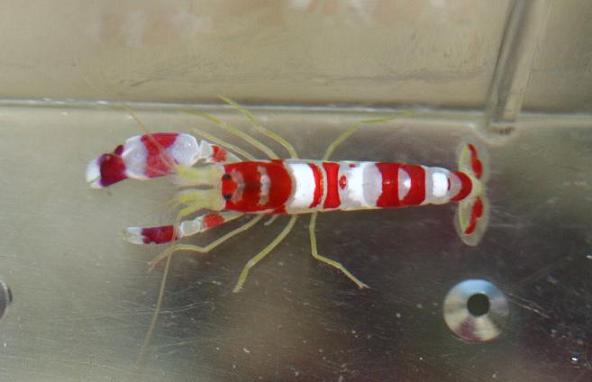 Randall's Pistol ShrimpAlpheus randalli
Compare
Questions and answers
What is the scientific name of the Anchialine Snapping Shrimp?
The scientific name of the Anchialine Snapping Shrimp is Metabetaeus lohena. Written with its author, the full name is Metabetaeus lohena A. H. Banner & D. M. Banner, 1960.
Which family does the Anchialine Snapping Shrimp belong to?
Metabetaeus lohena belongs to the family Alpheidae, in the order Decapoda and the class Malacostraca.
Where is the Anchialine Snapping Shrimp found?
Checklists and occurrence records place Metabetaeus lohena in 1 country: United States.
What other names does the Anchialine Snapping Shrimp have?
Metabetaeus lohena is also known in English as ʻōpaeʻulaʻnui.
Sources
Passages the profile rests on
- The species ranges in colour from pale pink to vibrant red. Source passage: “M. lohena grows to lengths of 18 mm and are pale pink to vibrant red in colour.” — English Wikipedia
- The shrimp has large claws and a clearly visible mandibular spot. Source passage: “Shrimp possess large claws and a clearly visible mandibular spot.” — English Wikipedia
- The species inhabits anchialine pools, which are landlocked water bodies connected underground to the ocean. Source passage: “They live in anchialine pools, which are landlocked bodies of water with underground connections to the ocean.” — English Wikipedia
- Its anchialine pool habitat can contain fresh or brackish surface water and saline water at greater depths. Source passage: “These pools often possess fresh or brackish water near the surface, but saline water at depth.” — English Wikipedia
- The species has been recorded in water with salinities ranging from 2 to 36 ppt. Source passage: “Shrimp can be found naturally living at salinities ranging from 2 to 36 ppt” — English Wikipedia
- The species occurs in water temperatures of approximately 20 °C or higher. Source passage: “water temperatures at around 20 °C (68 °F) or higher.” — English Wikipedia
- The species is native to Hawaii and Easter Island. Source passage: “Metabetaeus lohena, also known as the alpha snapping shrimp or anchialine snapping shrimp, is a species of alpheid shrimp native to Hawaii and Easter Island.” — English Wikipedia
- The species has a widespread distribution across multiple Hawaiian islands. Source passage: “Metabetaeus lohena has a widespread distribution in Hawaii where it is native to many islands.” — English Wikipedia
- The species scavenges for food and also hunts small anchialine invertebrates. Source passage: “Metabetaeus lohena is an alpheid scavenger, which will also hunt small anchialine invertebrates.” — English Wikipedia
- Hawaiian populations coexist with the ʻōpaeʻula shrimp, Halocaridina rubra, whose known distribution completely overlaps theirs. Source passage: “Hawaiian populations of M. lohena coexist alongside their prey species ʻōpaeʻula shrimp (Halocaridina rubra) with their known range entirely overlapping.” — English Wikipedia
- Invasive fish have a negative relationship with the density of the species. Source passage: “Invasive fish and the endemic shrimp Halocaridina rubra (Atyidae) had the strongest effects on M. lohena density, with negative and positive relations, respectively.” — usgs.gov
- The density of the species has a positive relationship with the presence of Halocaridina rubra. Source passage: “Invasive fish and the endemic shrimp Halocaridina rubra (Atyidae) had the strongest effects on M. lohena density, with negative and positive relations, respectively.” — usgs.gov
- Gravid females produce egg masses containing 20 to 29 eggs. Source passage: “Females once gravid will produce a mass of 20 to 29 eggs.” — English Wikipedia
- The larvae lack a yolk sac, suggesting that they undergo a planktotrophic feeding phase. Source passage: “M. lohena larvae lack a yolk sack, which suggests the species possess a planktotrophic larval feeding phase.” — English Wikipedia
Data
- Catalogue of Life, 2026-10-16 XR cc by
- Global Biodiversity Information Facility CC BY 4.0
- Wikidata CC0
- GeoNames CC BY 4.0
- Wikimedia Commons per image; credit shown with each image
- Within the Catalogue of Life, this name comes from The Integrated Taxonomic Information System cc0
References
- Banner, A. H.; Banner, D. M. (1960). Contributions to the knowledge of the alpheid shrimp of the Pacific Ocean. Part VII. On Metabetaeus Borradaile, with a new species from Hawaii. Pacific Science. 14: 299-303. where the name was published
- Titgen, Richard H. (1991). Summary of Albert H. and Dora M. Banners’ Contributions to the Knowledge of the Family Alphidae (Decapoda: Caridea). Pacific Science, Vol. 45, No. 3.
- McLaughlin, P. A., D. K. Camp, M. V. Angel, E. L. Bousfield, P. Brunel, R. C. Brusca, et al. (2005). Common and scientific names of aquatic invertebrates from the United States and Canada: Crustaceans. American Fisheries Society Special Publication 31.
- De Grave, Sammy, and C. H. J. M. Fransen. (2011). Carideorum catalogus: the recent species of the Dendrobranchiate, Stenopodidean, Procarididean and Caridean Shrimps (Crustacea: Decapoda). Zoologische Mededelingen, Vol. 85, No. 9.
This species in other databases
- Catalogue of Life 853FB
- Wikidata Q4468502
- iNaturalist 224959
- WoRMS urn:lsid:marinespecies.org:taxname:515065
Page built on 29 November 2026. See how the catalog is made and all sources and licences.
Cite this page
ScientificNames.org. (2026). Metabetaeus lohena (Anchialine Snapping Shrimp). Retrieved November 29, 2026, from https://scientificnames.org/species/metabetaeus-lohena
“Metabetaeus lohena (Anchialine Snapping Shrimp).” ScientificNames.org, 2026, scientificnames.org/species/metabetaeus-lohena. Accessed 29 Nov. 2026.
ScientificNames.org. “Metabetaeus lohena (Anchialine Snapping Shrimp).” Accessed November 29, 2026. https://scientificnames.org/species/metabetaeus-lohena.
@misc{scientificnames_metabetaeus_lohena_anchialine_snapping_shrimp,
  author = {{ScientificNames.org}},
  title = {Metabetaeus lohena (Anchialine Snapping Shrimp)},
  year = {2026},
  url = {https://scientificnames.org/species/metabetaeus-lohena},
  note = {Accessed 2026-11-29}
}