Species · Insects
Shiny Spider Beetle Mezium affine
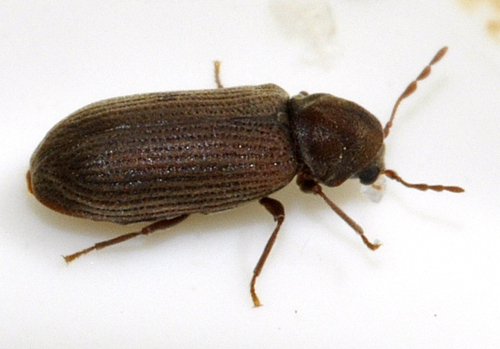
The scientific name of the Shiny Spider Beetle is Mezium affine. It is a species of insect in the family Ptinidae (spider beetles), order Coleoptera. The name dates from 1856.
- Scientific name
- Mezium affine Boieldieu, 1856
- Common name
- Shiny Spider Beetle
- Genus
- Mezium
- Family
- Ptinidae (Spider Beetles)
- Order
- Coleoptera
- Class
- Insecta
- Recorded in
- 10 countries
- Name status
- accepted in the Catalogue of Life

Overview
The species occurs throughout the Northern Hemisphere and is introduced in Australia. The adult has a very convex oval body, and its abdomen ranges from reddish brown to black.
Written 26 November 2026 from the sources listed below. Each statement was checked against the passage it cites; statements that could not be supported were removed.
Appearance
The adult shiny spider beetle has a very convex oval body. Its abdomen ranges in color from reddish brown to black, while its legs, antennae, and other body parts are cream-colored.[1][2][3]
The head, thorax, and legs are covered with scaly yellowish or gray hairs. The larva is yellowish white, with a brownish head and yellowish hairs.[4][5]
The adult beetle measures 1.5–3.5 millimetres in length. The larva can reach 4.5 millimetres in length.[6][7]
Habitat
The shiny spider beetle can occur in libraries and museums.[8]
Diet
The larvae feed on grain, spices, fish meal, dog biscuits, dried fruit, dried meat, dried mushrooms, seeds, wool, hair, feathers, skins, book bindings, dead insects, feces, and sugar.[9]
Behaviour
The larvae infest stored food and other products. The species can damage specimens and collections in libraries and museums.[10][11]
Similar species
The shiny spider beetle is also known by the common names northern spider beetle and hood spider beetle.[12]
Classification of the Shiny Spider Beetle
| Kingdom | Animalia |
|---|---|
| Phylum | Arthropoda |
| Subphylum | Hexapoda |
| Class | Insecta (Insect) |
| Order | Coleoptera (Beetle) |
| Suborder | Polyphaga |
| Series | Bostrichiformia |
| Superfamily | Bostrichoidea |
| Family | Ptinidae (Spider Beetles) |
| Subfamily | Ptininae |
| Tribe | Meziini |
| Genus | Mezium |
| Species | Mezium affine Boieldieu, 1856 |
This name was added to the Catalogue of Life from a contributing dataset by automated merging and has not yet been reviewed by its editors.
Where the Shiny Spider Beetle is found
Checklists and occurrence records place Mezium affine in 10 countries across Africa, North America and Oceania. GBIF holds 526 georeferenced records of it.
Countries
- Australia 158
- Canada 16
- France 19
- Germany 6
- New Zealand 14
- South Africa 3
- Spain 250
- The Netherlands 4
- United Kingdom 32
- United States 24
Regions and cities with the most records
- Gasteiz / Vitoria, Spain 217
- Basque Country, Spain 216
- New South Wales, Australia 120
- South Australia, Australia 24
- England, United Kingdom 16
- Provence-Alpes-Côte d'Azur, France 14
- Allauch, France 12
- Gardanne, France 12
- Les Pennes-Mirabeau, France 12
- Marignane, France 12
- Marseille, France 12
- Marseille 01, France 12
- Marseille 02, France 12
- Marseille 03, France 12
- Marseille 04, France 12
- Marseille 05, France 12
- Marseille 06, France 12
- Marseille 07, France 12
- Marseille 08, France 12
- Marseille 09, France 12
- Marseille 10, France 12
- Marseille 11, France 12
- Marseille 12, France 12
- Marseille 13, France 12
- Marseille 14, France 12
- Marseille 15, France 12
- Marseille 16, France 12
- Valencia, Spain 11
- Lincoln, United Kingdom 9
- Victoria, Australia 9
- Adelaide, Australia 8
- Adelaide Hills, Australia 8
- Murcia, Spain 8
- Mildura, Australia 7
- Ontinyent, Spain 7
- Alcantarilla, Spain 6
Range as the checklists state it
Europe & Northern Asia (excluding China)
North America
Australia
Africa
A number beside a place is its count of GBIF occurrence records. A place without a number comes from a checklist alone. Records show where a species has been observed or collected, which can include escapes and vagrants.
Common names
English
- Shiny Spider Beetle
Names in 3 other languages
- Chinese
- 谷蛛甲
- French
- ptine luisant
- German
- Spinnenkäfer
Synonyms
One other scientific name has been used for this species and is now treated as a synonym of Mezium affine.
- Mezium hirtipenne Reiche, 1864
Related species
-
 American Spider BeetleMezium americanum
-
 Drugstore BeetleStegobium paniceum
-
 Deathwatch BeetleXestobium rufovillosum
-
 Cigarette BeetleLasioderma serricorne
-
 Common Furniture BeetleAnobium punctatum
-
 Hadrobregmus pertinax
-
 Shiny Spider BeetleGibbium psylloides
-
 Smooth Spider BeetleGibbium aequinoctiale
Compare
Questions and answers
What is the scientific name of the Shiny Spider Beetle?
The scientific name of the Shiny Spider Beetle is Mezium affine. Written with its author, the full name is Mezium affine Boieldieu, 1856.
Which family does the Shiny Spider Beetle belong to?
Mezium affine belongs to the family Ptinidae, in the order Coleoptera and the class Insecta.
Where is the Shiny Spider Beetle found?
Checklists and occurrence records place Mezium affine in 10 countries, including Spain, Australia, United Kingdom, United States, France and Canada.
What is a beetle that looks like a spider?
The shiny spider beetle (Mezium affine Boieldieu, 1856) is also known as the northern spider beetle and hood spider beetle.[12]
What do spider beetles eat?
The larvae feed on grain, spices, fish meal, dog biscuits, dried fruit, dried meat, dried mushrooms, seeds, wool, hair, feathers, skins, book bindings, dead insects, feces, and sugar.[9]
Sources
Passages the profile rests on
- The adult beetle has a very convex oval body. Source passage: “This beetle is 1.5 to 3.5 millimetres (0.059 to 0.138 in) long with a very convex oval body.” — English Wikipedia
- The adult abdomen ranges in color from reddish brown to black. Source passage: “The abdomen is reddish brown to black” — English Wikipedia
- The legs, antennae, and other body parts are cream-colored. Source passage: “the legs, antennae, and other parts are cream-colored.” — English Wikipedia
- The head, thorax, and legs are covered with scaly yellowish or gray hairs. Source passage: “The head, thorax, and legs have a coating of scaly yellowish or gray hairs.” — English Wikipedia
- The larva is yellowish white with a brownish head and yellowish hairs. Source passage: “The larva is up to 4.5 millimetres (0.18 in) long and yellowish white in color with a brownish head. It is coated in yellowish hairs.” — English Wikipedia
- The adult beetle measures 1.5–3.5 millimetres in length. Source passage: “This beetle is 1.5 to 3.5 millimetres (0.059 to 0.138 in) long” — English Wikipedia
- The larva can reach 4.5 millimetres in length. Source passage: “The larva is up to 4.5 millimetres (0.18 in) long” — English Wikipedia
- The species can occur in libraries and museums. Source passage: “It can be found in libraries and museums” — English Wikipedia
- The larvae feed on grain, spices, fish meal, dog biscuits, dried fruit, dried meat, dried mushrooms, seeds, wool, hair, feathers, skins, book bindings, dead insects, feces, and sugar. Source passage: “They are known to live on grain, spices, fish meal, dog biscuits, dried fruit, dried meat, dried mushrooms, seeds, wool, hair, feathers, skins, book bindings, dead insects, feces, and sugar.” — English Wikipedia
- The larvae infest stored food and other products. Source passage: “The larvae infest stored food and other products.” — English Wikipedia
- The species can damage specimens and collections in libraries and museums. Source passage: “where it may damage specimens and collections.” — English Wikipedia
- The species is also known by the common names northern spider beetle and hood spider beetle. Source passage: “Its common names include shiny spider beetle, northern spider beetle, and hood spider beetle.” — English Wikipedia
Data
- Catalogue of Life, 2026-10-16 XR cc by
- Global Biodiversity Information Facility CC BY 4.0
- Wikidata CC0
- GeoNames CC BY 4.0
- Wikimedia Commons per image; credit shown with each image
- Within the Catalogue of Life, this name comes from The Integrated Taxonomic Information System cc0
References
- Papp, C. S. (1962). An illustrated and descriptive catalogue of the Ptinidae of North Amerika. Deutsche Entomologische Zeitschrift, N. F., Vol. 9, No. 5.
- Bousquet, Y. (1991). Beetles Associated with Stored Products in Canada: An Identification Guide. Publication 1837.
- Bousquet, Y. / Bousquet, Y., ed. (1991). Family Ptinidae - spider beetles. Checklist of Beetles of Canada and Alaska.
This species in other databases
Page built on 28 November 2026. See how the catalog is made and all sources and licences.
Cite this page
ScientificNames.org. (2026). Mezium affine (Shiny Spider Beetle). Retrieved November 28, 2026, from https://scientificnames.org/species/mezium-affine
“Mezium affine (Shiny Spider Beetle).” ScientificNames.org, 2026, scientificnames.org/species/mezium-affine. Accessed 28 Nov. 2026.
ScientificNames.org. “Mezium affine (Shiny Spider Beetle).” Accessed November 28, 2026. https://scientificnames.org/species/mezium-affine.
@misc{scientificnames_mezium_affine_shiny_spider_beetle,
  author = {{ScientificNames.org}},
  title = {Mezium affine (Shiny Spider Beetle)},
  year = {2026},
  url = {https://scientificnames.org/species/mezium-affine},
  note = {Accessed 2026-11-28}
}