Species · Reptiles
Milleretta Milleretta rubidgei
The scientific name of the Milleretta is Milleretta rubidgei. It is a species of reptile in the family Millerettidae. The name dates from 1938.
- Scientific name
- Milleretta rubidgei (Broom, 1938)
- Common name
- Milleretta
- Genus
- Milleretta
- Family
- Millerettidae
- Class
- Reptilia
- Recorded in
- 1 country
- Name status
- accepted in the Catalogue of Life
Overview
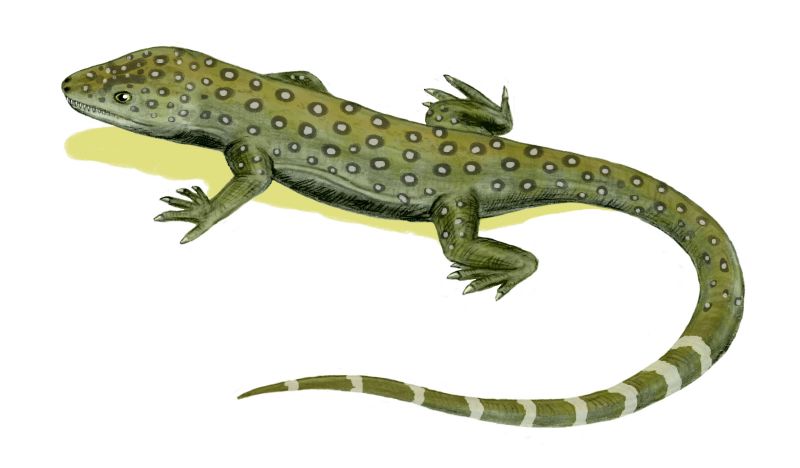
Milleretta probably inhabited forest-like environments in the Karoo Basin of South Africa. Milleretta had a lizard-like body shape and sturdy dorsal ribs with posterior expansions that overlapped adjacent ribs.
Written 26 November 2026 from the sources listed below. Each statement was checked against the passage it cites; statements that could not be supported were removed.
Appearance
Milleretta measured approximately 60 centimetres in length and had a lizard-like body shape.[1][2]
Its vertebrae had wide neural arches with projecting spines, horizontally oriented zygapophyses and prominent transverse processes. Adult vertebrae had fused centra and neural arches.[3][4][5]
Milleretta had particularly sturdy dorsal ribs with posterior expansions that overlapped adjacent ribs. Its ribs were also crenellated.[6][7]
Milleretta had a single row of teeth on its palatine bones. It also had fused pubes and ischia in its pelvic girdle, which had an expanded dorsal blade on the ilium.[8][9][10]
As Milleretta matured, it developed fully ossified femora, completely formed limb articular ends and expanded ribs.[11]
Habitat
Milleretta probably inhabited forest-like environments in the Karoo Basin of South Africa. The environment became increasingly dry over time.[12][13]
Diet
Milleretta was probably insectivorous. It had numerous sharp teeth that enabled it to chew insects.[14][15]
Behaviour
Milleretta may have used airborne sounds to detect prey or avoid predators. Its thick ribs reduced its body flexibility and swiftness.[16][17]
Classification of the Milleretta
| Kingdom | Animalia |
|---|---|
| Phylum | Chordata |
| Subphylum | Vertebrata |
| Infraphylum | Gnathostomata |
| Parvphylum | Osteichthyes |
| Megaclass | Tetrapoda |
| Class | Reptilia (Reptile) |
| Family | Millerettidae |
| Genus | Milleretta |
| Species | Milleretta rubidgei (Broom, 1938) |
This name was added to the Catalogue of Life from a contributing dataset by automated merging and has not yet been reviewed by its editors.
Where the Milleretta is found
Checklists and occurrence records place Milleretta rubidgei in 1 country. GBIF holds 8 georeferenced records of it.
Countries
Regions and cities with the most records
A number beside a place is its count of GBIF occurrence records. A place without a number comes from a checklist alone. Records show where a species has been observed or collected, which can include escapes and vagrants.
Common names
English
- Milleretta
Names in 1 other language
- Chinese
- 米勒古蜥
Questions and answers
What is the scientific name of the Milleretta?
The scientific name of the Milleretta is Milleretta rubidgei. Written with its author, the full name is Milleretta rubidgei (Broom, 1938).
Which family does the Milleretta belong to?
Milleretta rubidgei belongs to the family Millerettidae and the class Reptilia.
Where is the Milleretta found?
Checklists and occurrence records place Milleretta rubidgei in 1 country: South Africa.
Sources
Passages the profile rests on
- Milleretta had a lizard-like body shape. Source passage: “Milleretta was a moderately sized, lizard-like animal” — English Wikipedia
- Milleretta measured approximately 60 centimetres in length. Source passage: “about 60 centimetres (24 in) in length.” — English Wikipedia
- Milleretta had vertebrae with wide neural arches and spines projecting from them. Source passage: “The vertebrae of Milleretta have wide neural arches, in contrast to most neodiapsid reptiles. It had spines coming off the neural arches.” — English Wikipedia
- Milleretta possessed horizontally oriented zygapophyses and prominent transverse processes. Source passage: “Horizontally orientated zygopophyses are present, as well as prominent transverse processes.” — English Wikipedia
- Adult Milleretta vertebrae had fused centra and neural arches. Source passage: “BP/1/2040's adult vertebrae contrast those of the juvenile specimen only with the fused centrum and arch in the adult.” — English Wikipedia
- Milleretta had particularly sturdy dorsal ribs with posterior expansions that overlapped adjacent ribs. Source passage: “The ribs are especially sturdy dorsally, along with caudal expansions that help overlap the next rib over posteriorly.” — English Wikipedia
- Milleretta had crenellated ribs. Source passage: “These holocephalus ribs contain crenelations.” — English Wikipedia
- Milleretta had a single row of teeth on its palatine bones. Source passage: “There was a single row of teeth on the palatine.” — English Wikipedia
- Milleretta had fused pubes and ischia in its pelvic girdle. Source passage: “Not only are the centrum and arch fused, but the pubes and ischia are fused in its pelvic girdle.” — English Wikipedia
- Milleretta had a pelvic girdle with an expanded dorsal blade on the ilium. Source passage: “Alongside the fused bones, the dorsal blade on the ilium is expanded width-wise.” — English Wikipedia
- Milleretta developed fully ossified femora, completely formed limb articular ends and expanded ribs as it matured. Source passage: “The femur becoming fully ossified, complete formation of articular ends at the limbs, and expanding ribs occur as Milleretta become adults.” — English Wikipedia
- Milleretta probably inhabited forest-like environments in the Karoo Basin of South Africa. Source passage: “Milleretta probably lived in a forest-like environment due to the preserved forest-floor litter from the Karoo Basin located in South Africa.” — English Wikipedia
- The environment inhabited by Milleretta became increasingly dry over time. Source passage: “A recent examination of soil profiles shows that the environment in which Milleretta lived became more dry as time moved on.” — English Wikipedia
- Milleretta was probably insectivorous. Source passage: “It was probably insectivorous.” — English Wikipedia
- Milleretta had numerous sharp teeth that enabled it to chew insects. Source passage: “The vast range of sharp teeth helped make it possible to chew the insects present at the time.” — English Wikipedia
- Milleretta may have used airborne sounds to detect prey or avoid predators. Source passage: “The tympanic fossa, or eardrum, of Milleretta possibly helped them hunt prey or avoid predators by detecting airborn sound.” — English Wikipedia
- Milleretta's thick ribs reduced its body flexibility and swiftness. Source passage: “The thick ribs give protection to the cavity, but decrease the amount of flexibility of the body and decrease swiftness.” — English Wikipedia
Data
- Catalogue of Life, 2026-10-16 XR cc by
- Global Biodiversity Information Facility CC BY 4.0
- Wikidata CC0
- GeoNames CC BY 4.0
- Wikimedia Commons per image; credit shown with each image
- Within the Catalogue of Life, this name comes from New information on the anatomically derived milleretid Millereta rubidgei from the latest Permian based on µCT data cc0
References
- Broom R. On a new type of primitive fossil reptile from the Upper Permian of South Africa. Proceedings of the Zoological Society of London 1938; 108: 535-42. where the name was published
This species in other databases
Page built on 27 November 2026. See how the catalog is made and all sources and licences.
Cite this page
ScientificNames.org. (2026). Milleretta rubidgei (Milleretta). Retrieved November 27, 2026, from https://scientificnames.org/species/milleretta-rubidgei
“Milleretta rubidgei (Milleretta).” ScientificNames.org, 2026, scientificnames.org/species/milleretta-rubidgei. Accessed 27 Nov. 2026.
ScientificNames.org. “Milleretta rubidgei (Milleretta).” Accessed November 27, 2026. https://scientificnames.org/species/milleretta-rubidgei.
@misc{scientificnames_milleretta_rubidgei_milleretta,
  author = {{ScientificNames.org}},
  title = {Milleretta rubidgei (Milleretta)},
  year = {2026},
  url = {https://scientificnames.org/species/milleretta-rubidgei},
  note = {Accessed 2026-11-27}
}