Species · Flowering plants
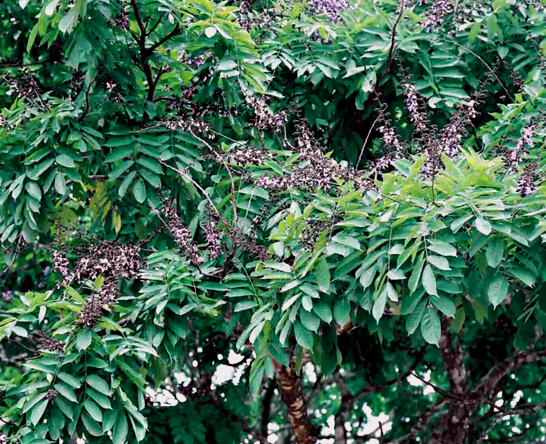
Millettia macrophylla
Millettia macrophylla has no English name on record in the checklists used here. It is a species of flowering plant in the family Fabaceae (bean), order Fabales.
- Scientific name
- Millettia macrophylla Benth.
- Genus
- Millettia
- Family
- Fabaceae (Bean)
- Order
- Fabales
- Class
- Magnoliopsida
- Red List category
- NT Near Threatened
- Recorded in
- 5 countries
- Name status
- accepted in the Catalogue of Life
Overview
Millettia macrophylla occurs in Cameroon, Equatorial Guinea, and Nigeria. It is traditionally used for menopausal symptoms and sexually transmitted diseases.
Written 27 November 2026 from the sources listed below. Each statement was checked against the passage it cites; statements that could not be supported were removed.
Habitat
Millettia macrophylla naturally inhabits subtropical or tropical moist lowland forests.[1]
Conservation
Millettia macrophylla is threatened by habitat loss.[2]
Uses
Millettia macrophylla is traditionally used to treat symptoms associated with menopause and to alleviate sexually transmitted diseases.[3][4]
In Cameroonian traditional medicine, its stem bark is used for menopausal symptoms.[5]
Extracts of Millettia macrophylla have demonstrated estrogenic effects in vitro on human embryonic kidney cells and in vivo on ovariectomized rats.[6]
Its estrogenic activity is associated with secondary metabolites binding to estrogen receptors alpha and beta.[7]
Extracts have been reported to prevent postmenopausal osteoporosis in Wistar rats.[8]
Appearance
The stem bark of Millettia macrophylla has been investigated in dried and pulverized form.[9]
Classification of Millettia macrophylla
| Kingdom | Plantae |
|---|---|
| Subkingdom | Pteridobiotina |
| Phylum | Tracheophyta |
| Class | Magnoliopsida |
| Order | Fabales |
| Family | Fabaceae (Bean) |
| Genus | Millettia |
| Species | Millettia macrophylla Benth. |
Where Millettia macrophylla is found
Checklists and occurrence records place Millettia macrophylla in 5 countries across Africa. GBIF holds 150 georeferenced records of it.
Countries
Regions and cities with the most records
- South-West, Cameroon 65
- Penja, Cameroon 28
- Njombé, Cameroon 27
- Tombel, Cameroon 27
- Loum, Cameroon 26
- Manjo, Cameroon 26
- Littoral, Cameroon 18
- Limbe, Cameroon 16
- South, Cameroon 13
- Mutengene, Cameroon 8
- Bamusso, Cameroon 7
- Buea, Cameroon 7
- Tiko, Cameroon 7
- Bioko Sur, Equatorial Guinea 6
- Lolodorf, Cameroon 5
1 more country has a few records outside this range
These countries hold a few records of Millettia macrophylla but lie outside the range the checklists give for it. Such records are often zoo or garden specimens, museum material or vagrants, so the species is not counted as occurring there.
A number beside a place is its count of GBIF occurrence records. A place without a number comes from a checklist alone. Records show where a species has been observed or collected, which can include escapes and vagrants.
Synonyms
4 other scientific names have been used for this species and are now treated as synonyms of Millettia macrophylla.
- Millettia hookeriana Taub.
- Phaseolodes hookeriana Kuntze
- Phaseoloides hookerianum Kuntze
- Phaseoloides macrophyllum (Benth.) Kuntze
Related species
-
 WengeMillettia laurentii
-
 PangapangaMillettia stuhlmannii
-
 UmzimbeetMillettia grandis
- Millettia sacleuxii
-
 Millettia thonningii
-
 Millettia duchesnei
- Millettia conraui
- Small Panga-pangaMillettia usaramensis
Compare
Questions and answers
What is another scientific name for Millettia macrophylla?
It is also known by the scientific name Millettia aboensis.[10]
Sources
Passages the profile rests on
- Millettia macrophylla naturally inhabits subtropical or tropical moist lowland forests. Source passage: “Its natural habitat is subtropical or tropical moist lowland forests.” — English Wikipedia
- Millettia macrophylla is threatened by habitat loss. Source passage: “It is threatened by habitat loss.” — English Wikipedia
- Millettia macrophylla is traditionally used to treat symptoms associated with menopause. Source passage: “Millettia macrophylla is used traditionally to treat menopause related symptoms.” — pmc.ncbi.nlm.nih.gov
- Millettia macrophylla is traditionally used to alleviate sexually transmitted diseases. Source passage: “Millettia macrophylla, also known as Millettia aboensis, is used to alleviate sexual transmitted diseases” — pmc.ncbi.nlm.nih.gov
- The stem bark of Millettia macrophylla is used in Cameroonian traditional medicine for menopausal symptoms. Source passage: “we have been studying the stem bark of Millettia macrophylla, a Cameroonian medicinal plant used in the treatment of menopausal symptoms.” — pmc.ncbi.nlm.nih.gov
- Extracts of Millettia macrophylla have demonstrated estrogenic effects in vitro on human embryonic kidney cells and in vivo on ovariectomized rats. Source passage: “This plant was shown to exhibit estrogenic effects in vitro on human embryonic kidney cells and in vivo on ovariectomized rats.” — pmc.ncbi.nlm.nih.gov
- The estrogenic activity of Millettia macrophylla is associated with secondary metabolites binding to estrogen receptors alpha and beta. Source passage: “the induction of the estrogenic activity by M. macrophylla is due to the binding of its secondary metabolites to ERα and ERβ.” — pmc.ncbi.nlm.nih.gov
- Extracts of Millettia macrophylla have been reported to prevent postmenopausal osteoporosis in Wistar rats. Source passage: “Millettia macrophylla was previously reported to have estrogenic effects and to prevent postmenopausal osteoporosis in Wistar rats.” — academia.edu
- The stem bark of Millettia macrophylla has been investigated in dried and pulverized form. Source passage: “The well-dried and pulverized stem bark of M. macrophylla (2500 g)” — pmc.ncbi.nlm.nih.gov
- Millettia macrophylla is also known by the scientific name Millettia aboensis. Source passage: “Millettia macrophylla, also known as Millettia aboensis” — pmc.ncbi.nlm.nih.gov
Data
- Catalogue of Life, 2026-10-16 XR cc by
- Global Biodiversity Information Facility CC BY 4.0
- Wikidata CC0
- GeoNames CC BY 4.0
- Within the Catalogue of Life, this name comes from The World Checklist of Vascular Plants (WCVP): Fabaceae cc by
References
- Hooker's Icon. Pl. 8: t. 788 (1848) where the name was published
This species in other databases
- Catalogue of Life 43D9B
- Wikidata Q5459442
- iNaturalist 440694
- World Flora Online wfo-0000200354
- GRIN 24307
Page built on 29 November 2026. See how the catalog is made and all sources and licences.
Cite this page
ScientificNames.org. (2026). Millettia macrophylla. Retrieved November 29, 2026, from https://scientificnames.org/species/millettia-macrophylla
“Millettia macrophylla.” ScientificNames.org, 2026, scientificnames.org/species/millettia-macrophylla. Accessed 29 Nov. 2026.
ScientificNames.org. “Millettia macrophylla.” Accessed November 29, 2026. https://scientificnames.org/species/millettia-macrophylla.
@misc{scientificnames_millettia_macrophylla,
  author = {{ScientificNames.org}},
  title = {Millettia macrophylla},
  year = {2026},
  url = {https://scientificnames.org/species/millettia-macrophylla},
  note = {Accessed 2026-11-29}
}