Species · Insects
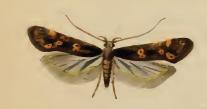
Mirificarma cytisella
Mirificarma cytisella has no English name on record in the checklists used here. It is a species of insect in the family Gelechiidae (gelechiid moths), order Lepidoptera. The name dates from 1833.
- Scientific name
- Mirificarma cytisella (Treitschke, 1833)
- Genus
- Mirificarma
- Family
- Gelechiidae (Gelechiid Moths)
- Order
- Lepidoptera
- Class
- Insecta
- Environment
- terrestrial
- Recorded in
- 11 countries
- Name status
- accepted in the Catalogue of Life

Overview
Mirificarma cytisella is a moth belonging to the family Gelechiidae. The species occurs across most of Europe, excluding Ireland, Great Britain, Fennoscandia, the Baltic region and parts of the Balkan Peninsula, and extends eastward to the Ural Mountains. The larvae feed predominantly from inside two or three leaves that they have spun together.
Written 27 November 2026 from the sources listed below. Each statement was checked against the passage it cites; statements that could not be supported were removed.
Diet
The larvae feed on Cytisus nigricans. Laburnum anagyroides is a possible larval food plant.[1][2]
Behaviour
The larvae feed predominantly from inside two or three leaves that they have spun together. They have been recorded in June, September and October.[3][4]
Classification of Mirificarma cytisella
| Kingdom | Animalia |
|---|---|
| Phylum | Arthropoda |
| Subphylum | Hexapoda |
| Class | Insecta (Insect) |
| Order | Lepidoptera |
| Superfamily | Gelechioidea |
| Family | Gelechiidae (Gelechiid Moths) |
| Subfamily | Gelechiinae |
| Tribe | Gelechiini |
| Genus | Mirificarma |
| Species | Mirificarma cytisella (Treitschke, 1833) |
Where Mirificarma cytisella is found
Checklists and occurrence records place Mirificarma cytisella in 11 countries. GBIF holds 171 georeferenced records of it.
Countries
- Austria 33
- France 23
- Germany 12
- Hungary 6
- Italy 32
- Poland 10
- Portugal 26
- Russia 14
- Serbia 5
- Spain 5
- Ukraine 5
Regions and cities with the most records
- Cuneo, Italy 26
- Provence-Alpes-Côte d'Azur, France 17
- Upper Austria, Austria 13
- Bavaria, Germany 11
- Lower Austria, Austria 10
- Regensburg, Germany 9
- Bragança, Portugal 8
- Bragança, Portugal 8
- Vila Real, Portugal 8
- Moscow Oblast, Russia 7
- Kelheim, Germany 6
- Occitanie, France 5
- Likino-Dulevo, Russia 4
- Styria, Austria 4
- Viana do Castelo, Portugal 4
- Alfena, Portugal 3
- Baguim do Monte, Portugal 3
- Bougado, Portugal 3
- Braga, Portugal 3
- Břeclav, Czechia 3
- Campanhã, Portugal 3
- Catalonia, Spain 3
- Ermesinde, Portugal 3
- Fânzeres, Portugal 3
- Gondomar, Portugal 3
- Gödöllő, Hungary 3
- Kabanovo, Russia 3
- Leça do Bailio, Portugal 3
- Maia, Portugal 3
- Orekhovo-Zuyevo, Russia 3
- Paranhos, Portugal 3
- Pest County, Hungary 3
- Pokrov, Russia 3
- Ponte de Lima, Portugal 3
- Porto, Portugal 3
- Rio Tinto, Portugal 3
A number beside a place is its count of GBIF occurrence records. A place without a number comes from a checklist alone. Records show where a species has been observed or collected, which can include escapes and vagrants.
Common names
Names in 1 other language
- Slovak
- psota zanovätníková
Synonyms
5 other scientific names have been used for this species and are now treated as synonyms of Mirificarma cytisella.
- Gelechia (Gelechia) cythisella Heydenreich, 1851
- Gelechia cytisella (Treitschke, 1833)
- Gelechia cytisella ab. roseella Hauder, 1918
- Lita cytisella Treitschke, 1833
- Mirificarma cytisella leonella Amsel, 1959
Related species
- Mirificarma maculatella
-
 Gorse GroundlingMirificarma mulinella
-
 Mirificarma eburnella
- Mirificarma flavella
-
 Greenweed GroundlingMirificarma lentiginosella
- Mirificarma interrupta
- Mirificarma cabezella
- Mirificarma denotata
Compare
Questions and answers
What is the wingspan of adult males?
Adult males have a wingspan of 6–8 mm.[5]
What is the wingspan of adult females?
Adult females have a wingspan of 6–7.5 mm.[6]
Sources
Passages the profile rests on
- The larvae feed on Cytisus nigricans. Source passage: “The larvae feed on Cytisus nigricans” — English Wikipedia
- Laburnum anagyroides is a possible larval food plant. Source passage: “and possibly Laburnum anagyroides.” — English Wikipedia
- The larvae feed predominantly from inside two or three leaves that they have spun together. Source passage: “They feed mostly from within two or three spun leaves.” — English Wikipedia
- The larvae have been recorded in June, September and October. Source passage: “Larvae can be found in June, September and October.” — English Wikipedia
- Adult males have a wingspan of 6–8 mm. Source passage: “The wingspan is 6–8 mm for males” — English Wikipedia
- Adult females have a wingspan of 6–7.5 mm. Source passage: “6-7.5 mm for females.” — English Wikipedia
Data
- Catalogue of Life, 2026-10-16 XR cc by
- Global Biodiversity Information Facility CC BY 4.0
- Wikidata CC0
- GeoNames CC BY 4.0
- Wikimedia Commons per image; credit shown with each image
- Within the Catalogue of Life, this name comes from Catalogue of World Gelechiidae cc0
This species in other databases
Page built on 29 November 2026. See how the catalog is made and all sources and licences.
Cite this page
ScientificNames.org. (2026). Mirificarma cytisella. Retrieved November 29, 2026, from https://scientificnames.org/species/mirificarma-cytisella
“Mirificarma cytisella.” ScientificNames.org, 2026, scientificnames.org/species/mirificarma-cytisella. Accessed 29 Nov. 2026.
ScientificNames.org. “Mirificarma cytisella.” Accessed November 29, 2026. https://scientificnames.org/species/mirificarma-cytisella.
@misc{scientificnames_mirificarma_cytisella,
  author = {{ScientificNames.org}},
  title = {Mirificarma cytisella},
  year = {2026},
  url = {https://scientificnames.org/species/mirificarma-cytisella},
  note = {Accessed 2026-11-29}
}