Species · Spiders and other arachnids
Socotra Island Blue Baboon Spider Monocentropus balfouri
The scientific name of the Socotra Island Blue Baboon Spider is Monocentropus balfouri. It is a species of arachnid in the family Theraphosidae (tarantulas), order Araneae. The name dates from 1897.
- Scientific name
- Monocentropus balfouri Pocock, 1897
- Common name
- Socotra Island Blue Baboon Spider
- Genus
- Monocentropus
- Family
- Theraphosidae (Tarantulas)
- Order
- Araneae
- Class
- Arachnida
- Recorded in
- 1 country
- Name status
- accepted in the Catalogue of Life

Overview
The species occurs on Socotra Island, which belongs to Yemen. Adults typically have vivid blue coloration, and the species exhibits communal behaviour.
Written 26 November 2026 from the sources listed below. Each statement was checked against the passage it cites; statements that could not be supported were removed.
Appearance
Adults typically have vivid blue coloration, although red and amber variants have been observed rarely. The carapace and most of the legs are blue, while the trochanters and other body parts are cream-colored or grey.[1][2]
The opisthosoma has cream, grey, and partial blue coloration.[3]
Habitat
The Blue Baboon Spider is terrestrial and can burrow opportunistically. It occurs at elevations of up to 850 metres above sea level.[4][5]
Behaviour
The species exhibits communal behaviour. In captivity, males and females of different ages can coexist without attacking one another when provided with sufficient food and appropriate care.[6][7]
When threatened, the spider raises its hind legs and exposes its chelicerae in a defensive posture. Further provocation can cause it to strike and bite rapidly, particularly when protecting an egg sac.[8][9]
The species does not possess urticating hairs.[10]
Uses
The species can be kept as a pet but is not considered suitable for beginners.[11]
Classification of the Socotra Island Blue Baboon Spider
| Kingdom | Animalia |
|---|---|
| Phylum | Arthropoda |
| Subphylum | Chelicerata |
| Class | Arachnida (Arachnid) |
| Order | Araneae (Spider) |
| Family | Theraphosidae (Tarantulas) |
| Genus | Monocentropus |
| Species | Monocentropus balfouri Pocock, 1897 |
Where the Socotra Island Blue Baboon Spider is found
Checklists and occurrence records place Monocentropus balfouri in 1 country across Asia. GBIF holds 14 georeferenced records of it.
Countries
Range as the checklists state it
Yemen (Socotra)
A number beside a place is its count of GBIF occurrence records. A place without a number comes from a checklist alone. Records show where a species has been observed or collected, which can include escapes and vagrants.
Common names
English
- Socotra Island Blue Baboon Spider
- Blue Baboon Spider
- Socotra Island Blue Baboon Tarantula
Names in 2 other languages
- Czech
- sklípkan Balfourův
- German
- Blaue Jemen-Vogelspinne
Related species
- Madagascan Brown TarantulaMonocentropus lambertoni
-
 Goliath BirdeaterTheraphosa blondi
-
 Gooty Sapphire Ornamental TarantulaPoecilotheria metallica
- Honduran CurlyhairTliltocatl albopilosus
-
 Mexican Orange-knee TarantulaBrachypelma hamorii
-
 Chilean Rose TarantulaGrammostola rosea
-
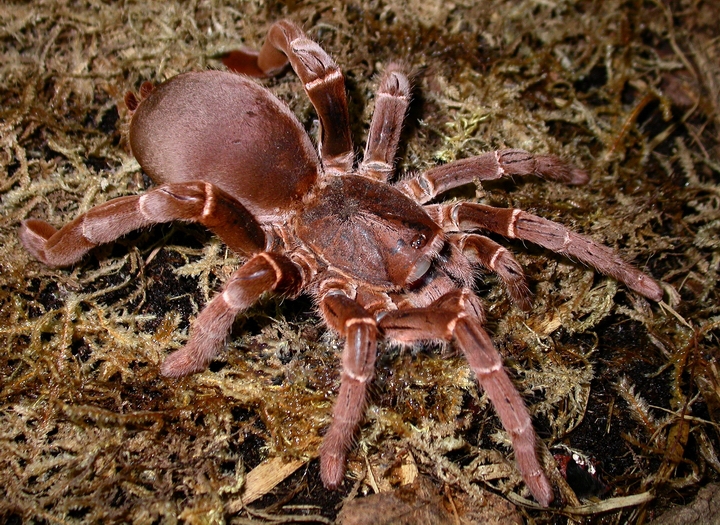 King Baboon SpiderPelinobius muticus
-
 Usambara Baboon TarantulaPterinochilus murinus
Compare
- Socotra Island Blue Baboon Spider vs Madagascan Brown Tarantula
- Socotra Island Blue Baboon Spider vs Goliath Birdeater
- Socotra Island Blue Baboon Spider vs Gooty Sapphire Ornamental Tarantula
- Socotra Island Blue Baboon Spider vs Honduran Curlyhair
- Socotra Island Blue Baboon Spider vs Mexican Orange-knee Tarantula
Questions and answers
What is the scientific name of the Socotra Island Blue Baboon Spider?
The scientific name of the Socotra Island Blue Baboon Spider is Monocentropus balfouri. Written with its author, the full name is Monocentropus balfouri Pocock, 1897.
Which family does the Socotra Island Blue Baboon Spider belong to?
Monocentropus balfouri belongs to the family Theraphosidae, in the order Araneae and the class Arachnida.
Where is the Socotra Island Blue Baboon Spider found?
Checklists and occurrence records place Monocentropus balfouri in 1 country: Yemen.
What other names does the Socotra Island Blue Baboon Spider have?
Monocentropus balfouri is also known in English as Blue Baboon Spider and Socotra Island Blue Baboon Tarantula.
Sources
Passages the profile rests on
- Adults typically have vivid blue coloration, although red and amber variants have been observed rarely. Source passage: “The adult coloration of M. balfouri is striking, a vivid blue, though some red and amber variants have been seen very rarely.” — English Wikipedia
- The carapace and most of the legs are blue, while the trochanters and other body parts are cream-colored or grey. Source passage: “The carapace is blue, as is the leg except for the trochanter, which, like the rest of the body, is cream-colored or grey.” — English Wikipedia
- The opisthosoma has cream, grey, and partial blue coloration. Source passage: “The opisthosoma (abdomen) is cream-colored, grey and partially blue.” — English Wikipedia
- This species is terrestrial and can burrow opportunistically. Source passage: “This tarantula is terrestrial and an opportunistic burrower.” — English Wikipedia
- The species occurs at elevations of up to 850 metres above sea level. Source passage: “The species is usually found up to 850 meters above sea level.” — English Wikipedia
- This tarantula exhibits communal behaviour. Source passage: “A unique behavior of this tarantula is that it is communal” — English Wikipedia
- In captivity, males and females of different ages can coexist without attacking one another when provided with sufficient food and appropriate care. Source passage: “In captivity, multiple males and females of different ages may live together without attacking one another, provided that they have enough food and proper care.” — English Wikipedia
- When threatened, the spider raises its hind legs and exposes its chelicerae in a defensive posture. Source passage: “When threatened, M. balfouri gives a characteristic “threat pose,” rearing up on the hind legs and baring the chelicerae.” — English Wikipedia
- Further provocation can cause the spider to strike and bite rapidly, particularly when it is protecting an egg sac. Source passage: “Further provocation will lead this tarantula to deliver a fast strike and bite, especially if protecting an egg sac.” — English Wikipedia
- The species does not possess urticating hairs. Source passage: “As it is a species of tarantula found in the Old World, M. balfouri does not possess urticating hairs.” — English Wikipedia
- The species can be kept as a pet but is not considered suitable for beginners. Source passage: “Like many tarantulas, M. balfouri can be kept as a pet, although it is not a beginner species.” — English Wikipedia
- Females typically live for approximately 10 to 14 years. Source passage: “Females of the species live for about 10 to 14 years” — English Wikipedia
- Males typically live for approximately 3 to 4 years. Source passage: “males tend to live for about 3 to 4 years.” — English Wikipedia
Data
- Catalogue of Life, 2026-10-16 XR cc by
- Global Biodiversity Information Facility CC BY 4.0
- Wikidata CC0
- GeoNames CC BY 4.0
- Wikimedia Commons per image; credit shown with each image
- Within the Catalogue of Life, this name comes from The World Spider Catalog cc by
References
- Pocock, R. I. (1897b). On the spiders of the suborder Mygalomorphae from the Ethiopian Region, contained in the collection of the British Museum. Proceedings of the Zoological Society of London 65(3): 724-774, pl. 46-48. doi: <a href="https://doi.org/10.1111/j.1096-3642.1897.tb03116.x" target="_blank">10.1111/j.1096-3642.1897.tb03116.x Link where the name was published
This species in other databases
Page built on 26 November 2026. See how the catalog is made and all sources and licences.
Cite this page
ScientificNames.org. (2026). Monocentropus balfouri (Socotra Island Blue Baboon Spider). Retrieved November 26, 2026, from https://scientificnames.org/species/monocentropus-balfouri
“Monocentropus balfouri (Socotra Island Blue Baboon Spider).” ScientificNames.org, 2026, scientificnames.org/species/monocentropus-balfouri. Accessed 26 Nov. 2026.
ScientificNames.org. “Monocentropus balfouri (Socotra Island Blue Baboon Spider).” Accessed November 26, 2026. https://scientificnames.org/species/monocentropus-balfouri.
@misc{scientificnames_monocentropus_balfouri_socotra_island_blue_baboon_spider,
  author = {{ScientificNames.org}},
  title = {Monocentropus balfouri (Socotra Island Blue Baboon Spider)},
  year = {2026},
  url = {https://scientificnames.org/species/monocentropus-balfouri},
  note = {Accessed 2026-11-26}
}