Species · Fishes
Argentine Goatfish Mullus argentinae
The scientific name of the Argentine Goatfish is Mullus argentinae. It is a species of fish in the family Mullidae (goatfish), order Mulliformes. The name dates from 1933.
- Scientific name
- Mullus argentinae Hubbs & Marini, 1933
- Common name
- Argentine Goatfish
- Genus
- Mullus
- Family
- Mullidae (Goatfish)
- Order
- Mulliformes
- Class
- Teleostei
- Environment
- marine
- Recorded in
- 3 countries
- Name status
- accepted in the Catalogue of Life

Overview
Mullus argentinae, the Argentine goatfish, is a species of ray-finned fish, a goatfish from the family Mullidae which is native to the western South Atlantic Ocean from Brazil to northern Argentina. This species was formally described in 1933 by Carl Leavitt Hubbs and Tomás Leandro Marini with the type locality given as the port of Quequén in Argentina.
Classification of the Argentine Goatfish
| Kingdom | Animalia |
|---|---|
| Phylum | Chordata |
| Subphylum | Vertebrata |
| Infraphylum | Gnathostomata |
| Parvphylum | Osteichthyes |
| Gigaclass | Actinopterygii |
| Superclass | Actinopteri |
| Class | Teleostei (Teleost) |
| Order | Mulliformes |
| Family | Mullidae (Goatfish) |
| Genus | Mullus (Mullets) |
| Species | Mullus argentinae Hubbs & Marini, 1933 |
Where the Argentine Goatfish is found
Checklists and occurrence records place Mullus argentinae in 3 countries. GBIF holds 194 georeferenced records of it.
Countries
Regions and cities with the most records
A number beside a place is its count of GBIF occurrence records. A place without a number comes from a checklist alone. Records show where a species has been observed or collected, which can include escapes and vagrants.
Common names
English
- Argentine Goatfish
Names in 4 other languages
- Czech
- parmice argentinská
- Danish
- Argentinsk mulle
- Japanese
- アカメヒメジ
- Spanish
- Trilla
Synonyms
3 other scientific names have been used for this species and are now treated as synonyms of Mullus argentinae.
- Mullus africanus Vasil'eva, 2011
- Mullus argentinae africanus Vasil'eva, 2011
- Mullus argentinus Hubbs & Marini, 1933
Related species
-
 Striped Red MulletMullus surmuletus
-
 Red MulletMullus barbatus
-
 Red GoatfishMullus auratus
-
 Yellow GoatfishMulloidichthys martinicus
-
 MoanoParupeneus multifasciatus
-
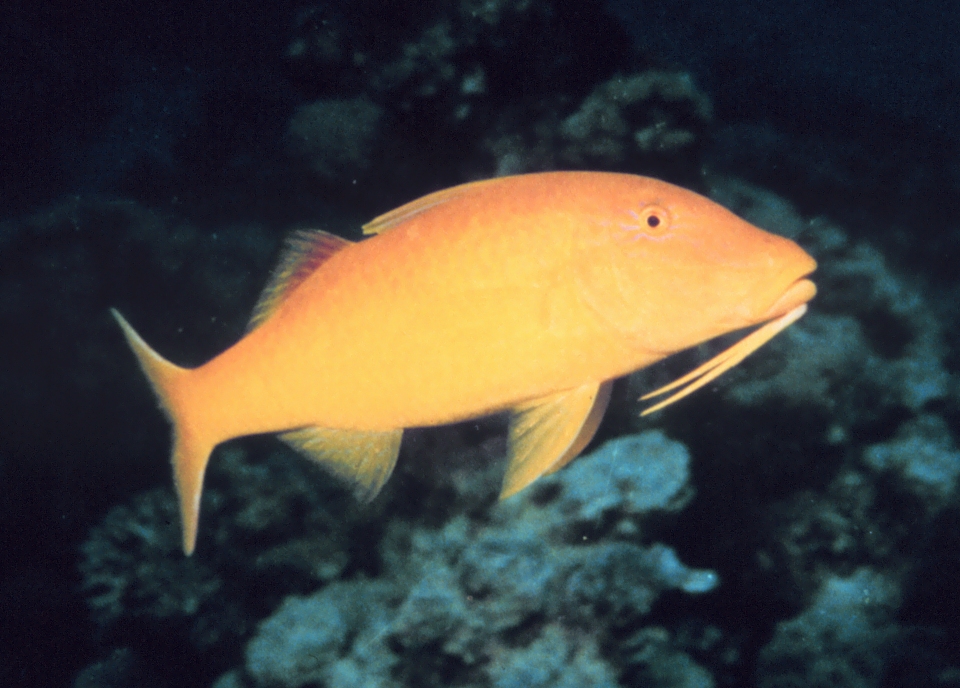 Gold-saddle GoatfishParupeneus cyclostomus
-
 Yellowstripe GoatfishMulloidichthys flavolineatus
-
 Red Sea GoatfishParupeneus forsskali
Compare
Questions and answers
What is the scientific name of the Argentine Goatfish?
The scientific name of the Argentine Goatfish is Mullus argentinae. Written with its author, the full name is Mullus argentinae Hubbs & Marini, 1933.
Which family does the Argentine Goatfish belong to?
Mullus argentinae belongs to the family Mullidae, in the order Mulliformes and the class Teleostei.
Where is the Argentine Goatfish found?
Checklists and occurrence records place Mullus argentinae in 3 countries: Brazil, Argentina and Uruguay.
Sources
Data
- Catalogue of Life, 2026-10-16 XR cc by
- Global Biodiversity Information Facility CC BY 4.0
- Wikidata CC0
- English Wikipedia CC BY-SA 4.0
- GeoNames CC BY 4.0
- Wikimedia Commons per image; credit shown with each image
- Within the Catalogue of Life, this name comes from World Register of Marine Species cc by
References
- Hubbs, C. L., & Marini, T. L. (1933). Nueva especie de Mullidae para la Argentina: Mullus argentinae. Physis (Buenos Aires), 11 (39): 346. where the name was published
This species in other databases
- Catalogue of Life 44K3Q
- Wikidata Q2242502
- iNaturalist 617593
- WoRMS urn:lsid:marinespecies.org:taxname:273661
- ITIS 620934
Page built on 26 November 2026. See how the catalog is made and all sources and licences.
Cite this page
ScientificNames.org. (2026). Mullus argentinae (Argentine Goatfish). Retrieved November 26, 2026, from https://scientificnames.org/species/mullus-argentinae
“Mullus argentinae (Argentine Goatfish).” ScientificNames.org, 2026, scientificnames.org/species/mullus-argentinae. Accessed 26 Nov. 2026.
ScientificNames.org. “Mullus argentinae (Argentine Goatfish).” Accessed November 26, 2026. https://scientificnames.org/species/mullus-argentinae.
@misc{scientificnames_mullus_argentinae_argentine_goatfish,
  author = {{ScientificNames.org}},
  title = {Mullus argentinae (Argentine Goatfish)},
  year = {2026},
  url = {https://scientificnames.org/species/mullus-argentinae},
  note = {Accessed 2026-11-26}
}