Species · Insects
Common Bushbrown Mycalesis perseus
The scientific name of the Common Bushbrown is Mycalesis perseus. It is a species of insect in the family Nymphalidae (purples), order Lepidoptera. The name dates from 1775.
- Scientific name
- Mycalesis perseus (Fabricius, 1775)
- Common name
- Common Bushbrown
- Genus
- Mycalesis
- Family
- Nymphalidae (Purples)
- Order
- Lepidoptera
- Class
- Insecta
- Recorded in
- 16 countries
- Name status
- accepted in the Catalogue of Life

Overview
The Common Bushbrown is a satyrine butterfly in the family Nymphalidae, with the accepted scientific name Mycalesis perseus (Fabricius, 1775). The species is reported from South Asia and Southeast Asia. It exhibits seasonal dimorphism, with distinct wet-season and dry-season forms.
Written 26 November 2026 from the sources listed below. Each statement was checked against the passage it cites; statements that could not be supported were removed.
Appearance
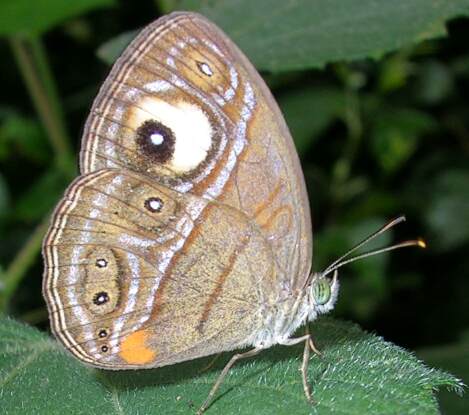
The Common Bushbrown exhibits distinct wet-season and dry-season forms. The wet-season form has a dark to somewhat pale Vandyke-brown upper surface, with pale subterminal and terminal lines on the wings.[1][2][3]
The wet-season forewing usually has a white-centred, fulvous-ringed black eyespot in interspace 2. The hindwing is generally uniform in colour.[4][5]
The wet-season underside has a narrow purplish-white discal band crossing both wings. The forewing underside typically bears between two and four eyespots, while the hindwing underside normally bears seven.[6][7][8]
The wet-season underside eyespot rows are bordered by sinuous purplish-white lines. On the hindwing underside, the three posterior eyespots form a straight line while the others curve outward.[9][10]
Female wet-season individuals have a larger median or posterior forewing upper-surface eyespot than males.[11]
The dry-season form has an upper surface similar to the wet-season form, but its median eyespot is generally smaller. Its underside is brown and may be suffused with purple and marked with darker brown transverse streaks.[12][13]
The dry-season discal band is obscure and may be represented only by black dots at the veins. The eyespots are usually indistinct or reduced to tiny dots.[14][15]
The antennae, head, thorax and abdomen are brown. The antennae may have cinereous-white sides and a black apex.[16][17]
The male has a black sex-mark on the underside of the forewing in form 2.[18]
Classification of the Common Bushbrown
| Kingdom | Animalia |
|---|---|
| Phylum | Arthropoda |
| Subphylum | Hexapoda |
| Class | Insecta (Insect) |
| Order | Lepidoptera |
| Superfamily | Papilionoidea |
| Family | Nymphalidae (Purples) |
| Subfamily | Satyrinae |
| Tribe | Elymniini |
| Genus | Mycalesis (Bushbrowns) |
| Species | Mycalesis perseus (Fabricius, 1775) |
Where the Common Bushbrown is found
Checklists and occurrence records place Mycalesis perseus in 16 countries across Asia. GBIF holds 3,394 georeferenced records of it.
Countries
- Australia 1,329
- Bangladesh 13
- Cambodia 9
- China 5
- India 876
- Indonesia 281
- Malaysia 74
- Myanmar 17
- Nepal 46
- Pakistan 9
- Philippines 70
- Singapore 456
- Sri Lanka 140
- Taiwan 42
- Thailand 23
- Vietnam 4
Regions and cities with the most records
- Queensland, Australia 1,080
- Novena, Singapore 449
- Ang Mo Kio New Town, Singapore 448
- Yio Chu Kang, Singapore 448
- Yishun New Town, Singapore 440
- Sungai Simpang, Singapore 439
- Queenstown Estate, Singapore 438
- Bukit Timah, Singapore 437
- Anak Bukit, Singapore 432
- Woodlands, Singapore 432
- Bukit Panjang New Town, Singapore 426
- Teck Whye, Singapore 426
- Choa Chu Kang New Town, Singapore 422
- Marsiling, Singapore 421
- Jurong East, Singapore 420
- Jurong Town, Singapore 418
- Keat Hong Village, Singapore 418
- Sembawang Estate, Singapore 418
- Sengkang New Town, Singapore 418
- Yew Tee, Singapore 418
- Jurong West, Singapore 415
- Johor Bahru, Malaysia 408
- Singapore, Singapore 408
- Boon Lay, Singapore 396
- Matilda Estate, Singapore 395
- MacPherson, Singapore 392
- Kampung Pasir Gudang Baru, Malaysia 389
- Masai, Malaysia 377
- Punggol, Singapore 377
- Taman Permas Jaya, Malaysia 376
- Kampung Larkin Lama, Malaysia 369
- Eunos, Singapore 368
- Pasir Gudang, Malaysia 345
- Marine Parade, Singapore 343
- Perling, Malaysia 340
- Bandar Seri Alam, Malaysia 338
3 more countries have a few records outside this range
These countries hold a few records of Mycalesis perseus but lie outside the range the checklists give for it. Such records are often zoo or garden specimens, museum material or vagrants, so the species is not counted as occurring there.
A number beside a place is its count of GBIF occurrence records. A place without a number comes from a checklist alone. Records show where a species has been observed or collected, which can include escapes and vagrants.
Common names
English
- Common Bushbrown
- Dingy Bush-brown
- Dingy Bushbrown
- Himalayan Common Bushbrown
Names in 5 other languages
- Bengali
- জংলাবিড়া
- Chinese
- 小單環眉眼蝶, 新目蝶, 曲斑眉眼蝶, 曲紋眉眼蝶, 無紋蛇目蝶, 裴斯眉眼蝶
- Japanese
- ヒメヒトツメジャノメ
- Tamil
- புதர் சிறகன்
- Thai
- ผีเสื้อตาลพุ่มธรรมดา
Synonyms
21 other scientific names have been used for this species and are now treated as synonyms of Mycalesis perseus.
- Coenonympha infuscata MacLeay, 1866
- Mycalesis acarya Fruhstorfer, 1911
- Mycalesis blasius Fabricius, 1798
- Mycalesis caesonia Wallengren, 1860
- Mycalesis cepheus Butler, 1867
- Mycalesis igoleta Felder, 1863
- Mycalesis indistans Moore, 1880
- Mycalesis infuscata Waterhouse & Lyell, 1914
- Mycalesis lalassis Hewitson, 1864
- Mycalesis lugens Butler, 1875
- Mycalesis lurida Butler, 1879
- Mycalesis modestus Miskin, 1890
- Mycalesis persa Smith & Kirby, 1902
- Mycalesis perseus blasius (Fabricius, 1798)
- Mycalesis prasias Fruhstorfer, 1911
- Mycalesis samba Moore, 1857
- Mycalesis tabitha Fabricius, 1763
- Mycalesis typhlus Fruhstorfer, 1908
- Mycalesis zia Butler, 1869
- Mycalesis zopyrus Kollar, 1844
- Papilio perseus Fabricius, 1775 ambiguous synonym
Related species
-
 Dark-branded BushbrownMycalesis mineus
-
 Glad-eye BushbrownMycalesis patnia
-
 Chinese BushbrownMycalesis gotama
-
 Long Brand BushbrownMycalesis visala
-
 White-bar BushbrownMycalesis anaxias
-
 Tamil BushbrownMycalesis subdita
-
 Lilacine BushbrownMycalesis francisca
-
 Burmese BushbrownMycalesis perseoides
Compare
Questions and answers
What is the scientific name of the Common Bushbrown?
The scientific name of the Common Bushbrown is Mycalesis perseus. Written with its author, the full name is Mycalesis perseus (Fabricius, 1775).
Which family does the Common Bushbrown belong to?
Mycalesis perseus belongs to the family Nymphalidae, in the order Lepidoptera and the class Insecta.
Where is the Common Bushbrown found?
Checklists and occurrence records place Mycalesis perseus in 16 countries, including Australia, India, Singapore, Indonesia, Sri Lanka and Malaysia.
What other names does the Common Bushbrown have?
Mycalesis perseus is also known in English as Dingy Bush-brown, Dingy Bushbrown and Himalayan Common Bushbrown.
What is the genus name of a butterfly?
The genus name of the Common Bushbrown is Mycalesis.[19]
Sources
Passages the profile rests on
- The species exhibits seasonal dimorphism, with distinct wet-season and dry-season forms. Source passage: “Mycalesis perseus exhibits seasonal dimorphism with distinct wet-season and dry-season forms.” — English Wikipedia
- The wet-season form has a dark to somewhat pale Vandyke-brown upper surface. Source passage: “Upperside dark to somewhat pale vandyke-brown.” — English Wikipedia
- The wet-season wings have pale subterminal and terminal lines on their upper surfaces. Source passage: “Fore and hind wings with subterminal and terminal pale lines.” — English Wikipedia
- The wet-season forewing usually has a white-centred, fulvous-ringed black eyespot in interspace 2. Source passage: “Fore wing with a white-centred, fulvous-ringed, black ocellus in interspace 2” — English Wikipedia
- The wet-season hindwing is generally uniform in colour. Source passage: “Hind wing uniform, occasionally two or three postmedian obscure ocelli present.” — English Wikipedia
- The wet-season underside has a narrow purplish-white discal band crossing both wings. Source passage: “but crossed by a common purplish - white narrow discal fascia.” — English Wikipedia
- The wet-season forewing underside typically bears between two and four eyespots. Source passage: “Fore wing with from two to four” — English Wikipedia
- The wet-season hindwing underside normally bears seven eyespots. Source passage: “hind wing normally with seven ocelli” — English Wikipedia
- The eyespot rows on the wet-season underside are bordered by sinuous purplish-white lines. Source passage: “on both wings the line of ocelli bordered inwardly and outwardly by sinuous purplish-white lines.” — English Wikipedia
- On the wet-season hindwing underside, the three posterior eyespots form a straight line while the others curve outward. Source passage: “On the hind wing only the three posterior ocelli in a straight line, the rest strongly curved outwards.” — English Wikipedia
- Female wet-season individuals have a larger median or posterior forewing upper-surface eyespot than males. Source passage: “In the female the median or posterior ocellus on the upperside of the fore wing is always larger than in the male.” — English Wikipedia
- The dry-season form has an upper surface similar to the wet-season form, but its median eyespot is generally smaller. Source passage: “Upperside similar to that in the wet-season form, the median ocellus generally smaller.” — English Wikipedia
- The dry-season underside is brown and may be suffused with purple and marked with darker brown transverse streaks. Source passage: “Underside brown, more or less suffused with purple and irrorated with darker brown minute transverse strigae;” — English Wikipedia
- The dry-season discal band is obscure and may be represented only by black dots at the veins. Source passage: “the transverse discal band obscure, often merely indicated by black dots at the veins” — English Wikipedia
- The dry-season eyespots are usually indistinct or reduced to tiny dots. Source passage: “Ocelli obsolescent, but when present as mere minute dots” — English Wikipedia
- The antennae, head, thorax and abdomen are brown. Source passage: “Antennae, head, thorax and abdomen brown;” — English Wikipedia
- The antennae may have cinereous-white sides and a black apex. Source passage: “antennae sometimes cinereous white on the sides with the apex black.” — English Wikipedia
- The male has a black sex-mark on the underside of the forewing in form 2. Source passage: “Male sex-marks in form 2, but that on the underside of the fore wing small (about 2 into, long) and black.” — English Wikipedia
- The accepted scientific name is Mycalesis perseus (Fabricius, 1775). Source passage: “Species Accepted Mycalesis perseus (Fabricius, 1775)” — gbif.org
Data
- Catalogue of Life, 2026-10-16 XR cc by
- Global Biodiversity Information Facility CC BY 4.0
- Wikidata CC0
- GeoNames CC BY 4.0
- Wikimedia Commons per image; credit shown with each image
- Within the Catalogue of Life, this name comes from Global Lepidoptera Index cc by
This species in other databases
Page built on 29 November 2026. See how the catalog is made and all sources and licences.
Cite this page
ScientificNames.org. (2026). Mycalesis perseus (Common Bushbrown). Retrieved November 29, 2026, from https://scientificnames.org/species/mycalesis-perseus
“Mycalesis perseus (Common Bushbrown).” ScientificNames.org, 2026, scientificnames.org/species/mycalesis-perseus. Accessed 29 Nov. 2026.
ScientificNames.org. “Mycalesis perseus (Common Bushbrown).” Accessed November 29, 2026. https://scientificnames.org/species/mycalesis-perseus.
@misc{scientificnames_mycalesis_perseus_common_bushbrown,
  author = {{ScientificNames.org}},
  title = {Mycalesis perseus (Common Bushbrown)},
  year = {2026},
  url = {https://scientificnames.org/species/mycalesis-perseus},
  note = {Accessed 2026-11-29}
}