Species · Birds
Slate-throated Whitestart Myioborus miniatus
The scientific name of the Slate-throated Whitestart is Myioborus miniatus. It is a species of bird in the family Parulidae (new world warbler), order Passeriformes. The name dates from 1827.
- Scientific name
- Myioborus miniatus (Swainson, 1827)
- Common name
- Slate-throated Whitestart
- Genus
- Myioborus
- Family
- Parulidae (New World Warbler)
- Order
- Passeriformes
- Class
- Aves
- Red List category
- LC Least Concern
- Environment
- terrestrial
- Recorded in
- 15 countries
- Name status
- accepted in the Catalogue of Life

Overview
The Slate-throated Whitestart is a bird in the family Parulidae, order Passeriformes and class Aves. It inhabits highland and foothill areas in Mexico, Central America and South America. It has geographically variable underparts, white vent and tail tips, and a tail-flashing foraging behaviour.
Written 26 November 2026 from the sources listed below. Each statement was checked against the passage it cites; statements that could not be supported were removed.
Appearance
The Slate-throated Whitestart has a deep rufous head, dark back, yellow breast and belly, and white vent and tail tips. Its bill is black and its legs are blackish-gray.[1][2]
The sexes have similar plumage, with slaty-gray heads and upperparts, blacker faces and small rusty caps. Underpart colour varies geographically from yellow across most of its range to red in the northernmost part.[3][4]
The species measures approximately 12 cm in length.[5]
Habitat
The Slate-throated Whitestart inhabits humid highland forests, occupying vegetation from the upper understory to the middle canopy. Recorded habitats include arroyos, canyons, forests, woodlands, shrublands and savannas.[6][7]
The species occurs in highlands and foothills in Mexico and Central America. Its South American range includes the Andes from western Venezuela to northwestern Argentina, as well as the Venezuelan Coastal Range, Sierra Nevada de Santa Marta and the tepuis.[8][9][10][11]
The species generally occurs at elevations between approximately 600 and 2,500 metres above sea level.[12]
The nominate subspecies occurs in western and southwestern Mexico, while M. m. molochinus occurs in eastern Mexico. M. m. intermedius occurs in southern Mexico and eastern Guatemala, and M. m. hellmayri occurs in southern Guatemala and southwestern El Salvador.[13][14][15][16]
M. m. comptus occurs in western and central Costa Rica, while M. m. aurantiacus occurs in eastern Costa Rica and western Panama. M. m. sanctaemartae occurs in northern Colombia, and M. m. pallidiventris occurs in northern Venezuela.[17][18][19][20]
M. m. subsimilis occurs in southwestern Ecuador and northwestern Peru. A specimen was recorded in Sigmund Stern Recreation Grove in San Francisco, California, in July 2024.[21][22]
Diet
The species occasionally consumes protein corpuscles from Cecropia plants.[23]
Behaviour
Pairs remain together throughout the year and frequently associate with mixed-species flocks. The species flashes its tail while hopping and flitting to flush insects, which it catches during aerial pursuits.[24][25]
The species occasionally gleans insects from tree bark. Its call note is a sharp sound described as 'pik'.[26][27]
Its song consists of varied whistled notes across most of its geographical range.[28]
Reproduction and life cycle
Pairs construct nests between April and May. The nest is a bulky, roofed structure with a side entrance, generally placed in a niche in a bank or steep slope.[29][30]
The female usually lays three eggs, although clutches of two also occur.[31]
Classification of the Slate-throated Whitestart
| Kingdom | Animalia |
|---|---|
| Phylum | Chordata |
| Subphylum | Vertebrata |
| Infraphylum | Gnathostomata |
| Parvphylum | Osteichthyes |
| Megaclass | Tetrapoda |
| Class | Aves (Bird) |
| Order | Passeriformes (Passerine) |
| Family | Parulidae (New World Warbler) |
| Genus | Myioborus (Whitestart) |
| Species | Myioborus miniatus (Swainson, 1827) |
Where the Slate-throated Whitestart is found
Checklists and occurrence records place Myioborus miniatus in 15 countries across North America and South America. GBIF holds 297,469 georeferenced records of it.
Countries
- Bolivia 1,172
- Brazil 23
- Colombia 89,602
- Costa Rica 57,728
- Ecuador 50,157
- El Salvador 1,310
- Guatemala 24,121
- Guyana 28
- Honduras 5,268
- Mexico 35,345
- Nicaragua 39
- Panama 8,836
- Peru 14,109
- United States 1,827
- Venezuela 7,904
Regions and cities with the most records
- Pichincha, Ecuador 30,982
- Puntarenas Province, Costa Rica 22,296
- Antioquia, Colombia 17,044
- Valle del Cauca Department, Colombia 12,401
- San José, Costa Rica 10,767
- Alajuela Province, Costa Rica 10,348
- Caldas Department, Colombia 10,062
- Napo, Ecuador 9,807
- Risaralda Department, Colombia 9,356
- Cuzco Department, Peru 8,888
- Circasia, Colombia 8,548
- Villamaría, Colombia 7,926
- Manizales, Colombia 7,914
- Chiriquí Province, Panama 7,750
- Cali, Colombia 7,481
- Cartago Province, Costa Rica 7,287
- Alta Verapaz, Guatemala 6,837
- San Isidro, Costa Rica 6,813
- Quindío Department, Colombia 6,717
- Neira, Colombia 6,551
- Itagüí, Colombia 6,488
- Cartago, Costa Rica 6,484
- Envigado, Colombia 6,384
- Cobán, Guatemala 6,361
- Paraíso, Costa Rica 6,109
- Oaxaca, Mexico 6,039
- Cundinamarca, Colombia 6,035
- San Cristóbal Verapaz, Guatemala 6,023
- Chinchiná, Colombia 6,015
- Magdalena Department, Colombia 5,965
- Yumbo, Colombia 5,901
- San Pedro Carchá, Guatemala 5,863
- La Estrella, Colombia 5,836
- Medellín, Colombia 5,513
- Chiapas, Mexico 5,503
- Retiro, Colombia 5,399
Range as the checklists state it
Middle America
South America
A number beside a place is its count of GBIF occurrence records. A place without a number comes from a checklist alone. Records show where a species has been observed or collected, which can include escapes and vagrants.
Common names
English
- Slate-throated Whitestart
- Slate-throated Redstart
Names in 30 other languages
- Arabic
- حميراء بيضاء أردوازية الحلق
- Catalan
- bosquerola gola de pissarra
- Chinese
- 暗喉鸲莺, 暗灰喉鴝鶯
- Croatian
- crvenotrba sjeničica
- Czech
- lesňáček pestrý
- Danish
- Rødbuget Hvidstjert
- Dutch
- Meniezanger
- Esperanto
- Ardezparulio, ardeza parulio
- Estonian
- tanu-mägisäälik
- Finnish
- huppuviuhkakerttuli
- French
- Paruline ardoisée
- German
- Larven-Waldsänger, Larvenwaldsänger
- Italian
- Codirosso golardesia, Parula pigliamosche gola ardesia
- Japanese
- ベニイタダキアメリカムシクイ
- Latvian
- tumšrīkles erickiņš
- Lithuanian
- pilkagurklis raudonuodeginis parulidas
- Norwegian
- skiferhvitstjert
- Polish
- Pleszówka ciemnoglowa, pleszówka ciemnogłowa
- Portuguese
- mariquita-cinza, mariquita-de-garganta-ardósia
- Russian
- Красно-чёрный горихвостковый певун, Черногорлая канделита
- Serbian
- Američka crvenrepka sa crvenim temenom
- Slovak
- horárik bridlicový
- Spanish
- Abanico pechinegro, Candelita Gargantipizarra, Candelita Pechinegra, Candelita plomiza, Chipe de montaña, Pavito Alas Negras
- Swedish
- skiffervitstjärt
- Turkish
- Kül Rengi Ötleğen
- Ukrainian
- чернітка чорногорла
- Welsh
- tinwen yddfddu
- arz
- حميراء بيضاء اردوازية الحلق
- brn
- Turi yibí
- nav
- Tseeyaałgaii bizééʼ halbáhígíí
Synonyms
3 other scientific names have been used for this species and are now treated as synonyms of Myioborus miniatus.
- Muscicapa derhamii Giraud, JP Jr, 1841
- Myiobius miniatus Swainson, WJ, 1827
- Setophaga miniata Swainson, 1827
Subspecies and varieties
- Myioborus miniatus aurantiacus subspecies
- Myioborus miniatus ballux subspecies
- Myioborus miniatus comptus subspecies
- Myioborus miniatus connectens subspecies
- Myioborus miniatus hellmayri subspecies
- Myioborus miniatus intermedius subspecies
- Myioborus miniatus miniatus subspecies
- Myioborus miniatus molochinus subspecies
- Myioborus miniatus pallidiventris subspecies
- Myioborus miniatus sanctaemartae subspecies
- Myioborus miniatus subsimilis subspecies
- Myioborus miniatus verticalis subspecies
Related species
-
 Painted RedstartMyioborus pictus
-
 Collared WhitestartMyioborus torquatus
-
 Golden-fronted WhitestartMyioborus ornatus
-
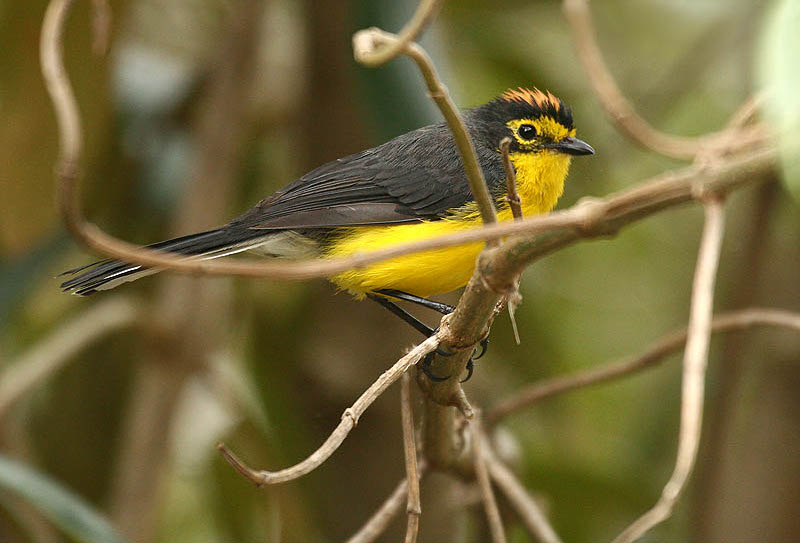 Spectacled WhitestartMyioborus melanocephalus
-
 Brown-capped WhitestartMyioborus brunniceps
-
 Tepui WhitestartMyioborus castaneocapilla
- Guaiquinima WhitestartMyioborus cardonai
-
 White-fronted WhitestartMyioborus albifrons
Compare
Questions and answers
What is the scientific name of the Slate-throated Whitestart?
The scientific name of the Slate-throated Whitestart is Myioborus miniatus. Written with its author, the full name is Myioborus miniatus (Swainson, 1827).
Which family does the Slate-throated Whitestart belong to?
Myioborus miniatus belongs to the family Parulidae, in the order Passeriformes and the class Aves.
Where is the Slate-throated Whitestart found?
Checklists and occurrence records place Myioborus miniatus in 15 countries, including Colombia, Costa Rica, Ecuador, Mexico, Guatemala and Peru.
What is the conservation status of the Slate-throated Whitestart?
The IUCN Red List category recorded for Myioborus miniatus is Least Concern (LC).
What other names does the Slate-throated Whitestart have?
Myioborus miniatus is also known in English as Slate-throated Redstart.
Who described the Slate-throated Whitestart?
William Swainson formally described the species in 1827 using a specimen collected in Valladolid, Michoacán, Mexico.[32]
What does the scientific name miniata mean?
The specific epithet miniata derives from the Latin word meaning painted vermilion.[33]
What genus does the species belong to?
The Slate-throated Whitestart belongs to the genus Myioborus, which was established in 1865.[34]
Sources
Passages the profile rests on
- The species has a deep rufous head, dark back, yellow breast and belly, and white vent and tail tips. Source passage: “It has a deep rufous head, dark back, and contrasting bright yellow breast, belly and white vent and tail tips.” — English Wikipedia
- The species has a black bill and blackish-gray legs. Source passage: “The bill is black, and the legs are blackish-gray.” — English Wikipedia
- Its underparts vary geographically from yellow across most of its range to red in the northernmost part. Source passage: “the underparts grade from yellow in most of its range, to red in the northernmost part.” — English Wikipedia
- The sexes have similar plumage, with slaty-gray heads and upperparts, blacker faces, and small rusty caps. Source passage: “Sexes look alike: head and upperparts slaty gray with blacker face and small rusty cap.” — ebird.org
- The species measures approximately 12 cm in length. Source passage: “The slate-throated whitestart is a long-tailed warbler measuring 12 cm (4.7 in) long.” — English Wikipedia
- The species inhabits humid highland forests, occupying vegetation from the upper understory to the middle canopy. Source passage: “in humid highland forests, from upper understory to mid canopy” — English Wikipedia
- Recorded habitats include arroyos, canyons, forests, woodlands, shrublands, and savannas. Source passage: “Habitat. Arroyos and Canyons, Forests and Woodlands, Shrublands, Savannas, and ...” — audubon.org
- The species occurs in highlands and foothills. Source passage: “Active and attractive warbler of highlands and foothills.” — ebird.org
- The species occurs in Mexico and Central America. Source passage: “It is found disjunctly in humid highland forests, from upper understory to mid canopy, in Mexico, Central America,” — English Wikipedia
- Its South American range includes the Andes from western Venezuela to northwestern Argentina. Source passage: “the Andes from western Venezuela to northwestern Argentina” — English Wikipedia
- The species also occurs in the Venezuelan Coastal Range, Sierra Nevada de Santa Marta, and the tepuis. Source passage: “the Venezuelan Coastal Range, Sierra Nevada de Santa Marta and the tepuis.” — English Wikipedia
- The species generally occurs at elevations between approximately 600 and 2,500 metres above sea level. Source passage: “It occurs at around 600 to 2,500 m (2,000 to 8,200 ft) above sea level.” — English Wikipedia
- The nominate subspecies occurs in western and southwestern Mexico. Source passage: “M. m. miniatus (Swainson, 1827) – west, southwest Mexico” — English Wikipedia
- The subspecies M. m. molochinus occurs in eastern Mexico. Source passage: “M. m. molochinus Wetmore, 1942 – east Mexico” — English Wikipedia
- The subspecies M. m. intermedius occurs in southern Mexico and eastern Guatemala. Source passage: “M. m. intermedius (Hartlaub, 1852) – south Mexico and east Guatemala” — English Wikipedia
- The subspecies M. m. hellmayri occurs in southern Guatemala and southwestern El Salvador. Source passage: “M. m. hellmayri Van Rossem, 1936 – south Guatemala and southwest El Salvador” — English Wikipedia
- The subspecies M. m. comptus occurs in western and central Costa Rica. Source passage: “M. m. comptus Wetmore, 1944 – west, central Costa Rica” — English Wikipedia
- The subspecies M. m. aurantiacus occurs in eastern Costa Rica and western Panama. Source passage: “M. m. aurantiacus (Baird, SF, 1865) – east Costa Rica and west Panama” — English Wikipedia
- The subspecies M. m. sanctaemartae occurs in northern Colombia. Source passage: “M. m. sanctaemartae Zimmer, JT, 1949 – north Colombia” — English Wikipedia
- The subspecies M. m. pallidiventris occurs in northern Venezuela. Source passage: “M. m. pallidiventris (Chapman, 1899) – north Venezuela” — English Wikipedia
- The subspecies M. m. subsimilis occurs in southwestern Ecuador and northwestern Peru. Source passage: “M. m. subsimilis Zimmer, JT, 1949 – southwest Ecuador and northwest Peru” — English Wikipedia
- A specimen was recorded in Sigmund Stern Recreation Grove in San Francisco, California, in July 2024. Source passage: “In July 2024, a specimen was spotted in the Sigmund Stern Recreation Grove of San Francisco, California.” — English Wikipedia
- The species occasionally consumes protein corpuscles from Cecropia plants. Source passage: “It will occasionally take protein corpuscles from Cecropia plants” — English Wikipedia
- Pairs remain together throughout the year and frequently associate with mixed-species flocks. Source passage: “Pairs remain together throughout year, often accompanying mixed flocks.” — English Wikipedia
- The species flashes its tail while hopping and flitting to flush insects, which it catches during aerial pursuits. Source passage: “It hops and flits about while flashing its tail to frighten insects which are then caught in aerial pursuits.” — English Wikipedia
- The species occasionally gleans insects from tree bark. Source passage: “will occasionally glean insects from tree bark.” — English Wikipedia
- Its call note is a sharp sound described as 'pik'. Source passage: “The slate-throated whitestart's call note is a sharp "pik" note.” — English Wikipedia
- Its song consists of varied whistled notes across most of its geographical range. Source passage: “throughout most of range it is a varied series of whistled notes, some slurred up, some slurred down.” — English Wikipedia
- Pairs construct nests between April and May. Source passage: “From April to May, pairs nest” — English Wikipedia
- The nest is a bulky, roofed structure with a side entrance, generally placed in a niche in a bank or steep slope. Source passage: “in a bulky, roofed structure with a side entrance, usually nestled in niche in bank or steep slope.” — English Wikipedia
- The female usually lays three eggs, although clutches of two also occur. Source passage: “The female lays 3, or sometimes 2, speckled white eggs.” — English Wikipedia
- The species was formally described in 1827 by William Swainson using a specimen collected in Valladolid, Michoacán, Mexico. Source passage: “The slate-throated whitestart was formally described in 1827 by the English zoologist William Swainson based on a specimen collected in Valladolid (Morelia) in the Mexican state of Michoacán.” — English Wikipedia
- The specific epithet miniata derives from the Latin word meaning painted vermilion. Source passage: “the specific epithet is from Latin miniatus meaning "painted vermilion".” — English Wikipedia
- The species is classified in the genus Myioborus, which was established in 1865. Source passage: “The slate-throated whitestart is now one of twelve species placed in the genus Myioborus that was introduced in 1865 by the American naturalist Spencer Baird.” — English Wikipedia
Data
- Catalogue of Life, 2026-10-16 XR cc by
- Global Biodiversity Information Facility CC BY 4.0
- Wikidata CC0
- GeoNames CC BY 4.0
- Wikimedia Commons per image; credit shown with each image
- Within the Catalogue of Life, this name comes from The Integrated Taxonomic Information System cc0
References
- Philos. Mag., new ser., 1: 368. 1827 where the name was published
- Gill, Frank, & and Minturn Wright. (2006). Birds of the World: Recommended English Names.
This species in other databases
Page built on 29 November 2026. See how the catalog is made and all sources and licences.
Cite this page
ScientificNames.org. (2026). Myioborus miniatus (Slate-throated Whitestart). Retrieved November 29, 2026, from https://scientificnames.org/species/myioborus-miniatus
“Myioborus miniatus (Slate-throated Whitestart).” ScientificNames.org, 2026, scientificnames.org/species/myioborus-miniatus. Accessed 29 Nov. 2026.
ScientificNames.org. “Myioborus miniatus (Slate-throated Whitestart).” Accessed November 29, 2026. https://scientificnames.org/species/myioborus-miniatus.
@misc{scientificnames_myioborus_miniatus_slate_throated_whitestart,
  author = {{ScientificNames.org}},
  title = {Myioborus miniatus (Slate-throated Whitestart)},
  year = {2026},
  url = {https://scientificnames.org/species/myioborus-miniatus},
  note = {Accessed 2026-11-29}
}