Species · Birds
New Caledonian Myzomela Myzomela caledonica
The scientific name of the New Caledonian Myzomela is Myzomela caledonica. It is a species of bird in the family Meliphagidae (honeyeater), order Passeriformes. The name dates from 1879.
- Scientific name
- Myzomela caledonica W. A. Forbes, 1879
- Common name
- New Caledonian Myzomela
- Genus
- Myzomela
- Family
- Meliphagidae (Honeyeater)
- Order
- Passeriformes
- Class
- Aves
- Red List category
- LC Least Concern
- Recorded in
- 2 countries
- Name status
- accepted in the Catalogue of Life

Overview
Myzomela caledonica is endemic to New Caledonia, with a recorded distribution including Grande Terre and the Isle of Pines. Adult males have scarlet heads, breasts and backs, while adult females and juveniles have predominantly dull brown plumage.
Written 27 November 2026 from the sources listed below. Each statement was checked against the passage it cites; statements that could not be supported were removed.
Appearance
Adult males have scarlet heads, breasts and backs, black wings and tails, and white bellies and rumps. Adult females have dull brown heads, breasts and backs, a slight red wash on the face, and duller wings and bellies.[1][2]
Juveniles resemble adult females. Adult males have cleaner white bellies and less grey coloration on the belly than scarlet myzomelas.[3][4]
New Caledonian myzomelas lack the white edges on their wing coverts found in scarlet myzomelas. Females have a stronger red hue on the throat than female scarlet myzomelas.[5][6]
The species measures approximately 11 cm in length and typically weighs between 6.5 and 8 grams. Males are slightly heavier than females.[7][8][9]
Habitat
Its natural habitats include humid rainforest, stunted hill forest and savanna woodland.[10]
The species also occupies modified habitats, including plantations and gardens.[11]
Reproduction and life cycle
Breeding takes place between November and January. The species constructs small cup-shaped nests with an internal diameter of 4.5–5 cm, using roots and plant fibres.[12][13][14][15]
Nests are positioned high in trees and attached using spider webs. Females lay two eggs per clutch.[16][17]
Both parents participate in incubating the eggs and feeding the young birds.[18][19]
Conservation
The species is considered common within its restricted geographic range. It is classified as Least Concern by the IUCN Red List and was most recently assessed in 2018.[20][21][22]
Similar species
The scarlet myzomela of Australia is sometimes considered to be the same species as the New Caledonian myzomela.[23]
Classification of the New Caledonian Myzomela
| Kingdom | Animalia |
|---|---|
| Phylum | Chordata |
| Subphylum | Vertebrata |
| Infraphylum | Gnathostomata |
| Parvphylum | Osteichthyes |
| Megaclass | Tetrapoda |
| Class | Aves (Bird) |
| Order | Passeriformes (Passerine) |
| Family | Meliphagidae (Honeyeater) |
| Genus | Myzomela (Cardinal Honeyeaters) |
| Species | Myzomela caledonica W. A. Forbes, 1879 |
Where the New Caledonian Myzomela is found
Checklists and occurrence records place Myzomela caledonica in 2 countries across Oceania. GBIF holds 1,366 georeferenced records of it.
Countries
Regions and cities with the most records
Range as the checklists state it
Australia
A number beside a place is its count of GBIF occurrence records. A place without a number comes from a checklist alone. Records show where a species has been observed or collected, which can include escapes and vagrants.
Common names
English
- New Caledonian Myzomela
- Scarlet Honeyeater
Names in 25 other languages
- Catalan
- mel·lífer de Nova Caledònia
- Chinese
- 新喀摄蜜鸟, 新喀里多尼亞攝蜜鳥
- Croatian
- crvenoprsi medojed
- Czech
- medosavka novokaledonská
- Danish
- Ny Caledonisk Honningæder, Ny Kaledonsk-honningæder
- Dutch
- Nieuw-Caledonische Dwerghoningeter
- Esperanto
- novkaledonia nanmielmanĝulo
- Finnish
- Uudenkaledonianpunamesikko
- French
- Myzomèle calédonien
- German
- Neukaledonien-Honigfresser
- Hungarian
- új-kaledóniai mézevő
- Italian
- Mangiamiele della Nuova Caledonia, Mizomela della Nuova Caledonia, Mizomela di New Caledonia, Succiamiele della Nuova Caledonia
- Japanese
- カレドニアミツスイ
- Lithuanian
- Naujosios Kaledonijos mizomela
- Norwegian
- kanakhonningeter
- Polish
- miodówka nowokaledońska
- Portuguese
- papa-mel-da-nova-caledónia, suga-mel-da-nova-caledónia, suga-mel-da-nova-caledônia
- Russian
- Новокаледонская медовка, Новокаледонская мизомела
- Slovak
- medárik novokaledónsky
- Spanish
- Mielero de Nueva Caledonia
- Swedish
- nyakaledonienmyzomela
- Turkish
- Yeni Kaledonya Mizomelası
- Ukrainian
- медовичка новокаледонська
- bwa
- tanabwaelaan
- pme
- mîîanon
Synonyms
One other scientific name has been used for this species and is now treated as a synonym of Myzomela caledonica.
- Myzomela sanguinolenta caledonica W. A. Forbes, 1879
Related species
-
 Scarlet MyzomelaMyzomela sanguinolenta
-
 Red-headed MyzomelaMyzomela erythrocephala
-
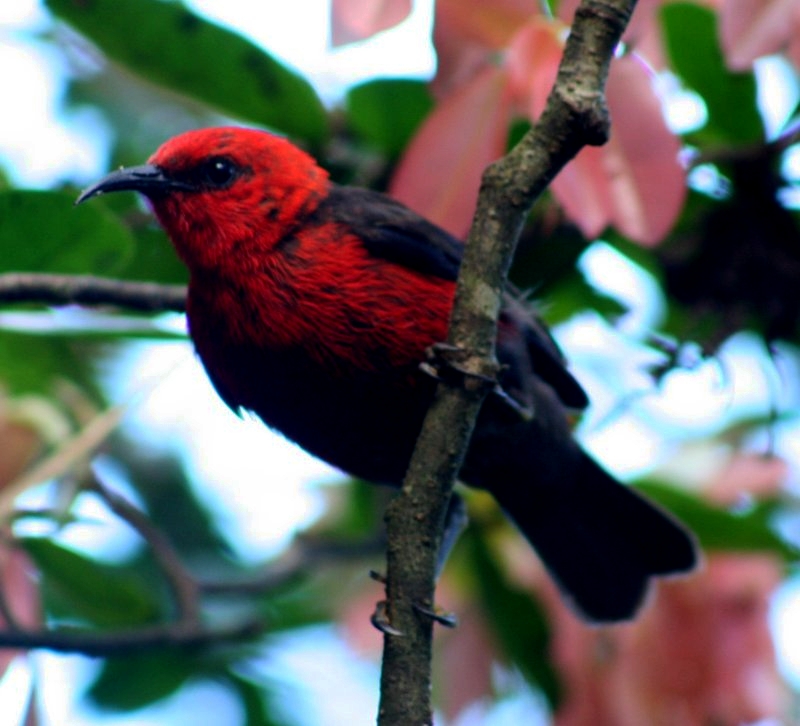 Micronesian MyzomelaMyzomela rubratra
-
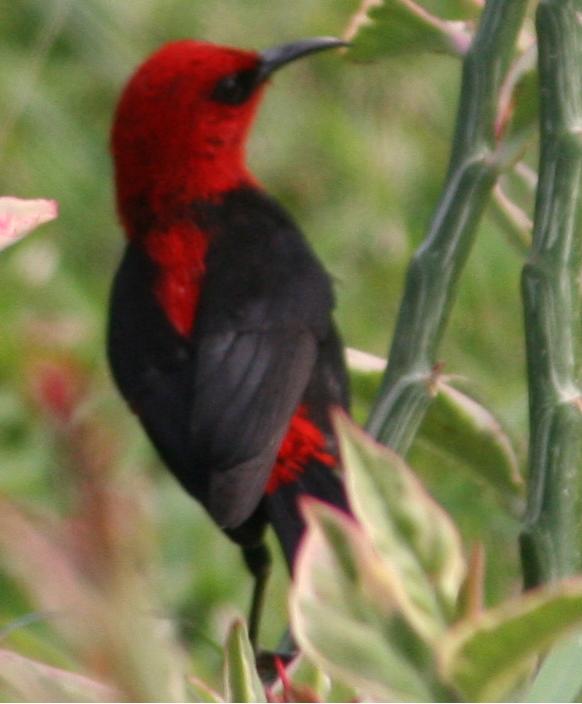 Cardinal MyzomelaMyzomela cardinalis
-
 Dusky MyzomelaMyzomela obscura
-
 Sulphur-breasted MyzomelaMyzomela jugularis
-
 Wakolo MyzomelaMyzomela wakoloensis
-
 Rotuma MyzomelaMyzomela chermesina
Compare
Questions and answers
What is the scientific name of the New Caledonian Myzomela?
The scientific name of the New Caledonian Myzomela is Myzomela caledonica. Written with its author, the full name is Myzomela caledonica W. A. Forbes, 1879.
Which family does the New Caledonian Myzomela belong to?
Myzomela caledonica belongs to the family Meliphagidae, in the order Passeriformes and the class Aves.
Where is the New Caledonian Myzomela found?
Checklists and occurrence records place Myzomela caledonica in 2 countries: New Caledonia and Australia.
What is the conservation status of the New Caledonian Myzomela?
The IUCN Red List category recorded for Myzomela caledonica is Least Concern (LC).
What other names does the New Caledonian Myzomela have?
Myzomela caledonica is also known in English as Scarlet Honeyeater.
Sources
Passages the profile rests on
- Adult males have scarlet heads, breasts and backs, black wings and tails, and white bellies and rumps. Source passage: “the male having a scarlet head, breast and back, black wings and tail and a white belly and rump.” — English Wikipedia
- Adult females have dull brown heads, breasts and backs, a slight red wash on the face, and duller wings and bellies. Source passage: “The female has a dull brown head, breast and back with a slight red wash on the face, and duller wings and belly.” — English Wikipedia
- Juveniles resemble adult females in appearance. Source passage: “Juvenile birds resemble the female.” — English Wikipedia
- Adult males have cleaner white bellies and less grey coloration on the belly than scarlet myzomelas. Source passage: “adult male New Caledonian myzomelas have cleaner white bellies with less of a grey wash.” — English Wikipedia
- New Caledonian myzomelas lack the white edges on their wing coverts found in scarlet myzomelas. Source passage: “The white edges to the wing coverts of the latter are also absent in this species.” — English Wikipedia
- Females have a stronger red hue on the throat than female scarlet myzomelas. Source passage: “Female New Caledonian myzomelas can be separated from scarlet myzomelas by the stronger red hue on their throat.” — English Wikipedia
- The species measures approximately 11 cm in length. Source passage: “The species is around 11 cm in length” — English Wikipedia
- The species typically weighs between 6.5 and 8 grams. Source passage: “typically weighs 6.5 to 8 grams.” — English Wikipedia
- Males are slightly heavier than females. Source passage: “The males are slightly heavier than the females.” — English Wikipedia
- Its natural habitats include humid rainforest, stunted hill forest and savanna woodland. Source passage: “its natural habitat is humid rainforest, stunted hill forest and savanna woodland.” — English Wikipedia
- The species also occupies modified habitats, including plantations and gardens. Source passage: “It has also moved into modified habitat such as plantations and gardens.” — English Wikipedia
- Breeding takes place between November and January. Source passage: “Breeding takes place between November and January” — English Wikipedia
- The species constructs small cup-shaped nests. Source passage: “these myzomelas make small cup-nests” — English Wikipedia
- The nests have an internal diameter of 4.5–5 cm. Source passage: “4.5–5 cm (1.8–2.0 in) across internally” — English Wikipedia
- Nest construction materials include roots and plant fibres. Source passage: “out of roots and plant fibres.” — English Wikipedia
- Nests are positioned high in trees and attached using spider webs. Source passage: “Nests are placed high up in trees and joined to the tree with the help of spider webs.” — English Wikipedia
- Females lay two eggs per clutch. Source passage: “Females lay two eggs” — English Wikipedia
- Both parents participate in incubating the eggs. Source passage: “which are incubated by both parents.” — English Wikipedia
- Both parents help feed the young birds. Source passage: “Both parents also help feed young.” — English Wikipedia
- The species is considered common within its restricted geographic range. Source passage: “Despite its restricted range, the species is common where it occurs” — English Wikipedia
- The species is classified as Least Concern by the IUCN Red List. Source passage: “is consequently considered to be of least concern by the IUCN Red List.” — English Wikipedia
- The species was most recently assessed for the IUCN Red List in 2018. Source passage: “has most recently been assessed for The IUCN Red List of Threatened Species in 2018.” — iucnredlist.org
- The scarlet myzomela of Australia is sometimes considered to be the same species as the New Caledonian myzomela. Source passage: “The species is sometimes considered to be the same species as the scarlet myzomela of Australia.” — English Wikipedia
Data
- Catalogue of Life, 2026-10-16 XR cc by
- Global Biodiversity Information Facility CC BY 4.0
- Wikidata CC0
- GeoNames CC BY 4.0
- Wikimedia Commons per image; credit shown with each image
- Within the Catalogue of Life, this name comes from The Integrated Taxonomic Information System cc0
References
- Paynter, Raymond A. Jr., ed. (1967). Check-List of Birds of the World, Vol. 12.
This species in other databases
Page built on 28 November 2026. See how the catalog is made and all sources and licences.
Cite this page
ScientificNames.org. (2026). Myzomela caledonica (New Caledonian Myzomela). Retrieved November 28, 2026, from https://scientificnames.org/species/myzomela-caledonica
“Myzomela caledonica (New Caledonian Myzomela).” ScientificNames.org, 2026, scientificnames.org/species/myzomela-caledonica. Accessed 28 Nov. 2026.
ScientificNames.org. “Myzomela caledonica (New Caledonian Myzomela).” Accessed November 28, 2026. https://scientificnames.org/species/myzomela-caledonica.
@misc{scientificnames_myzomela_caledonica_new_caledonian_myzomela,
  author = {{ScientificNames.org}},
  title = {Myzomela caledonica (New Caledonian Myzomela)},
  year = {2026},
  url = {https://scientificnames.org/species/myzomela-caledonica},
  note = {Accessed 2026-11-28}
}