Species · Insects
Marsh Damselbug Nabis limbatus
The scientific name of the Marsh Damselbug is Nabis limbatus. It is a species of insect in the family Nabidae (damsel bugs), order Hemiptera. The name dates from 1851.
- Scientific name
- Nabis limbatus Dahlbom, 1851
- Common name
- Marsh Damselbug
- Genus
- Nabis
- Family
- Nabidae (Damsel Bugs)
- Order
- Hemiptera
- Class
- Insecta
- Recorded in
- 24 countries
- Name status
- accepted in the Catalogue of Life

Overview
Nabis limbatus occurs across Northern Europe, parts of Western, Central and Eastern Europe, and eastward across the Palearctic to Siberia, China and Korea, and has been introduced in Canada. It has a micropterous form and overwinters in the egg stage.
Written 27 November 2026 from the sources listed below. Each statement was checked against the passage it cites; statements that could not be supported were removed.
Appearance
The Marsh Damselbug has a micropterous form.[1]
Habitat
The Marsh Damselbug inhabits tall grass and herbaceous vegetation in moist to wet environments. It occupies both partially shaded and open habitats.[2][3]
In forests, it occurs predominantly in clearings, pathway edges and forest margins. It sometimes occurs in drier habitats.[4][5]
In the Alps, it occurs at elevations reaching approximately 1,400 metres above sea level.[6]
Diet
The Marsh Damselbug is a predator that feeds on a nonspecific range of prey.[7]
Behaviour
The Marsh Damselbug hunts both on the ground and within herbaceous vegetation.[8]
Reproduction and life cycle
The Marsh Damselbug overwinters in the egg stage. Females mainly lay their eggs in August, inserting them into grass blades or the stems of herbaceous plants.[9][10][11]
The micropterous individuals undergo four nymphal stages.[12]
Classification of the Marsh Damselbug
| Kingdom | Animalia |
|---|---|
| Phylum | Arthropoda |
| Subphylum | Hexapoda |
| Class | Insecta (Insect) |
| Order | Hemiptera |
| Suborder | Heteroptera |
| Infraorder | Cimicomorpha |
| Superfamily | Nabidoidea |
| Family | Nabidae (Damsel Bugs) |
| Genus | Nabis |
| Species | Nabis limbatus Dahlbom, 1851 |
This name was added to the Catalogue of Life from a contributing dataset by automated merging and has not yet been reviewed by its editors.
Where the Marsh Damselbug is found
Checklists and occurrence records place Nabis limbatus in 24 countries. GBIF holds 9,389 georeferenced records of it.
Countries
- Aland Islands 27
- Austria 90
- Belarus 3
- Belgium 98
- Czechia 15
- Denmark 186
- Estonia 144
- Finland 1,391
- France 239
- Germany 538
- Hungary 7
- Ireland 36
- Italy 5
- Lithuania 12
- Luxembourg 145
- Norway 741
- Poland 201
- Russia 114
- Slovakia 5
- Sweden 1,230
- Switzerland 5
- The Netherlands 833
- Ukraine 5
- United Kingdom 3,319
Regions and cities with the most records
- England, United Kingdom 2,321
- Scotland, United Kingdom 481
- Wales, United Kingdom 455
- Maltby, United Kingdom 208
- Rotherham, United Kingdom 208
- Burngreave, United Kingdom 207
- Mexborough, United Kingdom 200
- Wath upon Dearne, United Kingdom 200
- Conisbrough, United Kingdom 199
- Rawmarsh, United Kingdom 199
- Dinnington, United Kingdom 195
- Sheffield, United Kingdom 185
- Wombwell, United Kingdom 168
- Chapeltown, United Kingdom 165
- Hoyland Nether, United Kingdom 158
- Myyrmäki, Finland 151
- Dronfield, United Kingdom 144
- Helsinki, Finland 143
- Bentley, United Kingdom 142
- Doncaster, United Kingdom 142
- Fulwood, United Kingdom 141
- Savonlinna, Finland 132
- Worksop, United Kingdom 131
- Skåne, Sweden 120
- Espoo, Finland 117
- Adwick le Street, United Kingdom 113
- Limburg, The Netherlands 110
- Luxembourg, Luxembourg 103
- South Elmsall, United Kingdom 101
- Staveley, United Kingdom 101
- Runcorn, United Kingdom 100
- Vantaa, Finland 99
- Widnes, United Kingdom 99
- Warrington, United Kingdom 98
- Lower Saxony, Germany 97
- Centre-Val de Loire, France 96
A number beside a place is its count of GBIF occurrence records. A place without a number comes from a checklist alone. Records show where a species has been observed or collected, which can include escapes and vagrants.
Common names
English
- Marsh Damselbug
Names in 9 other languages
- Czech
- lovčice krátkokřídlá
- Danish
- Bred nymfetæge
- Dutch
- Moerassikkelwants
- Finnish
- luhtatikarilude
- German
- Sumpfsichelwanze
- Korean
- 북쪽긴쐐기노린재
- Lithuanian
- Trumpasparnė Skerdblakė
- Polish
- Zażartka jajowata
- Russian
- Клоп-охотник окаймленный
Synonyms
One other scientific name has been used for this species and is now treated as a synonym of Nabis limbatus.
- Nabicula limbata (Dahlbom)
Related species
-
 Common DamselbugNabis rugosus
-
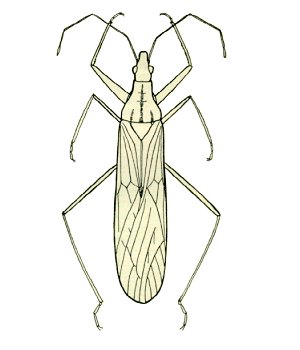 Pale Damsel BugNabis capsiformis
-
 Nabis roseipennis
-
 Common Damsel BugNabis americoferus
- Pacific Damsel BugNabis kinbergii
-
 Field Damsel BugNabis ferus
- Short-winged NabisNabis rufusculus
-
 Nabis pseudoferus
Compare
Questions and answers
What is the scientific name of the Marsh Damselbug?
The scientific name of the Marsh Damselbug is Nabis limbatus. Written with its author, the full name is Nabis limbatus Dahlbom, 1851.
Which family does the Marsh Damselbug belong to?
Nabis limbatus belongs to the family Nabidae, in the order Hemiptera and the class Insecta.
Where is the Marsh Damselbug found?
Checklists and occurrence records place Nabis limbatus in 24 countries, including United Kingdom, Finland, Sweden, The Netherlands, Norway and Germany.
Where are damsel bugs found?
The Marsh Damselbug occurs in Northern Europe and the northern parts of Western and Central Europe. It also occurs in Eastern Europe and extends eastward across the Palearctic to Siberia, China and Korea. It has been introduced in Canada.[13][14][15][16]
What attracts damsel bugs?
The Marsh Damselbug inhabits tall grass and herbaceous vegetation in moist to wet environments, including partially shaded and open habitats.[2][3]
What do damsel bugs eat?
The Marsh Damselbug is a predator that feeds on a nonspecific range of prey.[7]
Sources
Passages the profile rests on
- Nabis limbatus has a micropterous form. Source passage: “The micropterous bugs go through four nymphal stages.” — English Wikipedia
- Nabis limbatus inhabits tall grass and herbaceous vegetation in moist to wet environments. Source passage: “Nabis limbatus is found in tall grass and the herbaceous layer in moist to wet, half shady or open habitats.” — English Wikipedia
- Nabis limbatus occupies both partially shaded and open habitats. Source passage: “half shady or open habitats.” — English Wikipedia
- In forests, Nabis limbatus occurs predominantly in clearings, pathway edges and forest margins. Source passage: “In forests they are found predominantly in glades, the edge of pathways and margins.” — English Wikipedia
- Nabis limbatus sometimes occurs in drier habitats. Source passage: “Sometimes they are found in drier places.” — English Wikipedia
- In the Alps, Nabis limbatus occurs at elevations reaching approximately 1,400 metres above sea level. Source passage: “In the Alps, it rises to about 1400 meters above sea level.” — English Wikipedia
- Nabis limbatus is a predator that feeds on a nonspecific range of prey. Source passage: “It is a predator with a non-specific range of prey” — English Wikipedia
- Nabis limbatus hunts both on the ground and within herbaceous vegetation. Source passage: “hunts on the ground as well as in the herb layer.” — English Wikipedia
- Nabis limbatus overwinters in the egg stage. Source passage: “Overwintering occurs as the egg.” — English Wikipedia
- Female Nabis limbatus mainly lay their eggs in August. Source passage: “Females insert their eggs mainly in August” — English Wikipedia
- Female Nabis limbatus insert their eggs into grass blades or the stems of herbaceous plants. Source passage: “in blades of grass or the stems of herbaceous plants.” — English Wikipedia
- The micropterous individuals of Nabis limbatus undergo four nymphal stages. Source passage: “The micropterous bugs go through four nymphal stages.” — English Wikipedia
- Nabis limbatus occurs in Northern Europe and the northern parts of Western and Central Europe. Source passage: “It is found in Northern Europe and the northern part of Western and Central Europe.” — English Wikipedia
- Nabis limbatus occurs in Eastern Europe and extends eastward across the Palearctic to Siberia, China and Korea. Source passage: “It occurs in the East in Eastern Europe and across the Palearctic to Siberia to China and Korea.” — English Wikipedia
- Nabis limbatus has been introduced in Canada. Source passage: “It is introduced in Canada.” — English Wikipedia
- Nabis limbatus is recorded from Northern Europe and the northern parts of Western and Central Europe. Source passage: “It is found in Northern Europe and the northern part of Western and Central Europe.” — inaturalist.org
Data
- Catalogue of Life, 2026-10-16 XR cc by
- Global Biodiversity Information Facility CC BY 4.0
- Wikidata CC0
- GeoNames CC BY 4.0
- Wikimedia Commons per image; credit shown with each image
- Within the Catalogue of Life, this name comes from United Kingdom Species Inventory (UKSI) cc by
This species in other databases
Page built on 29 November 2026. See how the catalog is made and all sources and licences.
Cite this page
ScientificNames.org. (2026). Nabis limbatus (Marsh Damselbug). Retrieved November 29, 2026, from https://scientificnames.org/species/nabis-limbatus
“Nabis limbatus (Marsh Damselbug).” ScientificNames.org, 2026, scientificnames.org/species/nabis-limbatus. Accessed 29 Nov. 2026.
ScientificNames.org. “Nabis limbatus (Marsh Damselbug).” Accessed November 29, 2026. https://scientificnames.org/species/nabis-limbatus.
@misc{scientificnames_nabis_limbatus_marsh_damselbug,
  author = {{ScientificNames.org}},
  title = {Nabis limbatus (Marsh Damselbug)},
  year = {2026},
  url = {https://scientificnames.org/species/nabis-limbatus},
  note = {Accessed 2026-11-29}
}