Species · Mammals
Red Goral Naemorhedus baileyi
The scientific name of the Red Goral is Naemorhedus baileyi. It is a species of mammal in the family Bovidae (goats), order Artiodactyla. The name dates from 1914.
- Scientific name
- Naemorhedus baileyi Pocock, 1914
- Common name
- Red Goral
- Genus
- Naemorhedus
- Family
- Bovidae (Goats)
- Order
- Artiodactyla
- Class
- Mammalia
- Red List category
- VU Vulnerable
- Recorded in
- 3 countries
- Name status
- accepted in the Catalogue of Life

Overview
Naemorhedus baileyi is distinguished from other members of its genus by its bright reddish coat.
Written 26 November 2026 from the sources listed below. Each statement was checked against the passage it cites; statements that could not be supported were removed.
Appearance
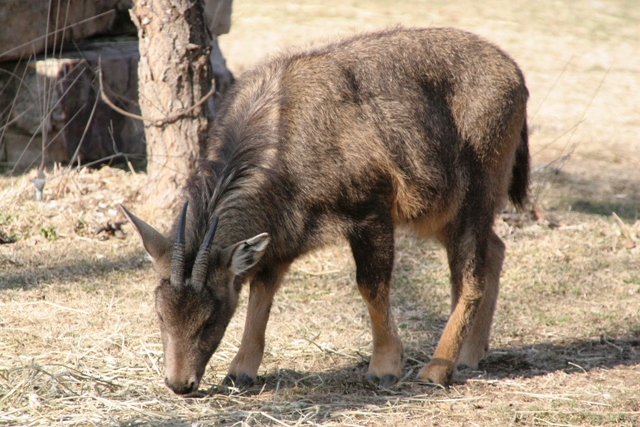
The Red Goral has a bright foxy-red coat with long, soft, shaggy hair. A thin dark stripe extends along its back from its head to the tip of its tail.[1][2]
Its undersides are lighter and buff-colored, while its legs match the rich red color of its body. Its very short black tail has a long tuft of dark hair at the tip.[3][4]
Both sexes have a pair of short, curved horns. Male horns are generally longer and thicker than female horns.[5][6]
Habitat
Red Gorals inhabit seasonal mountainous environments at elevations of approximately 1,000 to 2,000 meters. Their habitats include mountainous regions and woodlands.[7][8]
During the day, they graze on sunny slopes. At night, they retreat to sheltered ledges of rocky cliffs to sleep.[9][10]
Diet
Red Gorals eat lichens, grasses, stems, and leaves. Usnea lichen is their most common food source.[11][12]
Behaviour
Red Gorals are primarily active during daylight hours, particularly in the early morning and evening. They retreat to inaccessible cliffs at night and sleep on sheltered ledges.[13][10]
They are strong climbers and jumpers that escape predators by fleeing up cliffs. They can clear obstacles exceeding 1.8 meters in height from a standing start.[14][15]
Red Gorals migrate vertically between higher and lower forest areas according to the season. They occupy higher forest areas during summer and move to lower forest areas during winter.[16][17]
Red Gorals generally live alone, although females are often accompanied by their most recent offspring. They occasionally form small groups containing approximately three individuals.[18][19]
Male Red Gorals are territorial during the breeding season and produce a call resembling 'zer - zer'. Females whistle when males approach them.[20][21][22]
Red Gorals typically occupy home ranges of approximately 40 hectares.[23]
Reproduction and life cycle
Red Gorals breed between September and November. Females typically enter estrus at approximately 1.5 years of age and give birth at approximately two years of age.[24][25][26]
Male Red Gorals first exhibit rutting behavior and mating at approximately three years of age. During courtship, males follow females closely and use nasogenital contact to assess estrus.[27][28]
Receptive females signal estrus by raising their tails.[29]
Conservation
The Red Goral is listed as Vulnerable by the IUCN. Its estimated mature population is between 7,000 and 8,000 individuals.[30][31]
Overhunting is contributing to the continuing decline of the Red Goral population. Habitat loss from forestry activities and agricultural clearing also threatens the species.[32][33]
The Red Goral is listed in Appendix I of CITES. Protected areas containing the species include Hkakabo-Razi National Park in Myanmar and several protected areas in Tibet.[34][35]
Uses
Red Gorals are hunted for their meat, skin, antlers, legs, and gall bladders. Local human populations primarily consume their meat.[36][37]
Red Goral skins are sold to outside traders.[38]
Classification of the Red Goral
| Kingdom | Animalia |
|---|---|
| Phylum | Chordata |
| Subphylum | Vertebrata |
| Infraphylum | Gnathostomata |
| Parvphylum | Osteichthyes |
| Megaclass | Tetrapoda |
| Class | Mammalia (Mammal) |
| Subclass | Theria |
| Infraclass | Eutheria |
| Order | Artiodactyla (Artiodactyls) |
| Family | Bovidae (Goats) |
| Subfamily | Antilopinae |
| Tribe | Caprini |
| Genus | Naemorhedus (Goral) |
| Species | Naemorhedus baileyi Pocock, 1914 |
Where the Red Goral is found
Checklists and occurrence records place Naemorhedus baileyi in 3 countries across Asia. GBIF holds 30 georeferenced records of it.
Countries
Regions and cities with the most records
Range as the checklists state it
Southern Asia
A number beside a place is its count of GBIF occurrence records. A place without a number comes from a checklist alone. Records show where a species has been observed or collected, which can include escapes and vagrants.
Common names
English
- Red Goral
Names in 17 other languages
- Arabic
- غورال أحمر
- Chinese
- 紅斑羚, 红斑羚, 赤斑羚
- Czech
- goral červený
- Dutch
- Rode Goral
- Esperanto
- Ruĝa goralo
- Finnish
- himalajangoraali
- French
- Goral rouge
- German
- Rote Ziegenantilope, Roter Goral, Rotgoral, Tibetanischer Goral, Tibetgoral
- Hungarian
- Vörös gorál
- Japanese
- アカゴーラル
- Korean
- 붉은고랄
- Norwegian Bokmål
- Rødgoral
- Polish
- goral brunatny
- Portuguese
- Goral-vermelho
- Russian
- Тибетский горал
- Spanish
- Goral rojo
- uig
- قىزىل بۆكەن
Synonyms
3 other scientific names have been used for this species and are now treated as synonyms of Naemorhedus baileyi.
- Naemorhedus cranbrooki Hayman, 1961
- Nemorhaedus bailey Pocock, 1914
- Nemorhaedus baileyi Pocock, 1914
Related species
-
 Himalayan GoralNaemorhedus goral
-
 Long-tailed GoralNaemorhedus caudatus
-
 Chinese GoralNaemorhedus griseus
- Burmese GoralNaemorhedus evansi
- Himalayan Gray GoralNaemorhedus bedfordi
-
 AurochsBos primigenius
-
 Water BuffaloBubalus bubalis
-
 GaurBos gaurus
Compare
Questions and answers
What is the scientific name of the Red Goral?
The scientific name of the Red Goral is Naemorhedus baileyi. Written with its author, the full name is Naemorhedus baileyi Pocock, 1914.
Which family does the Red Goral belong to?
Naemorhedus baileyi belongs to the family Bovidae, in the order Artiodactyla and the class Mammalia.
Where is the Red Goral found?
Checklists and occurrence records place Naemorhedus baileyi in 3 countries: Myanmar, China and India.
What is the conservation status of the Red Goral?
The IUCN Red List category recorded for Naemorhedus baileyi is Vulnerable (VU).
Sources
Passages the profile rests on
- The red goral has a bright foxy-red coat with long, soft, shaggy hair. Source passage: “The red goral is a bright foxy-red animal with long, soft, shaggy hair.” — English Wikipedia
- A thin dark stripe extends along the red goral's back from its head to the tip of its tail. Source passage: “A thin, dark stripe runs along the back from the head to the tip of the tail.” — English Wikipedia
- The red goral has lighter buff-colored undersides and legs matching the rich red color of its body. Source passage: “The legs are the same rich red as the body, while the undersides are a lighter buff color.” — English Wikipedia
- The red goral has a very short black tail with a long tuft of dark hair at its tip. Source passage: “The black-colored tail is very short for a goral, but a long tuft of dark hair at the end may double its apparent length.” — English Wikipedia
- Both male and female red gorals have a pair of short, curved horns. Source passage: “Both males and females have a pair of short, arcing horns.” — English Wikipedia
- Male red gorals generally have longer and thicker horns than females. Source passage: “The horns of males tend to be longer and thicker than those of females” — English Wikipedia
- Red gorals inhabit seasonal mountainous environments at elevations of approximately 1,000 to 2,000 meters. Source passage: “Its natural habitats are seasonal mountainous areas 1,000 to 2,000 meters (3,300 to 6,600 ft) above sea level.” — English Wikipedia
- Red gorals inhabit mountainous regions and woodlands. Source passage: “Red gorals live in mountainous regions and woodlands in The People's Republic of China and other countries near China.” — English Wikipedia
- Red gorals graze on sunny slopes during the day and sleep on sheltered ledges of rocky cliffs at night. Source passage: “During the day, red gorals graze on sunny slopes, retreating to rocky cliffs at night, where they bed down on sheltered ledges.” — English Wikipedia
- Red gorals retreat to inaccessible cliffs at night and sleep on sheltered ledges. Source passage: “Red gorals are most active during the day, and tend to retreat to inaccessible cliffs at night, where they sleep on sheltered ledges.” — English Wikipedia
- Red gorals eat lichens, grasses, stems, and leaves. Source passage: “Their diets consist of lichens, grasses, stems, and leaves.” — English Wikipedia
- Usnea lichen is the most common food source of red gorals. Source passage: “Their most common food source is Usnea which is a type of lichen.” — English Wikipedia
- Red gorals are primarily active during daylight hours, particularly in the early morning and evening. Source passage: “N. baileyi is primarily diurnal, with most activity occurring in the early morning and evening.” — English Wikipedia
- Red gorals are strong climbers and jumpers that escape predators by fleeing up cliffs. Source passage: “They are strong climbers and jumpers, and seek safety from predators by fleeing up cliffs.” — English Wikipedia
- Red gorals can clear obstacles exceeding 1.8 meters in height from a standing start. Source passage: “They can clear obstacles over 1.8 m (5 ft 11 in) high from a standing start.” — English Wikipedia
- Red gorals migrate vertically between higher and lower forest areas according to the season. Source passage: “The goral is an animal that migrates vertically according to the season.” — English Wikipedia
- During summer, red gorals occupy higher forest areas and move to lower forest areas during winter. Source passage: “During the summer seasons they stay in the upper area of the forest while during the winters they migrate down to the low areas in the forest.” — English Wikipedia
- Red gorals generally live alone, although females are often accompanied by their most recent offspring. Source passage: “Red gorals are primarily solitary, although females tend to be accompanied by their latest youngster.” — English Wikipedia
- Red gorals occasionally form small groups containing approximately three individuals. Source passage: “N. baileyi is occasionally seen in small groups, typically with three animals.” — English Wikipedia
- Male red gorals are territorial during the breeding season. Source passage: “Males are territorial during the breeding season.” — English Wikipedia
- Male red gorals produce a call resembling 'zer - zer' during the breeding season. Source passage: “males make a call which sounds like "zer - zer" during the breeding season” — English Wikipedia
- Female red gorals whistle when males approach them. Source passage: “female red gorals also whistle as males approach.” — English Wikipedia
- Red gorals typically occupy home ranges of approximately 40 hectares. Source passage: “Red gorals typically inhabit a home range of around 40 hectares.” — English Wikipedia
- Red gorals breed between September and November. Source passage: “This species breeds from September to November.” — English Wikipedia
- Female red gorals typically enter estrus at approximately 1.5 years of age. Source passage: “Typically, the female goral enters estrus at the age of 1.5 years” — English Wikipedia
- Female red gorals typically give birth at approximately two years of age. Source passage: “gives birth at 2 years of age” — English Wikipedia
- Male red gorals first exhibit rutting behavior and mating at approximately three years of age. Source passage: “whereas males first show rutting behavior and mating at 3 years of age.” — English Wikipedia
- During courtship, male red gorals follow females closely and use nasogenital contact to assess estrus. Source passage: “During the rut, males will follow females closely, being in frequent nasogenital contact (often accompanied by smelling and licking) to determine the onset of estrus.” — English Wikipedia
- Receptive female red gorals signal estrus by raising their tails. Source passage: “Receptive females tend to stand still as the male approaches, signalling their estrus by raising their tails.” — English Wikipedia
- The red goral is listed as Vulnerable by the IUCN. Source passage: “The IUCN lists the red goral as vulnerable.” — English Wikipedia
- The estimated mature population of red gorals is between 7,000 and 8,000 individuals. Source passage: “The mature population of red gorals is estimated at 7,000–8,000 individuals” — English Wikipedia
- Overhunting is contributing to the continuing decline of the red goral population. Source passage: “there is still a continuing population decline due to over-hunting.” — English Wikipedia
- Habitat loss from forestry activities and agricultural clearing threatens the red goral. Source passage: “Habitat loss due to forestry practices and clearing for agriculture also poses a major threat.” — English Wikipedia
- The red goral is listed in Appendix I of CITES. Source passage: “This species is listed on Appendix I of CITES (2009).” — English Wikipedia
- Protected areas containing red gorals include Hkakabo-Razi National Park in Myanmar and several protected areas in Tibet. Source passage: “Red gorals inhabit several protected regions, including Hkakabo-Razi National Park in Myanmar, and Gangxiang, Muotuo, Xiaca, and Medoq in Tibet.” — English Wikipedia
- Red gorals are hunted for their meat, skin, antlers, legs, and gall bladders. Source passage: “Red gorals are hunted for their meat, skin, antler, legs, and gall bladder.” — English Wikipedia
- Local human populations primarily consume red goral meat. Source passage: “The meat of the red goral is mostly eaten by the local human population” — English Wikipedia
- Red goral skins are sold to outside traders. Source passage: “while the skin of the red goral is then sold to outside traders.” — English Wikipedia
Data
- Catalogue of Life, 2026-10-16 XR cc by
- Global Biodiversity Information Facility CC BY 4.0
- Wikidata CC0
- GeoNames CC BY 4.0
- Wikimedia Commons per image; credit shown with each image
- Within the Catalogue of Life, this name comes from The Integrated Taxonomic Information System cc0
References
- J. Bombay Nat. Hist. Soc. vol.23 p.32 where the name was published
- Wilson, Don E., and DeeAnn M. Reeder, eds. (1993). Mammal Species of the World: A Taxonomic and Geographic Reference, 2nd Ed., 3rd Printing.
- Wilson, Don E., and F. Russell Cole. (2000). Common Names of Mammals of the World.
- Wilson, Don E., and DeeAnn M. Reeder, eds. (2005). Mammal Species of the World: A Taxonomic and Geographic Reference, 3rd Ed., Vols. 1 & 2.
- Wilson, D. E., and R. A. Mittermeier, eds. (2011). Handbook of the Mammals of the World, Vol. 2: Hoofed Mammals.
- Burgin, Connor J., Don E. Wilson, Russell A. Mittermeier, Anthony B. Rylands, et al. (2020). Illustrated Checklist of the Mammals of the World. Vol. 2. Eulipotyphla to Carnivora.
This species in other databases
Page built on 28 November 2026. See how the catalog is made and all sources and licences.
Cite this page
ScientificNames.org. (2026). Naemorhedus baileyi (Red Goral). Retrieved November 28, 2026, from https://scientificnames.org/species/naemorhedus-baileyi
“Naemorhedus baileyi (Red Goral).” ScientificNames.org, 2026, scientificnames.org/species/naemorhedus-baileyi. Accessed 28 Nov. 2026.
ScientificNames.org. “Naemorhedus baileyi (Red Goral).” Accessed November 28, 2026. https://scientificnames.org/species/naemorhedus-baileyi.
@misc{scientificnames_naemorhedus_baileyi_red_goral,
  author = {{ScientificNames.org}},
  title = {Naemorhedus baileyi (Red Goral)},
  year = {2026},
  url = {https://scientificnames.org/species/naemorhedus-baileyi},
  note = {Accessed 2026-11-28}
}