Species · Fishes
Similis Shell Dweller Neolamprologus similis
The scientific name of the Similis Shell Dweller is Neolamprologus similis. It is a species of fish in the family Cichlidae (cichlid), order Cichliformes. The name dates from 1992.
- Scientific name
- Neolamprologus similis Büscher, 1992
- Common name
- Similis Shell Dweller
- Genus
- Neolamprologus
- Family
- Cichlidae (Cichlid)
- Order
- Cichliformes
- Class
- Teleostei
- Environment
- freshwater
- Recorded in
- 1 country
- Name status
- accepted in the Catalogue of Life

Overview
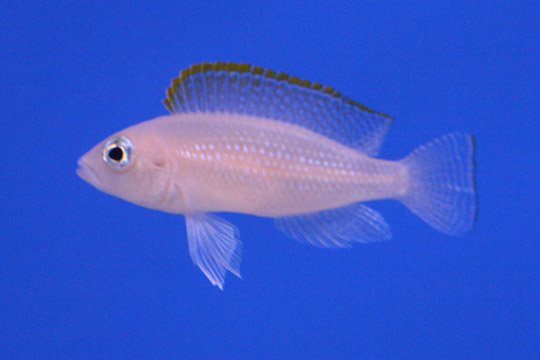
The Similis Shell Dweller is a shell-dwelling cichlid associated with Lake Tanganyika. It is endemic to Lake Tanganyika in Africa and is known along the shores of the Democratic Republic of the Congo and Tanzania. It has a copper-coloured body with vertical white stripes extending from its head to the base of its tail.
Written 26 November 2026 from the sources listed below. Each statement was checked against the passage it cites; statements that could not be supported were removed.
Habitat
The Similis Shell Dweller is a shell-dwelling cichlid associated with Lake Tanganyika. It is endemic to the lake and is known along the shores of the Democratic Republic of the Congo and Tanzania.[1][2]
Appearance
The Similis Shell Dweller has a copper-coloured body with vertical white stripes extending from its head to the base of its tail. It can reach a maximum total length of 5 centimetres.[3][4]
Behaviour
The Similis Shell Dweller forms small colonies or harems depending on the available space.[5]
Reproduction and life cycle
Males and females are not visually distinguishable, although males are larger.[6]
Male offspring are tolerated within the group until they become active competitors of the adult male. Female offspring are tolerated and eventually courted as mates.[7][8]
Females may attract neighbouring males and become targets of mate theft.[9]
Uses
The Similis Shell Dweller is kept as a popular freshwater aquarium fish.[10]
Classification of the Similis Shell Dweller
| Kingdom | Animalia |
|---|---|
| Phylum | Chordata |
| Subphylum | Vertebrata |
| Infraphylum | Gnathostomata |
| Parvphylum | Osteichthyes |
| Gigaclass | Actinopterygii |
| Superclass | Actinopteri |
| Class | Teleostei (Teleost) |
| Order | Cichliformes |
| Family | Cichlidae (Cichlid) |
| Subfamily | Pseudocrenilabrinae |
| Genus | Neolamprologus |
| Species | Neolamprologus similis Büscher, 1992 |
Where the Similis Shell Dweller is found
Checklists and occurrence records place Neolamprologus similis in 1 country. GBIF holds 22 georeferenced records of it.
Countries
Regions and cities with the most records
A number beside a place is its count of GBIF occurrence records. A place without a number comes from a checklist alone. Records show where a species has been observed or collected, which can include escapes and vagrants.
Common names
English
- Similis Shell Dweller
Synonyms
One other scientific name has been used for this species and is now treated as a synonym of Neolamprologus similis.
- Lamprologus similis (Büscher, 1992)
Related species
-
 Many-banded Shell DwellerNeolamprologus multifasciatus
-
 Princess CichlidNeolamprologus brichardi
-
 Lemon CichlidNeolamprologus leleupi
-
 Daffodil CichlidNeolamprologus pulcher
-
 Tanganyikan NeolamprologusNeolamprologus caudopunctatus
-
 Neolamprologus brevis
-
 Cylinder CichlidNeolamprologus cylindricus
-
 Five-barred LamprologusNeolamprologus tretocephalus
Compare
Questions and answers
What is the scientific name of the Similis Shell Dweller?
The scientific name of the Similis Shell Dweller is Neolamprologus similis. Written with its author, the full name is Neolamprologus similis Büscher, 1992.
Which family does the Similis Shell Dweller belong to?
Neolamprologus similis belongs to the family Cichlidae, in the order Cichliformes and the class Teleostei.
Where is the Similis Shell Dweller found?
Checklists and occurrence records place Neolamprologus similis in 1 country: Democratic Republic of the Congo.
How big do shell dweller cichlids get?
The Similis Shell Dweller can reach a maximum total length of 5 centimetres.[4]
Sources
Passages the profile rests on
- Neolamprologus similis is a shell-dwelling cichlid associated with Lake Tanganyika. Source passage: “Neolamprologus similis is a shell-dwelling cichlid endemic to Lake Tanganyika in Africa” — English Wikipedia
- Neolamprologus similis is endemic to Lake Tanganyika in Africa and is known along the shores of the Democratic Republic of the Congo and Tanzania. Source passage: “where it is only known along the shores of the Democratic Republic of the Congo and Tanzania.” — English Wikipedia
- Neolamprologus similis has a copper-coloured body with vertical white stripes extending from its head to the base of its tail. Source passage: “N. similis is copper-coloured with vertical white stripes running from the head to the base of the tail.” — English Wikipedia
- Neolamprologus similis can reach a maximum total length of 5 centimetres. Source passage: “It can reach up to 5 centimetres (2.0 in) in total length” — English Wikipedia
- Neolamprologus similis forms small colonies or harems depending on the available space. Source passage: “and form small colonies or harems—depending on available space” — English Wikipedia
- Male and female Neolamprologus similis are not visually distinguishable, although males are larger. Source passage: “This fish is monomorphic: males and females are not visually different (males are bigger)” — English Wikipedia
- Male offspring are tolerated within the group until they become active competitors of the adult male. Source passage: “in which the male fry are tolerated until they become active competitors of the male.” — English Wikipedia
- Female offspring are tolerated and eventually courted as mates. Source passage: “Female fry are not only tolerated but are eventually courted as mates.” — English Wikipedia
- Females may attract neighbouring males and become targets of mate theft. Source passage: “The females also are objects of interest to neighboring males and may be targets of theft.” — English Wikipedia
- Neolamprologus similis is kept as a popular freshwater aquarium fish. Source passage: “and it is a popular freshwater aquarium fish.” — English Wikipedia
Data
- Catalogue of Life, 2026-10-16 XR cc by
- Global Biodiversity Information Facility CC BY 4.0
- Wikidata CC0
- GeoNames CC BY 4.0
- Wikimedia Commons per image; credit shown with each image
- Within the Catalogue of Life, this name comes from World Register of Marine Species cc by
References
- Büscher, H. H. (1992). Ein neuer Cichlide aus dem Tanganjikasee Neolamprologus similis n. sp. Die Aquarien- Und Terrarienzeitschrift (DATZ), 45 (8): 520–525. where the name was published
This species in other databases
- Catalogue of Life 46K3Z
- Wikidata Q906935
- iNaturalist 611599
- WoRMS urn:lsid:marinespecies.org:taxname:1011140
- ITIS 648824
Page built on 29 November 2026. See how the catalog is made and all sources and licences.
Cite this page
ScientificNames.org. (2026). Neolamprologus similis (Similis Shell Dweller). Retrieved November 29, 2026, from https://scientificnames.org/species/neolamprologus-similis
“Neolamprologus similis (Similis Shell Dweller).” ScientificNames.org, 2026, scientificnames.org/species/neolamprologus-similis. Accessed 29 Nov. 2026.
ScientificNames.org. “Neolamprologus similis (Similis Shell Dweller).” Accessed November 29, 2026. https://scientificnames.org/species/neolamprologus-similis.
@misc{scientificnames_neolamprologus_similis_similis_shell_dweller,
  author = {{ScientificNames.org}},
  title = {Neolamprologus similis (Similis Shell Dweller)},
  year = {2026},
  url = {https://scientificnames.org/species/neolamprologus-similis},
  note = {Accessed 2026-11-29}
}