Species · Molluscs
Hawaiian Black Nerite Nerita picea
The scientific name of the Hawaiian Black Nerite is Nerita picea. It is a species of mollusc in the family Neritidae (nerites), order Cycloneritida. The name dates from 1841.
- Scientific name
- Nerita picea Récluz, 1841
- Common name
- Hawaiian Black Nerite
- Genus
- Nerita
- Family
- Neritidae (Nerites)
- Order
- Cycloneritida
- Class
- Gastropoda
- Environment
- marine
- Recorded in
- 1 country
- Name status
- accepted in the Catalogue of Life
Overview
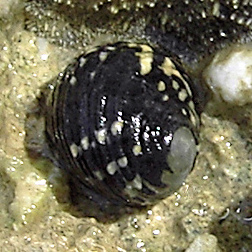
The Hawaiian Black Nerite is a mollusc with an ovate-shaped shell. It occurs throughout the Hawaiian coastline. Its shell has a dark blue to black exterior and a white interior.
Written 26 November 2026 from the sources listed below. Each statement was checked against the passage it cites; statements that could not be supported were removed.
Appearance
The Hawaiian Black Nerite has an ovate-shaped shell with a dark blue to black exterior and a white interior. The shell is solid and calcareous, with small ridges that create a textured surface.[1][2]
Mature individuals have shell sizes ranging from 5 to 20 mm.[3]
Habitat
The species commonly occurs in clusters in the upper part of the intertidal zone.[4]
It occurs throughout the Hawaiian coastline and is endemic to the Hawaiian Islands.[5][6]
Uses
In Hawaiian culture, the species is eaten boiled as a snack.[7]
Similar species
Echinolittorina hawaiiensis is identified as a snail with a similar appearance to the Hawaiian Black Nerite. Echinolittorina hawaiiensis is endemic to Hawai'i.[8][9]
Classification of the Hawaiian Black Nerite
| Kingdom | Animalia |
|---|---|
| Phylum | Mollusca |
| Class | Gastropoda (Gastropod) |
| Subclass | Neritimorpha |
| Order | Cycloneritida |
| Superfamily | Neritoidea |
| Family | Neritidae (Nerites) |
| Subfamily | Neritinae |
| Genus | Nerita |
| Species | Nerita picea Récluz, 1841 |
Where the Hawaiian Black Nerite is found
Checklists and occurrence records place Nerita picea in 1 country. GBIF holds 1,576 georeferenced records of it.
Countries
Regions and cities with the most records
- Hawaii, United States 1,091
- Kaneohe, United States 280
- Makiki / Lower Punchbowl / Tantalus, United States 273
- Waikīkī, United States 268
- Manoa, United States 265
- Kalihi Valley, United States 258
- Diamond Head / Kapahulu / Saint Louis Heights, United States 257
- Kailua, United States 252
- Kuliouou - Kalani Iki, United States 247
- East Honolulu, United States 246
- Honolulu, United States 246
- Niu Valley, United States 246
- Joint Base Pearl Harbor Hickam, United States 205
- Aliamanu / Salt Lakes / Foster Village, United States 184
- ʻEwa Beach-Iroquois Point, United States 170
- Mililani Town, United States 157
- Schofield-Wheeler, United States 157
- Schofield Barracks, United States 156
- Kīhei, United States 151
- Pearl City, United States 148
- ‘Ewa Beach, United States 147
- Wahiawā, United States 124
- Wahiawā-Whitmore, United States 123
- Waipahu, United States 123
- ‘Ewa Gentry, United States 122
- ʻEwa Gentry-West Loch, United States 119
- Koolauloa, United States 114
- Mililani Mauka, United States 114
- Kapolei, United States 108
- Makakilo, United States 108
- Mililani Mauka / Launani Valley, United States 108
- Kapolei Villages, United States 107
- Makakilo City, United States 107
- Makakilo-Makaīwa Hills-Kunia, United States 107
- Makakilo / Kapolei / Honokai Hale, United States 104
- Kahului, United States 100
6 more countries have a few records outside this range
These countries hold a few records of Nerita picea but lie outside the range the checklists give for it. Such records are often zoo or garden specimens, museum material or vagrants, so the species is not counted as occurring there.
A number beside a place is its count of GBIF occurrence records. A place without a number comes from a checklist alone. Records show where a species has been observed or collected, which can include escapes and vagrants.
Common names
English
- Hawaiian Black Nerite
Names in 4 other languages
- Hawaiian
- Pipipi
- Japanese
- クロヅケアマガイ, クロミアマガイ
- Portuguese
- Nerite-havaiano
- Russian
- Нерита смолистая
Synonyms
4 other scientific names have been used for this species and are now treated as synonyms of Nerita picea.
- Nerita (Ritena) picea Récluz, 1841
- Nerita bullula Reeve, 1855
- Nerita obscura Hombron & Jacquinot, 1848
- Neritina insculpta Reeve, 1856
Related species
-
 Checkered NeriteNerita tessellata
-
 Polished NeriteNerita polita
-
 Blotched NeriteNerita albicilla
-
 Bleeding Tooth NeriteNerita peloronta
-
 Pleated NeriteNerita plicata
-
 Four-tooth NeriteNerita versicolor
-
 Black NeriteNerita melanotragus
-
 Australian Black NeriteNerita atramentosa
Compare
Questions and answers
What is the scientific name of the Hawaiian Black Nerite?
The scientific name of the Hawaiian Black Nerite is Nerita picea. Written with its author, the full name is Nerita picea Récluz, 1841.
Which family does the Hawaiian Black Nerite belong to?
Nerita picea belongs to the family Neritidae, in the order Cycloneritida and the class Gastropoda.
Where is the Hawaiian Black Nerite found?
Checklists and occurrence records place Nerita picea in 1 country: United States.
Where are nerites native to?
The Hawaiian Black Nerite is endemic to the Hawaiian Islands.[6]
Sources
Passages the profile rests on
- The species has an ovate-shaped shell with a dark blue to black exterior and a white interior. Source passage: “Nerita picea is a marine snail with an ovate shaped shell that is dark blue to black in color on the outside and internally white.” — English Wikipedia
- Its shell is solid and calcareous, with small ridges that create a textured surface. Source passage: “Nerita picea have a rather solid calcareous shell with little ridges that gives texture to the shell.” — English Wikipedia
- Mature individuals have shell sizes ranging from 5 to 20 mm. Source passage: “Nerita picea range in size from 5–20mm when mature.” — English Wikipedia
- The species commonly occurs in clusters in the upper part of the intertidal zone. Source passage: “commonly found in clusters on the high part of the intertidal zone.” — English Wikipedia
- The species occurs throughout the Hawaiian coastline. Source passage: “This species is found all throughout the Hawaiian coastline” — English Wikipedia
- The species is endemic to the Hawaiian Islands. Source passage: “and is endemic to the Hawaiian Islands.” — English Wikipedia
- In Hawaiian culture, the species is eaten boiled as a snack. Source passage: “In Hawaiian culture, Nerita picea or Pipipi are often eaten boiled as a snack,” — English Wikipedia
- Echinolittorina hawaiiensis is identified as a snail with a similar appearance to Nerita picea. Source passage: “A similar snail in appearance is the Echinolittorina hawaiiensis” — scholarspace.manoa.hawaii.edu
- Echinolittorina hawaiiensis, identified as a similar-looking species, is endemic to Hawai'i. Source passage: “which is endemic to Hawai'i,” — scholarspace.manoa.hawaii.edu
Data
- Catalogue of Life, 2026-10-16 XR cc by
- Global Biodiversity Information Facility CC BY 4.0
- Wikidata CC0
- GeoNames CC BY 4.0
- Within the Catalogue of Life, this name comes from World Register of Marine Species cc by
References
- Récluz, C. A. (1841). Description de quelques nouvelles espèces de Nérites vivantes. Revue Zoologique, Par La Société Cuvierienne, 1841. where the name was published
This species in other databases
Page built on 27 November 2026. See how the catalog is made and all sources and licences.
Cite this page
ScientificNames.org. (2026). Nerita picea (Hawaiian Black Nerite). Retrieved November 27, 2026, from https://scientificnames.org/species/nerita-picea
“Nerita picea (Hawaiian Black Nerite).” ScientificNames.org, 2026, scientificnames.org/species/nerita-picea. Accessed 27 Nov. 2026.
ScientificNames.org. “Nerita picea (Hawaiian Black Nerite).” Accessed November 27, 2026. https://scientificnames.org/species/nerita-picea.
@misc{scientificnames_nerita_picea_hawaiian_black_nerite,
  author = {{ScientificNames.org}},
  title = {Nerita picea (Hawaiian Black Nerite)},
  year = {2026},
  url = {https://scientificnames.org/species/nerita-picea},
  note = {Accessed 2026-11-27}
}