Species · Flowering plants
Texas Toadflax Nuttallanthus texanus
The scientific name of the Texas Toadflax is Nuttallanthus texanus. It is a species of flowering plant in the family Plantaginaceae (plantain family), order Lamiales.
- Scientific name
- Nuttallanthus texanus (Scheele) D.A.Sutton
- Common name
- Texas Toadflax
- Genus
- Nuttallanthus
- Family
- Plantaginaceae (Plantain Family)
- Order
- Lamiales
- Class
- Magnoliopsida
- Recorded in
- 5 countries
- Name status
- accepted in the Catalogue of Life

Overview
Texas toadflax is a flowering plant that grows as an annual or biennial plant. It commonly grows in patches along roadsides and occurs across much of the western United States.
Written 27 November 2026 from the sources listed below. Each statement was checked against the passage it cites; statements that could not be supported were removed.
Appearance
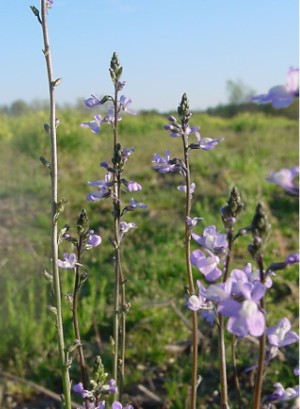
Texas toadflax produces raceme-type inflorescences.[1]
Habitat
Texas toadflax commonly grows in patches along roadsides. It occurs across much of the western United States.[2][3]
Classification of the Texas Toadflax
| Kingdom | Plantae |
|---|---|
| Subkingdom | Pteridobiotina |
| Phylum | Tracheophyta |
| Class | Magnoliopsida |
| Order | Lamiales |
| Family | Plantaginaceae (Plantain Family) |
| Subfamily | Antirrhinoideae |
| Genus | Nuttallanthus (Toadflax) |
| Species | Nuttallanthus texanus (Scheele) D.A.Sutton |
Where the Texas Toadflax is found
Checklists and occurrence records place Nuttallanthus texanus in 5 countries across North America and South America. GBIF holds 10,769 georeferenced records of it.
Countries where it is native or its origin is not stated
Countries where it has been introduced
Regions and cities with the most records
- Texas, United States 2,791
- California, United States 2,488
- Arizona, United States 800
- Arkansas, United States 589
- Oklahoma, United States 300
- Georgia, United States 277
- Encinitas, United States 276
- San Diego, United States 268
- Santee, United States 268
- National City, United States 264
- Casa de Oro-Mount Helix, United States 260
- El Cajon, United States 258
- Bostonia, United States 254
- Poway, United States 254
- Seaside, United States 248
- Rancho San Diego, United States 246
- Monterey, United States 245
- Tanque Verde, United States 244
- La Mesa, United States 242
- Winter Gardens, United States 242
- Lemon Grove, United States 237
- Pacific Grove, United States 237
- Lakeside, United States 234
- Spring Valley, United States 234
- Marina, United States 233
- La Presa, United States 222
- Coronado, United States 203
- Salinas, United States 203
- Chula Vista, United States 202
- Catalina Foothills, United States 201
- Prunedale, United States 195
- Escondido, United States 191
- Oro Valley, United States 177
- Highland Village, United States 171
- Casas Adobes, United States 167
- San Marcos, United States 166
9 more countries have a few records outside this range
These countries hold a few records of Nuttallanthus texanus but lie outside the range the checklists give for it. Such records are often zoo or garden specimens, museum material or vagrants, so the species is not counted as occurring there.
Range as the checklists state it
Hawaii [I] (Oahu [I], E-Maui [I], Hawaii Isl. [I]); Canada (Alberta, British Columbia, Saskatchewan); USA (Alabama, Arkansas, Arizona, California, Colorado, Florida, Georgia, Illinois, Kansas, Kentucky, Louisiana, Minnesota, Missouri, Mississippi, Montana, North Carolina, North Dakota, Nebraska, New Mexico, Oklahoma, Oregon, South Carolina, South Dakota, Tennessee, Texas, Utah, Virginia, Washington State, Wyoming); Mexico (Sonora, etc.); Revillagigedos Isl. (Isla Socorro); Dominican Republic; Colombia [I]
A number beside a place is its count of GBIF occurrence records. A place without a number comes from a checklist alone. Records show where a species has been observed or collected, which can include escapes and vagrants.
Common names
English
- Texas Toadflax
- Toadflax
Names in 1 other language
- French
- linaire du Texas
Synonyms
2 other scientific names have been used for this species and are now treated as synonyms of Nuttallanthus texanus.
- Linaria canadensis var. texana (Scheele) Pennell
- Linaria texana Scheele
Related species
-
 Old-field ToadflaxNuttallanthus canadensis
- Nuttallanthus floridanus
- Nuttallanthus subandinus
-
 Common FoxgloveDigitalis purpurea
-
 BacopaBacopa monnieri
-
 Blond PsylliumPlantago ovata
-
 Broadleaf PlantainPlantago major
-
 Ribwort PlantainPlantago lanceolata
Compare
Questions and answers
What is the scientific name of the Texas Toadflax?
The scientific name of the Texas Toadflax is Nuttallanthus texanus. Written with its author, the full name is Nuttallanthus texanus (Scheele) D.A.Sutton.
Which family does the Texas Toadflax belong to?
Nuttallanthus texanus belongs to the family Plantaginaceae, in the order Lamiales and the class Magnoliopsida.
Where is the Texas Toadflax found?
Checklists and occurrence records place Nuttallanthus texanus in 5 countries, including Mexico, Canada and Dominican Republic.
What other names does the Texas Toadflax have?
Nuttallanthus texanus is also known in English as Toadflax.
Why is toadflax so called?
The name toadflax refers to the resemblance of the species' leaves to the narrow leaves of true flax. The toad-related part of the name is thought to have originated from confusion between the Latin words bubonium and bufonis. The common name Texas toadflax refers to the species' natural occurrence in Texas.[4][5][6]
Sources
Passages the profile rests on
- The species produces raceme-type inflorescences. Source passage: “Its inflorescence is raceme.” — English Wikipedia
- The species commonly grows in patches along roadsides. Source passage: “It can often be seen in patches along roadsides.” — English Wikipedia
- The species occurs across much of the western United States. Source passage: “found across much of the western United States.” — English Wikipedia
- The common name Texas toadflax refers to the species' natural occurrence in Texas. Source passage: “The common name Texas toadflax refers to it growing naturally in Texas” — English Wikipedia
- The toadflax name refers to the resemblance of the species' leaves to the narrow leaves of true flax. Source passage: “toadflax is for the resemblance of leaves to the narrow ones of true flax” — English Wikipedia
- The toad-related part of the common name is thought to have originated from confusion between the Latin words bubonium and bufonis. Source passage: “the reference to toads is thought to come from mistaking the Latin bubonium in the description of a plant used in traditional medicine to treat groin swelling (buboes) for bufonis meaning toad.” — English Wikipedia
Data
- Catalogue of Life, 2026-10-16 XR cc by
- Global Biodiversity Information Facility CC BY 4.0
- Wikidata CC0
- GeoNames CC BY 4.0
- Wikimedia Commons per image; credit shown with each image
- Within the Catalogue of Life, this name comes from Synonymic Checklists of the Vascular Plants of the World cc by
References
- Sutton, D. A. Revis. Tribe Antirrhineae [Sutton] 460 (1988). where the name was published
This species in other databases
Page built on 27 November 2026. See how the catalog is made and all sources and licences.
Cite this page
ScientificNames.org. (2026). Nuttallanthus texanus (Texas Toadflax). Retrieved November 27, 2026, from https://scientificnames.org/species/nuttallanthus-texanus
“Nuttallanthus texanus (Texas Toadflax).” ScientificNames.org, 2026, scientificnames.org/species/nuttallanthus-texanus. Accessed 27 Nov. 2026.
ScientificNames.org. “Nuttallanthus texanus (Texas Toadflax).” Accessed November 27, 2026. https://scientificnames.org/species/nuttallanthus-texanus.
@misc{scientificnames_nuttallanthus_texanus_texas_toadflax,
  author = {{ScientificNames.org}},
  title = {Nuttallanthus texanus (Texas Toadflax)},
  year = {2026},
  url = {https://scientificnames.org/species/nuttallanthus-texanus},
  note = {Accessed 2026-11-27}
}