Species · Flowering plants
Norfolk Island Oberonia Oberonia titania
The scientific name of the Norfolk Island Oberonia is Oberonia titania. It is a species of flowering plant in the family Orchidaceae (orchid), order Asparagales.
- Scientific name
- Oberonia titania Lindl.
- Common name
- Norfolk Island Oberonia
- Genus
- Oberonia
- Family
- Orchidaceae (Orchid)
- Order
- Asparagales
- Class
- Liliopsida
- Recorded in
- 5 countries
- Name status
- accepted in the Catalogue of Life
Overview
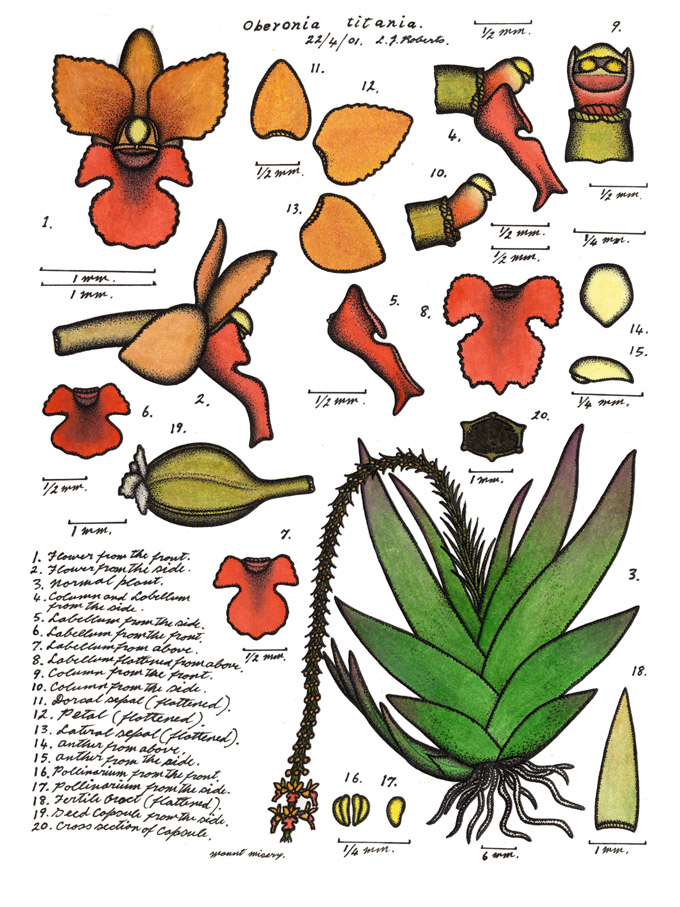
Norfolk Island Oberonia is a clump-forming epiphytic herb. It grows on trees in rainforest environments. It produces between 50 and 350 pinkish to red flowers arranged in whorls of six to eight.
Written 27 November 2026 from the sources listed below. Each statement was checked against the passage it cites; statements that could not be supported were removed.
Appearance
Each shoot bears between four and ten fleshy, lance-shaped to egg-shaped green or greyish leaves. The leaves measure 40–60 mm long and 3–5 mm wide, and their bases overlap.[1][2][3]
The plant produces between 50 and 350 pinkish to red flowers. Individual flowers are approximately 1.2 mm long and 1.0 mm wide, and are arranged in whorls containing six to eight flowers each.[4][5][6]
The flowering stem arches or hangs and measures 30–80 mm long. The sepals and petals are egg-shaped, spread widely apart and measure approximately 0.9 mm long.[7][8][9][10]
The labellum is cup-shaped and has three lobes. It measures approximately 1.0 mm long and 0.6 mm wide.[11][12]
Habitat
Norfolk Island Oberonia grows on trees in rainforest environments.[13]
Reproduction and life cycle
Flowering occurs from January through June.[14]
Conservation
Norfolk Island Oberonia is classified as vulnerable under New South Wales conservation legislation.[15]
Habitat degradation and habitat loss are major threats to the species. Illegal collecting is also identified as a major threat.[16][17]
Classification of the Norfolk Island Oberonia
| Kingdom | Plantae |
|---|---|
| Subkingdom | Pteridobiotina |
| Phylum | Tracheophyta |
| Class | Liliopsida |
| Order | Asparagales |
| Family | Orchidaceae (Orchid) |
| Genus | Oberonia (Fairy Orchids) |
| Species | Oberonia titania Lindl. |
Where the Norfolk Island Oberonia is found
Checklists and occurrence records place Oberonia titania in 5 countries across Oceania. GBIF holds 521 georeferenced records of it.
Countries
Regions and cities with the most records
- Queensland, Australia 224
- New South Wales, Australia 140
- Brisbane, Australia 27
- Gold Coast, Australia 21
- Port Macquarie, Australia 15
- Mont-Dore, New Caledonia 13
- Sunshine Coast, Australia 13
- Dumbéa, New Caledonia 12
- Nouméa, New Caledonia 8
- Cairns, Australia 7
- Kingston, Norfolk Island 7
- Australian Capital Territory, Australia 5
- Caloundra, Australia 3
- Loyalty Islands, New Caledonia 3
A number beside a place is its count of GBIF occurrence records. A place without a number comes from a checklist alone. Records show where a species has been observed or collected, which can include escapes and vagrants.
Common names
English
- Norfolk Island Oberonia
Synonyms
9 other scientific names have been used for this species and are now treated as synonyms of Oberonia titania.
- Iridorchis titania Kuntze
- Iridorkis titania (Lindl.) Kuntze
- Malaxis palmicola (F.Muell.) F.Muell.
- Malaxis titania (Lindl.) Rchb.f.
- Oberonia crateriformis D.L.Jones & M.A.Clem.
- Oberonia neocaledonica Schltr.
- Oberonia palmicola F.Muell.
- Oberonia rimachila D.L.Jones & M.A.Clem.
- Titania miniata Endl.
Related species
- Mossman Fairy OrchidOberonia attenuata
-
 Yellow-flowered KingOberonia complanata
-
 Brown's OberoniaOberonia brunoniana
- Falconer's OberoniaOberonia falconeri
-
 Bristly Fairy KingOberonia setigera
- Oberonia disticha
- Oberonia equitans
- Oberonia caulescens
Compare
Questions and answers
What is the scientific name of the Norfolk Island Oberonia?
The scientific name of the Norfolk Island Oberonia is Oberonia titania. Written with its author, the full name is Oberonia titania Lindl..
Which family does the Norfolk Island Oberonia belong to?
Oberonia titania belongs to the family Orchidaceae, in the order Asparagales and the class Liliopsida.
Where is the Norfolk Island Oberonia found?
Checklists and occurrence records place Oberonia titania in 5 countries: Australia, New Caledonia, Norfolk Island, Vanuatu and Fiji.
Sources
Passages the profile rests on
- Each shoot bears between four and ten fleshy, lance-shaped to egg-shaped green or greyish leaves. Source passage: “Each shoot has between four and ten fleshy, lance-shaped to egg-shaped, green or greyish leaves” — English Wikipedia
- The leaves measure 40–60 mm long and 3–5 mm wide. Source passage: “leaves 40–60 mm (1.6–2.4 in) long and 3–5 mm (0.12–0.20 in) wide” — English Wikipedia
- The bases of the leaves overlap. Source passage: “with their bases overlapping.” — English Wikipedia
- The plant produces between 50 and 350 pinkish to red flowers. Source passage: “Between 50 and 350 pinkish to red flowers” — English Wikipedia
- Individual flowers are approximately 1.2 mm long and 1.0 mm wide. Source passage: “flowers about 1.2 mm (0.047 in) long and 1.0 mm (0.039 in) wide” — English Wikipedia
- The flowers are arranged in whorls containing six to eight flowers each. Source passage: “arranged in whorls of between six and eight” — English Wikipedia
- The flowering stem arches or hangs. Source passage: “on an arching to hanging flowering stem” — English Wikipedia
- The flowering stem measures 30–80 mm long. Source passage: “flowering stem 30–80 mm (1.2–3.1 in) long.” — English Wikipedia
- The sepals and petals are egg-shaped and spread widely apart. Source passage: “The sepals and petals are egg-shaped, spread widely apart from each other” — English Wikipedia
- The sepals and petals are approximately 0.9 mm long. Source passage: “about 0.9 mm (0.035 in) long.” — English Wikipedia
- The labellum is cup-shaped and has three lobes. Source passage: “The labellum is cup shaped, about 1.0 mm (0.039 in) long and 0.6 mm (0.024 in) wide with three lobes.” — English Wikipedia
- The labellum measures approximately 1.0 mm long and 0.6 mm wide. Source passage: “about 1.0 mm (0.039 in) long and 0.6 mm (0.024 in) wide” — English Wikipedia
- The species grows on trees in rainforest environments. Source passage: “grows on trees in rainforest” — English Wikipedia
- Flowering occurs from January through June. Source passage: “Flowering occurs between January and June.” — English Wikipedia
- The species is classified as vulnerable under New South Wales conservation legislation. Source passage: “This orchid is classed as "vulnerable" under the New South Wales Government Biodiversity Conservation Act 2016.” — English Wikipedia
- Habitat degradation and habitat loss are identified as major threats to the species. Source passage: “The main threats to the species are habitat degradation and loss,” — English Wikipedia
- Illegal collecting is identified as a major threat to the species. Source passage: “and illegal collecting.” — English Wikipedia
Data
- Catalogue of Life, 2026-10-16 XR cc by
- Global Biodiversity Information Facility CC BY 4.0
- Wikidata CC0
- GeoNames CC BY 4.0
- Wikimedia Commons per image; credit shown with each image
- Within the Catalogue of Life, this name comes from The World Checklist of Vascular Plants (WCVP) cc by
References
- Fol. Orchid. 8: 8 (1859) where the name was published
This species in other databases
Page built on 27 November 2026. See how the catalog is made and all sources and licences.
Cite this page
ScientificNames.org. (2026). Oberonia titania (Norfolk Island Oberonia). Retrieved November 27, 2026, from https://scientificnames.org/species/oberonia-titania
“Oberonia titania (Norfolk Island Oberonia).” ScientificNames.org, 2026, scientificnames.org/species/oberonia-titania. Accessed 27 Nov. 2026.
ScientificNames.org. “Oberonia titania (Norfolk Island Oberonia).” Accessed November 27, 2026. https://scientificnames.org/species/oberonia-titania.
@misc{scientificnames_oberonia_titania_norfolk_island_oberonia,
  author = {{ScientificNames.org}},
  title = {Oberonia titania (Norfolk Island Oberonia)},
  year = {2026},
  url = {https://scientificnames.org/species/oberonia-titania},
  note = {Accessed 2026-11-27}
}