Species · Birds
White-browed Chat-tyrant Ochthoeca leucophrys
The scientific name of the White-browed Chat-tyrant is Ochthoeca leucophrys. It is a species of bird in the family Tyrannidae (tyrant flycatcher), order Passeriformes. The name dates from 1837.
- Scientific name
- Ochthoeca leucophrys (d'Orbigny & Lafresnaye, 1837)
- Common name
- White-browed Chat-tyrant
- Genus
- Ochthoeca
- Family
- Tyrannidae (Tyrant Flycatcher)
- Order
- Passeriformes
- Class
- Aves
- Red List category
- LC Least Concern
- Recorded in
- 6 countries
- Name status
- accepted in the Catalogue of Life

Overview
Ochthoeca leucophrys occurs in Argentina, Bolivia, Chile, Ecuador, and Peru. It is distinguished by a broad white eyebrow extending beyond the eye and pale gray underparts.
Written 27 November 2026 from the sources listed below. Each statement was checked against the passage it cites; statements that could not be supported were removed.
Appearance
Adults measure 14.5–15.5 cm in length. Males and females have the same plumage.[1][2]
Adults of the nominate subspecies have a dark gray to grayish-brown crown and a broad white eyebrow extending from the lores beyond the eye. Their upperparts are slightly lighter than the crown, with a slight cinnamon tinge on the lower back and rump.[3][4][5]
The wings are dusky gray with two faint cinnamon-colored bars. The dusky tail has white outer webs on the outermost feathers, while the throat and underparts are pale gray, becoming whitish on the crissum.[6][7][8]
Juveniles have an overall brownish tinge and conspicuous wing bars.[9]
The subspecies leucometopa has darker upperparts than the nominate subspecies, lacks cinnamon coloration, and has white edges on the remiges. The subspecies urubambae resembles leucometopa but has a slightly paler crown.[10][11]
The subspecies interior resembles urubambae but is slightly darker overall. The subspecies dissors has intermediate plumage characteristics between urubambae and interior.[12][13]
The subspecies tucumana has more cinnamon coloration on its back and rump, more distinct wing bars, and slightly paler underparts than the nominate subspecies.[14]
Habitat
The species inhabits dry montane forests and Polylepis woodlands. It uses open and semiopen scrubby habitats in the Andes.[15][16]
It favors ravines, gorges, and grassy slopes and is often found in rocky valleys and gullies. It frequently occurs near water, including along streams.[17][18][19]
It also occurs in cultivated areas containing hedgerows and inhabits agricultural terraces in and around villages.[20][21]
In Ecuador, it occurs at elevations of 2,200–2,800 m. In Peru, it occurs at elevations of 2,400–4,200 m.[22][23]
In Bolivia and Argentina, it occurs at elevations of 2,000–3,500 m.[24]
Diet
The species feeds on insects.[25]
Behaviour
The species usually forages alone or in pairs. It perches upright in exposed positions on bushes.[26][27]
It captures prey mainly in mid-air and sometimes makes sallies to the ground. It often returns to the same perch after capturing prey.[28][29]
The species is resident throughout the year.[30]
Reproduction and life cycle
Its breeding season appears to extend from October through January in Peru and from November through February in Argentina.[31][32]
The only documented nest was an open cup constructed from small twigs and lined with feathers, hair, and wool. It was situated in a grass clump beside a stream on a ravine slope.[33][34]
The documented nest contained one egg.[35]
Similar species
The White-browed Chat-tyrant and Piura chat-tyrant form a superspecies.[36]
Conservation
The IUCN classifies the White-browed Chat-tyrant as Least Concern. It has a very large geographic range, and its population is believed to be stable, although its size is unknown.[37][38][39]
No immediate threats to the species have been identified.[40]
The species is considered rare and locally distributed in Ecuador and common and widespread in Peru.[41][42]
The species occurs in national parks in Peru and Bolivia.[43]
Classification of the White-browed Chat-tyrant
| Kingdom | Animalia |
|---|---|
| Phylum | Chordata |
| Subphylum | Vertebrata |
| Infraphylum | Gnathostomata |
| Parvphylum | Osteichthyes |
| Megaclass | Tetrapoda |
| Class | Aves (Bird) |
| Order | Passeriformes (Passerine) |
| Family | Tyrannidae (Tyrant Flycatcher) |
| Genus | Ochthoeca (Chat-tyrants) |
| Species | Ochthoeca leucophrys (d'Orbigny & Lafresnaye, 1837) |
Where the White-browed Chat-tyrant is found
Checklists and occurrence records place Ochthoeca leucophrys in 6 countries across South America. GBIF holds 12,831 georeferenced records of it.
Countries
Regions and cities with the most records
- Cuzco Department, Peru 5,122
- Wanchaq, Peru 2,160
- Cusco, Peru 2,140
- Santiago, Peru 1,896
- Arequipa, Peru 1,257
- Lima region, Peru 1,250
- Arica y Parinacota Region, Chile 871
- Cajamarca Department, Peru 655
- Ancash, Peru 483
- Salta, Argentina 444
- Tucuman, Argentina 379
- Ciudad Satelite, Peru 359
- Cochabamba, Bolivia 339
- Cajamarca, Peru 337
- Selva Alegre, Peru 327
- Arequipa, Peru 315
- Jacobo Hunter, Peru 301
- Junin, Peru 241
- Ayacucho, Peru 217
- Huánuco Department, Peru 216
- Apurímac Department, Peru 210
- Quillacollo, Bolivia 206
- Vinto, Bolivia 206
- Colcapirhua, Bolivia 200
- Tiquipaya, Bolivia 200
- Jujuy, Argentina 167
- Cono Norte, Peru 159
- La Libertad, Peru 156
- La Paz Department, Bolivia 144
- Abancay, Peru 120
- Achocalla, Bolivia 97
- La Paz, Bolivia 93
- Centenario, Peru 90
- Huaraz, Peru 88
- Chilca, Peru 85
- Huancayo, Peru 82
Range as the checklists state it
South America
A number beside a place is its count of GBIF occurrence records. A place without a number comes from a checklist alone. Records show where a species has been observed or collected, which can include escapes and vagrants.
Common names
English
- White-browed Chat-Tyrant
Names in 24 other languages
- Catalan
- tirà diademat d'argent
- Chinese
- 白眉唧霸鹟, 白眉鵖霸鶲
- Croatian
- olovasti muhar
- Czech
- tyranovec běločelý
- Danish
- Hvidbrynet Bjergtyran
- Dutch
- Witbrauwtapuittiran
- Esperanto
- blankbrova montotirano
- Finnish
- valkokulmapitaho
- French
- Pitajo à sourcils blancs
- German
- Graubauch-Schmätzertyrann, Schluchtentyrann
- Italian
- Tiranno pigliamosche cigliabianche
- Japanese
- マミジロヒタキタイランチョウ
- Lithuanian
- baltabruvis šnekutis
- Norwegian
- hvitbryntyrann
- Polish
- kląszczyk białobrewy
- Portuguese
- falso-chasco-de-sobrancelha-branca, pitajo-cinzento
- Russian
- Белобровая тираннита, Белобровый чекановый тиранн
- Serbian
- Tiranka travarka sa belom obrvom
- Slovak
- pamuchár hájový
- Spanish
- Pitajo gris
- Swedish
- vitbrynad bergtyrann
- Turkish
- Ak Kaşlı Bülbül Tiranı
- Ukrainian
- пітайо білобровий
- Welsh
- crecdeyrn aelwyn
Synonyms
One other scientific name has been used for this species and is now treated as a synonym of Ochthoeca leucophrys.
- Fluvicola leucophrys d'Orbigny & Lafresnaye, 1837
Subspecies and varieties
- Ochthoeca leucophrys dissors subspecies
- Ochthoeca leucophrys interior subspecies
- Ochthoeca leucophrys leucometopa subspecies
- Ochthoeca leucophrys leucophrys subspecies
- Ochthoeca leucophrys tucumana subspecies
- Ochthoeca leucophrys urubambae subspecies
Related species
-
 Rufous-breasted Chat-tyrantOchthoeca rufipectoralis
-
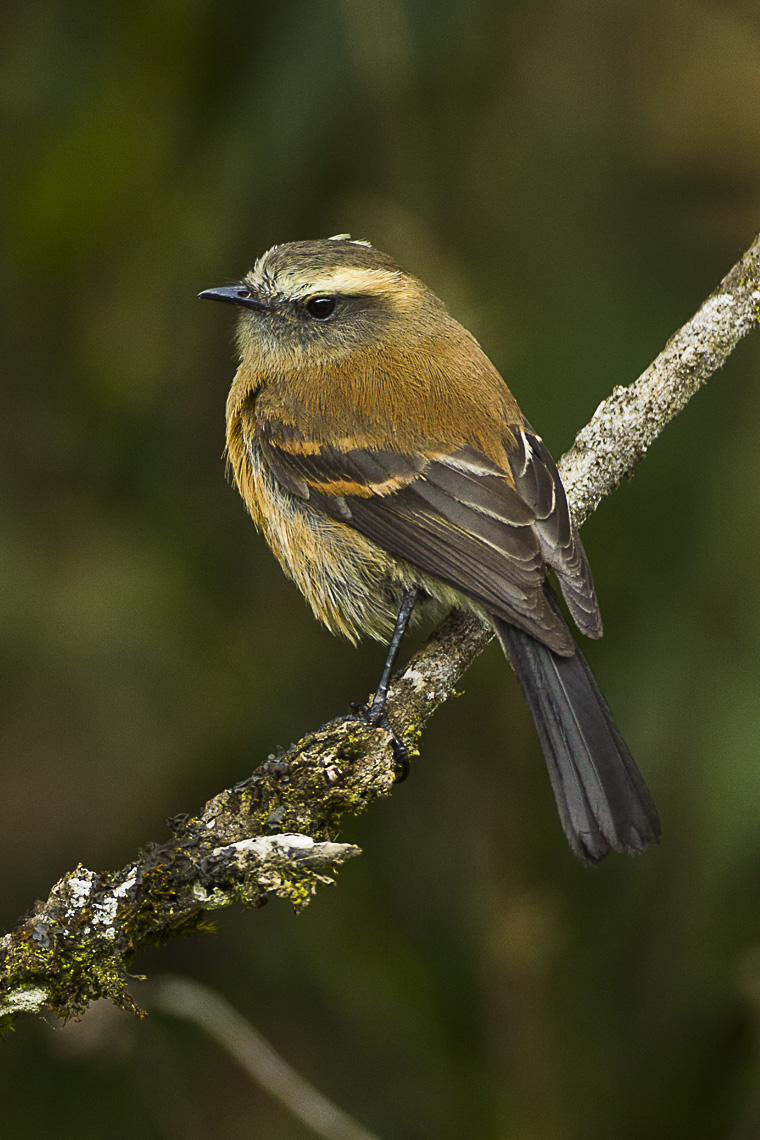 Brown-backed Chat-tyrantOchthoeca fumicolor
-
 Slaty-backed Chat-tyrantOchthoeca cinnamomeiventris
-
 D'Orbigny's Chat-tyrantOchthoeca oenanthoides
- Blackish Chat-tyrantOchthoeca nigrita
-
 Maroon-belted Chat-tyrantOchthoeca thoracica
-
 Piura Chat-tyrantOchthoeca piurae
- Rufous-browed Chat-tyrantOchthoeca superciliosa
Compare
Questions and answers
What is the scientific name of the White-browed Chat-tyrant?
The scientific name of the White-browed Chat-tyrant is Ochthoeca leucophrys. Written with its author, the full name is Ochthoeca leucophrys (d'Orbigny & Lafresnaye, 1837).
Which family does the White-browed Chat-tyrant belong to?
Ochthoeca leucophrys belongs to the family Tyrannidae, in the order Passeriformes and the class Aves.
Where is the White-browed Chat-tyrant found?
Checklists and occurrence records place Ochthoeca leucophrys in 6 countries: Peru, Argentina, Chile, Bolivia, Ecuador and Colombia.
What is the conservation status of the White-browed Chat-tyrant?
The IUCN Red List category recorded for Ochthoeca leucophrys is Least Concern (LC).
How many subspecies are recognized?
Six subspecies are recognized for the White-browed Chat-tyrant.[44]
What was the species originally called?
The species was originally described under the name Fluvicola leucophrys.[45]
Sources
Passages the profile rests on
- Adults measure 14.5–15.5 cm in length. Source passage: “The white-browed chat-tyrant is 14.5 to 15.5 cm (5.7 to 6.1 in) long.” — English Wikipedia
- Males and females have the same plumage. Source passage: “The sexes have the same plumage.” — English Wikipedia
- Adults of the nominate subspecies have a dark gray to grayish-brown crown. Source passage: “Adults of the nominate subspecies O. l. leucophrys have a dark gray to grayish brown crown” — English Wikipedia
- The nominate subspecies has a broad white eyebrow extending from the lores beyond the eye. Source passage: “a wide white supercilium that begins at the lores and extends well past the eye” — English Wikipedia
- The nominate subspecies has slightly lighter gray to grayish-brown upperparts than its crown, with a slight cinnamon tinge on the lower back and rump. Source passage: “Their upperparts are a slightly lighter gray to grayish brown than the crown with a slight cinnamon tinge on the lower back and rump.” — English Wikipedia
- Its wings are dusky gray with two faint cinnamon-colored bars. Source passage: “Their wings are a duskier gray with two faint cinnamon wing bars.” — English Wikipedia
- Its tail is dusky and has white outer webs on the outermost feathers. Source passage: “Their tail is dusky with white outer webs on the outermost feathers.” — English Wikipedia
- Its throat and underparts are pale gray, becoming whitish on the crissum. Source passage: “Their throat and underparts are pale gray that becomes whitish on the crissum.” — English Wikipedia
- Juveniles have an overall brownish tinge and conspicuous wing bars. Source passage: “Juveniles have a brownish overall tinge with conspicuous wing bars.” — English Wikipedia
- The subspecies leucometopa has darker upperparts than the nominate subspecies, lacks cinnamon coloration, and has white edges on the remiges. Source passage: “O. l. leucometopa: darker upperparts than nominate with no cinnamon, and white edges on the remiges” — English Wikipedia
- The subspecies urubambae resembles leucometopa but has a slightly paler crown. Source passage: “O. l. urubambae: like leucometopa with a slightly paler crown” — English Wikipedia
- The subspecies interior resembles urubambae but is slightly darker overall. Source passage: “O. l. interior: like urubambae but overall slightly darker” — English Wikipedia
- The subspecies dissors has intermediate plumage characteristics between urubambae and interior. Source passage: “O. l. dissors: intermediate between urubambae and interior” — English Wikipedia
- The subspecies tucumana has more cinnamon coloration on its back and rump, more distinct wing bars, and slightly paler underparts than the nominate subspecies. Source passage: “O. l. tucumana: more cinnamon on back and rump than nominate with more distinct wing bars and slightly paler underparts” — English Wikipedia
- The species inhabits dry montane forests and Polylepis woodlands. Source passage: “The white-browed chat-tyrant inhabits dry montane forest and Polylepis woodlands.” — English Wikipedia
- It uses open and semiopen scrubby habitats in the Andes. Source passage: “Small flycatcher of open and semiopen scrubby habitats in the Andes.” — ebird.org
- It favors ravines, gorges, and grassy slopes. Source passage: “It favors ravines, gorges, and grassy slopes” — English Wikipedia
- It is frequently found near water, including along streams. Source passage: “and is often found near water such as along streams.” — English Wikipedia
- It is often found in rocky valleys and gullies. Source passage: “Often in rocky valleys and gullies” — ebird.org
- It also occurs in cultivated areas containing hedgerows. Source passage: “It also often occurs in cultivated areas that have hedgerows.” — English Wikipedia
- It also inhabits agricultural terraces in and around villages. Source passage: “and agricultural terraces in and around villages.” — ebird.org
- In Ecuador, it occurs at elevations of 2,200–2,800 m. Source passage: “between 2,200 and 2,800 m (7,200 and 9,200 ft) in Ecuador” — English Wikipedia
- In Peru, it occurs at elevations of 2,400–4,200 m. Source passage: “between 2,400 and 4,200 m (7,900 and 13,800 ft) in Peru” — English Wikipedia
- In Bolivia and Argentina, it occurs at elevations of 2,000–3,500 m. Source passage: “between 2,000 and 3,500 m (6,600 and 11,500 ft) in Bolivia and Argentina.” — English Wikipedia
- The species feeds on insects. Source passage: “The white-browed chat-tyrant feeds on insects.” — English Wikipedia
- It usually forages alone or in pairs. Source passage: “It usually forages singly or in pairs.” — English Wikipedia
- It perches upright in exposed positions on bushes. Source passage: “It perches in the open, upright on a bush” — English Wikipedia
- It captures prey mainly in mid-air and sometimes by making sallies to the ground. Source passage: “and takes prey mostly in mid-air and sometimes with a sally to the ground.” — English Wikipedia
- It often returns to the same perch after capturing prey. Source passage: “It often returns to the same perch after a capture.” — English Wikipedia
- The species is resident throughout the year. Source passage: “The white-browed chat-tyrant is a year-round resident.” — English Wikipedia
- Its breeding season appears to extend from October through January in Peru. Source passage: “appears to span October to January in Peru” — English Wikipedia
- Its breeding season appears to extend from November through February in Argentina. Source passage: “and November to February in Argentina.” — English Wikipedia
- The only documented nest was an open cup constructed from small twigs and lined with feathers, hair, and wool. Source passage: “The one known nest was an open cup made from small twigs lined with feathers, hair, and wool.” — English Wikipedia
- The documented nest was situated in a grass clump beside a stream on a ravine slope. Source passage: “It was placed in a clump of grass near a stream on the side of a ravine.” — English Wikipedia
- The documented nest contained one egg. Source passage: “It contained one egg.” — English Wikipedia
- The white-browed chat-tyrant and Piura chat-tyrant form a superspecies. Source passage: “The white-browed and Piura chat-tyrants form a superspecies.” — English Wikipedia
- The IUCN classifies the white-browed chat-tyrant as Least Concern. Source passage: “The IUCN has assessed the white-browed chat-tyrant as being of Least Concern.” — English Wikipedia
- The species has a very large geographic range. Source passage: “It has a very large range;” — English Wikipedia
- Its population is believed to be stable, although its size is unknown. Source passage: “its population size is not known and is believed to be stable.” — English Wikipedia
- No immediate threats to the species have been identified. Source passage: “No immediate threats have been identified.” — English Wikipedia
- The species is considered rare and locally distributed in Ecuador. Source passage: “It is considered "rare and local" in Ecuador” — English Wikipedia
- The species is considered common and widespread in Peru. Source passage: “and "common and widespread" in Peru.” — English Wikipedia
- The species occurs in national parks in Peru and Bolivia. Source passage: “It occurs in national parks in Peru and Bolivia.” — English Wikipedia
- Six subspecies are recognized for the white-browed chat-tyrant. Source passage: “The white-browed chat-tyrant has these six subspecies:” — English Wikipedia
- The species was originally described under the name Fluvicola leucophrys. Source passage: “The white-browed chat-tyrant was originally described as "F[luvicola] leucophrys".” — English Wikipedia
Data
- Catalogue of Life, 2026-10-16 XR cc by
- Global Biodiversity Information Facility CC BY 4.0
- Wikidata CC0
- GeoNames CC BY 4.0
- Wikimedia Commons per image; credit shown with each image
- Within the Catalogue of Life, this name comes from The Integrated Taxonomic Information System cc0
References
- Gill, Frank, & and Minturn Wright. (2006). Birds of the World: Recommended English Names.
This species in other databases
Page built on 28 November 2026. See how the catalog is made and all sources and licences.
Cite this page
ScientificNames.org. (2026). Ochthoeca leucophrys (White-browed Chat-tyrant). Retrieved November 28, 2026, from https://scientificnames.org/species/ochthoeca-leucophrys
“Ochthoeca leucophrys (White-browed Chat-tyrant).” ScientificNames.org, 2026, scientificnames.org/species/ochthoeca-leucophrys. Accessed 28 Nov. 2026.
ScientificNames.org. “Ochthoeca leucophrys (White-browed Chat-tyrant).” Accessed November 28, 2026. https://scientificnames.org/species/ochthoeca-leucophrys.
@misc{scientificnames_ochthoeca_leucophrys_white_browed_chat_tyrant,
  author = {{ScientificNames.org}},
  title = {Ochthoeca leucophrys (White-browed Chat-tyrant)},
  year = {2026},
  url = {https://scientificnames.org/species/ochthoeca-leucophrys},
  note = {Accessed 2026-11-28}
}