Species · Flowering plants
Operculicarya decaryi
Operculicarya decaryi has no English name on record in the checklists used here. It is a species of flowering plant in the family Anacardiaceae (sumac family), order Sapindales.
- Scientific name
- Operculicarya decaryi H.Perrier
- Genus
- Operculicarya
- Family
- Anacardiaceae (Sumac Family)
- Order
- Sapindales
- Class
- Magnoliopsida
- Red List category
- LC Least Concern
- Recorded in
- 1 country
- Name status
- accepted in the Catalogue of Life
Overview
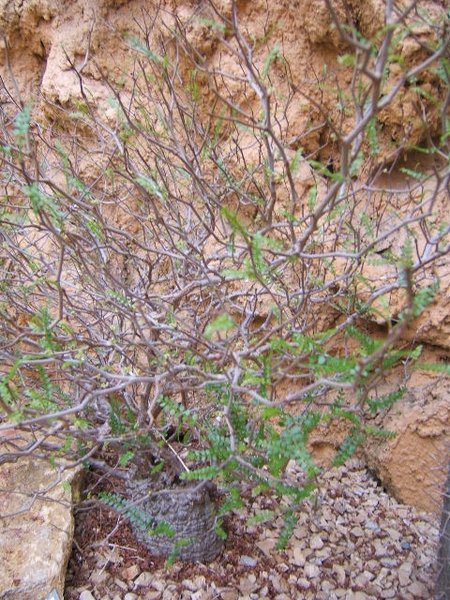
The native range is Madagascar. It is a thick-stemmed succulent plant that produces red flowers smaller than 2 mm.
Written 26 November 2026 from the sources listed below. Each statement was checked against the passage it cites; statements that could not be supported were removed.
Appearance
Operculicarya decaryi is a thick-stemmed succulent plant. It produces red flowers smaller than 2 mm.[1][2]
Its inflorescences develop at the ends of short branches and often contain approximately five flowers.[3][4]
Habitat
The species grows primarily in seasonally dry tropical biomes. It occurs in Madagascar.[5][6]
Behaviour
Operculicarya decaryi is drought tolerant and grows well in full sun in most places. It cannot tolerate freezing conditions.[7][8][9]
Reproduction and life cycle
Operculicarya decaryi can be propagated using woody cuttings in a uniformly moist soil mixture. It can also be propagated from pieces of its tuberous roots.[10][11]
Uses
Operculicarya decaryi is cultivated as a bonsai tree.[12]
Classification of Operculicarya decaryi
| Kingdom | Plantae |
|---|---|
| Subkingdom | Pteridobiotina |
| Phylum | Tracheophyta |
| Class | Magnoliopsida |
| Order | Sapindales |
| Family | Anacardiaceae (Sumac Family) |
| Tribe | Tapiririeae |
| Genus | Operculicarya |
| Species | Operculicarya decaryi H.Perrier |
Where Operculicarya decaryi is found
Checklists and occurrence records place Operculicarya decaryi in 1 country across Africa. GBIF holds 187 georeferenced records of it.
Countries
Regions and cities with the most records
- Toliara, Madagascar 8
- Ampanihy, Madagascar 7
- Jafaro, Madagascar 6
- Tsiombe, Madagascar 6
- Beloha, Madagascar 5
- Betioky, Madagascar 5
- Tôlanaro, Madagascar 4
- Amboasary, Madagascar 3
1 more country has a few records outside this range
These countries hold a few records of Operculicarya decaryi but lie outside the range the checklists give for it. Such records are often zoo or garden specimens, museum material or vagrants, so the species is not counted as occurring there.
Range as the checklists state it
S-Madagascar
A number beside a place is its count of GBIF occurrence records. A place without a number comes from a checklist alone. Records show where a species has been observed or collected, which can include escapes and vagrants.
Common names
Names in 4 other languages
- Chinese
- 盖果漆
- Finnish
- norsuparipuu
- Malagasy
- Jiabiha, Zabia, Zabihy Daro, Zaby, Zoby
- Slovak
- slonovník Decaryho
Questions and answers
Sources
Passages the profile rests on
- Operculicarya decaryi is a thick-stemmed succulent plant. Source passage: “is a thick stemmed succulent plant species in the family Anacardiaceae” — English Wikipedia
- The species produces red flowers smaller than 2 mm. Source passage: “It has small (less than 2 mm) red flowers in winter.” — English Wikipedia
- Its inflorescences develop at the ends of short branches. Source passage: “The inflorescence is at the end of short branches” — English Wikipedia
- Its inflorescences often contain approximately five flowers. Source passage: “often consist of about five flowers.” — English Wikipedia
- The species grows primarily in seasonally dry tropical biomes. Source passage: “grows primarily in the seasonally dry tropical biome.” — powo.science.kew.org
- The species occurs in Madagascar. Source passage: “It is found in Madagascar” — English Wikipedia
- The species is drought tolerant. Source passage: “It is drought tolerant” — English Wikipedia
- The species grows well in full sun in most places. Source passage: “does well in full sun in most places.” — English Wikipedia
- Operculicarya decaryi cannot tolerate freezing conditions. Source passage: “It cannot tolerate freezing conditions.” — English Wikipedia
- Operculicarya decaryi can be propagated using woody cuttings in a uniformly moist soil mixture. Source passage: “Woody cuttings need a soil mixture kept uniformly moist for propagation.” — English Wikipedia
- The species can also be propagated from pieces of its tuberous roots. Source passage: “It can also be propagated using pieces of the tuberous roots.” — English Wikipedia
- Operculicarya decaryi is cultivated as a bonsai tree. Source passage: “and is also grown as a bonsai tree.” — English Wikipedia
Data
- Catalogue of Life, 2026-10-16 XR cc by
- Global Biodiversity Information Facility CC BY 4.0
- Wikidata CC0
- GeoNames CC BY 4.0
- Wikimedia Commons per image; credit shown with each image
- Within the Catalogue of Life, this name comes from Synonymic Checklists of the Vascular Plants of the World cc by
References
- Perrier, H. (1944). Mém. Mus. Natl. Hist. Nat. 18: 249 (1944). where the name was published
This species in other databases
- Catalogue of Life 6SNQX
- Wikidata Q3067579
- iNaturalist 431383
- World Flora Online wfo-0001049413
- GRIN 498965
Page built on 27 November 2026. See how the catalog is made and all sources and licences.
Cite this page
ScientificNames.org. (2026). Operculicarya decaryi. Retrieved November 27, 2026, from https://scientificnames.org/species/operculicarya-decaryi
“Operculicarya decaryi.” ScientificNames.org, 2026, scientificnames.org/species/operculicarya-decaryi. Accessed 27 Nov. 2026.
ScientificNames.org. “Operculicarya decaryi.” Accessed November 27, 2026. https://scientificnames.org/species/operculicarya-decaryi.
@misc{scientificnames_operculicarya_decaryi,
  author = {{ScientificNames.org}},
  title = {Operculicarya decaryi},
  year = {2026},
  url = {https://scientificnames.org/species/operculicarya-decaryi},
  note = {Accessed 2026-11-27}
}