Species · Insects
Karkloof Blue Orachrysops ariadne
The scientific name of the Karkloof Blue is Orachrysops ariadne. It is a species of insect in the family Lycaenidae (blues), order Lepidoptera. The name dates from 1898.
- Scientific name
- Orachrysops ariadne (Butler, 1898)
- Common name
- Karkloof Blue
- Family
- Lycaenidae (Blues)
- Order
- Lepidoptera
- Class
- Insecta
- Red List category
- EN Endangered
- Recorded in
- 1 country
- Name status
- accepted in the Catalogue of Life
Overview
The species inhabits Mistbelt grasslands in the KwaZulu-Natal midlands and is endemic to South Africa. It has deep blue upper wing surfaces, a wingspan of 26 to 40 mm, and only four known populations in KwaZulu-Natal, South Africa.
Written 27 November 2026 from the sources listed below. Each statement was checked against the passage it cites; statements that could not be supported were removed.
Appearance
The upper surface of the wings is deep blue, with black veins along the inner margin and a black outer margin. The underside is light brown with multiple black and white spots.[1][2]
The wingspan ranges from 26 to 40 mm.[3]
The larvae are approximately 1 mm long, dark green, and covered with long, thick setae.[4]
Habitat
The Karkloof Blue inhabits Mistbelt grasslands in the KwaZulu-Natal midlands. The species is endemic to South Africa.[5][6]
Behaviour
The butterfly is a rapid flier and has been recorded travelling 157 metres while searching for food. Adults are active from March through April.[7][8]
After feeding on Indigofera leaves, the larvae burrow into plant tissue. Some larvae are taken into nests of Camponotus natalensis for pupation.[9][10]
Reproduction and life cycle
The species produces one generation per year. Females lay their eggs on the stems and leaves of Indigofera woodii var. laxa.[11][12]
The eggs hatch after an incubation period of 18 to 30 days.[13]
Diet
The larvae feed on the leaves of Indigofera plants. The butterfly depends on specific host plants.[14][15]
Adult butterflies feed on nectar from eight recorded plant sources. These include Hebenstretia dura and Tephrosia polystachya.[16][17]
Conservation
The Karkloof Blue is critically endangered. Agricultural development has transformed up to 92% of the KwaZulu-Natal midlands into unsuitable habitat, while approximately 1% remains in healthy condition for species such as this butterfly.[18][19][20]
Seasonal grass burning to clear cropland threatens existing butterfly populations. The invasive plant Eupatorium macrocephalum threatens the species by disrupting the composition of its Mistbelt habitat.[21][22]
Invasive plants threaten Indigofera species on which the butterfly depends for food and reproduction.[15][23]
Conservation measures include removing invasive plants and propagating additional Indigofera host plants. Controlled burns are planned for later in the season, after the butterflies have entered the pupal stage underground.[24][25]
Classification of the Karkloof Blue
| Kingdom | Animalia |
|---|---|
| Phylum | Arthropoda |
| Subphylum | Hexapoda |
| Class | Insecta (Insect) |
| Order | Lepidoptera |
| Superfamily | Papilionoidea |
| Family | Lycaenidae (Blues) |
| Species | Orachrysops ariadne (Butler, 1898) |
This name was added to the Catalogue of Life from a contributing dataset by automated merging and has not yet been reviewed by its editors.
Where the Karkloof Blue is found
Checklists and occurrence records place Orachrysops ariadne in 1 country. GBIF holds 176 georeferenced records of it.
Countries
Regions and cities with the most records
- KwaZulu-Natal, South Africa 174
- Howick, South Africa 156
- Mpophomeni, South Africa 16
- Mooi River, South Africa 8
Range as the checklists state it
Global
A number beside a place is its count of GBIF occurrence records. A place without a number comes from a checklist alone. Records show where a species has been observed or collected, which can include escapes and vagrants.
Common names
English
- Karkloof Blue
- Karkloof Blue Butterfly
Names in 1 other language
- Afrikaans
- Karkloof-bloutjie
Synonyms
One other scientific name has been used for this species and is now treated as a synonym of Orachrysops ariadne.
- Catachrysops ariadne Butler, 1898
Related species
-
 Common BluePolyommatus icarus
-
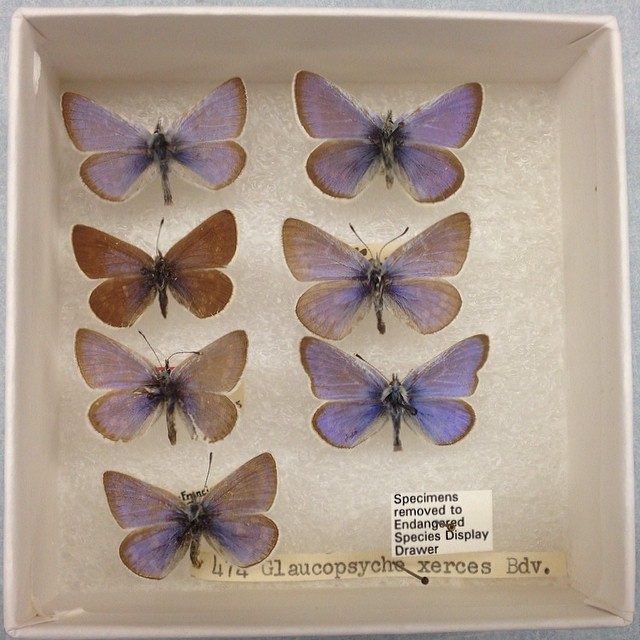 Xerces BlueGlaucopsyche xerces
-
 Adonis BlueLysandra bellargus
-
 Western Pygmy BlueBrephidium exilis
-
 AtalaEumaeus atala
-
 Holly BlueCelastrina argiolus
-
 Long-tailed BlueLampides boeticus
-
 HarvesterFeniseca tarquinius
Compare
Questions and answers
What is the scientific name of the Karkloof Blue?
The scientific name of the Karkloof Blue is Orachrysops ariadne. Written with its author, the full name is Orachrysops ariadne (Butler, 1898).
Which family does the Karkloof Blue belong to?
Orachrysops ariadne belongs to the family Lycaenidae, in the order Lepidoptera and the class Insecta.
Where is the Karkloof Blue found?
Checklists and occurrence records place Orachrysops ariadne in 1 country: South Africa.
What is the conservation status of the Karkloof Blue?
The IUCN Red List category recorded for Orachrysops ariadne is Endangered (EN).
What other names does the Karkloof Blue have?
Orachrysops ariadne is also known in English as Karkloof Blue Butterfly.
Sources
Passages the profile rests on
- The upper surface of the wings is deep blue with black veins along the inner margin and a black outer margin. Source passage: “The interior wing of the Karklooff blue supports a deep blue color with black veins on the inner margin, while the outer margin is black.” — English Wikipedia
- The underside of the wings is light brown with multiple black and white spots. Source passage: “The wings underside pattern supports a light brown color with multiple black and white spots.” — English Wikipedia
- The wingspan ranges from 26 to 40 mm. Source passage: “The wingspan is 26–40 mm.” — English Wikipedia
- The larvae are approximately 1 mm long, dark green and covered with long, thick setae. Source passage: “O. ariadne larvae are 1 mm in length with a dark green coloration and long thick setae.” — English Wikipedia
- The species inhabits Mistbelt grasslands in the KwaZulu-Natal midlands. Source passage: “This butterfly is endemic to South Africa, where it is only known from a few localities in the 'Mistbelt grasslands' within the KwaZulu-Natal midlands.” — English Wikipedia
- The species is endemic to South Africa. Source passage: “This butterfly is endemic to South Africa” — English Wikipedia
- The butterfly is a rapid flier and has been recorded travelling 157 metres while searching for food. Source passage: “O. ariadne is known to be a rapid flier, covering recorded distances of 157 meters in food search.” — English Wikipedia
- Adults are active from March through April. Source passage: “Adults are on wing from March to April.” — English Wikipedia
- The larvae burrow into plant tissue after feeding on Indigofera leaves. Source passage: “They will feed on the leaves of Indigofera, which the species supports a host relationship with before burrowing into the plant tissue.” — English Wikipedia
- Some larvae are taken into nests of Camponotus natalensis for pupation. Source passage: “some larvae are taken to the nests of species Camponotus natalensis for pupating.” — English Wikipedia
- The species produces one generation per year. Source passage: “There is only one generation per year, as the Karkloof blue is univoltine.” — English Wikipedia
- Females lay their eggs on the stems and leaves of Indigofera woodii var. laxa. Source passage: “The females eggs are laid on the stems and leaves of the indigo shrub, Indigofera woodii var. laxa.” — English Wikipedia
- The eggs hatch after an incubation period of 18 to 30 days. Source passage: “The larvae will then begin to hatch after an incubation period of 18 to 30 days.” — English Wikipedia
- The larvae feed on the leaves of Indigofera plants. Source passage: “They will feed on the leaves of Indigofera” — English Wikipedia
- The butterfly depends on specific host plants. Source passage: “The butterfly relies on specific host plants” — academia.edu
- Adult butterflies feed on nectar from eight recorded plant sources. Source passage: “In its adult life stage, O. ariadne feed on nectar from eight recorded sources” — English Wikipedia
- Recorded adult nectar sources include Hebenstretia dura and Tephrosia polystachya. Source passage: “including Hebenstretia dura and Tephrosia polystachya.” — English Wikipedia
- The species is critically endangered according to the cited biological and conservation document. Source passage: “Orachrysops ariadne is critically endangered” — academia.edu
- Agricultural development has transformed up to 92% of the KwaZulu-Natal midlands into unsuitable habitat. Source passage: “agricultural development in the last decades have transformed up to 92% of the KwaZulu-Natal midlands into unusable habitat” — English Wikipedia
- Approximately 1% of the KwaZulu-Natal midlands remains in healthy condition for species such as this butterfly. Source passage: “with only around 1% remaining in healthy condition for species like O. ariadne.” — English Wikipedia
- Seasonal grass burning to clear cropland threatens existing butterfly populations. Source passage: “seasonal burning of grasses by the locals to clear cropland, which threaten existing populations of butterflies.” — English Wikipedia
- The invasive plant Eupatorium macrocephalum threatens the species by disrupting the composition of its Mistbelt habitat. Source passage: “invasive species such as Eupatorium macrocephalum which disrupt the plant composition of the Mistbelt ecosystem” — English Wikipedia
- Invasive plants threaten Indigofera species that the butterfly depends on for food and reproduction. Source passage: “threatening native species such as Indigofera which the Karkloof depends on for food and reproduction.” — English Wikipedia
- Conservation measures include removing invasive plants and propagating additional Indigofera host plants. Source passage: “by removal of invasive species, and propagation of more host plants (Indigofera)” — English Wikipedia
- Controlled burns are planned for later in the season after the butterflies have entered the pupal stage underground. Source passage: “plans have been implemented regarding the controlled burns to be conducted in the later season when O. ariadne have been moved under ground by Camponotus Natalensis after entering the pupa stage.” — English Wikipedia
Data
- Catalogue of Life, 2026-10-16 XR cc by
- Global Biodiversity Information Facility CC BY 4.0
- Wikidata CC0
- GeoNames CC BY 4.0
- Within the Catalogue of Life, this name comes from The IUCN Red List of Threatened Species cc by
This species in other databases
Page built on 27 November 2026. See how the catalog is made and all sources and licences.
Cite this page
ScientificNames.org. (2026). Orachrysops ariadne (Karkloof Blue). Retrieved November 27, 2026, from https://scientificnames.org/species/orachrysops-ariadne
“Orachrysops ariadne (Karkloof Blue).” ScientificNames.org, 2026, scientificnames.org/species/orachrysops-ariadne. Accessed 27 Nov. 2026.
ScientificNames.org. “Orachrysops ariadne (Karkloof Blue).” Accessed November 27, 2026. https://scientificnames.org/species/orachrysops-ariadne.
@misc{scientificnames_orachrysops_ariadne_karkloof_blue,
  author = {{ScientificNames.org}},
  title = {Orachrysops ariadne (Karkloof Blue)},
  year = {2026},
  url = {https://scientificnames.org/species/orachrysops-ariadne},
  note = {Accessed 2026-11-27}
}