Species · Birds
Ashy Tailorbird Orthotomus ruficeps
The scientific name of the Ashy Tailorbird is Orthotomus ruficeps. It is a species of bird in the family Cisticolidae (cisticolas & allies), order Passeriformes. The name dates from 1830.
- Scientific name
- Orthotomus ruficeps (Lesson, 1830)
- Common name
- Ashy Tailorbird
- Genus
- Orthotomus
- Family
- Cisticolidae (Cisticolas & Allies)
- Order
- Passeriformes
- Class
- Aves
- Red List category
- LC Least Concern
- Recorded in
- 8 countries
- Name status
- accepted in the Catalogue of Life
Overview
Orthotomus ruficeps occurs in Southeast Asia, including southern Myanmar, southern Thailand, the Malay Peninsula, Singapore, Borneo, Sumatra, Java, Mapun, southern Vietnam and Cambodia. Its orange face is a diagnostic identification feature within its range.
Written 26 November 2026 from the sources listed below. Each statement was checked against the passage it cites; statements that could not be supported were removed.
Habitat
The Ashy Tailorbird typically inhabits lowland forests near the coast and is associated with subtropical or tropical moist lowland forest. Its forest habitats include mangrove forests, secondary forests, swamp forests and scrubland.[1][2][3]
The species has been recorded at elevations up to 900 m on Sumatra and Borneo. On inshore and offshore islands, it typically occupies more open habitats.[4][5]
Appearance
The Ashy Tailorbird measures approximately 7 cm in length and weighs approximately 12 g. Its bill is long, slightly curved downward at the tip, bark brown on its upper surface and horn-coloured underneath.[6][7][8][9]
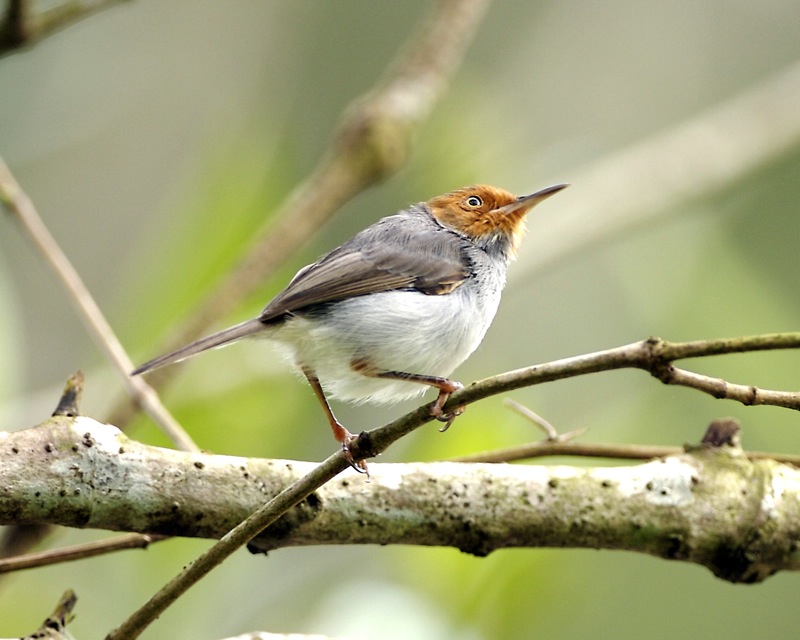
Adult males have a rufous-chestnut face, chin and forecrown, with an ashy-grey back, upper wings and throat. Their grey underparts become progressively lighter toward an almost white belly, and their tail is lighter grey.[10][11][12][13][14]
The degree of head redness and the shade of grey on the back vary among subspecies. The species has a dark-tipped tail that is frequently held cocked upward, and its orange face is a diagnostic identification feature within its range.[15][16][17]
Behaviour
The Ashy Tailorbird forages in pairs and small family groups. It searches for food in forest canopies, undergrowth and along forest edges.[18][19]
The species has adapted to widespread conversion of rainforest into palm oil plantations. It has also been reported as one of the more common bird species in a study of oil palm plantations.[20][21]
Diet
The Ashy Tailorbird is insectivorous. Recorded prey includes ants, caterpillars, flies and beetles.[22][23]
In oil palm plantations, the species has adapted its diet to include the weevil Elaeidobius kamerunicus.[24]
Reproduction and life cycle
The Ashy Tailorbird constructs its nest by stitching together the two sides of a large leaf. It makes holes along the leaf edges and joins them with plant fibres or spiderweb.[25][26]
The nesting site is usually no more than 1 m above the ground. The clutch typically contains two to three eggs.[27][28]
The plaintive cuckoo is a recorded brood parasite of the Ashy Tailorbird.[29]
Conservation
The Ashy Tailorbird is classified as Least Concern by the IUCN. It has a wide distribution, and no evidence of population declines has been reported.[30][31]
The species was most recently assessed for the IUCN Red List in 2025.[32]
Classification of the Ashy Tailorbird
| Kingdom | Animalia |
|---|---|
| Phylum | Chordata |
| Subphylum | Vertebrata |
| Infraphylum | Gnathostomata |
| Parvphylum | Osteichthyes |
| Megaclass | Tetrapoda |
| Class | Aves (Bird) |
| Order | Passeriformes (Passerine) |
| Family | Cisticolidae (Cisticolas & Allies) |
| Genus | Orthotomus (Tailorbird) |
| Species | Orthotomus ruficeps (Lesson, 1830) |
Where the Ashy Tailorbird is found
Checklists and occurrence records place Orthotomus ruficeps in 8 countries across Asia. GBIF holds 41,760 georeferenced records of it.
Countries
- Brunei 303
- Cambodia 476
- Indonesia 2,771
- Malaysia 18,517
- Philippines 12
- Singapore 17,209
- Thailand 1,416
- Vietnam 1,056
Regions and cities with the most records
- Ang Mo Kio New Town, Singapore 17,250
- Yio Chu Kang, Singapore 17,241
- Novena, Singapore 17,132
- Yishun New Town, Singapore 17,000
- Sungai Simpang, Singapore 16,983
- Sengkang New Town, Singapore 16,925
- Sembawang Estate, Singapore 16,342
- Bukit Timah, Singapore 15,797
- Queenstown Estate, Singapore 15,636
- Woodlands, Singapore 15,524
- Matilda Estate, Singapore 15,104
- Anak Bukit, Singapore 14,523
- Bukit Panjang New Town, Singapore 14,236
- Teck Whye, Singapore 14,119
- Choa Chu Kang New Town, Singapore 14,095
- Yew Tee, Singapore 14,074
- Marsiling, Singapore 13,737
- Keat Hong Village, Singapore 13,502
- Jurong East, Singapore 13,447
- Kampung Pasir Gudang Baru, Malaysia 13,286
- Jurong West, Singapore 13,285
- Jurong Town, Singapore 13,175
- Boon Lay, Singapore 12,152
- Pasir Gudang, Malaysia 11,976
- Singapore, Singapore 11,845
- Johor Bahru, Malaysia 11,447
- Masai, Malaysia 11,418
- Sabah, Malaysia 11,398
- MacPherson, Singapore 11,347
- Eunos, Singapore 11,281
- Punggol, Singapore 11,196
- Bandar Seri Alam, Malaysia 11,195
- Marine Parade, Singapore 9,980
- Ulu Bedok, Singapore 9,930
- Kampong Pasir Ris, Singapore 9,725
- Bedok New Town, Singapore 9,573
A number beside a place is its count of GBIF occurrence records. A place without a number comes from a checklist alone. Records show where a species has been observed or collected, which can include escapes and vagrants.
Common names
English
- Ashy Tailorbird
- Gray Tailorbird
- Grey Tailorbird
Names in 27 other languages
- Catalan
- ocell sastre cendrós
- Chinese
- 灰縫葉鶯, 灰缝叶莺
- Croatian
- kestenjastolica šivalica
- Czech
- krejčiřík šedý
- Danish
- Askegrå Skrædderfugl
- Dutch
- Grijze Snijdervogel
- Esperanto
- cindra tajlorbirdo
- Finnish
- harmaaräätäli
- French
- Couturière à tête rousse
- German
- Grauschneidervogel, Rotgesicht-Schneidervogel
- Indonesian
- Cinenen kelabu
- Italian
- Uccello sarto cenerino, Uccello sarto testarossa
- Japanese
- アカガオサイホウチョウ
- Lithuanian
- peleninė nendrinukė siuvėja
- Norwegian
- askeskredderfugl
- Polish
- krawczyk rdzawolicy
- Portuguese
- costureiro-cinzento, costureiro-de-cabeça-ruiva
- Russian
- Пепельная портниха
- Serbian
- Pepeljasta ptica krojač
- Slovak
- krajčírik popolavý
- Spanish
- Sastrecillo ceniciento
- Swedish
- askgrå skräddarfågel
- Thai
- นกกระจิบหัวแดง
- Turkish
- Kül Rengi Terzikuşu
- Ukrainian
- кравчик рудощокий
- Welsh
- teiliwr llwyd
- jav
- Prenjak Atas
Synonyms
One other scientific name has been used for this species and is now treated as a synonym of Orthotomus ruficeps.
- Edela ruficeps Lesson, RP, 1830
Subspecies and varieties
- Orthotomus ruficeps baeus subspecies
- Orthotomus ruficeps baweanus subspecies
- Orthotomus ruficeps borneoensis subspecies
- Orthotomus ruficeps cagayanensis subspecies
- Orthotomus ruficeps cineraceus subspecies
- Orthotomus ruficeps concinnus subspecies
- Orthotomus ruficeps germaini subspecies
- Orthotomus ruficeps palliolatus subspecies
- Orthotomus ruficeps ruficeps subspecies
Related species
-
 Common TailorbirdOrthotomus sutorius
-
 Dark-necked TailorbirdOrthotomus atrogularis
-
 Rufous-tailed TailorbirdOrthotomus sericeus
-
 Cambodian TailorbirdOrthotomus chaktomuk
-
 Olive-backed TailorbirdOrthotomus sepium
-
 Visayan TailorbirdOrthotomus castaneiceps
-
 Yellow-breasted TailorbirdOrthotomus samarensis
-
 Grey-backed TailorbirdOrthotomus derbianus
Compare
Questions and answers
What is the scientific name of the Ashy Tailorbird?
The scientific name of the Ashy Tailorbird is Orthotomus ruficeps. Written with its author, the full name is Orthotomus ruficeps (Lesson, 1830).
Which family does the Ashy Tailorbird belong to?
Orthotomus ruficeps belongs to the family Cisticolidae, in the order Passeriformes and the class Aves.
Where is the Ashy Tailorbird found?
Checklists and occurrence records place Orthotomus ruficeps in 8 countries, including Malaysia, Singapore, Indonesia, Thailand, Vietnam and Cambodia.
What is the conservation status of the Ashy Tailorbird?
The IUCN Red List category recorded for Orthotomus ruficeps is Least Concern (LC).
What other names does the Ashy Tailorbird have?
Orthotomus ruficeps is also known in English as Gray Tailorbird and Grey Tailorbird.
Do tailor birds really sew nests?
The Ashy Tailorbird constructs its nest by stitching together the two sides of a large leaf. It makes holes along the leaf edges and joins them using plant fibres or spiderweb.[25][26]
What do tailor birds eat?
The Ashy Tailorbird is insectivorous. Its recorded prey includes ants, caterpillars, flies and beetles.[22][23]
What are 10 interesting facts about the tailorbird?
The Ashy Tailorbird measures approximately 7 cm and weighs approximately 12 g. Adult males have a rufous-chestnut face, while females have a white chin and throat. Its orange face is a diagnostic identification feature, and its dark-tipped tail is frequently held cocked upward. It forages in pairs and small family groups, eats insects, and constructs nests by stitching together large leaves. Its nests are usually no more than 1 m above the ground and typically contain two to three eggs. The plaintive cuckoo is a recorded brood parasite. The species also occurs in oil palm plantations, where it consumes the weevil Elaeidobius kamerunicus.[6][7][10][33][16][17][18][22][25][27][28][29][20][24]
Where does a tailorbird live?
The Ashy Tailorbird occurs across Southeast Asia, including the Malay Peninsula, Singapore, Borneo, Sumatra, Java and Mapun, as well as southern Vietnam and Cambodia. It typically inhabits coastal lowland forests, including mangrove, secondary and swamp forests, and scrubland.[34][35][36][37][1][2]
Sources
Passages the profile rests on
- The species typically inhabits lowland forests near the coast. Source passage: “Its natural habitats is typically lowland forests close to the coast” — English Wikipedia
- Its forest habitats include mangrove forests, secondary forests, swamp forests and scrubland. Source passage: “including mangrove forest, secondary forest, swamp forest and scrubland.” — English Wikipedia
- The species is associated with subtropical or tropical moist lowland forest. Source passage: “habitats are subtropical or tropical moist lowland forest” — inaturalist.org
- The species has been recorded at elevations up to 900 m on Sumatra and Borneo. Source passage: “it has been recorded up to 900 m (3,000 ft) on Sumatra and Borneo.” — English Wikipedia
- On inshore and offshore islands, the species typically occupies more open habitats. Source passage: “On inshore and offshore islands, it typically lives in more open habitats.” — English Wikipedia
- The species measures approximately 7 cm in length. Source passage: “measuring 7 cm (2.8 in) in length” — English Wikipedia
- The species weighs approximately 12 g. Source passage: “weighing 12 g (0.42 oz).” — English Wikipedia
- The bill is bark brown on its upper surface and horn-coloured underneath. Source passage: “The bill, which is bark brown above and horn coloured below” — English Wikipedia
- The bill is long and slightly curved downward at its tip. Source passage: “is long and slightly decurved at the tip.” — English Wikipedia
- Adult males have a rufous-chestnut face, chin and forecrown. Source passage: “the male having a rufous-chestnut face, chin and forecrown” — English Wikipedia
- Adult males have an ashy-grey back, upper wings and throat. Source passage: “an ashy grey back, upper wing and throat” — English Wikipedia
- The male's grey underparts become progressively lighter toward an almost white belly. Source passage: “from the throat down the breast to the belly the grey becomes lighter until it is almost white on the belly.” — English Wikipedia
- The male has a lighter-grey tail. Source passage: “The tail is lighter grey.” — English Wikipedia
- Males have grey throats. Source passage: “Males are gray-throated,” — ebird.org
- The degree of head redness and the shade of grey on the back vary among subspecies. Source passage: “The subspecies vary in the redness of the head and shade of grey on the back.” — English Wikipedia
- The species has a dark-tipped tail that is frequently held cocked upward. Source passage: “with a long bill and a dark-tipped, frequently-cocked-up tail.” — ebird.org
- The orange face is a diagnostic identification feature within the species' range. Source passage: “Orange face diagnostic within its range.” — ebird.org
- The species forages in pairs and small family groups. Source passage: “The ashy tailorbird is found foraging in pairs and small family groups.” — English Wikipedia
- The species forages in forest canopies, undergrowth and along forest edges. Source passage: “It will feed in both the canopy of forests and the undergrowth, as well as the forest edge.” — English Wikipedia
- The species has adapted to widespread conversion of rainforest into palm oil plantations. Source passage: “The species has adapted well to the widespread conversion of rainforest into palm oil plantations” — English Wikipedia
- The species has been reported as one of the more common bird species in a study of oil palm plantations. Source passage: “being one of the more common species found in one study.” — English Wikipedia
- The species is insectivorous. Source passage: “It is an insectivore” — English Wikipedia
- Recorded prey includes ants, caterpillars, flies and beetles. Source passage: “and has been recorded taking ants, caterpillars, flies and beetles.” — English Wikipedia
- In oil palm plantations, the species has adapted its diet to include the weevil Elaeidobius kamerunicus. Source passage: “In these plantations its diet has adapted to taking a species of weevil, Elaeidobius kamerunicus” — English Wikipedia
- The species constructs its nest by stitching together the two sides of a large leaf. Source passage: “builds a nest by stitching together the two sides of a large leaf” — English Wikipedia
- The nest is assembled by making holes along leaf edges and joining them with plant fibres or spiderweb. Source passage: “pushing holes through the edges and using plant fibers or spiderweb tie them together.” — English Wikipedia
- The nesting site is usually no more than 1 m above the ground. Source passage: “The nesting site is usually low down, no more than 1 m (3.3 ft) off the ground” — English Wikipedia
- The clutch typically contains two to three eggs. Source passage: “and the clutch size is two to three eggs.” — English Wikipedia
- The plaintive cuckoo is a recorded brood parasite of the species. Source passage: “The species is targeted by at least one brood parasite, the plaintive cuckoo” — English Wikipedia
- The species is classified as Least Concern by the IUCN. Source passage: “has been evaluated as least concern by the International Union for Conservation of Nature.” — English Wikipedia
- The species has a wide distribution and no evidence of population declines has been reported. Source passage: “The ashy tailorbird has a wide distribution with no evidence of any declines” — English Wikipedia
- The species was most recently assessed for the IUCN Red List in 2025. Source passage: “has most recently been assessed for The IUCN Red List of Threatened Species in 2025.” — iucnredlist.org
- Females have a white chin and throat, a pale-grey wash across the breast and paler upperparts than males. Source passage: “The female is similar but with a white chin and throat, a pale grey wash across the breast, and has paler upperparts.” — English Wikipedia
- The species occurs across Southeast Asia, from southern Myanmar and southern Thailand through the Malay Peninsula and Singapore. Source passage: “ranging from southern Myanmar and southern Thailand through the Malay Peninsula and Singapore.” — English Wikipedia
- The species occurs on Borneo, Sumatra and Java. Source passage: “It is found widely across Greater Sunda Islands, namely Borneo, Sumatra and Java” — English Wikipedia
- The species also occurs on Mapun, a Philippine island near Borneo. Source passage: “including the Philippine island of Mapun (which is close to Borneo).” — English Wikipedia
- A separate population occurs in southern Vietnam and Cambodia. Source passage: “Another disjunct population is found in southern Vietnam and Cambodia.” — English Wikipedia
Data
- Catalogue of Life, 2026-10-16 XR cc by
- Global Biodiversity Information Facility CC BY 4.0
- Wikidata CC0
- GeoNames CC BY 4.0
- Wikimedia Commons per image; credit shown with each image
- Within the Catalogue of Life, this name comes from The Integrated Taxonomic Information System cc0
References
- Gill, Frank, & and Minturn Wright. (2006). Birds of the World: Recommended English Names.
This species in other databases
Page built on 29 November 2026. See how the catalog is made and all sources and licences.
Cite this page
ScientificNames.org. (2026). Orthotomus ruficeps (Ashy Tailorbird). Retrieved November 29, 2026, from https://scientificnames.org/species/orthotomus-ruficeps
“Orthotomus ruficeps (Ashy Tailorbird).” ScientificNames.org, 2026, scientificnames.org/species/orthotomus-ruficeps. Accessed 29 Nov. 2026.
ScientificNames.org. “Orthotomus ruficeps (Ashy Tailorbird).” Accessed November 29, 2026. https://scientificnames.org/species/orthotomus-ruficeps.
@misc{scientificnames_orthotomus_ruficeps_ashy_tailorbird,
  author = {{ScientificNames.org}},
  title = {Orthotomus ruficeps (Ashy Tailorbird)},
  year = {2026},
  url = {https://scientificnames.org/species/orthotomus-ruficeps},
  note = {Accessed 2026-11-29}
}