Species · Insects
Crimson Rose Pachliopta hector
The scientific name of the Crimson Rose is Pachliopta hector. It is a species of insect in the family Papilionidae (swallowtail butterfly), order Lepidoptera. The name dates from 1758.
- Scientific name
- Pachliopta hector (Linnaeus, 1758)
- Common name
- Crimson Rose
- Genus
- Pachliopta
- Family
- Papilionidae (Swallowtail Butterfly)
- Order
- Lepidoptera
- Class
- Insecta
- Red List category
- LC Least Concern
- Recorded in
- 5 countries
- Name status
- accepted in the Catalogue of Life

Overview
Pachliopta hector (Linnaeus, 1758), known as the Crimson Rose, is a large swallowtail butterfly in the family Papilionidae, order Lepidoptera and class Insecta. The species inhabits jungle and open country and is recorded from Pakistan, India, Sri Lanka and the Maldives, with a possible occurrence along the coast of western Myanmar.
Written 26 November 2026 from the sources listed below. Each statement was checked against the passage it cites; statements that could not be supported were removed.
Appearance
The female has duller, pale crimson hindwing spots and subterminal markings than the male.[1]
Habitat
The species inhabits both jungle and open country. In South India, it occurs at elevations up to 2400 metres during the dry season and throughout the year at lower elevations.[2][3][4]
Diet
Adult butterflies frequently feed on flowers, particularly Lantana. Nectar is considered essential for the adult butterfly.[5][6]
The larvae feed on Aristolochia indica, Aristolochia bracteolata and Thottea siliquosa.[7]
Behaviour
The species flies slowly with a fluttering but steady flight close to the ground. At greater heights, it flies faster and more strongly.[8][9]
The species basks with its wings spread flat. Individuals sometimes bask in small groups at heights of 10 to 15 metres in trees.[10][11]
The species often roosts overnight in large groups on tree and shrub branches. It exhibits strong migratory tendencies, and thousands of individuals may congregate before migrating to other areas.[12][13][14]
The caterpillars are known to exhibit cannibalism.[15]
Reproduction and life cycle
The species can produce up to seven generations in a year. Development from egg to adult takes approximately 39 to 47 days, and the eggs hatch after approximately seven days.[16][17][18]
Higher nectar intake is thought to increase egg production. The caterpillar passes through five instars.[19][20]
The pupa is pinkish brown and has distinctive wing-like abdominal expansions.[21]
Conservation
The IUCN classified the species as Least Concern in 2019. The species is protected by law in India.[22][23]
Similar species
The species has flight and behavioural characteristics resembling those of the Common Mormon. A female form of the Common Mormon, known as romulus, mimics the Crimson Rose.[24][25]
Classification of the Crimson Rose
| Kingdom | Animalia |
|---|---|
| Phylum | Arthropoda |
| Subphylum | Hexapoda |
| Class | Insecta (Insect) |
| Order | Lepidoptera |
| Superfamily | Papilionoidea |
| Family | Papilionidae (Swallowtail Butterfly) |
| Genus | Pachliopta (Rose Swallowtails) |
| Species | Pachliopta hector (Linnaeus, 1758) |
Where the Crimson Rose is found
Checklists and occurrence records place Pachliopta hector in 5 countries. GBIF holds 2,826 georeferenced records of it.
Countries
Regions and cities with the most records
- Tamil Nadu, India 767
- Karnataka, India 677
- Bengaluru, India 346
- Bommasandra Industrial Area, India 259
- Hebbagodi, India 259
- Jigani, India 256
- Electronic City Phase I, India 254
- koppana Agrahara, India 254
- Andhra Pradesh, India 244
- Maharashtra, India 187
- Telangana, India 173
- Injambakkam, India 152
- Kerala, India 152
- Neelankarai, India 152
- Saint Thomas Mount, India 151
- Jalladiampet, India 150
- Pallikaranai, India 149
- Madipakkam, India 148
- Ramapuram, India 148
- Kullattūr, India 147
- Meddappakkam, India 147
- Meenambakkam, India 146
- Rajakilpakkam, India 145
- Anekal, India 144
- Pallāvaram, India 144
- Polichalur, India 144
- Mugalivakkam, India 143
- Sholinganallur, India 140
- Kallamchavadi, India 138
- Porur, India 138
- Nerkunram, India 137
- Yelahanka, India 137
- Maduraivayal, India 134
- Maduravoyal, India 133
- Kaikalapettai, India 129
- Nalambūr, India 128
Range as the checklists state it
IND
SRL
A number beside a place is its count of GBIF occurrence records. A place without a number comes from a checklist alone. Records show where a species has been observed or collected, which can include escapes and vagrants.
Common names
English
- Crimson Rose
- Crimson Rose Swallowtail
Names in 4 other languages
- Finnish
- punatäplänoita
- Japanese
- ヘクトールベニモンアゲハ
- Marathi
- गुलाबी राणी
- Tamil
- சிவப்பு உடல் அழகி
Synonyms
3 other scientific names have been used for this species and are now treated as synonyms of Pachliopta hector.
- Atrophaneura hector (Linnaeus, 1758)
- Papilio hector Linnaeus, 1758
- Papilio hector heroicus Fruhstorfer, 1908
Related species
-
 Common RosePachliopta aristolochiae
-
 Malabar RosePachliopta pandiyana
-
 Pink RosePachliopta kotzebuea
-
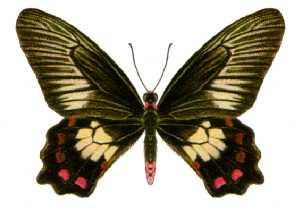 Red-bodied SwallowtailPachliopta polydorus
-
 Black RosePachliopta antiphus
-
 Atrophaneura MariaePachliopta mariae
-
 Pachliopta phlegon
-
 Mourning SwallowtailPachliopta atropos
Compare
Questions and answers
What is the scientific name of the Crimson Rose?
The scientific name of the Crimson Rose is Pachliopta hector. Written with its author, the full name is Pachliopta hector (Linnaeus, 1758).
Which family does the Crimson Rose belong to?
Pachliopta hector belongs to the family Papilionidae, in the order Lepidoptera and the class Insecta.
Where is the Crimson Rose found?
Checklists and occurrence records place Pachliopta hector in 5 countries: India, Sri Lanka, Maldives, Bangladesh and Indonesia.
What is the conservation status of the Crimson Rose?
The IUCN Red List category recorded for Pachliopta hector is Least Concern (LC).
What other names does the Crimson Rose have?
Pachliopta hector is also known in English as Crimson Rose Swallowtail.
Which species does the crimson rose belong to?
The Crimson Rose is the English name of Pachliopta hector (Linnaeus, 1758).[26]
To which species does the crimson rose belong?
The Crimson Rose belongs to the species Pachliopta hector (Linnaeus, 1758).[26]
Sources
Passages the profile rests on
- The female has duller, pale crimson hindwing spots and subterminal markings than the male. Source passage: “the discal series of spots and subterminal lunules are much duller and are pale crimson irrorated (sprinkled) with black scales.” — English Wikipedia
- The species inhabits both jungle and open country. Source passage: “This butterfly is at home both in jungle and in open country.” — English Wikipedia
- In South India, the species occurs at elevations up to 2400 metres during the dry season. Source passage: “During the dry season, it will be found up to 2400 m (8000 feet) in South India” — English Wikipedia
- The species occurs throughout the year at lower elevations. Source passage: “it is found all the year round at lower elevations.” — English Wikipedia
- Adult butterflies frequently feed on flowers, particularly Lantana. Source passage: “The crimson rose is very fond of flowers, especially Lantana.” — English Wikipedia
- Nectar is considered essential for the adult butterfly. Source passage: “Nectar appears to be essential for the butterfly” — English Wikipedia
- The larvae feed on Aristolochia indica, Aristolochia bracteolata and Thottea siliquosa. Source passage: “including Aristolochia indica, Aristolochia bracteolata, and Thottea siliquosa.” — English Wikipedia
- The species flies slowly with a fluttering but steady flight close to the ground. Source passage: “Close to the ground, the flight of the crimson rose is slow and fluttering but steady.” — English Wikipedia
- At greater heights, the species flies faster and more strongly. Source passage: “At greater heights, it flies faster and stronger.” — English Wikipedia
- The species basks with its wings spread flat. Source passage: “It basks with its wings spread flat” — English Wikipedia
- Individuals sometimes bask in small groups at heights of 10 to 15 metres in trees. Source passage: “sometimes in small congregations at heights of 10 to 15 metres up in the trees.” — English Wikipedia
- The species often roosts overnight in large groups on tree and shrub branches. Source passage: “The butterfly often roosts for the night in large companies on the twigs and branches of trees and shrubs” — English Wikipedia
- The species exhibits strong migratory tendencies. Source passage: “its strong migratory tendencies.” — English Wikipedia
- Thousands of individuals may congregate before migrating to other areas. Source passage: “several thousand crimson roses can be found congregating and then they begin migrating to other areas.” — English Wikipedia
- The caterpillars are known to exhibit cannibalism. Source passage: “The caterpillars are known to display cannibalistic behaviour.” — English Wikipedia
- The species can produce up to seven generations in a year. Source passage: “They breed up to seven times per year” — English Wikipedia
- Development from egg to adult takes approximately 39 to 47 days. Source passage: “it has been found to take only 39–47 days from egg to adult.” — English Wikipedia
- The eggs hatch after approximately seven days. Source passage: “the eggs hatch in seven days.” — English Wikipedia
- Higher nectar intake is thought to increase egg production. Source passage: “a higher nectar intake is thought to increase egg production.” — English Wikipedia
- The caterpillar passes through five instars. Source passage: “The caterpillar has five instars.” — English Wikipedia
- The pupa is pinkish brown and has distinctive wing-like abdominal expansions. Source passage: “The pupa is pinkish brown with darker expanded wing cases. The wing-like expansions on the abdomen are distinctive.” — English Wikipedia
- The IUCN classified the species as Least Concern in 2019. Source passage: “The IUCN classified the species as Least Concern in 2019.” — English Wikipedia
- The species is protected by law in India. Source passage: “This species is protected by law in India.” — English Wikipedia
- The species has flight and behavioural characteristics resembling those of the Common Mormon. Source passage: “Its flight and behaviour is much like that of the common Mormon.” — English Wikipedia
- A female form of the Common Mormon, known as romulus, mimics the Crimson Rose. Source passage: “the female form romulus.” — English Wikipedia
- The species is described as a large swallowtail butterfly. Source passage: “is a large swallowtail butterfly” — English Wikipedia
Data
- Catalogue of Life, 2026-10-16 XR cc by
- Global Biodiversity Information Facility CC BY 4.0
- Wikidata CC0
- GeoNames CC BY 4.0
- Wikimedia Commons per image; credit shown with each image
- Within the Catalogue of Life, this name comes from Global Butterfly Information System cc by
This species in other databases
Page built on 28 November 2026. See how the catalog is made and all sources and licences.
Cite this page
ScientificNames.org. (2026). Pachliopta hector (Crimson Rose). Retrieved November 28, 2026, from https://scientificnames.org/species/pachliopta-hector
“Pachliopta hector (Crimson Rose).” ScientificNames.org, 2026, scientificnames.org/species/pachliopta-hector. Accessed 28 Nov. 2026.
ScientificNames.org. “Pachliopta hector (Crimson Rose).” Accessed November 28, 2026. https://scientificnames.org/species/pachliopta-hector.
@misc{scientificnames_pachliopta_hector_crimson_rose,
  author = {{ScientificNames.org}},
  title = {Pachliopta hector (Crimson Rose)},
  year = {2026},
  url = {https://scientificnames.org/species/pachliopta-hector},
  note = {Accessed 2026-11-28}
}