Species · Birds
Broad-billed Prion Pachyptila vittata
The scientific name of the Broad-billed Prion is Pachyptila vittata. It is a species of bird in the family Procellariidae (fulmars), order Procellariiformes. The name dates from 1777.
- Scientific name
- Pachyptila vittata (G. Forster, 1777)
- Common name
- Broad-billed Prion
- Genus
- Pachyptila
- Family
- Procellariidae (Fulmars)
- Order
- Procellariiformes
- Class
- Aves
- Red List category
- LC Least Concern
- Environment
- marine, terrestrial
- Recorded in
- 8 countries
- Name status
- accepted in the Catalogue of Life

Overview
Pachyptila vittata inhabits oceans and coastal areas throughout the Southern Hemisphere. It is distinguished by its heavy iron-grey bill, developed lamellae and dark M-shaped marking across its back and wings.
Written 26 November 2026 from the sources listed below. Each statement was checked against the passage it cites; statements that could not be supported were removed.
Appearance
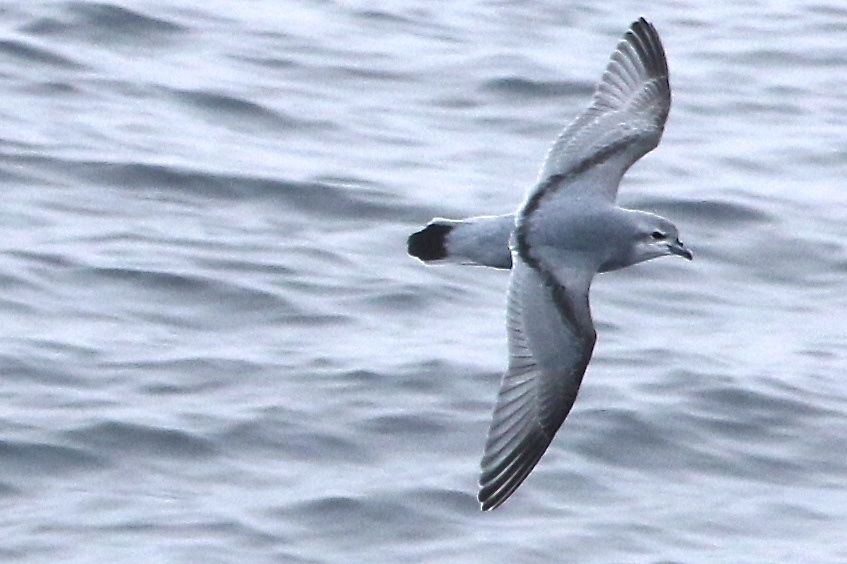
The Broad-billed Prion has blue-grey upperparts and white underparts, with a dark M-shaped marking across its back and wings. Its crown is grey, its eye stripe is dark and its tail is black-tipped.[1][2][3]
Its heavy bill is iron-grey but can appear blackish at a distance. The bill has the most developed lamellae among prions.[4][5]
Compared with the fairy prion, it has a more distinct head pattern and a less extensive tail band.[6][7]
The species measures 25–30 cm in length, has a wingspan of 57 to 66 cm and an average weight of 160 to 235 g.[8][9][10]
Habitat
The Broad-billed Prion inhabits oceans and coastal areas throughout the Southern Hemisphere. Its range extends from the southeast Atlantic to New Zealand, mainly near the Antarctic Convergence.[11][12]
Its breeding habitats include coastal slopes, lava fields and cliffs on breeding islands.[13]
Diet
The Broad-billed Prion feeds on copepods, squid and fish. It uses its bill to skim water while flying and filter out food, and also obtains food by surface-seizing.[14][15][16]
Behaviour
The species does not regularly follow fishing boats.[17]
Reproduction and life cycle
Breeding begins in July or August. The Broad-billed Prion lays a single white egg in a burrow-type nest, measuring approximately 50.0 by 36.8 mm.[18][19][20]
Both parents incubate the egg for approximately 50 days. After incubation, the parents spend approximately 50 days raising the chick.[21][22]
Breeding colonies begin dispersing from December onwards. Some adults remain near breeding islands during winter and may visit their burrows.[23][24]
In the South Atlantic, the species breeds on Tristan da Cunha and Gough Island. In the South Pacific, it breeds on islands off the southern coast of New Zealand's South Island and on the Chatham Islands.[25][26]
Its breeding colonies also include the subantarctic Antipodes Islands.[27]
Conservation
The Broad-billed Prion has an estimated occurrence range of 10,500,000 km² and an estimated population of 15 million individuals. It is classified as Least Concern by the IUCN.[28][29][30]
Cats and rats have drastically reduced the species' numbers on some islands.[31]
Similar species
The fairy prion is a similar species. The Broad-billed Prion has a more distinct head pattern and a less extensive tail band.[6][7]
Classification of the Broad-billed Prion
| Kingdom | Animalia |
|---|---|
| Phylum | Chordata |
| Subphylum | Vertebrata |
| Infraphylum | Gnathostomata |
| Parvphylum | Osteichthyes |
| Megaclass | Tetrapoda |
| Class | Aves (Bird) |
| Order | Procellariiformes (Petrels) |
| Family | Procellariidae (Fulmars) |
| Genus | Pachyptila (Prions) |
| Species | Pachyptila vittata (G. Forster, 1777) |
Where the Broad-billed Prion is found
Checklists and occurrence records place Pachyptila vittata in 8 countries across Africa and Oceania. GBIF holds 2,562 georeferenced records of it.
Countries
- Antarctica 41
- Australia 281
- French Southern Territories 7
- Heard Island and McDonald Islands 4
- New Zealand 1,635
- Saint Helena 203
- South Africa 184
- South Georgia and the South Sandwich Islands 207
Regions and cities with the most records
- Chatham Islands, New Zealand 326
- Southland, New Zealand 93
- Tristan da Cunha, Saint Helena 52
- New South Wales, Australia 49
- Auckland, New Zealand 43
- Sydney, Australia 34
- Invercargill, New Zealand 33
- Avondale, New Zealand 29
- Mount Eden, New Zealand 29
- New Lynn, New Zealand 29
- Remuera, New Zealand 29
- Auckland, New Zealand 28
- Otahuhu, New Zealand 28
- Otara, New Zealand 28
- Mangere, New Zealand 27
- Manukau City, New Zealand 27
- Papatoetoe, New Zealand 27
- Victoria, Australia 27
- Western Australia, Australia 23
- Western Cape, South Africa 23
- Perth, Australia 21
- Manurewa, New Zealand 20
- South Australia, Australia 20
- Takanini, New Zealand 19
- Muizenberg, South Africa 18
- Retreat, South Africa 18
- Papakura, New Zealand 17
- Canterbury, New Zealand 15
- Paraparaumu, New Zealand 14
- Tasmania, Australia 13
- Wellington Region, New Zealand 12
- Adelaide, Australia 10
- Waikato Region, New Zealand 10
- Adelaide Hills, Australia 9
- Porirua, New Zealand 9
- Queensland, Australia 8
5 more countries have a few records outside this range
These countries hold a few records of Pachyptila vittata but lie outside the range the checklists give for it. Such records are often zoo or garden specimens, museum material or vagrants, so the species is not counted as occurring there.
Range as the checklists state it
Australia
Africa
A number beside a place is its count of GBIF occurrence records. A place without a number comes from a checklist alone. Records show where a species has been observed or collected, which can include escapes and vagrants.
Common names
English
- Broad-billed Prion
- Parara
Names in 29 other languages
- Afrikaans
- Breëbekwalvisvoël
- Arabic
- بريون واسع المنقار
- Catalan
- petrell prió becample
- Chinese
- 闊嘴鋸鸌, 阔嘴锯鹱
- Croatian
- krupnokljuni zovoj
- Czech
- buřňák širokozobý
- Danish
- Brednæbbet Hvalfugl
- Dutch
- breedbekprion
- Esperanto
- larĝbeka petreleto
- Estonian
- mustnokk-vaalalind
- Finnish
- leveänokkaprioni
- French
- Prion de Forster
- German
- Forster-Entensturmvogel, Großer Entensturmvogel
- Hungarian
- szélescsőrű cethojsza
- Italian
- Prione beccolargo
- Japanese
- ヒロハシクジラドリ
- Lithuanian
- plačiasnapis prionas
- Māori
- Pararā
- Norwegian
- brednebbhvalfugl
- Polish
- petrelek szerokodzioby
- Portuguese
- faigão-de-bico-largo
- Russian
- Ширококлювая китовая птичка, Ширококлювый прион
- Serbian
- Širokokljuni prion
- Slovak
- hladinár širokozobý
- Spanish
- Petrel-paloma de pico ancho, Prión pico ancho, Prión piquiancho
- Swedish
- brednäbbad valfågel
- Turkish
- Büyük Priyon
- Ukrainian
- пріон широкодзьобий
- Welsh
- prion aeliog
Synonyms
7 other scientific names have been used for this species and are now treated as synonyms of Pachyptila vittata.
- Pachyptila forsteri (Latham, 1790)
- Pachyptila vittata balaena Mathews, GM, 1938
- Pachyptila vittata keyteli Mathews, GM, 1912
- Pachyptila vittata vittata Forster, JGA, 1777
- Prion vittatus keyteli Mathews, GM, 1912
- Procellaria forsteri Latham, 1790
- Procellaria vittata G. Forster, 1777
Related species
-
 Fairy PrionPachyptila turtur
-
 Antarctic PrionPachyptila desolata
-
 Slender-billed PrionPachyptila belcheri
-
 Fulmar PrionPachyptila crassirostris
-
 Salvin's PrionPachyptila salvini
-
 MacGillivray's PrionPachyptila macgillivrayi
-
 Manx ShearwaterPuffinus puffinus
-
 Southern Giant PetrelMacronectes giganteus
Compare
Questions and answers
What is the scientific name of the Broad-billed Prion?
The scientific name of the Broad-billed Prion is Pachyptila vittata. Written with its author, the full name is Pachyptila vittata (G. Forster, 1777).
Which family does the Broad-billed Prion belong to?
Pachyptila vittata belongs to the family Procellariidae, in the order Procellariiformes and the class Aves.
Where is the Broad-billed Prion found?
Checklists and occurrence records place Pachyptila vittata in 8 countries, including New Zealand, Australia, South Georgia and the South Sandwich Islands, Saint Helena, South Africa and Antarctica.
What is the conservation status of the Broad-billed Prion?
The IUCN Red List category recorded for Pachyptila vittata is Least Concern (LC).
What other names does the Broad-billed Prion have?
Pachyptila vittata is also known in English as Parara.
When was the Broad-billed Prion described?
It was described in 1777 by Georg Forster.[32]
Where does the Broad-billed Prion breed?
It breeds on Tristan da Cunha and Gough Island in the South Atlantic, on islands off the southern coast of New Zealand's South Island, on the Chatham Islands and on the subantarctic Antipodes Islands.[25][26][27]
What does the name Pachyptila mean?
The genus name Pachyptila combines Greek words meaning dense or thick and feather or plumage.[33]
What does the specific epithet vittata mean?
The specific epithet vittata derives from the Latin word vittatus, meaning banded.[34]
What does the word prion mean?
The word prion derives from the Ancient Greek word priōn, meaning saw, referring to the serrated edges of the bill.[35]
Sources
Passages the profile rests on
- The species has blue-grey upperparts and white underparts. Source passage: “blue-grey upperparts, white underparts” — English Wikipedia
- The species has a dark M-shaped marking across its back and wings. Source passage: “the ever present dark "M" across its back and wings.” — English Wikipedia
- The species has a grey crown, a dark eye stripe and a black-tipped tail. Source passage: “It has a grey crown, a dark eye stripe, and a black-tipped tail.” — English Wikipedia
- Its heavy bill is iron-grey but can appear blackish at a distance. Source passage: “Its heavy bill is iron-grey but can appear blackish from a distance.” — English Wikipedia
- Its bill has the most developed lamellae among prions. Source passage: “Its bill has the best developed lamellae of all the prions” — English Wikipedia
- The species has a more distinct head pattern and a less extensive tail band than the fairy prion. Source passage: “The head pattern is more distinct and the tail band is less extensive than that of the similar fairy prion.” — English Wikipedia
- The fairy prion is identified as a similar species based on head pattern and tail-band differences. Source passage: “than that of the similar fairy prion.” — English Wikipedia
- The species measures 25–30 cm in length. Source passage: “measuring 25 to 30 cm (9.8 to 11.8 in) long” — English Wikipedia
- Its wingspan ranges from 57 to 66 cm. Source passage: “with a wingspan of 57 to 66 cm (22 to 26 in)” — English Wikipedia
- Its average weight ranges from 160 to 235 g. Source passage: “weighing on average 160 to 235 g (5.6 to 8.3 oz).” — English Wikipedia
- The species inhabits oceans and coastal areas throughout the Southern Hemisphere. Source passage: “This species is found throughout oceans and coastal areas in the Southern Hemisphere.” — English Wikipedia
- The species ranges from the southeast Atlantic to New Zealand, mainly near the Antarctic Convergence. Source passage: “It ranges from the southeast Atlantic to New Zealand mainly near the Antarctic Convergence.” — English Wikipedia
- Its breeding habitats include coastal slopes, lava fields and cliffs on breeding islands. Source passage: “Breeding begins on the coastal slopes, lava fields, or cliffs of the breeding islands” — English Wikipedia
- The species feeds on copepods, squid and fish. Source passage: “eat crustaceans (copepods), squid, and fish.” — English Wikipedia
- The species uses its bill to skim water while flying and filter out food. Source passage: “where the bird flies with its bill in the water, skimming water in, and then filtering the food.” — English Wikipedia
- The species also obtains food by surface-seizing. Source passage: “They also surface-seize.” — English Wikipedia
- The species does not regularly follow fishing boats. Source passage: “This prion doesn't follow fishing boats regularly.” — English Wikipedia
- Breeding begins in July or August. Source passage: “Breeding begins on the coastal slopes, lava fields, or cliffs of the breeding islands in July or August” — English Wikipedia
- The species lays a single egg in a burrow-type nest. Source passage: “as they lay their single egg in a burrow type nest.” — English Wikipedia
- The egg is white and measures approximately 50.0 by 36.8 mm. Source passage: “The clutch is a single white egg which is approximately 50.0 mm × 36.8 mm (1.97 in × 1.45 in).” — English Wikipedia
- Both parents incubate the egg for approximately 50 days. Source passage: “Both parents incubate the egg for 50 days” — English Wikipedia
- The parents spend approximately 50 days raising the chick after incubation. Source passage: “and then spend another 50 days raising the chick.” — English Wikipedia
- Breeding colonies begin dispersing from December onwards. Source passage: “Colonies disperse from December onwards” — English Wikipedia
- Some adults remain near breeding islands during winter and may visit their burrows. Source passage: “some adults remain in the vicinity of the breeding islands and may visit their burrows in winter.” — English Wikipedia
- In the South Atlantic, the species breeds on Tristan da Cunha and Gough Island. Source passage: “In the south Atlantic it breeds on Tristan da Cunha and Gough Island” — English Wikipedia
- In the South Pacific, the species breeds on islands off the southern coast of New Zealand's South Island and on the Chatham Islands. Source passage: “in the south Pacific it breeds on islands off the south coast of South Island, New Zealand and on the Chatham Islands.” — English Wikipedia
- Its breeding colonies include the subantarctic Antipodes Islands. Source passage: “on the subantarctic Antipodes Islands” — English Wikipedia
- The species has an estimated occurrence range of 10,500,000 km². Source passage: “This prion has an occurrence range of 10,500,000 km2 (4,100,000 sq mi)” — English Wikipedia
- The estimated population of the species is 15 million individuals. Source passage: “an estimated population of 15 million.” — English Wikipedia
- The species is classified as Least Concern by the IUCN. Source passage: “It is categorised as least concern by the IUCN.” — English Wikipedia
- Cats and rats have drastically reduced the species' numbers on some islands. Source passage: “on some islands, cats and rats have reduced this prion's numbers drastically.” — English Wikipedia
- The species was described in 1777 by Georg Forster. Source passage: “The broad-billed prion was described in 1777 by the German naturalist Georg Forster” — English Wikipedia
- The genus name Pachyptila combines Greek words meaning dense or thick and feather or plumage. Source passage: “The genus name combines the Ancient Greek pakhus meaning "dense" or "thick" with ptilon meaning "feather" or "plumage".” — English Wikipedia
- The specific epithet vittata derives from the Latin word vittatus, meaning banded. Source passage: “The specific epithet vittata is from the Latin vittatus meaning "banded".” — English Wikipedia
- The word prion derives from the Ancient Greek word priōn, meaning saw, referring to the serrated edges of the bill. Source passage: “The word "prion" comes from the Ancient Greek priōn meaning "a saw", which is in reference to the serrated edges of the bill.” — English Wikipedia
Data
- Catalogue of Life, 2026-10-16 XR cc by
- Global Biodiversity Information Facility CC BY 4.0
- Wikidata CC0
- GeoNames CC BY 4.0
- Wikimedia Commons per image; credit shown with each image
- Within the Catalogue of Life, this name comes from The Integrated Taxonomic Information System cc0
References
- Mayr, Ernst, and G. William Cottrell, eds. (1979). Check-List of Birds of the World, Vol. 1, Second Edition.
- Gill, Frank, & and Minturn Wright. (2006). Birds of the World: Recommended English Names.
This species in other databases
- Catalogue of Life 6THKZ
- Wikidata Q276242
- iNaturalist 4159
- WoRMS urn:lsid:marinespecies.org:taxname:212647
- Avibase brbpri1
Page built on 29 November 2026. See how the catalog is made and all sources and licences.
Cite this page
ScientificNames.org. (2026). Pachyptila vittata (Broad-billed Prion). Retrieved November 29, 2026, from https://scientificnames.org/species/pachyptila-vittata
“Pachyptila vittata (Broad-billed Prion).” ScientificNames.org, 2026, scientificnames.org/species/pachyptila-vittata. Accessed 29 Nov. 2026.
ScientificNames.org. “Pachyptila vittata (Broad-billed Prion).” Accessed November 29, 2026. https://scientificnames.org/species/pachyptila-vittata.
@misc{scientificnames_pachyptila_vittata_broad_billed_prion,
  author = {{ScientificNames.org}},
  title = {Pachyptila vittata (Broad-billed Prion)},
  year = {2026},
  url = {https://scientificnames.org/species/pachyptila-vittata},
  note = {Accessed 2026-11-29}
}