Species · Crustaceans
Paguristes eremita
Paguristes eremita has no English name on record in the checklists used here. It is a species of crustacean in the family Diogenidae (lefthanded hermit crabs), order Decapoda. The name dates from 1767.
- Scientific name
- Paguristes eremita (Linnaeus, 1767)
- Genus
- Paguristes
- Family
- Diogenidae (Lefthanded Hermit Crabs)
- Order
- Decapoda
- Class
- Malacostraca
- Environment
- marine
- Recorded in
- 8 countries
- Name status
- accepted in the Catalogue of Life
Overview
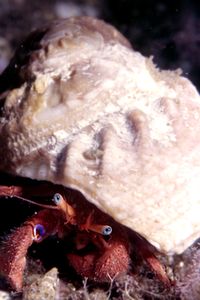
Paguristes eremita occurs on sandy seabeds and in seagrass meadows among Neptune grass, at depths between 10 and 50 m. It has a purplish spot at the base of the dactylus and is often associated with sea anemones, epizoanthids and hydroids.
Written 27 November 2026 from the sources listed below. Each statement was checked against the passage it cites; statements that could not be supported were removed.
Appearance
The species has a pointed rostrum and a spine at the tip of its small eye scale. Its eye stalks are long and cylindrical, and its thorny antennal scales nearly cover the bases of the antennae.[1][2][3]
Its claws are granulated and covered with short hairs, with the left claw slightly larger than the right. The first three pairs of walking legs are similar in length, while the fourth pair is much shorter.[4][5][6]
Its walking legs are laterally compressed, and the fifth pair ends in small claws. Its general colour ranges from orange-red to brown, and its eyes are greyish-blue.[7][8][9]
A purplish spot at the base of the dactylus distinguishes the species. Its carapace can reach approximately 20 mm in length.[10][11]
Habitat
The species occurs on sandy stretches of seabed and inhabits seagrass meadows among Neptune grass. It occupies empty gastropod mollusc shells.[12][13][14]
It occurs at depths between 10 and 50 m. It was studied on a sublittoral soft seabed at 24 m depth in the Gulf of Trieste.[15][16]
Diet
The species is a detritivore.[17]
Behaviour
The species is normally active during the day. Under mild hypoxia, individuals move onto elevated substrates with better oxygenation.[18][19]
Mild hypoxia is accompanied by reduced locomotory activity, increased body movements and extension from the shell. During severe hypoxia, individuals become mostly immobile in overturned shells.[20][21]
Anoxia causes individuals to emerge from their shells and briefly move without shells. The species exhibits relative tolerance to oxygen depletion compared with other crustaceans.[22][23]
Extended anoxia of approximately 1.5 days is associated with mortality.[24]
Reproduction and life cycle
Breeding takes place throughout the year. The larvae are planktonic.[25][26]
Larval development includes two zoea stages and one megalopa stage before metamorphosis into juvenile hermit crabs.[27]
Classification of Paguristes eremita
| Kingdom | Animalia |
|---|---|
| Phylum | Arthropoda |
| Subphylum | Crustacea |
| Class | Malacostraca |
| Order | Decapoda |
| Suborder | Pleocyemata |
| Infraorder | Anomura |
| Superfamily | Paguroidea (Hermit Crabs) |
| Family | Diogenidae (Lefthanded Hermit Crabs) |
| Genus | Paguristes |
| Species | Paguristes eremita (Linnaeus, 1767) |
Where Paguristes eremita is found
Checklists and occurrence records place Paguristes eremita in 8 countries. GBIF holds 833 georeferenced records of it.
Countries
Regions and cities with the most records
- Occitanie, France 118
- Sète, France 115
- Frontignan, France 112
- Trieste, Italy 40
- Monfalcone, Italy 34
- Koper, Slovenia 32
- Lattes, France 32
- Marseille, France 32
- Marseille 01, France 32
- Marseille 02, France 32
- Marseille 03, France 32
- Marseille 04, France 32
- Marseille 05, France 32
- Marseille 06, France 32
- Marseille 07, France 32
- Marseille 08, France 32
- Marseille 09, France 32
- Marseille 10, France 32
- Marseille 11, France 32
- Marseille 12, France 32
- Marseille 13, France 32
- Marseille 14, France 31
- Marseille 16, France 31
- Allauch, France 30
- Mauguio, France 28
- Provence-Alpes-Côte d'Azur, France 26
- La Crau, France 23
- Castelnau-le-Lez, France 22
- La Garde, France 22
- Lunel, France 22
- Montpellier, France 22
- Hyères, France 21
- Marseille 15, France 19
- Ayamonte, Spain 18
- Isla Cristina, Spain 18
- La Seyne-sur-Mer, France 18
6 more countries have a few records outside this range
These countries hold a few records of Paguristes eremita but lie outside the range the checklists give for it. Such records are often zoo or garden specimens, museum material or vagrants, so the species is not counted as occurring there.
A number beside a place is its count of GBIF occurrence records. A place without a number comes from a checklist alone. Records show where a species has been observed or collected, which can include escapes and vagrants.
Common names
Names in 5 other languages
- Croatian
- Okati rak samac
- French
- Piade, Piade (La)
- German
- Augenfleck-Einsiedler
- Italian
- Paguro eremita mediterraneo
- Portuguese
- Bernardo-eremita
Synonyms
5 other scientific names have been used for this species and are now treated as synonyms of Paguristes eremita.
- Cancer eremita Linnaeus, 1767
- Paguristes maculatus (Risso, 1827)
- Paguristes oculatus (Fabricius, 1775)
- Pagurus maculatus Risso, 1827
- Pagurus oculatus Fabricius, 1775
Related species
-
 Red Reef Hermit CrabPaguristes cadenati
-
 Common Hermit CrabPaguristes frontalis
-
 White Speckled HermitPaguristes puncticeps
- Furry Hermit CrabPaguristes ulreyi
-
 Pink Hermit CrabPaguristes gamianus
-
 Blue-eye HermitPaguristes sericeus
- Digger HermitPaguristes bakeri
-
 Paguristes inconstans
Compare
Questions and answers
What is the diet of a hermit crab?
Paguristes eremita is a detritivore.[17]
Sources
Passages the profile rests on
- The species has a pointed rostrum and a spine at the tip of its small eye scale. Source passage: “The rostrum is pointed and there is a spine at the tip of the small eye scale.” — English Wikipedia
- Its eye stalks are long and cylindrical. Source passage: “The eye stalks are long and cylindrical” — English Wikipedia
- Its antennal scales are thorny and nearly cover the bases of the antennae. Source passage: “the antennal scales are thorny and nearly cover the bases of the antennae.” — English Wikipedia
- Its claws are granulated and covered with short hairs. Source passage: “The chelae (claws) are granulated and covered with short hairs.” — English Wikipedia
- The left claw is slightly larger than the right claw. Source passage: “The left chela is slightly larger than the right one.” — English Wikipedia
- Its first three pairs of walking legs are similar in length, while its fourth pair is much shorter. Source passage: “the first three pairs are similar in length, the fourth pair are much shorter” — English Wikipedia
- Its walking legs are laterally compressed. Source passage: “The walking legs are laterally compressed” — English Wikipedia
- The fifth pair of walking legs ends in small claws. Source passage: “the fifth pair end in small claws.” — English Wikipedia
- Its general colour ranges from orange-red to brown, and its eyes are greyish-blue. Source passage: “The general colour of this crab is orange-red to brown, and the eyes are greyish-blue.” — English Wikipedia
- A purplish spot at the base of the dactylus distinguishes this species. Source passage: “A purplish spot at the base of the dactylus is diagnostic of this species.” — English Wikipedia
- Its carapace can reach approximately 20 mm in length. Source passage: “The carapace of this hermit crab can grow to a length of about 20 mm (0.8 in).” — English Wikipedia
- The species occurs on sandy stretches of seabed. Source passage: “it occurs on sandy stretches of seabed” — English Wikipedia
- The species inhabits seagrass meadows among Neptune grass. Source passage: “in seagrass meadows among the Neptune grass.” — English Wikipedia
- The species occupies empty gastropod mollusc shells. Source passage: “P. eremita inhabits the empty shell of a gastropod mollusc.” — English Wikipedia
- The species was studied on a sublittoral soft seabed at 24 m depth in the Gulf of Trieste. Source passage: “Small-scale (0.25 m2) hypoxia and anoxia were experimentally generated on a sublittoral soft bottom in 24 m depth in the Gulf of Trieste.” — pmc.ncbi.nlm.nih.gov
- The species occurs at depths between 10 and 50 m. Source passage: “Its depth range is 10 to 50 m (33 to 164 ft)” — English Wikipedia
- The species is a detritivore. Source passage: “Like other crabs, P. eremita is a detritivore.” — English Wikipedia
- The species is normally active during the day. Source passage: “The activity pattern of normally day-active crabs was altered during hypoxia and anoxia.” — pmc.ncbi.nlm.nih.gov
- Under mild hypoxia, individuals move onto elevated substrates with better oxygenation. Source passage: “Initially, at mild hypoxia (2.0 to 1.0 ml l− 1 DO), hermit crabs showed avoidance by moving onto better oxygenated, elevated substrata.” — pmc.ncbi.nlm.nih.gov
- Mild hypoxia is accompanied by reduced locomotory activity, increased body movements and extension from the shell. Source passage: “This was accompanied by a series of responses including decreased locomotory activity, increased body movements and extension from the shell.” — pmc.ncbi.nlm.nih.gov
- During severe hypoxia, individuals become mostly immobile in overturned shells. Source passage: “During a moribund phase at severe hypoxia (0.5 to 0.01 ml l− 1 DO), crabs were mostly immobile in overturned shells” — pmc.ncbi.nlm.nih.gov
- Anoxia causes individuals to emerge from their shells and briefly move without shells. Source passage: “Anoxia triggered emergence from the shell, with a brief locomotion spurt of shell-less crabs.” — pmc.ncbi.nlm.nih.gov
- The species exhibits relative tolerance to oxygen depletion compared with other crustaceans. Source passage: “Among the crustaceans, which are a sensitive group to oxygen depletion, P. eremita is relatively tolerant.” — pmc.ncbi.nlm.nih.gov
- Extended anoxia of approximately 1.5 days is associated with mortality. Source passage: “Mortality occurred after extended anoxia (~ 1.5 d)” — pmc.ncbi.nlm.nih.gov
- Breeding takes place throughout the year. Source passage: “Breeding takes place all year round.” — English Wikipedia
- The larvae are planktonic. Source passage: “The larvae are planktonic” — English Wikipedia
- Larval development includes two zoea stages and one megalopa stage before metamorphosis into juvenile hermit crabs. Source passage: “pass through two zoea larval stages and one megalopa stage before undergoing metamorphosis into juvenile hermit crabs.” — English Wikipedia
Data
- Catalogue of Life, 2026-10-16 XR cc by
- Global Biodiversity Information Facility CC BY 4.0
- Wikidata CC0
- GeoNames CC BY 4.0
- Wikimedia Commons per image; credit shown with each image
- Within the Catalogue of Life, this name comes from The Integrated Taxonomic Information System cc0
References
- Lemaitre, R.; McLaughlin, P., 2020, World Paguroidea & Lomisoidea database. Paguristes eremita (Linnaeus, 1767). Accessed through: World Register of Marine Species at: http://www.marinespecies.org/aphia.php?p=taxdetails&id=107200 on 2020-03-02 where the name was published
- McLaughlin, Patsy A., Tomoyuki Komai, Rafael Lemaitre, and Dwi Listyo Rahayu. (2010). Annotated checklist of Anomuran decapod crustaceans of the world [...]. Part 1 - Lithodoidea, Lomisoidea and Paguroidea. Raffles Bulletin of Zoology, Supplement No. 23.
This species in other databases
- Catalogue of Life B3YGC
- Wikidata Q3888980
- iNaturalist 324584
- WoRMS urn:lsid:marinespecies.org:taxname:107200
Page built on 28 November 2026. See how the catalog is made and all sources and licences.
Cite this page
ScientificNames.org. (2026). Paguristes eremita. Retrieved November 28, 2026, from https://scientificnames.org/species/paguristes-eremita
“Paguristes eremita.” ScientificNames.org, 2026, scientificnames.org/species/paguristes-eremita. Accessed 28 Nov. 2026.
ScientificNames.org. “Paguristes eremita.” Accessed November 28, 2026. https://scientificnames.org/species/paguristes-eremita.
@misc{scientificnames_paguristes_eremita,
  author = {{ScientificNames.org}},
  title = {Paguristes eremita},
  year = {2026},
  url = {https://scientificnames.org/species/paguristes-eremita},
  note = {Accessed 2026-11-28}
}