Species · Insects
Eastern Panthea Panthea furcilla
The scientific name of the Eastern Panthea is Panthea furcilla. It is a species of insect in the family Noctuidae (cutworms), order Lepidoptera. The name dates from 1864.
- Scientific name
- Panthea furcilla (Packard, 1864)
- Common name
- Eastern Panthea
- Genus
- Panthea
- Family
- Noctuidae (Cutworms)
- Order
- Lepidoptera
- Class
- Insecta
- Recorded in
- 2 countries
- Name status
- accepted in the Catalogue of Life
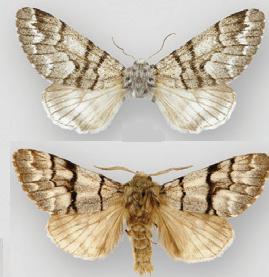
Overview
Eastern Panthea is a moth belonging to the family Noctuidae. The species occurs across the boreal forest region of Canada westward to the Rocky Mountains and in the eastern United States from Maine south to Florida, extending northward to Indiana and Ohio. Adults have a wingspan ranging from 33 to 50 mm.
Written 27 November 2026 from the sources listed below. Each statement was checked against the passage it cites; statements that could not be supported were removed.
Appearance
Adults have a wingspan ranging from 33 to 50 mm. Male specimens of the australis subspecies have wingspans of approximately 36–44 mm.[1][2]
Habitat
The species occurs in the boreal forest region of Canada.[3]
Diet
The larvae feed on eastern larch, pine trees, and spruce trees.[4][5][6]
Recorded host-plant genera include Larix, Picea, Pinus, and Tsuga. The species is described as a specialist on plants in the family Pinaceae.[7][8]
Behaviour
Adults fly from June through August in Canada.[9]
Reproduction and life cycle
The species produces a single brood annually in Canada. In the southern United States, it produces two or more generations, depending on location.[10][11]
Classification of the Eastern Panthea
| Kingdom | Animalia |
|---|---|
| Phylum | Arthropoda |
| Subphylum | Hexapoda |
| Class | Insecta (Insect) |
| Order | Lepidoptera |
| Superfamily | Noctuoidea |
| Family | Noctuidae (Cutworms) |
| Subfamily | Pantheinae |
| Genus | Panthea |
| Species | Panthea furcilla (Packard, 1864) |
Where the Eastern Panthea is found
Checklists and occurrence records place Panthea furcilla in 2 countries. GBIF holds 7,162 georeferenced records of it.
Countries
Regions and cities with the most records
- Ontario, Canada 1,640
- Massachusetts, United States 1,335
- Vermont, United States 468
- Greenfield, United States 435
- Michigan, United States 361
- Amherst, United States 356
- Amherst Center, United States 355
- Northampton, United States 341
- Maine, United States 318
- New York, United States 299
- Quebec, Canada 248
- Connecticut, United States 209
- New Hampshire, United States 201
- Pennsylvania, United States 194
- Gardner, United States 141
- Maryland, United States 141
- Nova Scotia, Canada 140
- North Carolina, United States 121
- Palmer, United States 120
- Ohio, United States 115
- Alabama, United States 114
- Texas, United States 112
- Virginia, United States 100
- Ithaca, United States 96
- Needham, United States 88
- New Jersey, United States 88
- Georgia, United States 87
- Peterborough, Canada 86
- Kitchener, Canada 82
- West Roxbury, United States 79
- Mattapan, United States 77
- Dedham, United States 75
- Norwood, United States 74
- Randolph, United States 74
- Canton, United States 73
- Hyde Park, United States 73
A number beside a place is its count of GBIF occurrence records. A place without a number comes from a checklist alone. Records show where a species has been observed or collected, which can include escapes and vagrants.
Common names
English
- Eastern Panthea
- Eastern Panthea Moth
Synonyms
One other scientific name has been used for this species and is now treated as a synonym of Panthea furcilla.
- Platycerura furcilla Packard, 1864
Subspecies and varieties
- Panthea furcilla australis subspecies
- Panthea furcilla furcilla subspecies
Related species
-
 Pine ArchesPanthea coenobita
-
 Tufted Spruce CaterpillarPanthea acronyctoides
-
 Cascades Panthea MothPanthea virginarius
-
 Giant Panthea MothPanthea gigantea
-
 Panthea grisea
-
 Panthea greyi
-
 Panthea reducta
-
 Panthea guatemala
Compare
Questions and answers
What is the scientific name of the Eastern Panthea?
The scientific name of the Eastern Panthea is Panthea furcilla. Written with its author, the full name is Panthea furcilla (Packard, 1864).
Which family does the Eastern Panthea belong to?
Panthea furcilla belongs to the family Noctuidae, in the order Lepidoptera and the class Insecta.
Where is the Eastern Panthea found?
Checklists and occurrence records place Panthea furcilla in 2 countries: United States and Canada.
What other names does the Eastern Panthea have?
Panthea furcilla is also known in English as Eastern Panthea Moth.
Where does Eastern Panthea occur?
The species occurs across the boreal forest region of Canada westward to the Rocky Mountains. In the eastern United States, it ranges from Maine south to Florida and northward to Indiana and Ohio.[12][13][14]
Where does the australis subspecies occur?
The australis subspecies occurs from Kentucky, South Carolina, and Georgia southward to the Gulf States and westward to eastern Texas.[15]
Where does the furcilla subspecies occur?
The furcilla subspecies occurs across Canada south to the northern range of the australis subspecies.[16]
Sources
Passages the profile rests on
- Adults have a wingspan ranging from 33 to 50 mm. Source passage: “It has a wingspan of 33–50 mm.” — English Wikipedia
- Male specimens of the australis subspecies have wingspans of approximately 36–44 mm. Source passage: “ssp australis - male ~ 36-44 mm;” — mothphotographersgroup.msstate.edu
- The species occurs in the boreal forest region of Canada. Source passage: “across the boreal forest region of Canada” — English Wikipedia
- The larvae feed on eastern larch. Source passage: “The larvae feed on eastern larch, pines, and Spruces.” — English Wikipedia
- The larvae feed on pine trees. Source passage: “The larvae feed on eastern larch, pines, and Spruces.” — English Wikipedia
- The larvae feed on spruce trees. Source passage: “The larvae feed on eastern larch, pines, and Spruces.” — English Wikipedia
- Recorded host-plant genera include Larix, Picea, Pinus, and Tsuga. Source passage: “Host genera: Larix Picea Pinus Tsuga.” — mothphotographersgroup.msstate.edu
- The species is described as a specialist on plants in the family Pinaceae. Source passage: “specialist on Pinaceae (Crabo et al 2014).” — mothphotographersgroup.msstate.edu
- Adults fly from June through August in Canada. Source passage: “The moth flies from June to August in a single brood in Canada” — English Wikipedia
- The species produces a single brood annually in Canada. Source passage: “in a single brood in Canada” — English Wikipedia
- The species produces two or more generations in the southern United States, depending on location. Source passage: “in two or more generations in the southern United States, depending on the location.” — English Wikipedia
- The species occurs across the boreal forest region of Canada westward to the Rocky Mountains. Source passage: “across the boreal forest region of Canada west to the Rocky Mountains” — English Wikipedia
- In the eastern United States, the species ranges from Maine south to Florida. Source passage: “from Maine to Florida” — English Wikipedia
- The species' eastern United States range extends northward to Indiana and Ohio. Source passage: “north to Indiana and Ohio.” — English Wikipedia
- The australis subspecies occurs from Kentucky, South Carolina, and Georgia southward to the Gulf States and westward to eastern Texas. Source passage: “P. f. australis: KY, SC and GA southward to Gulf States and westward to eastern TX.” — mothphotographersgroup.msstate.edu
- The furcilla subspecies occurs across Canada south to the northern range of the australis subspecies. Source passage: “P. f. furcilla: Across Canada south to northern range of P. f. australis.” — mothphotographersgroup.msstate.edu
- The species is recorded year-round in the southern United States. Source passage: “Year round in southern US.” — mothphotographersgroup.msstate.edu
- The species is recorded during June and July in boreal Canada. Source passage: “June-July in boreal Canada.” — mothphotographersgroup.msstate.edu
Data
- Catalogue of Life, 2026-10-16 XR cc by
- Global Biodiversity Information Facility CC BY 4.0
- Wikidata CC0
- GeoNames CC BY 4.0
- Wikimedia Commons per image; credit shown with each image
- Within the Catalogue of Life, this name comes from Global Lepidoptera Index cc by
References
- Packard. (1864). Proceedings of the Entomological Society of Philadelphia. 3. http://www.biodiversitylibrary.org/item/23810#page/112/mode/2up Link where the name was published
This species in other databases
Page built on 29 November 2026. See how the catalog is made and all sources and licences.
Cite this page
ScientificNames.org. (2026). Panthea furcilla (Eastern Panthea). Retrieved November 29, 2026, from https://scientificnames.org/species/panthea-furcilla
“Panthea furcilla (Eastern Panthea).” ScientificNames.org, 2026, scientificnames.org/species/panthea-furcilla. Accessed 29 Nov. 2026.
ScientificNames.org. “Panthea furcilla (Eastern Panthea).” Accessed November 29, 2026. https://scientificnames.org/species/panthea-furcilla.
@misc{scientificnames_panthea_furcilla_eastern_panthea,
  author = {{ScientificNames.org}},
  title = {Panthea furcilla (Eastern Panthea)},
  year = {2026},
  url = {https://scientificnames.org/species/panthea-furcilla},
  note = {Accessed 2026-11-29}
}