Species · Fishes
Paracanthopoma parva
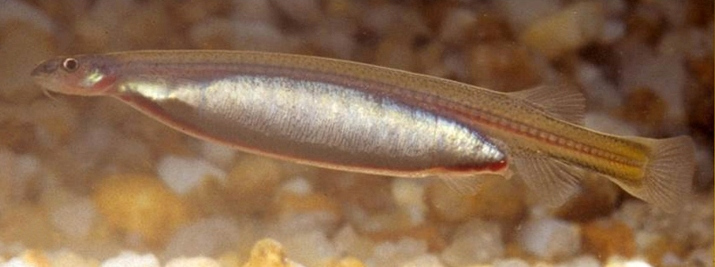
Paracanthopoma parva has no English name on record in the checklists used here. It is a species of fish in the family Trichomycteridae (pencil catfish), order Siluriformes. The name dates from 1935.
- Scientific name
- Paracanthopoma parva Giltay, 1935
- Genus
- Paracanthopoma
- Family
- Trichomycteridae (Pencil Catfish)
- Order
- Siluriformes
- Class
- Teleostei
- Environment
- freshwater
- Recorded in
- 5 countries
- Name status
- accepted in the Catalogue of Life
Overview
Paracanthopoma parva is endemic to Brazil and occurs in the Amazon and Essequibo River basins. It has been observed riding on the gills of a giant catfish.
Written 27 November 2026 from the sources listed below. Each statement was checked against the passage it cites; statements that could not be supported were removed.
Habitat
Paracanthopoma parva has been recorded attached to the gills of the giant catfish Brachyplatystoma vaillantii.[1]
Behaviour
Paracanthopoma parva has been observed riding on the gills of a giant catfish. Riding on a large host provides dispersal opportunities, access to feeding hosts, and protection from predators.[2][3]
Classification of Paracanthopoma parva
| Kingdom | Animalia |
|---|---|
| Phylum | Chordata |
| Subphylum | Vertebrata |
| Infraphylum | Gnathostomata |
| Parvphylum | Osteichthyes |
| Gigaclass | Actinopterygii |
| Superclass | Actinopteri |
| Class | Teleostei (Teleost) |
| Order | Siluriformes (Catfish) |
| Family | Trichomycteridae (Pencil Catfish) |
| Subfamily | Vandelliinae |
| Genus | Paracanthopoma |
| Species | Paracanthopoma parva Giltay, 1935 |
Where Paracanthopoma parva is found
Checklists and occurrence records place Paracanthopoma parva in 5 countries. GBIF holds 119 georeferenced records of it.
Countries
Regions and cities with the most records
- Mato Grosso, Brazil 21
- Amazonas, Brazil 16
- Pará, Brazil 11
- Roraima, Brazil 10
- Rondônia, Brazil 8
- Meta Department, Colombia 6
- Amazonas, Venezuela 4
- Apuí, Brazil 4
- Rio Preto da Eva, Brazil 4
- Vichada Department, Colombia 4
- Caracaraí, Brazil 3
- Puerto Carreño, Colombia 3
A number beside a place is its count of GBIF occurrence records. A place without a number comes from a checklist alone. Records show where a species has been observed or collected, which can include escapes and vagrants.
Common names
Names in 1 other language
- Czech
- kandiru malý
Related species
- Paracanthopoma cangussu
- Paracanthopoma jiparanaensis
- Paracanthopoma saci
- Paracanthopoma ventuarensis
-
 CandiruVandellia cirrhosa
-
 GreasefishRhizosomichthys totae
-
 Trichomycterus rivulatus
-
 Trichogenes claviger
Compare
Questions and answers
How large does Paracanthopoma parva grow?
It reaches approximately 2.7 centimetres in standard length.[4]
Where does Paracanthopoma parva occur?
It is endemic to Brazil and occurs in the Amazon and Essequibo River basins.[5]
Which host has Paracanthopoma parva been recorded riding on?
It has been recorded attached to the gills of the giant catfish Brachyplatystoma vaillantii.[1]
What benefits does riding on a large host provide?
It provides dispersal opportunities, access to feeding hosts, and protection from predators.[3]
Sources
Passages the profile rests on
- Paracanthopoma parva has been recorded attached to the gills of the giant catfish Brachyplatystoma vaillantii. Source passage: “Paracanthopoma parva has been found on the gills of another species of giant catfish, Brachyplatystoma vaillantii.” — English Wikipedia
- Paracanthopoma parva has been observed riding on the gills of a giant catfish. Source passage: “Paracanthopoma parva has been found on the gills of another species of giant catfish, Brachyplatystoma vaillantii.” — English Wikipedia
- Riding on a large host provides Paracanthopoma parva with dispersal opportunities, access to feeding hosts, and protection from predators. Source passage: “Riding on a giant host is advantageous for dispersal, no need to search for hosts to feed, and protection from predators.” — English Wikipedia
- Paracanthopoma parva reaches approximately 2.7 centimetres in standard length. Source passage: “P. parva grows to about 2.7 centimetres (1.1 in) SL” — English Wikipedia
- Paracanthopoma parva is endemic to Brazil and occurs in the Amazon and Essequibo River basins. Source passage: “P. parva grows to about 2.7 centimetres (1.1 in) SL and is endemic to Brazil where it occurs in the Amazon and Essequibo River basins.” — English Wikipedia
Data
- Catalogue of Life, 2026-10-16 XR cc by
- Global Biodiversity Information Facility CC BY 4.0
- Wikidata CC0
- GeoNames CC BY 4.0
- Within the Catalogue of Life, this name comes from World Register of Marine Species cc by
References
- Giltay, L. (1935). Notes ichthyologiques. X.--Description d’une espèce nouvelle de Trichomycteridae. Bulletin Du Musée Royal d’Histoire Naturelle de Belgique, 11 (27): 1–3. where the name was published
This species in other databases
- Catalogue of Life 4CNKD
- Wikidata Q3132508
- iNaturalist 621711
- WoRMS urn:lsid:marinespecies.org:taxname:1015255
- ITIS 682145
Page built on 28 November 2026. See how the catalog is made and all sources and licences.
Cite this page
ScientificNames.org. (2026). Paracanthopoma parva. Retrieved November 28, 2026, from https://scientificnames.org/species/paracanthopoma-parva
“Paracanthopoma parva.” ScientificNames.org, 2026, scientificnames.org/species/paracanthopoma-parva. Accessed 28 Nov. 2026.
ScientificNames.org. “Paracanthopoma parva.” Accessed November 28, 2026. https://scientificnames.org/species/paracanthopoma-parva.
@misc{scientificnames_paracanthopoma_parva,
  author = {{ScientificNames.org}},
  title = {Paracanthopoma parva},
  year = {2026},
  url = {https://scientificnames.org/species/paracanthopoma-parva},
  note = {Accessed 2026-11-28}
}