Species · Birds
Greater Bird-of-paradise Paradisaea apoda
The scientific name of the Greater Bird-of-paradise is Paradisaea apoda. It is a species of bird in the family Paradisaeidae (bird-of-paradise), order Passeriformes. The name dates from 1758.
- Scientific name
- Paradisaea apoda Linnaeus, 1758
- Common name
- Greater Bird-of-paradise
- Genus
- Paradisaea
- Family
- Paradisaeidae (Bird-of-paradise)
- Order
- Passeriformes
- Class
- Aves
- Red List category
- LC Least Concern
- Recorded in
- 3 countries
- Name status
- accepted in the Catalogue of Life

Overview
Paradisaea apoda occurs in southwest New Guinea and the Aru Islands of Indonesia. Males have predominantly maroon-brown plumage, an iridescent-green face and abundant yellow tail feathers used in courtship displays.
Written 26 November 2026 from the sources listed below. Each statement was checked against the passage it cites; statements that could not be supported were removed.
Appearance
The male has predominantly maroon-brown body plumage, an iridescent-green face, and an iridescent yellow-and-silver crown, head and nape. Its flank plumes are yellow at their bases and become white with maroon-red streaks.[1][2][3]
The male has a black breast and white and yellow plumes that it raises above its back during display. It also has abundant yellow tail feathers used in courtship displays.[4][5]
The female has unbarred maroon-brown plumage. Both sexes have yellow irises and blue bills.[6][7]
The male measures up to 43 cm long, excluding its elongated twin tail-wires, while the female measures approximately 35 cm long. The Greater Bird-of-paradise is the largest species in the genus Paradisaea.[8][9][10]
Habitat
The Greater Bird-of-paradise inhabits lowland and foothill forests, including lowland and hill forests.[11][12]
Diet
The species feeds mainly on fruits, seeds and small insects. Its diet includes tree fruits and arthropods, including fruits from certain mahogany and nutmeg trees.[13][14][15]
Behaviour
Individuals become active and forage before sunrise. Foraging birds produce loud wawk and wok calls throughout the forest.[16][17]
Females sometimes forage alongside other birds-of-paradise and unrelated bird species.[18]
Males congregate in leks to display to females. During the first main display pose, they raise their rump plumes over their backs and extend their wings.[19][20]
During one courtship pose, males depress their bodies close to branches and prance or charge along them. They assume a posture called the flower position when females are present.[21][22]
Male courtship displays can include wiping their bills against branches, tearing leaves and hanging upside down from branches. Males use eight variations of calls during courtship rituals.[23][24][25]
During mating seasons, males spend most of their time at their display grounds. They begin calling before sunrise and stop shortly after sunset, feeding briefly and infrequently.[26][27][28]
Reproduction and life cycle
The species has a polygynous mating system. Females select mates based on indirect genetic benefits that increase offspring fitness.[29][30]
Courtship and mating activity occurs most commonly from March through May and from August through December. Males do not provide parental care to offspring.[31][32]
Conservation
The Greater Bird-of-paradise is classified as Least Concern on the IUCN Red List and is listed in Appendix II of CITES. Its large geographical range does not meet the Vulnerable threshold under the range-size criterion.[33][34][35]
Uses
The species appears on various coins and banknotes of the Trinidad and Tobago dollar.[36]
Classification of the Greater Bird-of-paradise
| Kingdom | Animalia |
|---|---|
| Phylum | Chordata |
| Subphylum | Vertebrata |
| Infraphylum | Gnathostomata |
| Parvphylum | Osteichthyes |
| Megaclass | Tetrapoda |
| Class | Aves (Bird) |
| Order | Passeriformes (Passerine) |
| Family | Paradisaeidae (Bird-of-paradise) |
| Genus | Paradisaea (Paradisaeas) |
| Species | Paradisaea apoda Linnaeus, 1758 |
Where the Greater Bird-of-paradise is found
Checklists and occurrence records place Paradisaea apoda in 3 countries across Oceania. GBIF holds 1,421 georeferenced records of it.
Countries
Regions and cities with the most records
- Western Province, Papua New Guinea 822
- Papua, Indonesia 106
- Maluku, Indonesia 95
- Morobe Province, Papua New Guinea 25
- Bulolo, Papua New Guinea 22
- Central Province, Papua New Guinea 5
- Dobo, Indonesia 4
- Hela Province, Papua New Guinea 4
- Western Highlands Province, Papua New Guinea 4
- National Capital, Papua New Guinea 3
- Port Moresby, Papua New Guinea 3
1 more country has a few records outside this range
These countries hold a few records of Paradisaea apoda but lie outside the range the checklists give for it. Such records are often zoo or garden specimens, museum material or vagrants, so the species is not counted as occurring there.
Range as the checklists state it
Australia
A number beside a place is its count of GBIF occurrence records. A place without a number comes from a checklist alone. Records show where a species has been observed or collected, which can include escapes and vagrants.
Common names
English
- Greater Bird-of-paradise
Names in 32 other languages
- Arabic
- طائر الجنة الكبير
- Bulgarian
- Голяма райска птица
- Catalan
- ocell del paradís cuablanc gros
- Chinese
- 大天堂鳥, 大极乐鸟
- Croatian
- smeđoleđa rajska ptica
- Czech
- rajka velká
- Danish
- Stor Paradisfugl
- Dutch
- Grote Paradijsvogel
- Esperanto
- granda paradizeo
- Estonian
- pruun-paradiisilind, suur-paradiisilind
- Finnish
- isoparatiisilintu
- French
- Paradisier grand-émeraude
- German
- Großer Paradiesvogel, Großparadiesvogel, Göttervogel
- Hungarian
- nagy paradicsommadár
- Indonesian
- Cenderawasih kuning-besar, Cendrawasih besar
- Italian
- Paradisea maggiore, Uccello del paradiso maggiore
- Japanese
- オオフウチョウ
- Lithuanian
- didysis rojaus paukštis
- Norwegian
- slørparadisfugl
- Polish
- cudowronka wielka
- Portuguese
- ave-do-paraíso-grande
- Russian
- Большая райская птица
- Serbian
- Velika rajska ptica
- Slovak
- rajka svadobná
- Spanish
- Ave del paraíso esmeralda grande, Ave-del-paraíso Esmeralda Grande
- Swedish
- större paradisfågel
- Thai
- นกปักษาสวรรค์ใหญ่
- Turkish
- Büyük Cennetkuşu
- Ukrainian
- дивоптах великий
- Vietnamese
- Chim thiên đường lớn
- Welsh
- aderyn paradwys mawr
- pnb
- وڈا جنتی
Synonyms
3 other scientific names have been used for this species and are now treated as synonyms of Paradisaea apoda.
- Paradisaea apoda apoda Linnaeus, 1758
- Paradisaea apoda novaeguineae d'Albertis & Salvadori, 1879
- Paradisea apoda Linnaeus, C, 1776
Related species
-
 Raggiana Bird-of-paradiseParadisaea raggiana
-
 Red Bird-of-paradiseParadisaea rubra
-
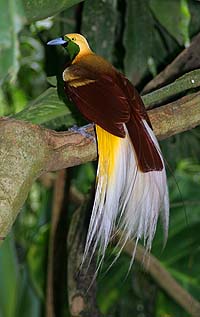 Lesser Bird-of-paradiseParadisaea minor
-
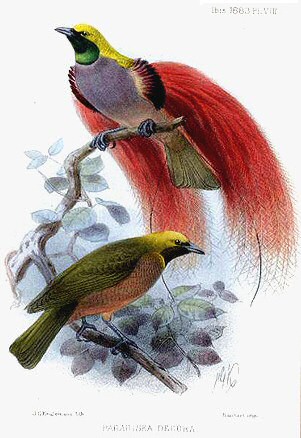 Goldie's Bird-of-paradiseParadisaea decora
-
 Emperor Bird-of-paradiseParadisaea guilielmi
-
 Wilson's Bird-of-paradiseDiphyllodes respublica
-
 Vogelkop LophorinaLophorina superba
-
 Greater LophorinaLophorina latipennis
Compare
Questions and answers
What is the scientific name of the Greater Bird-of-paradise?
The scientific name of the Greater Bird-of-paradise is Paradisaea apoda. Written with its author, the full name is Paradisaea apoda Linnaeus, 1758.
Which family does the Greater Bird-of-paradise belong to?
Paradisaea apoda belongs to the family Paradisaeidae, in the order Passeriformes and the class Aves.
Where is the Greater Bird-of-paradise found?
Checklists and occurrence records place Paradisaea apoda in 3 countries: Papua New Guinea, Indonesia and Australia.
What is the conservation status of the Greater Bird-of-paradise?
The IUCN Red List category recorded for Paradisaea apoda is Least Concern (LC).
What is the largest bird of paradise?
The Greater Bird-of-paradise is the largest species in the genus Paradisaea.[10]
Sources
Passages the profile rests on
- The male has predominantly maroon-brown body plumage. Source passage: “the rest of the body plumage is largely maroon-brown.” — English Wikipedia
- The male has an iridescent-green face and an iridescent yellow-and-silver crown, head and nape. Source passage: “The male birds also have an iridescent-green face, with an equally iridescent yellow-and-silver crown, head, and nape” — English Wikipedia
- The male's flank plumes are yellow at their bases and become white with maroon-red streaks. Source passage: “The flank plumes are yellow at the base but turn white, streaked with maroon-red.” — English Wikipedia
- The male has abundant yellow tail feathers used in courtship displays. Source passage: “with a notable profusion of yellow tail feathers which are used in courtship displays.” — English Wikipedia
- The male has a black breast and white and yellow plumes that he raises above his back during display. Source passage: “Male has a black breast and white and yellow plumes which he raises above his back during his display,” — ebird.org
- The female has unbarred maroon-brown plumage. Source passage: “The female has unbarred, though still richly-hued, maroon-brown plumage” — English Wikipedia
- Both sexes have yellow irises and blue bills. Source passage: “In both sexes, the iris is yellow and the bill is blue.” — English Wikipedia
- The male measures up to 43 cm long, excluding its elongated twin tail-wires. Source passage: “The males measure up to 43 cm (17 in), excluding the long, twin tail-wires.” — English Wikipedia
- The female measures approximately 35 cm long. Source passage: “The female is smaller, at roughly 35 cm (14 in).” — English Wikipedia
- The greater bird-of-paradise is the largest species in the genus Paradisaea. Source passage: “The greater bird-of-paradise is the largest member of the genus Paradisaea” — English Wikipedia
- The species inhabits lowland and foothill forests. Source passage: “A large bird of lowland and foothill forest and edge.” — ebird.org
- The species occurs in lowland and hill forests. Source passage: “distributed to lowland and hill forests” — English Wikipedia
- The species feeds mainly on fruits, seeds and small insects. Source passage: “The diet consists mainly of fruits, seeds, and small insects.” — English Wikipedia
- Its diet includes tree fruits and arthropods. Source passage: “being highly fond of tree fruits and arthropods” — English Wikipedia
- The species consumes fruits from certain mahogany and nutmeg trees. Source passage: “their consumption of specific fruits, such as those of certain mahogany (Swietenia sp) and nutmeg (Myristica sp) trees” — English Wikipedia
- Individuals become active and forage before sunrise. Source passage: “the birds become active and forage in the pre-dawn hours before sunrise” — English Wikipedia
- Foraging birds produce loud wawk and wok calls throughout the forest. Source passage: “when their loud wawk-wawk, wǒk-wǒk-wǒk cries resound throughout the forest” — English Wikipedia
- Females sometimes forage alongside other birds-of-paradise and unrelated bird species. Source passage: “The females are often found foraging in association with other bird-of-paradise species, and even other unrelated avian species.” — English Wikipedia
- Males congregate in leks to display to females. Source passage: “Males display in trees above the ground and congregate in a lek or "court" versus individually displaying for females.” — English Wikipedia
- Males raise their rump plumes over their backs and extend their wings during the first main display pose. Source passage: “erecting their large plumes at their rumps over their backs and extending their wings (Pose 1).” — English Wikipedia
- During one courtship pose, males depress their bodies close to branches and prance or charge along them. Source passage: “They subsequently depress their bodies close to the branches that they are on, retract their wings, leave their tail plumes erected, and prance or charge along their branch (Pose 2).” — English Wikipedia
- Males assume a display posture called the flower position when females are present. Source passage: “Males will assume this last position, referred to as the "flower position" when females are present” — English Wikipedia
- Male courtship displays can include wiping their bills against branches and tearing leaves. Source passage: “Other courtship behaviors outside of the physical dance can consist of bill-wiping” — English Wikipedia
- Male courtship displays include hanging upside down from branches. Source passage: “as well as leaf-tearing, hanging upside down from the branch, and vocalizations.” — English Wikipedia
- Males use eight variations of calls during courtship rituals. Source passage: “Males use eight variations of calls, commonly referred to as "wauks" within courtship rituals” — English Wikipedia
- Males spend most of their time at their display grounds during mating seasons. Source passage: “Males spend the majority of their time during mating seasons at their respective display grounds.” — English Wikipedia
- Males begin calling before sunrise and stop shortly after sunset. Source passage: “They begin calling before sunrise and cease shortly after sunset.” — English Wikipedia
- Males feed briefly and infrequently during mating seasons. Source passage: “They feed very briefly and infrequently” — English Wikipedia
- The species has a polygynous mating system. Source passage: “Male greater birds-of-paradise, as polygynous breeders” — English Wikipedia
- Females select mates based on indirect genetic benefits that increase offspring fitness. Source passage: “females choose male mates based upon indirect genetic benefits which increase offspring fitness.” — English Wikipedia
- Males do not provide parental care to offspring. Source passage: “Since males do not contribute to offspring in any other way (i.e. through parental care)” — English Wikipedia
- Courtship and mating activity occurs most commonly from March through May and from August through December. Source passage: “This mating behavior most commonly occurs between March and May, and again August through December” — English Wikipedia
- The species is classified as Least Concern on the IUCN Red List. Source passage: “the greater bird-of-paradise is evaluated as Least Concern on the IUCN Red List of Threatened Species.” — English Wikipedia
- The species is listed in Appendix II of CITES. Source passage: “It is listed in Appendix II of CITES.” — English Wikipedia
- The species has a large geographical range that does not meet the Vulnerable threshold under the range-size criterion. Source passage: “This species has a large range, and hence does not approach the thresholds for Vulnerable under the range size criterion” — datazone.birdlife.org
- The species appears on various coins and banknotes of the Trinidad and Tobago dollar. Source passage: “The bird still appears on various coins and banknotes of the Trinidad and Tobago dollar” — English Wikipedia
- The species occurs in southwest New Guinea and the Aru Islands of Indonesia. Source passage: “of southwest New Guinea and Aru Islands, Indonesia.” — English Wikipedia
- Its New Guinea distribution includes the southern lowlands from Timika east to the Fly and Strickland Rivers drainages. Source passage: “southern lowlands from Timika east to Fly and Strickland Rivers drainages.” — australian.museum
Data
- Catalogue of Life, 2026-10-16 XR cc by
- Global Biodiversity Information Facility CC BY 4.0
- Wikidata CC0
- GeoNames CC BY 4.0
- Wikimedia Commons per image; credit shown with each image
- Within the Catalogue of Life, this name comes from The Integrated Taxonomic Information System cc0
References
- Linnaeus, & Carolus. (1758). Systema Naturae per Regna Tria Naturae, Secundum Classes, Ordines, Genera, Species, Cum Characteribus, Differentiis, Synonymis, Locis, 10th Edition, Vol. 1. where the name was published
- Dickinson, Edward C., ed. (2003). The Howard and Moore Complete Checklist of the Birds of the World, 3rd Edition.
- Gill, Frank, & and Minturn Wright. (2006). Birds of the World: Recommended English Names.
This species in other databases
Page built on 27 November 2026. See how the catalog is made and all sources and licences.
Cite this page
ScientificNames.org. (2026). Paradisaea apoda (Greater Bird-of-paradise). Retrieved November 27, 2026, from https://scientificnames.org/species/paradisaea-apoda
“Paradisaea apoda (Greater Bird-of-paradise).” ScientificNames.org, 2026, scientificnames.org/species/paradisaea-apoda. Accessed 27 Nov. 2026.
ScientificNames.org. “Paradisaea apoda (Greater Bird-of-paradise).” Accessed November 27, 2026. https://scientificnames.org/species/paradisaea-apoda.
@misc{scientificnames_paradisaea_apoda_greater_bird_of_paradise,
  author = {{ScientificNames.org}},
  title = {Paradisaea apoda (Greater Bird-of-paradise)},
  year = {2026},
  url = {https://scientificnames.org/species/paradisaea-apoda},
  note = {Accessed 2026-11-27}
}