Species · Crustaceans
Red King Crab Paralithodes camtschaticus
The scientific name of the Red King Crab is Paralithodes camtschaticus. It is a species of crustacean in the family Lithodidae (king crab), order Decapoda. The name dates from 1815.
- Scientific name
- Paralithodes camtschaticus (Tilesius, 1815)
- Common name
- Red King Crab
- Genus
- Paralithodes
- Family
- Lithodidae (King Crab)
- Order
- Decapoda
- Class
- Malacostraca
- Environment
- marine
- Recorded in
- 5 countries
- Name status
- accepted in the Catalogue of Life

Overview
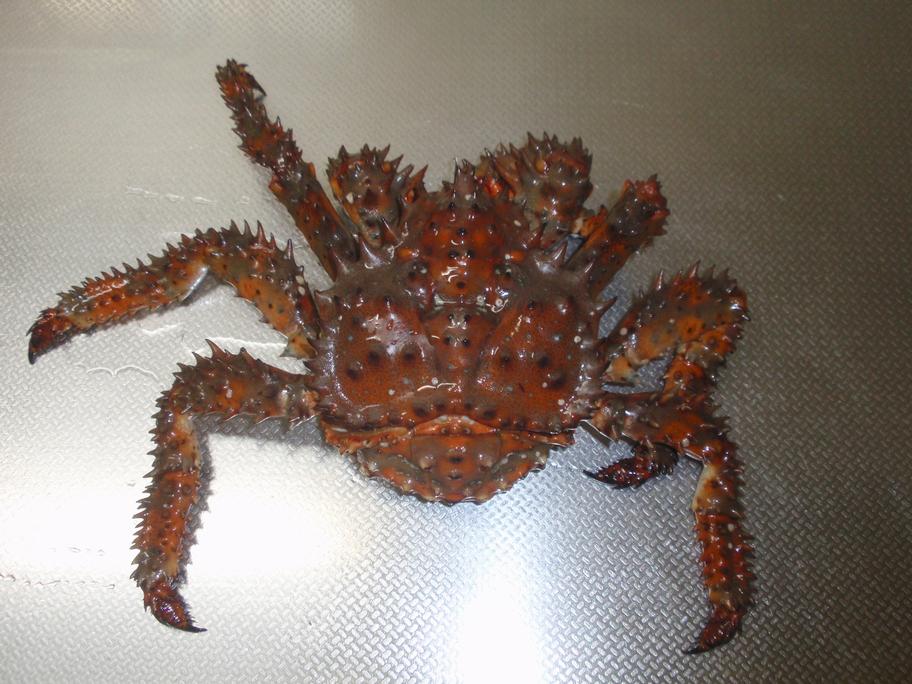
Paralithodes camtschaticus inhabits the North Pacific, from the Bering Sea to the Gulf of Alaska, and has also been introduced into the Barents Sea. Living individuals typically have a dark red or burgundy body, and the species can attain a leg span of 1.8 m.
Written 24 November 2026 from the sources listed below. Each statement was checked against the passage it cites; statements that could not be supported were removed.
Appearance
Living individuals typically have a dark red or burgundy body. The abdomen is fan-shaped and tucked beneath the rear of the carapace.[1][2]
The Red King Crab has five pairs of legs: one pair bearing claws, three pairs of walking legs, and a small fifth pair normally tucked beneath the carapace. Adult males generally have a larger right claw than left claw.[3][4]
Males have a narrow abdominal flap, whereas females have a wide flap covering most of the underside of the abdomen. The carapace can reach 28 cm in width.[5][6]
Habitat
Adults inhabit sandy and muddy seabed substrates at depths commonly exceeding 200 metres. They occupy both intertidal habitats and offshore waters deeper than 200 metres.[7][8]
Newly hatched larvae occupy shallow waters where food and protection are plentiful. Juveniles settle on the ocean bottom in waters less than 90 feet deep.[9][10]
The species occurs across water temperatures ranging from -1.8 to 12.8 °C.[11]
Diet
Larvae feed on plankton. Adults are generalized carnivores that consume various animals, including fish remains.[12][13]
In the Barents Sea, the species has been reported to consume capelin egg masses. It can also consume other king crabs.[14][15]
Behaviour
Individuals generally form concentrated groups called pods after reaching approximately two years of age. Juveniles between one and four years old form groups containing as many as 500,000 individuals.[16][17]
Juvenile pods disperse for feeding. Adults migrate annually between shallow coastal waters and deeper offshore feeding grounds.[18][19]
Adult males and females tend to segregate by sex in deeper waters away from mating and molting grounds. Adult males in the Kodiak area have been documented migrating up to 100 miles round-trip annually.[20][21]
Reproduction and life cycle
Females mate once annually, while males may mate multiple times each spring. Females must molt before mating, whereas adult males do not need to molt to mate.[22][23]
Females attach fertilized eggs to their pleopods beneath the abdomen and brood thousands of embryos beneath their abdominal flap for approximately one year.[24][25]
Larvae hatch as free-swimming forms after embryonic development is complete. They undergo five molts during their first three to four months.[26][27]
Females begin incubating another group of eggs within days of hatching.[28]
Conservation
The native Far Eastern coastal population has experienced a steady decline for reasons that remain unclear. Fishing controls introduced by the United States during the 1980s and 2000s have not stopped the population decline described.[29][30]
The Pribilof Islands red king crab fishery has been closed since 1999 because of low stock abundance and concerns about blue king crab bycatch. The Kodiak, Alaska Peninsula, Cook Inlet, and Prince William Sound red king crab fisheries are closed because of low abundance.[31][32]
Uses
Red king crab was historically Alaska's most commercially important shellfish species. Between 1975 and 2018, U.S. crabbers harvested nearly 854 million pounds of red king crab from Alaska waters.[33][34]
The species provides a source of dietary protein. Its hepatopancreas contains enzymes of potential industrial value.[35][36]
Similar species
The Red King Crab is closely related to the blue king crab (Paralithodes platypus) and the golden or brown king crab (Lithodes aequispinus).[37][38]
Classification of the Red King Crab
| Kingdom | Animalia |
|---|---|
| Phylum | Arthropoda |
| Subphylum | Crustacea |
| Class | Malacostraca |
| Order | Decapoda |
| Suborder | Pleocyemata |
| Infraorder | Anomura |
| Superfamily | Lithodoidea (King Crabs) |
| Family | Lithodidae (King Crab) |
| Genus | Paralithodes |
| Species | Paralithodes camtschaticus (Tilesius, 1815) |
Where the Red King Crab is found
Checklists and occurrence records place Paralithodes camtschaticus in 5 countries. GBIF holds 9,428 georeferenced records of it.
Countries
Regions and cities with the most records
- Finnmark, Norway 205
- Alaska, United States 44
- Troms, Norway 19
- Murmansk, Russia 11
- Primorye, Russia 3
1 more country has a few records outside this range
These countries hold a few records of Paralithodes camtschaticus but lie outside the range the checklists give for it. Such records are often zoo or garden specimens, museum material or vagrants, so the species is not counted as occurring there.
Range as the checklists state it
East Pacific
A number beside a place is its count of GBIF occurrence records. A place without a number comes from a checklist alone. Records show where a species has been observed or collected, which can include escapes and vagrants.
Common names
English
- Red King Crab
- Alaskan King Crab
- Alaskan King Stone Crab
- Japanese Crab
- Kamchatka Crab
- Russian Crab
- King Crab
Names in 16 other languages
- Asturian
- cámbaru de Kamchatka
- Chinese
- 堪察加擬石蟹
- Czech
- krab kamčatský
- Dutch
- Kamtsjatkakrab, Rode koningskrab
- Estonian
- Kamtšatka ebakrabi
- French
- crabe royal du Kamtchatka
- German
- Alaska-Königskrabbe, Kamschatka-Krabbe, Kamtschatkakrabbe, Königskrabbe
- Italian
- Granchio gigante, Granchio reale rosso, Granchio trottatore, Re granchio rosso
- Japanese
- タラバガニ
- Korean
- 왕게
- Lithuanian
- Kamčiatkinis karališkasis krabas
- Norwegian Bokmål
- kongekrabbe
- Polish
- czerwony krab królewski
- Russian
- Камчатский краб
- Spanish
- Cangrejo rey, Centolla de Alaska (Cangrejo rey rojo)
- Swedish
- kamtjatkakrabba, kungskrabba
Synonyms
6 other scientific names have been used for this species and are now treated as synonyms of Paralithodes camtschaticus.
- Lithodes japonica von Siebold, 1824
- Lithodes japonicus De Haan, 1849
- Lithodes spinosissimus Brandt, 1848
- Maja camtschatica Tilesius, 1815
- Paralithodes camtschatica (Tilesius, 1815)
- Paralithodes rostrofalcatus MacKay, 1932
Related species
-
 Blue King CrabParalithodes platypus
-
 Brown King CrabParalithodes brevipes
- California King CrabParalithodes californiensis
- Spiny King CrabParalithodes rathbuni
- Paralithodes bishuensis
-
 Southern King CrabLithodes santolla
-
 Norway King CrabLithodes maja
-
 Golden King CrabLithodes aequispinus
Compare
Questions and answers
What is the scientific name of the Red King Crab?
The scientific name of the Red King Crab is Paralithodes camtschaticus. Written with its author, the full name is Paralithodes camtschaticus (Tilesius, 1815).
Which family does the Red King Crab belong to?
Paralithodes camtschaticus belongs to the family Lithodidae, in the order Decapoda and the class Malacostraca.
Where is the Red King Crab found?
Checklists and occurrence records place Paralithodes camtschaticus in 5 countries: Norway, United States, Russia, Canada and Denmark.
What other names does the Red King Crab have?
Paralithodes camtschaticus is also known in English as Alaskan King Crab, Alaskan King Stone Crab, Japanese Crab, Kamchatka Crab, Russian Crab and King Crab.
What makes a red king crab different?
Living individuals typically have a dark red or burgundy body. The species has five pairs of legs, including a small fifth pair normally tucked beneath the carapace.[1][3]
What does the red king crab eat?
Larvae feed on plankton, while adults are generalized carnivores that consume various animals, including fish remains. The species can also consume capelin egg masses and other king crabs.[12][13][14][15]
What is the diet of a crab?
Red King Crab larvae feed on plankton. Adults consume various animals, including fish remains, capelin egg masses, and other king crabs.[12][13][14][15]
What is a crab's natural habitat?
Adult Red King Crabs inhabit sandy and muddy seabed substrates, including intertidal habitats and offshore waters deeper than 200 metres. Newly hatched larvae occupy shallow waters, while juveniles settle on the ocean bottom in waters less than 90 feet deep.[7][9][10][8]
Sources
Passages the profile rests on
- Living individuals typically have a dark red or burgundy body. Source passage: “Red king crabs (Paralithodes camtschaticus) are a species of large crab that appear dark red or burgundy in color.” — adfg.alaska.gov
- The abdomen is fan-shaped and tucked beneath the rear of the carapace. Source passage: “Red king crabs have "tails," or abdomens, that are distinctive, being fan-shaped and tucked underneath the rear of the shell.” — adfg.alaska.gov
- The species has five pairs of legs, including one pair bearing claws, three pairs of walking legs, and a small fifth pair normally tucked beneath the carapace. Source passage: “They also have five pairs of legs; the first bears their claws or pincers, the right claw is usually the largest on the adults, the next three pairs are their walking legs, and the fifth pair of legs are small and normally tucked underneath the rear portion of their carapace.” — adfg.alaska.gov
- Adult males generally have a larger right claw than left claw. Source passage: “King crabs have 5 sets of appendages, the first two are pincers, the right is usually larger then the left.” — animaldiversity.org
- Males have a narrow abdominal flap, whereas females have a wide flap covering most of the underside of the abdomen. Source passage: “Male red king crabs have a narrow abdominal flap whereas female red king crabs have a wide abdominal flap that covers most of the underside of the abdomen.” — adfg.alaska.gov
- The carapace can reach 28 cm in width. Source passage: “Red king crabs can reach a carapace width up to 28 cm (11 in)” — English Wikipedia
- Adults inhabit sandy and muddy seabed substrates at depths commonly exceeding 200 metres. Source passage: “Adult crabs are found usually more than 200 metres (656 ft) down on the sand and muddy areas in the substrate.” — English Wikipedia
- Adults occupy both intertidal habitats and offshore waters deeper than 200 metres. Source passage: “Adults are found in the intertidal zone at depths of more than 200 m in the preferred sand and mud substrates.” — animaldiversity.org
- Newly hatched larvae occupy shallow waters where food and protection are plentiful. Source passage: “newly hatched crab (zoea larvae) stay in the shallower waters where food and protection are plentiful.” — English Wikipedia
- Juveniles settle on the ocean bottom in waters less than 90 feet deep. Source passage: “Red king crabs settle in waters less than 90 feet deep.” — adfg.alaska.gov
- The species occurs across water temperatures ranging from -1.8 to 12.8 °C. Source passage: “Red king crabs have been seen in water temperatures that range from −1.8 to 12.8 °C (28.8–55.0 °F)” — English Wikipedia
- Larvae feed on plankton. Source passage: “Larval P. camtschatica are planktivores.” — animaldiversity.org
- Adults are generalized carnivores that consume various animals, including fish remains. Source passage: “The adult form feeds on many different animals including some fish parts and are generalized carnivore.” — animaldiversity.org
- In the Barents Sea, the species has been reported to consume capelin egg masses. Source passage: “some evidence indicates that the red king crabs eat the egg masses of the capelin” — English Wikipedia
- The species can consume other king crabs. Source passage: “king crabs (they can be cannibalistic)” — adfg.alaska.gov
- Individuals generally form concentrated groups called pods after reaching approximately two years of age. Source passage: “Usually, after the age of two, the crabs move down to depths of 20–50 m (66–164 ft) and take part in what is known as podding; hundreds of crabs come together in tight, highly concentrated groups.” — English Wikipedia
- Juveniles between one and four years old form groups containing as many as 500,000 individuals. Source passage: “From the ages of 1 to 4 Alaskan king crabs form clusters of up to 500,000 individuals called pods.” — animaldiversity.org
- Juvenile pods disperse for feeding. Source passage: “The pods disperse only for feeding.” — animaldiversity.org
- Adults migrate annually between shallow coastal waters and deeper offshore feeding grounds. Source passage: “Adult red king crabs exhibit near shore to offshore (or shallow to deep) and back, annual migrations.” — adfg.alaska.gov
- Adult males and females tend to segregate by sex in deeper waters away from mating and molting grounds. Source passage: “Adult crabs tend to segregate by sex off the mating-molting grounds.” — adfg.alaska.gov
- Adult males in the Kodiak area have been documented migrating up to 100 miles round-trip annually. Source passage: “Adult male red king crabs in the Kodiak area have been known to migrate up to 100 miles round-trip annually” — adfg.alaska.gov
- Females mate once annually, while males may mate multiple times each spring. Source passage: “Females mate once a year while males may mate multiple times each spring.” — animaldiversity.org
- Females must molt before mating, whereas adult males do not need to molt to mate. Source passage: “Adult females must molt in order to mate but males do not.” — adfg.alaska.gov
- Females brood thousands of fertilized embryos beneath their abdominal flap for approximately one year. Source passage: “Adult females brood thousands of embryos underneath their tail flap for about a year's time.” — adfg.alaska.gov
- Females attach fertilized eggs to their pleopods beneath the abdomen. Source passage: “These fertilized eggs are attached by the female to her pleopods under the abdomen” — animaldiversity.org
- Larvae hatch as free-swimming forms after embryonic development is complete. Source passage: “When the embryos are fully developed they hatch as swimming larvae” — adfg.alaska.gov
- Larvae undergo five molts during their first three to four months. Source passage: “During 3 to 4 months, the zoea molt 5 times.” — animaldiversity.org
- Females begin incubating another group of eggs within days of hatching. Source passage: “Within days of hatching, the female begins incubating next group of eggs.” — animaldiversity.org
- The native Far Eastern coastal population has experienced a steady decline for reasons that remain unclear. Source passage: “Red king crabs are experiencing a steady decline in numbers in their native far east coastal waters for unclear reasons” — English Wikipedia
- Fishing controls introduced by the United States during the 1980s and 2000s have not stopped the population decline described in the source. Source passage: “Fishing controls set by the United States in the 1980s and 2000s have failed to stem the decline.” — English Wikipedia
- The Pribilof Islands red king crab fishery has been closed since 1999 because of low stock abundance and concerns about blue king crab bycatch. Source passage: “The Pribilof Islands red king crab fishery has been closed since 1999 due to a relatively low stock abundance, low precision of the abundance estimate and to avoid bycatch of the depleted Pribilof Islands blue king crab” — adfg.alaska.gov
- The Kodiak, Alaska Peninsula, Cook Inlet, and Prince William Sound red king crab fisheries are closed because of low abundance. Source passage: “The red king crab fisheries in Kodiak, the Alaska Peninsula, Cook Inlet, and Prince William Sound areas are closed due to low abundance.” — adfg.alaska.gov
- Red king crab was historically Alaska's most commercially important shellfish species. Source passage: “Red king crabs were historically the most commercially important shellfish species in Alaska.” — adfg.alaska.gov
- Between 1975 and 2018, U.S. crabbers harvested nearly 854 million pounds of red king crab from Alaska waters. Source passage: “Between 1975 and 2018, U.S. crabbers harvested nearly 854 million pounds of red king crab” — adfg.alaska.gov
- The species provides a source of dietary protein. Source passage: “Red king crabs can provide many dietary benefits including a good source of protein.” — adfg.alaska.gov
- The hepatopancreas contains enzymes of potential industrial value. Source passage: “The complex of proteolytic enzymes of the red king crab hepatopancreas is of interest in various industries.” — English Wikipedia
- The red king crab is closely related to the blue king crab (Paralithodes platypus). Source passage: “They are closely related to blue king crabs (Paralithodes platypus)” — adfg.alaska.gov
- The red king crab is closely related to the golden or brown king crab (Lithodes aequispinus). Source passage: “and golden (brown) king crabs (Lithodes aequispinus).” — adfg.alaska.gov
Data
- Catalogue of Life, 2026-10-16 XR cc by
- Global Biodiversity Information Facility CC BY 4.0
- Wikidata CC0
- GeoNames CC BY 4.0
- Wikimedia Commons per image; credit shown with each image
- Within the Catalogue of Life, this name comes from The Integrated Taxonomic Information System cc0
References
- Williams, Austin B., Lawrence G. Abele, D. L. Felder, H. H. Hobbs, Jr., R. B. Manning, et al. (1989). Common and Scientific Names of Aquatic Invertebrates from the United States and Canada: Decapod Crustaceans. American Fisheries Society Special Publication 17.
- McLaughlin, P. A., D. K. Camp, M. V. Angel, E. L. Bousfield, P. Brunel, R. C. Brusca, et al. (2005). Common and scientific names of aquatic invertebrates from the United States and Canada: Crustaceans. American Fisheries Society Special Publication 31.
- McLaughlin, Patsy A., Tomoyuki Komai, Rafael Lemaitre, and Dwi Listyo Rahayu. (2010). Annotated checklist of Anomuran decapod crustaceans of the world [...]. Part 1 - Lithodoidea, Lomisoidea and Paguroidea. Raffles Bulletin of Zoology, Supplement No. 23.
This species in other databases
- Catalogue of Life B3JCD
- Wikidata Q721171
- iNaturalist 123807
- WoRMS urn:lsid:marinespecies.org:taxname:233889
Page built on 24 November 2026. See how the catalog is made and all sources and licences.
Cite this page
ScientificNames.org. (2026). Paralithodes camtschaticus (Red King Crab). Retrieved November 24, 2026, from https://scientificnames.org/species/paralithodes-camtschaticus
“Paralithodes camtschaticus (Red King Crab).” ScientificNames.org, 2026, scientificnames.org/species/paralithodes-camtschaticus. Accessed 24 Nov. 2026.
ScientificNames.org. “Paralithodes camtschaticus (Red King Crab).” Accessed November 24, 2026. https://scientificnames.org/species/paralithodes-camtschaticus.
@misc{scientificnames_paralithodes_camtschaticus_red_king_crab,
  author = {{ScientificNames.org}},
  title = {Paralithodes camtschaticus (Red King Crab)},
  year = {2026},
  url = {https://scientificnames.org/species/paralithodes-camtschaticus},
  note = {Accessed 2026-11-24}
}