Species · Insects
Purple Copper Paralucia spinifera
The scientific name of the Purple Copper is Paralucia spinifera. It is a species of insect in the family Lycaenidae (blues), order Lepidoptera. The name dates from 1978.
- Scientific name
- Paralucia spinifera Edwards & Common, 1978
- Common name
- Purple Copper
- Genus
- Paralucia
- Family
- Lycaenidae (Blues)
- Order
- Lepidoptera
- Class
- Insecta
- Red List category
- EN Endangered
- Recorded in
- 1 country
- Name status
- accepted in the Catalogue of Life

Overview
Paralucia spinifera is endemic to Australia and is known from the Central Tablelands of New South Wales, particularly around Bathurst, Oberon and Lithgow. Its copper-coloured upper wing surfaces display purple, blue and green iridescence in sunlight.
Written 27 November 2026 from the sources listed below. Each statement was checked against the passage it cites; statements that could not be supported were removed.
Appearance
The Purple Copper has a relatively thick body and adults have a wingspan of 20–30 mm. The upper surfaces of the wings are copper-coloured and display purple, blue and green iridescence in sunlight.[1][2][3]
The undersides of the wings have brown, black and grey patterns. The butterfly has black antennae marked with white spots and ending in black tips.[4][5]
Caterpillars grow to approximately 22 mm in length and are light green with darker longitudinal markings.[6][7]
Habitat
The Purple Copper inhabits open woodland or open forest with a sparse understorey dominated by native blackthorn. Known habitat sites generally occur above 850 metres above sea level.[8][9]
The species primarily inhabits elevations above 900 metres. Its habitat commonly receives full-day sunlight and experiences regular winter snowfalls or heavy frosts.[10][11]
Known habitat sites contain native blackthorn and the attendant ant Anonychomyrma itinerans. These sites receive three to four hours of direct spring sunlight.[12][13]
Diet
The butterfly's larvae feed exclusively on the leaves of native blackthorn.[14]
Adult butterflies perch in sunlight and feed on nearby flowers.[15]
Behaviour
Adult butterflies generally fly between 10 am and 2 pm on warm, sunny days with little or no wind. Adult males fly rapidly approximately one metre above the ground.[16][17]
Male butterflies rest in sunlight with their wings parted. Females fly more slowly than males and generally remain near their host plants.[18][19]
The species exhibits territorial chasing and spiralling courtship pursuits involving multiple males pursuing one female.[20]
Caterpillars are nocturnal and feed on blackthorn leaves between 10 pm and 5 am from November to January. They are attended by between one and 15 ants.[21][22]
Attendant ants protect caterpillars from predators in exchange for sugary honeydew produced by the caterpillars.[23]
Reproduction and life cycle
Females lay their eggs on or near native blackthorn bushes. Caterpillar eggs take between 14 and 17 days to hatch.[24][25]
Pupation takes place underground inside the nests of attendant ants between December and August.[26]
Conservation
The Purple Copper is listed as endangered in New South Wales and nationally listed as vulnerable under Australia's Environment Protection and Biodiversity Conservation Act 1999. In 2021, it was identified as one of 26 Australian butterfly species at greatest risk of extinction.[27][28][29]
The number of surviving individuals is unknown. Identified threats include habitat clearing and development, weed invasion and grazing.[30][31][32]
Changes in controlled burning procedures and habitat disturbance by feral pigs are also identified threats.[33][34]
Uses
The species contributes to pollination and plays a role in food chains.[35]
Classification of the Purple Copper
| Kingdom | Animalia |
|---|---|
| Phylum | Arthropoda |
| Subphylum | Hexapoda |
| Class | Insecta (Insect) |
| Order | Lepidoptera |
| Superfamily | Papilionoidea |
| Family | Lycaenidae (Blues) |
| Subfamily | Theclinae |
| Tribe | Luciini |
| Genus | Paralucia |
| Species | Paralucia spinifera Edwards & Common, 1978 |
Where the Purple Copper is found
Checklists and occurrence records place Paralucia spinifera in 1 country. GBIF holds 1,083 georeferenced records of it.
Countries
Regions and cities with the most records
A number beside a place is its count of GBIF occurrence records. A place without a number comes from a checklist alone. Records show where a species has been observed or collected, which can include escapes and vagrants.
Common names
English
- Purple Copper
- Bathurst Copper
Related species
-
 Fiery CopperParalucia pyrodiscus
-
 Bright CopperParalucia aurifer
-
 Common BluePolyommatus icarus
-
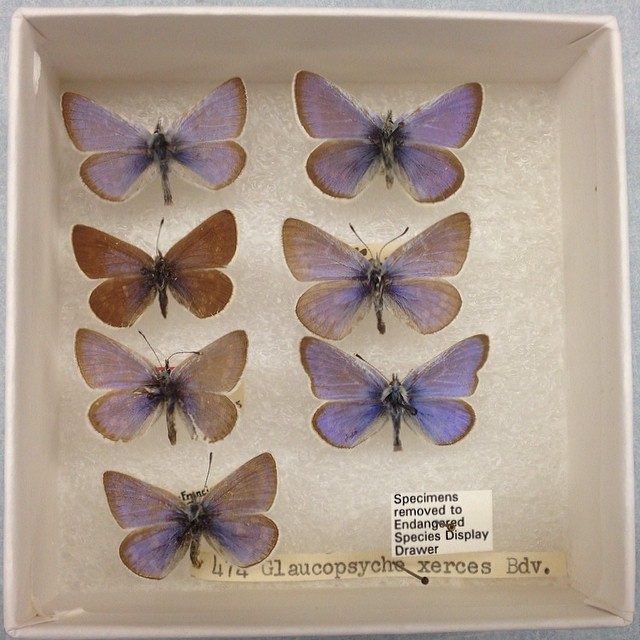 Xerces BlueGlaucopsyche xerces
-
 Adonis BlueLysandra bellargus
-
 Western Pygmy BlueBrephidium exilis
-
 AtalaEumaeus atala
-
 Holly BlueCelastrina argiolus
Compare
Questions and answers
What is the scientific name of the Purple Copper?
The scientific name of the Purple Copper is Paralucia spinifera. Written with its author, the full name is Paralucia spinifera Edwards & Common, 1978.
Which family does the Purple Copper belong to?
Paralucia spinifera belongs to the family Lycaenidae, in the order Lepidoptera and the class Insecta.
Where is the Purple Copper found?
Checklists and occurrence records place Paralucia spinifera in 1 country: Australia.
What is the conservation status of the Purple Copper?
The IUCN Red List category recorded for Paralucia spinifera is Endangered (EN).
What other names does the Purple Copper have?
Paralucia spinifera is also known in English as Bathurst Copper.
Sources
Passages the profile rests on
- The butterfly has a relatively thick body. Source passage: “The body is relatively thick.” — English Wikipedia
- Adults have a wingspan of 20–30 mm. Source passage: “The wingspan is of 20–30 mm.” — English Wikipedia
- The upper surfaces of the wings are copper-coloured and display purple, blue and green iridescence in sunlight. Source passage: “The upper sides of its wings are copper-colored and have a purple, blue, and green iridescence when in the sunlight.” — English Wikipedia
- The undersides of the wings have brown, black and grey patterns. Source passage: “The undersides of the wings are patterned with brown, black, and gray.” — English Wikipedia
- The butterfly has black antennae marked with white spots and ending in black tips. Source passage: “Its black antennae are dotted with white spots, and end with a black tip.” — English Wikipedia
- Caterpillars grow to approximately 22 mm in length. Source passage: “Caterpillars grow to about 22 mm in length” — environment.nsw.gov.au
- Caterpillars are light green with darker longitudinal markings. Source passage: “and are light green with darker longitudinal markings.” — environment.nsw.gov.au
- The species inhabits open woodland or open forest with a sparse understorey dominated by native blackthorn. Source passage: “The purple copper butterfly lives in open woodland or open forest with a sparse understorey that is dominated by the shrub native blackthorn – Bursaria spinosa subsp. lasiophylla.” — environment.nsw.gov.au
- Known habitat sites generally occur above 850 metres above sea level. Source passage: “altitude greater than 850 m above sea level” — environment.nsw.gov.au
- The species primarily inhabits elevations above 900 metres. Source passage: “The habitat of the purple copper butterfly is found primarily in altitudes above 900 m (3000 ft)” — English Wikipedia
- Its habitat commonly receives full-day sunlight and experiences regular winter snowfalls or heavy frosts. Source passage: “and are generally seen with exposure to the full day sun (often with a west to north appearance), and with extremes of cold such as regular winter snowfalls or heavy frosts” — English Wikipedia
- Known habitat sites contain native blackthorn and the attendant ant Anonychomyrma itinerans. Source passage: “presence of native blackthorn (Bursaria spinosa subsp. lasiophylla) presence of attendant ant (Anonychomyrma itinerans)” — environment.nsw.gov.au
- Known habitat sites receive three to four hours of direct spring sunlight. Source passage: “3–4 hours of exposure to direct spring sunlight.” — environment.nsw.gov.au
- The butterfly's larvae feed exclusively on the leaves of native blackthorn. Source passage: “Native blackthorn is the only food plant of the purple copper butterfly larvae (caterpillar).” — environment.nsw.gov.au
- Adult butterflies perch in sunlight and feed on nearby flowers. Source passage: “They also like to perch in the sun and feed on nearby flowers.” — environment.nsw.gov.au
- Adult butterflies generally fly between 10 am and 2 pm on warm, sunny days with little or no wind. Source passage: “they usually fly between 10 am and 2 pm on warm sunny days with little or no wind.” — environment.nsw.gov.au
- Adult males fly rapidly approximately one metre above the ground. Source passage: “Adult males fly rapidly at about one metre from the ground” — environment.nsw.gov.au
- Male butterflies rest in sunlight with their wings parted. Source passage: “rest in the sun with their wings parted.” — environment.nsw.gov.au
- Females fly more slowly than males and generally remain near their host plants. Source passage: “Females fly less rapidly and tend to stay closer to the host plant, a native blackthorn shrub” — environment.nsw.gov.au
- The species exhibits territorial chasing and spiralling courtship pursuits involving multiple males pursuing one female. Source passage: “Typical behaviours include territorial chasing and spiralling courtship chases, with one female being pursued by several males.” — environment.nsw.gov.au
- Caterpillars are nocturnal and feed on blackthorn leaves between 10 pm and 5 am from November to January. Source passage: “They are nocturnal and can be found crawling along the blackthorn stems and feeding on the leaves from 10 pm to 5 am between November and January.” — environment.nsw.gov.au
- Caterpillars are attended by between one and 15 ants. Source passage: “They will be attended by between one and 15 ants” — environment.nsw.gov.au
- Attendant ants protect caterpillars from predators in exchange for sugary honeydew produced by the caterpillars. Source passage: “which protects caterpillars from predators in return for a sugary honeydew produced by the caterpillars.” — environment.nsw.gov.au
- Females lay their eggs on or near native blackthorn bushes. Source passage: “After mating, the female oviposits eggs on or near the area of Bursaria spinosa subsp. lasiophylla.” — English Wikipedia
- Caterpillar eggs take between 14 and 17 days to hatch. Source passage: “During the 14 to 17 days the caterpillars take to hatch” — environment.nsw.gov.au
- Pupation takes place underground inside the nests of attendant ants between December and August. Source passage: “Pupation (the transformation from caterpillar to butterfly) occurs between December and August within the underground ants' nest.” — environment.nsw.gov.au
- The species is listed as endangered in New South Wales. Source passage: “The Bathurst copper butterfly is considered endangered in NSW” — English Wikipedia
- The species is nationally listed as vulnerable under Australia's Environment Protection and Biodiversity Conservation Act 1999. Source passage: “The Bathurst copper butterfly is also listed nationally as a vulnerable species under section 178 of the Environment Protection and Biodiversity Conservation Act 1999 (EPBC Act).” — English Wikipedia
- The species was identified in 2021 as one of 26 Australian butterfly species at greatest risk of extinction. Source passage: “This species was identified by scientists in 2021 as one of 26 Australian butterflies at greatest risk of extinction.” — environment.nsw.gov.au
- The number of surviving individuals is unknown. Source passage: “We don’t know exactly how many individuals remain” — environment.nsw.gov.au
- Habitat clearing and development are identified threats to the species. Source passage: “Current threats to the Bathurst copper butterfly include clearing and development” — English Wikipedia
- Weed invasion and grazing are identified threats to the species. Source passage: “weed invasion, grazing” — English Wikipedia
- Changes in controlled burning procedures threaten the species. Source passage: “and changes in controlled burn procedures.” — English Wikipedia
- Habitat disturbance by feral pigs is an identified threat. Source passage: “habitat disturbance by feral pigs.” — environment.nsw.gov.au
- The species contributes to pollination and plays a role in food chains. Source passage: “Purple copper butterflies are important pollinators and play a valuable role in food chains.” — environment.nsw.gov.au
Data
- Catalogue of Life, 2026-10-16 XR cc by
- Global Biodiversity Information Facility CC BY 4.0
- Wikidata CC0
- GeoNames CC BY 4.0
- Wikimedia Commons per image; credit shown with each image
- Within the Catalogue of Life, this name comes from Global Lepidoptera Index cc by
This species in other databases
Page built on 28 November 2026. See how the catalog is made and all sources and licences.
Cite this page
ScientificNames.org. (2026). Paralucia spinifera (Purple Copper). Retrieved November 28, 2026, from https://scientificnames.org/species/paralucia-spinifera
“Paralucia spinifera (Purple Copper).” ScientificNames.org, 2026, scientificnames.org/species/paralucia-spinifera. Accessed 28 Nov. 2026.
ScientificNames.org. “Paralucia spinifera (Purple Copper).” Accessed November 28, 2026. https://scientificnames.org/species/paralucia-spinifera.
@misc{scientificnames_paralucia_spinifera_purple_copper,
  author = {{ScientificNames.org}},
  title = {Paralucia spinifera (Purple Copper)},
  year = {2026},
  url = {https://scientificnames.org/species/paralucia-spinifera},
  note = {Accessed 2026-11-28}
}